Black Art In America gallery celebrates printmaking with inaugural art fair
For all its merits and national props for its booming fine artscape, says Najee Dorsey, Atlanta still lacks major art fairs.
Dorsey’s gallery in East Point, Black Art in America, is leading the way with its upcoming Fine Art Print Fair August 11 and August 12.
“We’re going to debunk the myths that some collectors think they’re not getting an original work if they buy a print,” says Dorsey, an artist and Black Art in America founder and CEO. “Prints are assets just like any other painting or sculpture.”
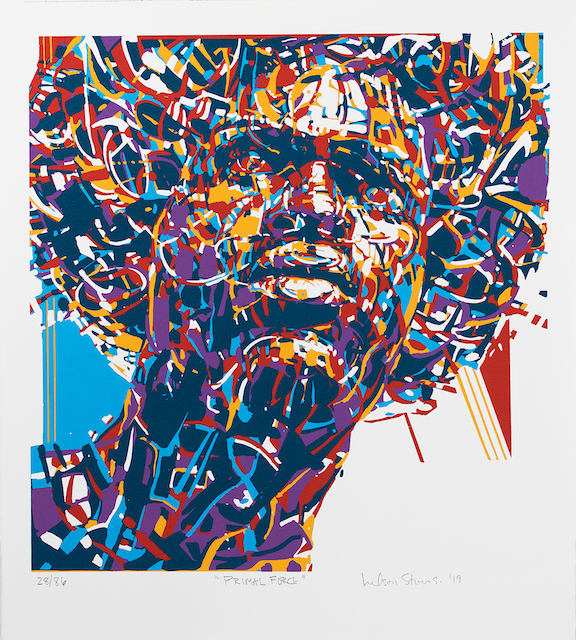
The Fine Art Print Fair features works by more than 50 artists, from the late Dr. Samella Lewis and Georgia’s own David Driskell to today’s contemporary artists, among them Atlanta-based Jamaal Barber, who is an artist ambassador for the event, along with Jennifer Mack-Watkins.
Barber co-curated the gallery’s current exhibit, Better Days: Joy and Revolution, the backdrop of the fair that explores Black identity and showcases the many methods and styles of printmaking — woodblock, etching, monoprint, silkscreen and more.
“Printmakers are largely under-recognized, and there’s a misunderstanding that because prints are made in multiples, they’re not as technical as {other art forms},” says Faron Manuel, director of the Black Art in America Foundation. “We want to give printmakers their moment and showcase the beautiful, thoughtful, challenging work that they do.”
Barber’s works in the exhibit are large woodblocks with captivating carvings of Black people, some embedded in nature. Displaying the blocks gives insight to visitors who may not consider the skill of the medium.
“It’s a complex process,” says Manuel, who is also the gallery’s director of programs and exhibits. “When you look at a finished print, you can see the dimension and details, but most people aren’t thinking of the process or the original mold that it comes from.”
This spotlight on printmaking is a revival of sorts — a reminder of early methods of mass production. While the medium never died, it was eclipsed for a moment, Manuel says. He has seen a renewed interest in printmaking and more support among museums and foundations.
“Printmaking is the way multiple images were made when we didn’t have copiers and digital technology,” he says. “It’s a true art form.”
The technique gives artists control over their work. And, as materials can be manipulated in the process, slightly varying the outcome, some prints become originals.
The fair will feature printmaking demonstrations, educational presentations by the artist ambassadors and stations where visitors can view and purchase prints. With prints available at varying price points, the fair is also about accessibility for those looking to start collections.
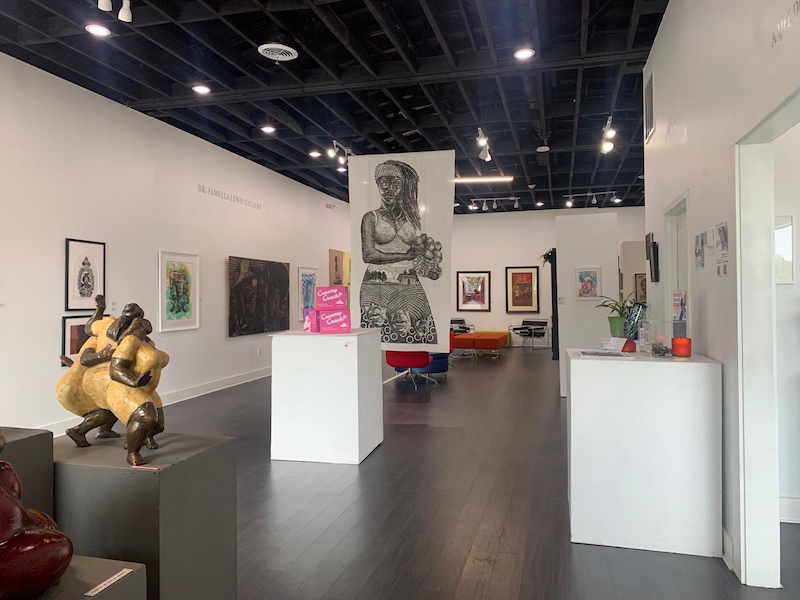
Aside from the woodblocks in the gallery, other traditional printmaking is represented. On one wall, Selma Burke, a Harlem Renaissance sculptor, is shown with her relief portrait of Franklin D. Roosevelt, the model for his image on the U.S. dime.
“Prints created by artists are all around us in ways we don’t always think about,” Dorsey says.
Another wall is filled with red, white and blue imagery. Here protest art features American flags overflowing with names of freedom fighters, state violence victims and perpetrators of White supremacist violence like Bull Connor.
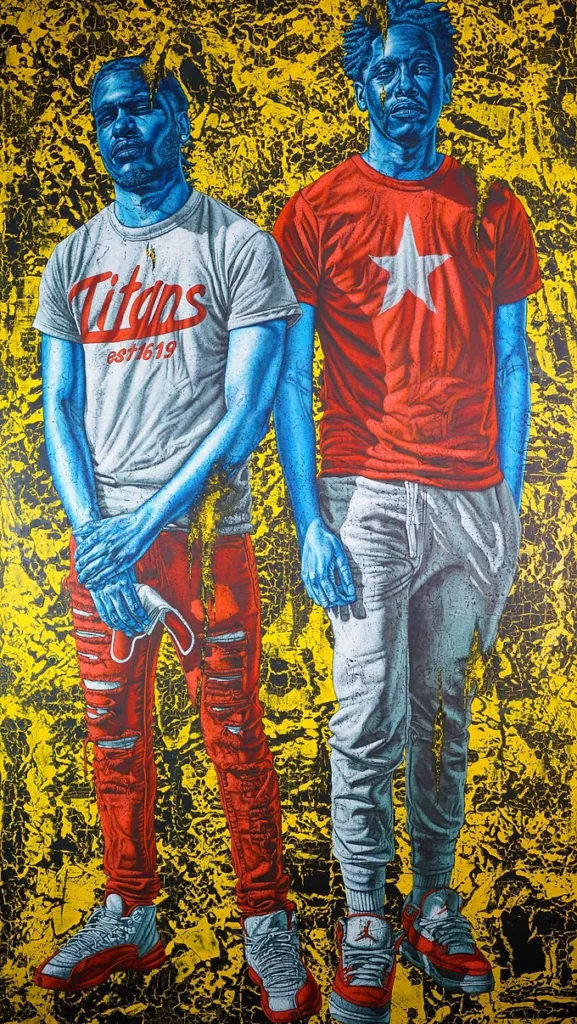
Next to the flags is a more hopeful scene — a giclee print of Alfred Conteh’s Evan and Aaron. Two young Black men stand side by side as if they’re being photographed. They look, at once, beaming with pride to be noticed and covered in the kind of cool that tempers their smile. Their skin is a beautiful blue that calms the brisk black and yellow background.
“Alfred tends to make images of people you’d see in the community,” says Manuel. “Their being in red and blue, holding a mask to give context of the pandemic, his shirt saying 1619 — this represents the 400-year span of us being here. Even the word ‘Titans’ (on one man’s T-shirt) is a symbol of the strength it has taken to survive that journey.”
It’s the perfect example of the medium’s foremost benefit. Conteh’s original painting is a massive 8-foot canvas that was so well received that Black Art in America digitally reproduced it to meet people’s interest.
The Black Art in America team hopes the fair will inspire other artists to consider adding printmaking to their practice to reach more collectors, Dorsey says. It’s set to become an annual event.
“We see an opportunity for this fair to be a major staple in the national arts community for artists of color because Atlanta is an international city, our reach {at BAIA} is international and we’ve got collectors coming in from all over the country to participate,” Dorsey says. “This amount of talent and work is historical for our inaugural event.”
::
Angela Oliver is a proud native of old Atlanta who grew up in the West End. A WKU journalism and Black studies grad, daily news survivor and member of Delta Sigma Theta, she works in the grassroots nonprofit world while daydreaming about seeing her scripts come alive on the big screen.
STAY UP TO DATE ON ALL THINGS ArtsATL
Subscribe to our free weekly e-newsletter.

PLEASE SUPPORT ARTSATL
Your Gift Sustains the Coverage You Count On!
Related Posts