MOCA GA christens its new digs, fittingly, with a survey of Georgia art
MOCA GA’s inaugural exhibition — Selections from the MOCA GA Permanent Collection 1949-2025 — comprises 75 works from the museum’s collection of some 1,600 pieces. Curated by founding director Annette Cone-Skelton, the exhibition is thoughtful, engaging and a sensory feast. For longtimers, it will be an emotionally resonant scrapbook of highlights from1949 to the present. For younger visitors, it ought to be a revelation: Despite the struggles experienced by most communities that are not New York City — lack of attention, respect, resources, market — this art scene has long been lively and accomplished.
Given the time span and variety of media and styles, the show could have felt like a long list of stuff. It does not. Instead, a commitment to craftsmanship and a formal elegance undergirds Cone-Skelton’s selections, which are expertly corralled into thematic clusters, punctuating the installation with visual rhymes and contrasts.
For example, in Gallery D, a grouping of monochromatic, meditative minimalist works, including Katherine Mitchell’s 1996-7 diptych For my Brother, share space with the raucous energy and vivid color of James Herbert’s painting, Windmills (1978). Similarly, the exuberant curvilinear rhythms of Amalia Amaki’s button-strewn, mixed-media work I’d Rather Two-Step (1997) is a counterpoint to a series of gridded works on the opposite wall.
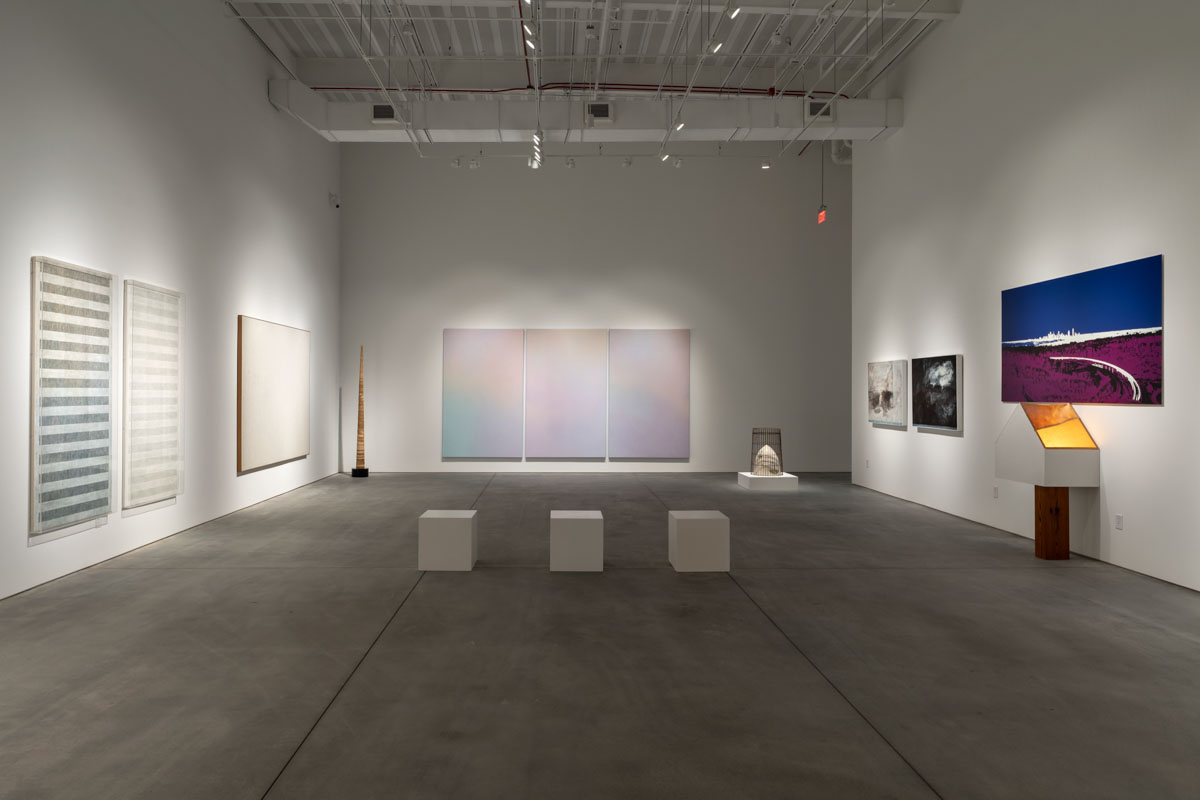
In the visual rhyming category, facing each other across the largest gallery, are the luminous discs of Don Cooper’s The Moment As It Is (2008) and Xie Caomin’s kaleidoscopic 2010 Mandala #14 (The Mandala of Ruins Series), which share spiritual interests as well as circular compositions.
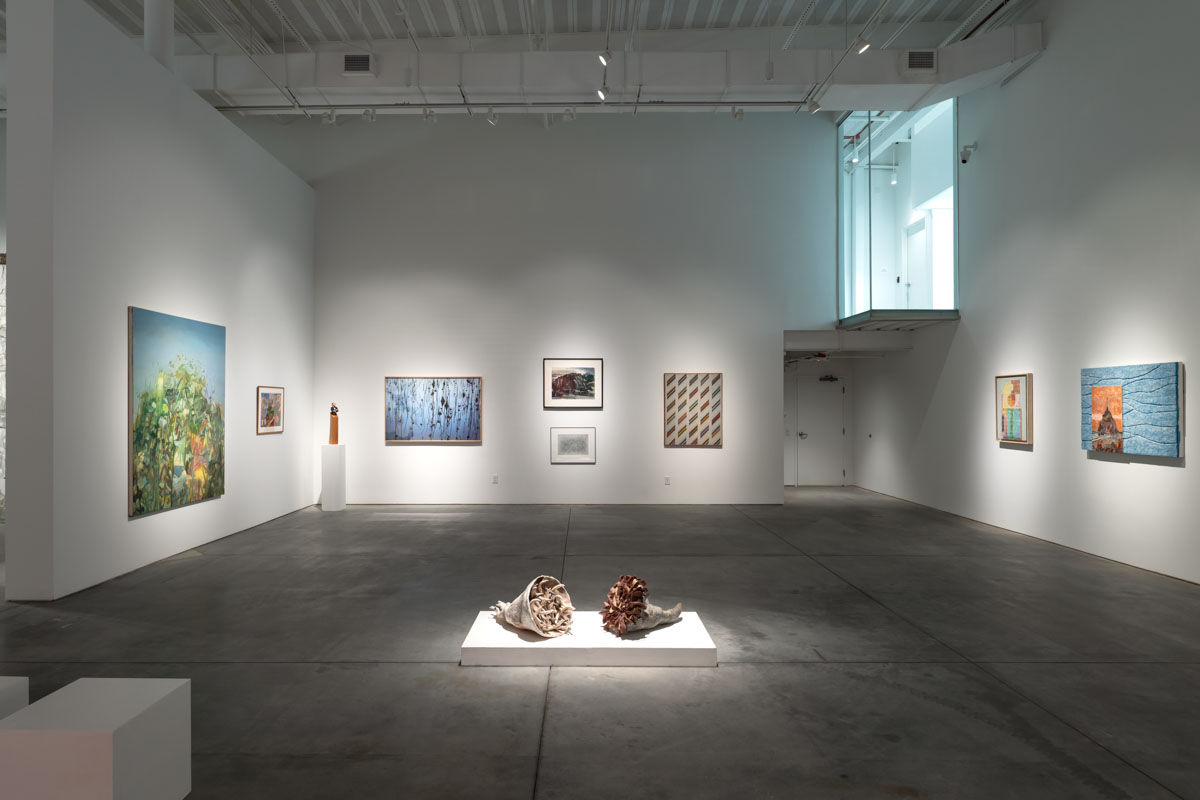
Images of nature abound in the Edge Gallery. Works range from Lamar Dodd’s more traditional landscape At the Foot of the Blackland (1949) to Diane Kempler’s sci-fi-ish, overgrown ceramic seed pods of 2015.
How about an exclamation point? Herb Creecy used an airbrush, a squeegee and lipstick red paint to create the joyous Untitled #4 (1992), a dynamic abstract composition that brings to mind a riotous spring garden.
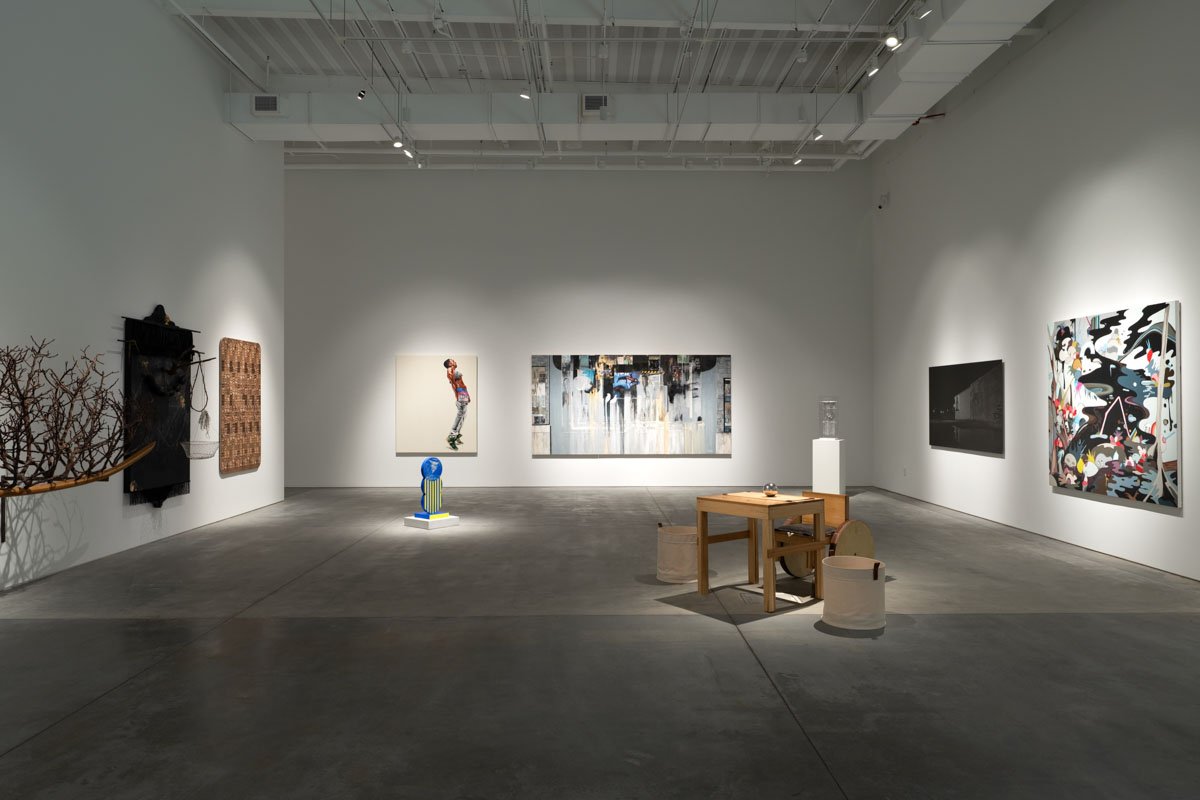
We move from nature to architecture in the Loridans Gallery. Rocio Rodriguez’s muscular painting, Totem (2011), an abstraction of stacked black blocks, hangs behind Beverly Buchanan’s Flye Town (1990). This quartet of her famed miniature shacks bespeak the vicissitudes of poverty as well as the stubborn endurance of its occupants. Spreading across the opposite wall, Radcliffe Bailey’s installation Cascade (2001-2006) continues the metaphorically loaded use of the house in poetic allusions to Black history and personal experience.
Fahamu Pecou’s openly anguished self-portrait Phoenix (2014) contrasts with Bailey’s oblique references. Its juxtaposition to the hopeful references to Barack Obama’s election embedded in Larry Walker’s Wall Spirits and Other Secrets: Believe 01.20.09 (2008) renders it even more wrenching.
Cone-Skelton adds a light touch with the inclusion of some of Susan Cofer’s piquant miniature sculptural portraits of members of Atlanta’s art community. Among them are a particularly deft likeness of Jerry Cullum, Atlanta’s longest-running art critic, and a tribute to the indomitable Robert Edge, a cornerstone patron.
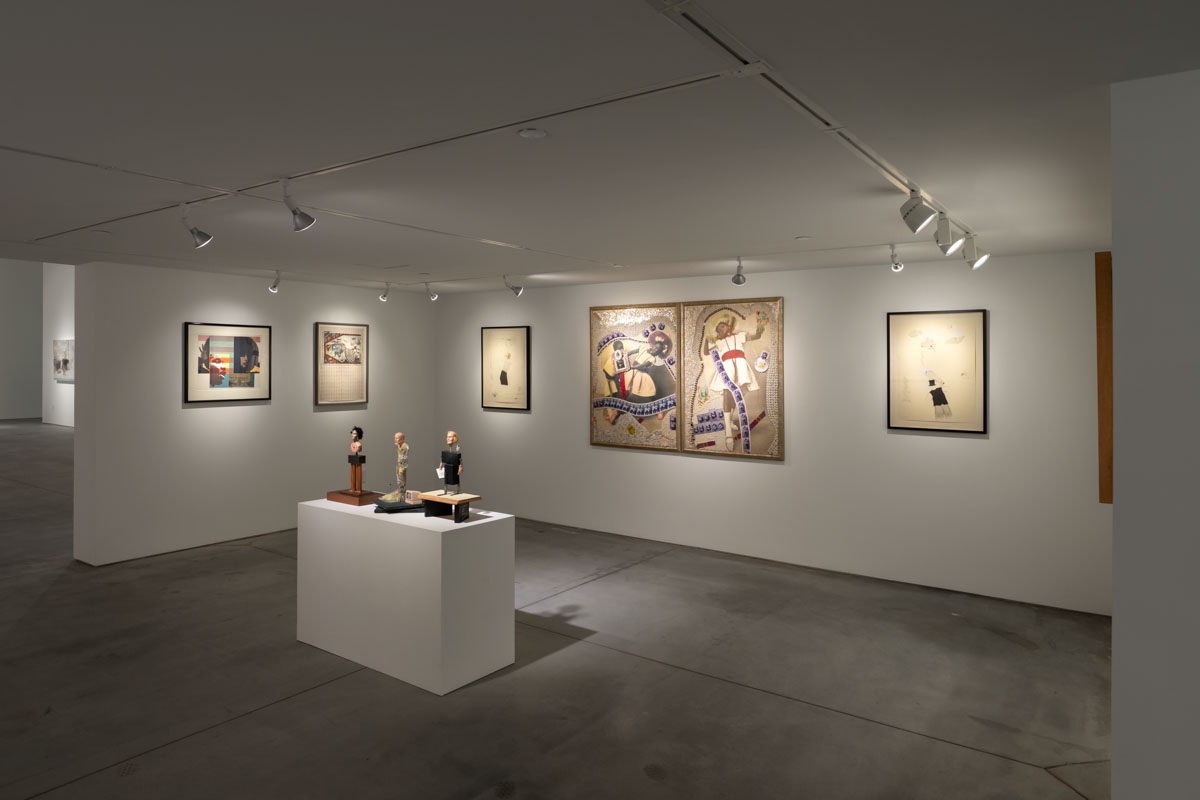
Cone-Skelton is aided by the excellent gallery design by Mack Scogin Merrill Elam Architects. Led by Elam, the Atlanta firm has created spaces that offer variety of scale, volume and light. Smaller works are nestled in a low-ceilinged space, while airy volumes give large-scale works room to breathe. The architects also create dramatic sight lines that invigorate the viewing experience.
It is important to know that MOCA GA has built its collection without a dedicated acquisition fund. Rather, it has largely relied on two anchors: the 250 works from CGR’s corporate collection, which museum co-founder and former president of CGR David Golden gifted to the museum when it first launched a quarter-century ago, and the Working Artist Project, MOCA GA’s fellowship program, through which the museum has acquired 51 works and counting by important mid-career and emerging artists.
Cone-Skelton has covered a lot of territory here — with aplomb. It’s no criticism to say, however, that there are many other stories to tell — the richness of photography and crafts, book arts and the more experimental, rough-and-tumble end of the spectrum, for example.
Given the quality of this exhibition and its installation, we can only look forward to what MOCA GA can show us in its new permanent home in the coming years.
MOCA GA announced today in a press release that the museum is now officially open to the public. The museum briefly opened for a VIP and artist’s reception earlier this month but had not opened its doors to the wider public due to a hold up with its certificate of occupancy. That hold is now over.
The general public can visit this week October 7-10 (Wednesday from noon to 5 p.m., Thursday and Friday from noon to 8 p.m. and Saturday from noon to 5 p.m.). The museum will be closed October 13-17. Starting on October 20, the museum will be open for its regular museum hours from noon to 5 p.m. On October 23, from 6 p.m. to 8 p.m., MOCA GA will host the opening reception for its 2025-2026 Working Artist Project Fellow Wilay Méndez Páez’s solo exhibition, La aleatoriedad de los símbolos/The Randomness of the Symbols. More information can be found online at mocaga.org. Stay tuned for an upcoming review of Páez’s exhibition by ArtsATL’s Leia Genis.
::

Catherine Fox is a co-founder and retired chief of ArtsATL.org. She was art and architecture critic at The Atlanta Journal-Constitution for 27 years. During that time, she was honored as Cox Writer of the Year and won multiple Green Eyeshade awards for criticism as well as awards from the Atlanta chapter of the American Institute of Architects, the City of Atlanta Urban Design Commission and the American Association of Sunday and Feature Editors. She has written for ARTnews and other publications and is an author of the inaugural volume of Atlanta Art Now, a publication devoted to critical discussion of Atlanta’s visual artists, published in late 2011. She received her B.A. and M. A. in the history of art from the University of Michigan in 1970 and 1972, respectively.
STAY UP TO DATE ON ALL THINGS ArtsATL
Subscribe to our free weekly e-newsletter.

PLEASE SUPPORT ARTSATL
Your Gift Sustains the Coverage You Count On!
Related Posts