MOCA GA opens privately Monday; Annette Cone-Skelton reflects on 26 years supporting Georgia artists
As Annette Cone-Skelton stands in the west gallery of the new MOCA GA building on September 2, two weeks before the museum is set to open for VIP guests, she appears strikingly stoic; somber even.
Her eyes scan the high-ceilinged, rectangular room where artworks hang on virgin white walls.
Cone-Skelton, the founding director, CEO and president of MOCA GA, curated the space she’s now standing in with mostly works from the 60s and 70s, created by Georgia artists, many of whom she knew as nascent creatives. They had gone to school with her at Atlanta College of Art (ACA) when she herself was a budding painter.
“A lot of them are no longer with us,” she says.
Her tone comes into focus. It is reverence. She is among giants. She is among friends.
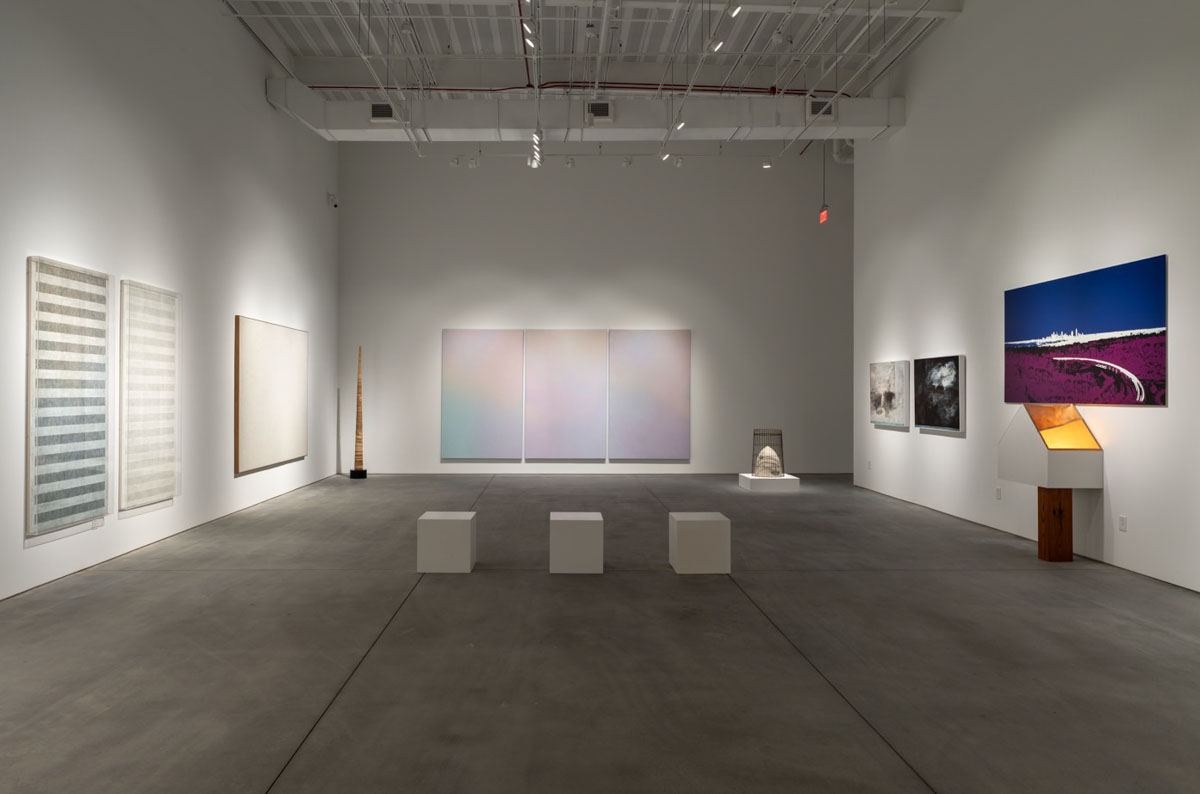
The room holds work by Edward Walker Ross, a Southeastern minimalist painter who headed ACA’s painting department for a decade; Katherine Mitchell, who was in Cone-Skelton’s ACA class and builds tightly gridded, geometric paintings; Judy Barber, a painter whose work is now part of Georgia’s State Art Collection; Genevieve Arnold, a fixture of the Atlanta art scene known for pairing figurative and abstracted takes on the places she’s traveled; and Martin Emanuel, an Atlanta sculptor whose creations made of rammed earth have been shown at MOCA GA since its founding 26 years ago.
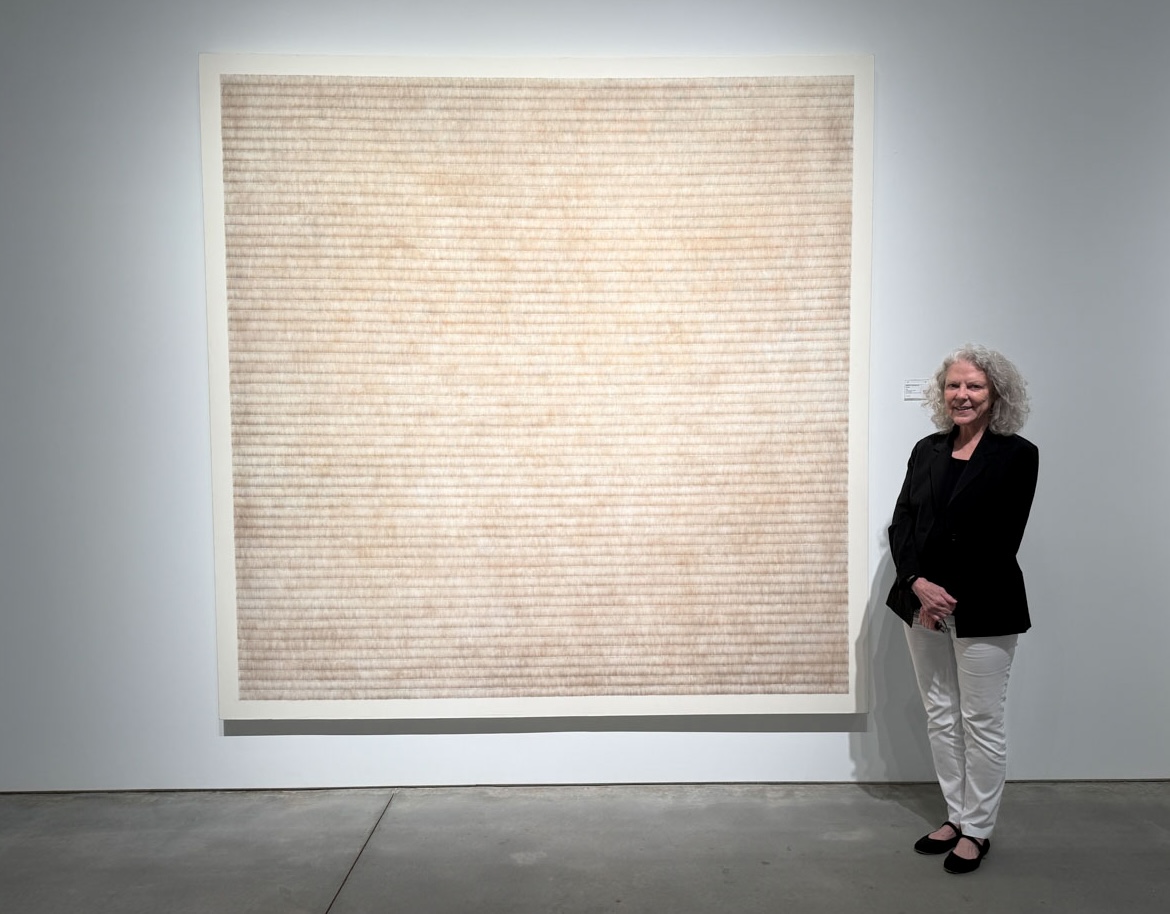
In the room with Cone-Skelton is also a massive square canvas measuring eight feet, marked with millions of delicate, sand-colored, vertical lines organized in neat, horizontal rows. The untitled work is one of Cone-Skelton’s own, created with pastel pencil in 1995. The work, she once told ArtsATL in a 2018 interview, put her into a meditative trance when she was creating it.
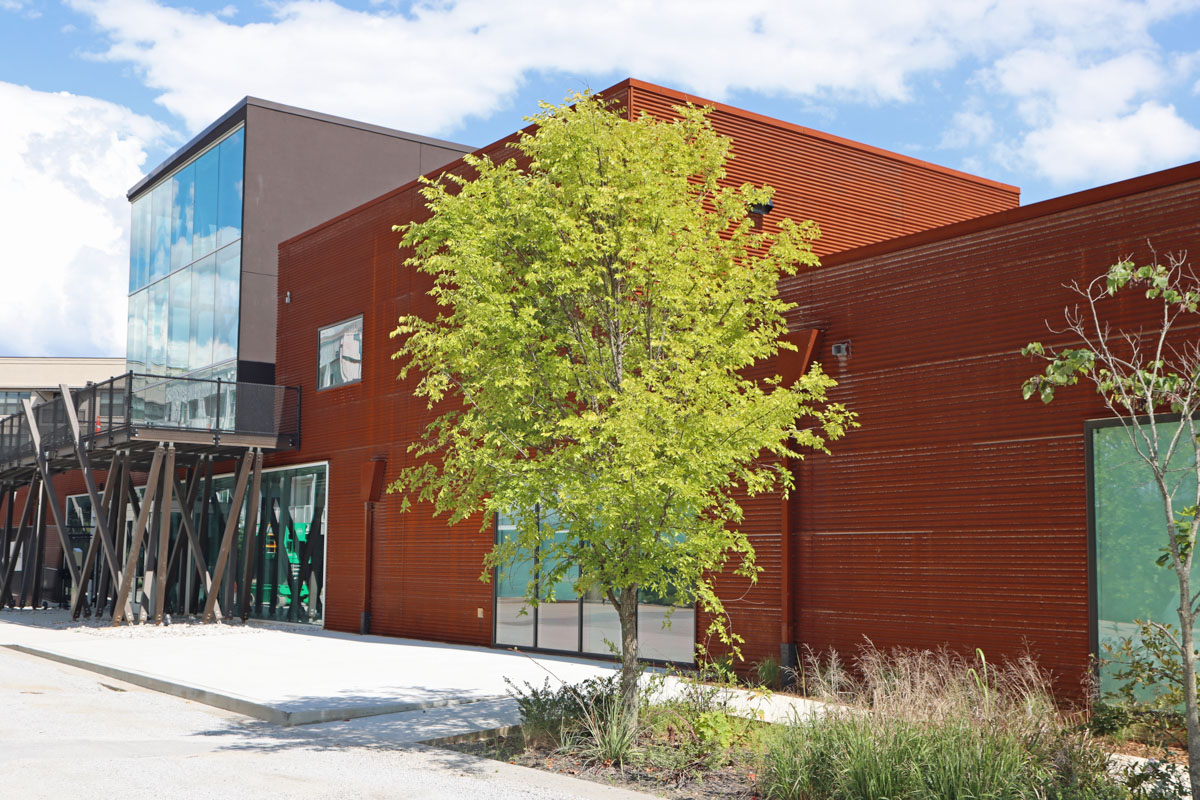
It was during one of those flow states (while creating a different work with black paint) that she first had a vision for MOCA GA’s earliest museum space. When she envisioned that space, she pictured something far more modest than the $16.4 million, 26,000 square-foot, architecturally striking building she stands in now. She merely saw a “stable place of our own,” she remembers.
“This is more than I imagined,” she says of the new building, which was designed by Mack Scogin Merrill Elam Architects. “I didn’t expect that we would ever be able to raise the funds to build this. And that has just been so rewarding.”
She credits the museum’s longstanding relationships and crystal-clear mission for its ability to fundraise. The City of Atlanta made one of the campaign’s most pivotal contributions, giving $2 million in 2024 — a gift that pushed the fundraising effort to 90 percent of its goal.
“[Mayor Andre Dickens] made the announcement here looking at our vacant land… we hadn’t even started at that point,” Cone-Skelton remembers. “It’s really important for a city of this size to have a museum like this, and one that supports our own culture.”
Supporting that culture is what drove Cone-Skelton to found MOCA GA back in 2000. At the time, Atlanta had little infrastructure to support artists like her.
“We didn’t have that much in the way of exhibition support,” she remembers. “We didn’t have the museums. We didn’t have that many galleries.”
There had been momentum once — Mayor Maynard Jackson had launched programs like the Fulton County Arts Council and brought in Shirley Franklin and Michael Lomax to run them — but those initiatives didn’t last. What remained was, in Cone-Skelton’s words, “just this huge void.”
By then, she had moved on from teaching and gallery management to run her own art consulting business. As a consultant, she was contracted by corporations and private collectors to find them interesting art, which in turn helped her support Georgia artists.
One of her collectors was CGR Advisors, a private real estate investment firm. When they decided to downsize, the fate of their art collection, which comprised 250 works by Georgia artists, was uncertain. Cone-Skelton began lobbying the president of the company, David Golden.
“Let’s start a museum,” she remembers saying to him. “It took a while, but they warmed up to it … They donated the collection and David Golden became our founding benefactor.”
MOCA GA got its 501(c)(3) status in August of 2000.

Now more than a quarter century later, as Cone-Skelton wanders the new museum building, it must strike her how far she’s carried the organization. Yet, she doesn’t boast. Instead, she wears an air of humility.
Standing next to her own painting, she shifts in her shoes and admits how she did not want to include any of her paintings in the exhibition, but her staff strongly disagreed.
“They convinced me that I needed to put my own work in this show,” she says.
It’s easy to see why. She is the founding mother of MOCA GA. To not include one of her works in the new building’s opening exhibition, particularly in the room that features the early pioneers of Atlanta’s contemporary art world, would be to present a tree without its deepest root.
The grand opening exhibition, curated by Cone-Skelton, includes 48 artists and roughly 70 pieces from MOCA GA’s permanent collection, spread throughout the building’s five galleries. The works span time (though not organized chronologically), going back to Lamar Dodd’s work from the 1940s and stretching forward to the most recent works produced by MOCA GA’s 2026 Working Artist Project (WAP) cohort.
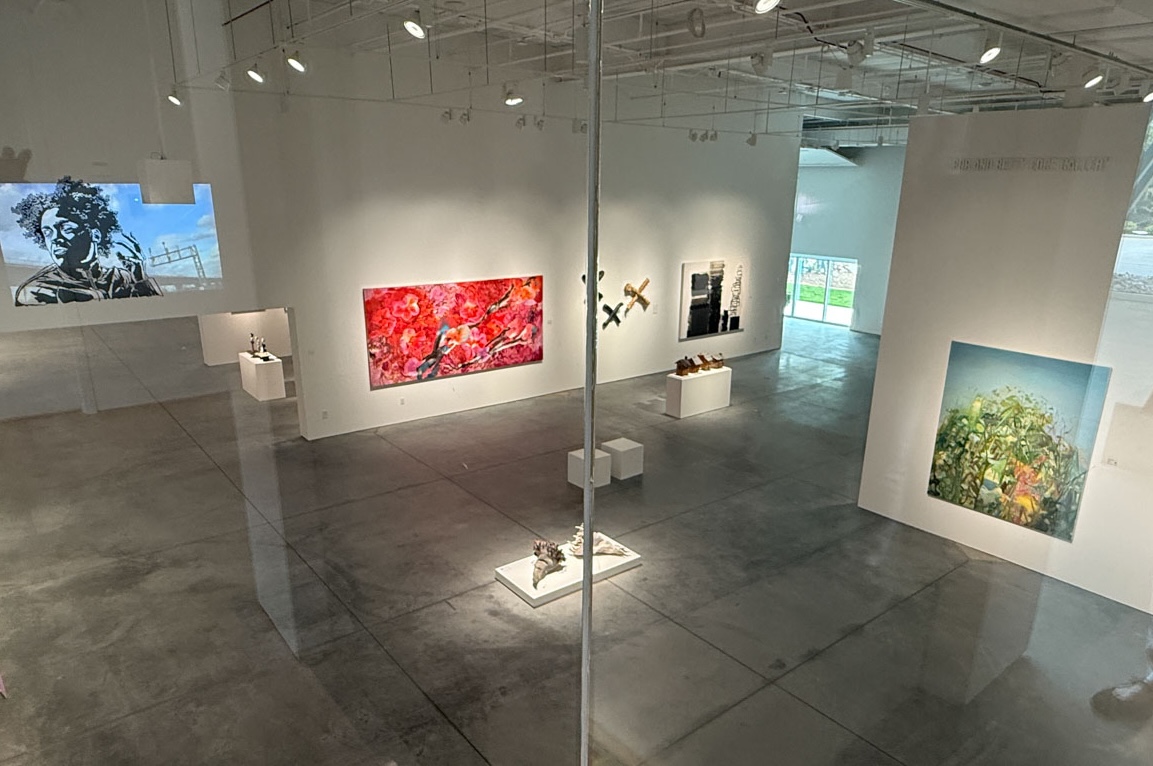
The WAP has been a signature program of MOCA GA for 19 years. Artists chosen to be a part of the program get a solo exhibition at MOCA GA, get to work with an esteemed guest curator recruited from a major national museum (including the Whitney, LACMA and MASS MoCA) and get an assigned apprentice.
A gallery space on the east side of the new building is where many of the newer WAP artists are showcased. MOCA GA’s most recent WAP cohort, who each exhibited just before the museum closed its longtime home on Bennett Street inside the TULA Art Center (where it had been since 2007), are displayed in that space, including works by Ayana Raz, Corinne Coloruso and ArtsATL’s 2026 One to Watch, Sergio Suarez. Pieces by Fahamu Pecou and Larry Walker are also on view there among many others.
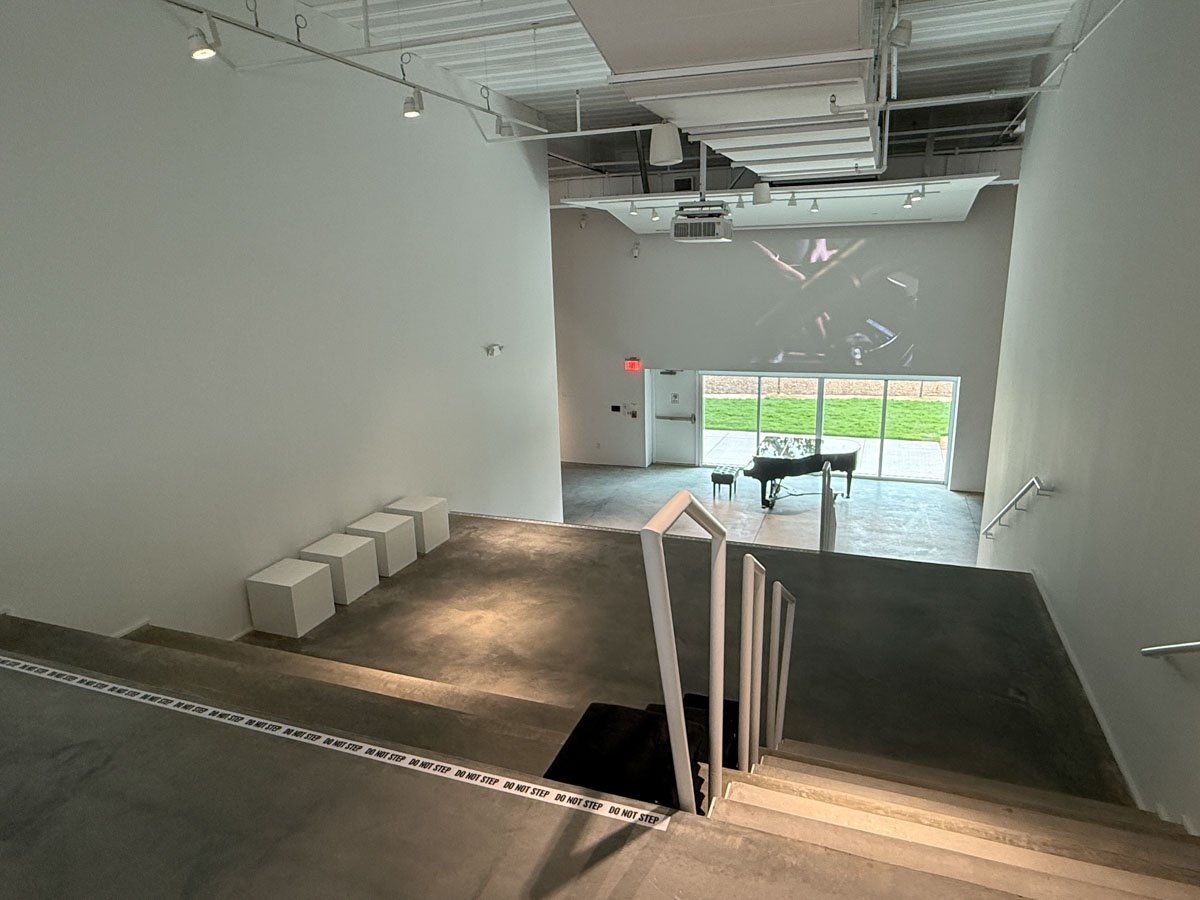
A contemporary, concrete cascade of steps that double as tiered seating descends into that gallery. The white wall above the steps serves as a lofty place to project art.
“This is our theater,” Cone-Skelton says. “It’s kind of like the heart of the museum in that we envision it not only for artists’ talks, lectures, performances, musical performances and dance, but also a gathering place for people who are visiting the museum to just come, sit down and have a conversation about what they’ve been seeing.”
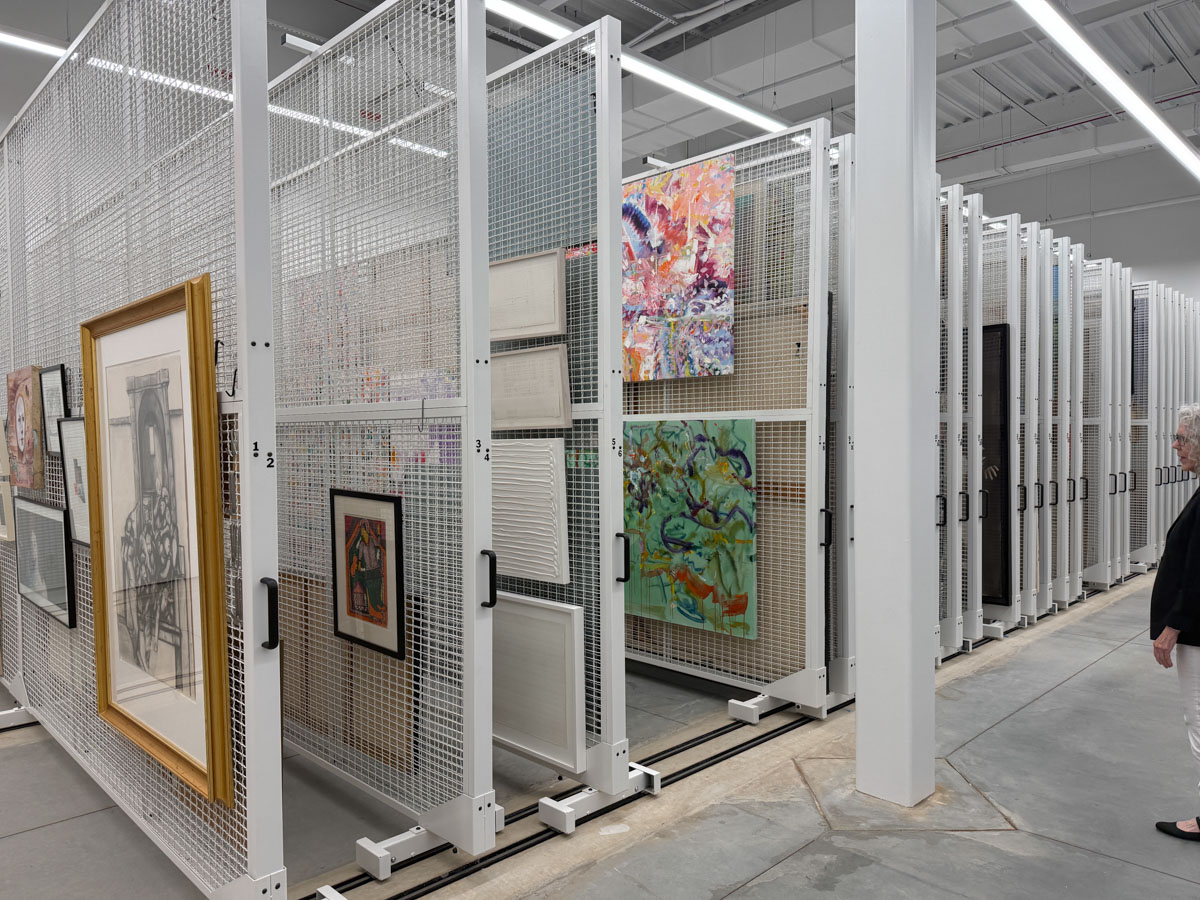
Also central to the museum is a windowless room most visitors will likely never see: the archives. This is where the museum now houses its permanent collection numbering more than 1,600 works (that’s six times the 250 works MOCA GA started with). For the first time in its history, MOCA GA can house its entire collection in one, strategically designed space.
Cone-Skelton shows off the archives room proudly. Two-story-tall, moving grates organize the museum’s framed artworks. White shelves that move using rotating hand-cranks hold all sorts of three-dimensional works. Huge cases of thin metal drawers contain art prints. Decorating the tops of those drawers are some fun, puppet-like sculptures made by Susan Cofer of notable people who have been influential in Atlanta’s art world (including one of Tomer Zvulun and another of Lois Reitzes). A new intern is busy cataloguing.
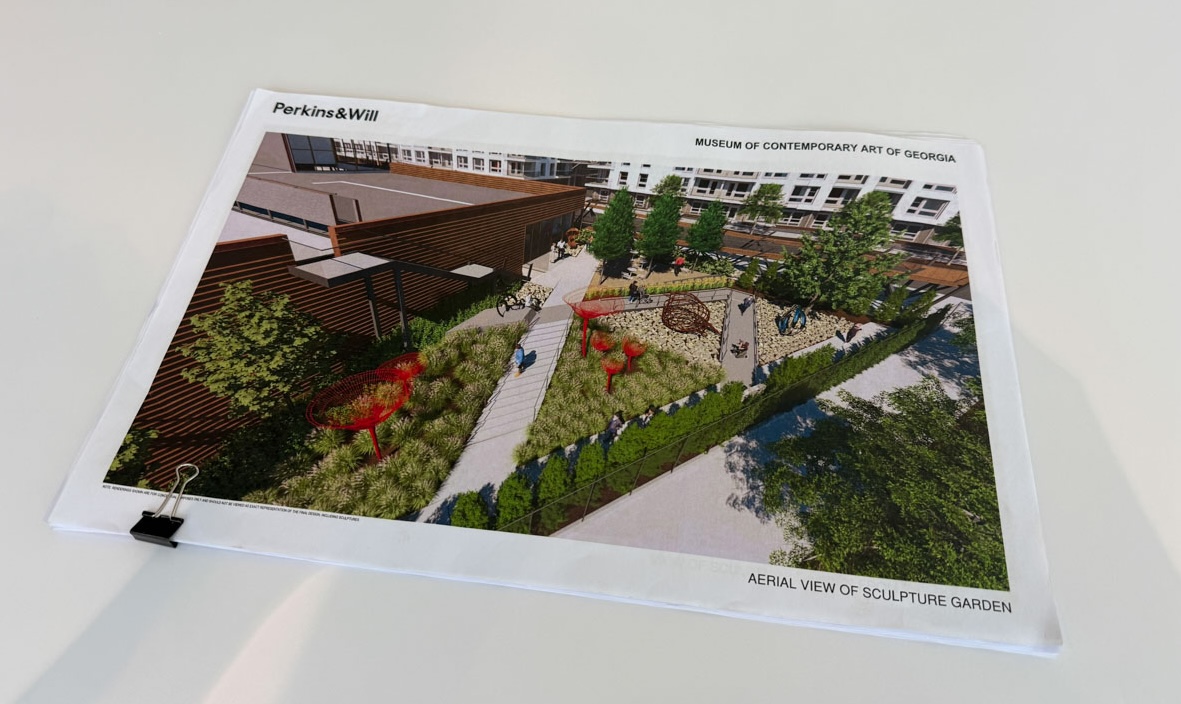
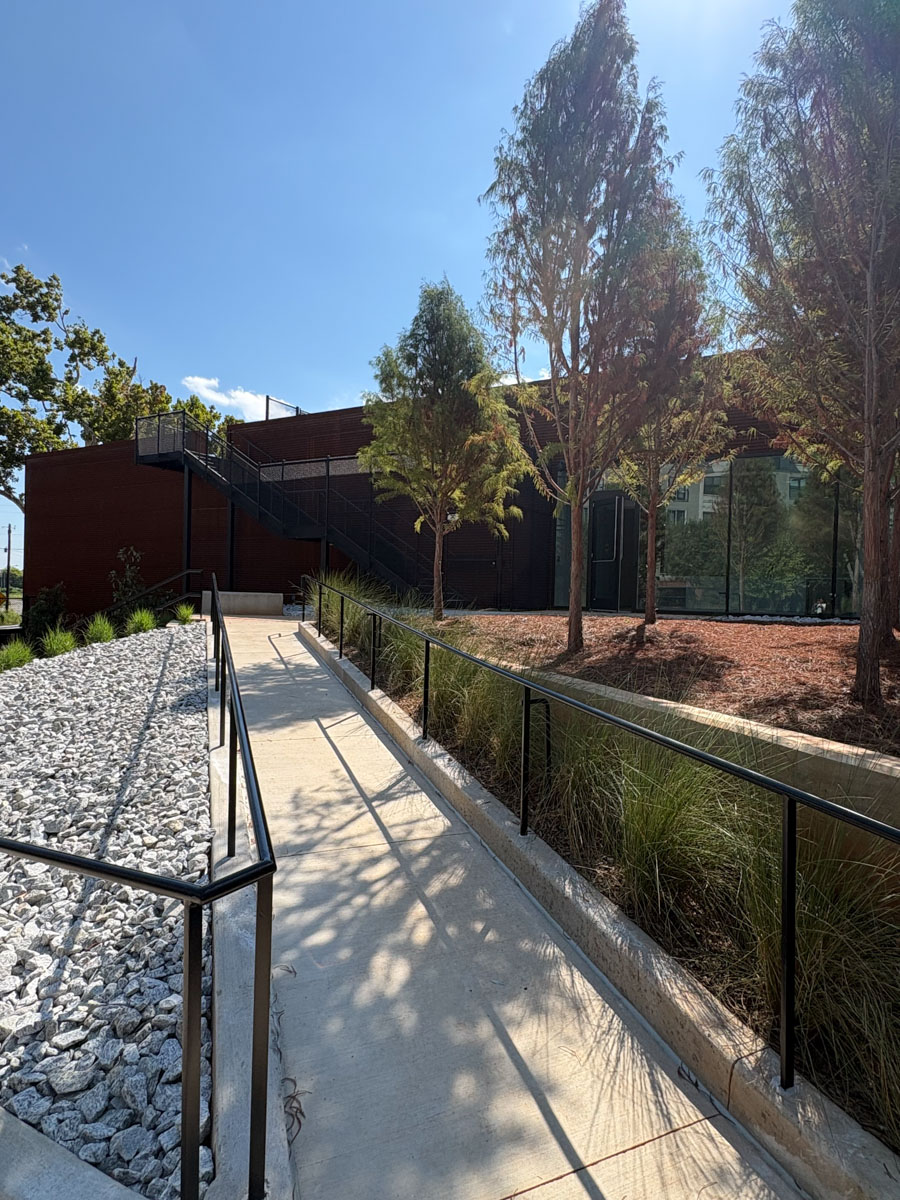
The outdoor spaces at the new MOCA GA are equally impressive as the indoor ones. Behind the museum is a sculpture garden designed by Perkins and Will that will have rotating sculpture exhibitions rather than a static arrangement. The rooftop, an expansive space that overlooks the Goat Farm Arts Center campus, with its historic industrial buildings and roughly 51 working artist studios, will be a memorable place to host art events. An open-air projection screen has already been installed up top.
The exterior design, with its weathered steel beams, old railroad ties, and other industrial- details, gives a nod to the area’s railroad roots. A zig-zag ramp — nicknamed “the Trestle” — is both architecturally interesting and functional as an ADA-compliant walkway.
And on one corner of the new building is Cone-Skelton’s light-filled office. After completing her tour, she sits at a round table, peering out the window. Asked how it feels to be sitting there two weeks from opening day, that same somber look from the west gallery returns.
“It’s hard to give you how I’m feeling right now. It’s a real mixed feeling. I’m relieved. I’m excited. It’s a dream come true,” she says, then pauses. “But as an artist, it is really powerful to have been able to move through these many years. It’s something to leave behind that will help my community of artists.”

On September 14, MOCA GA will open its doors for a VIP ribbon-cutting ceremony at 3:30 p.m. (by invitation only); followed by a private reception for WAP fellows and artists. A public preview will soon be offered (time and date TBD).
::

Danielle Charbonneau is ArtsATL’s senior editor of art + design and dance. She joined ArtsATL following her time as an arts reporter for The Atlanta Journal-Constitution. She holds an MA in specialized journalism in the arts from the University of Southern California. She is known for her curiosity, craft and wanderlust.
STAY UP TO DATE ON ALL THINGS ArtsATL
Subscribe to our free weekly e-newsletter.

PLEASE SUPPORT ARTSATL
Your Gift Sustains the Coverage You Count On!
Related Posts