‘Threads of a Living Legacy,’ honors how Marquetta Johnson taught without speaking
Leia’s Long Look is a monthly column providing focused looks at individual artworks, prompting slow looking and deeper reflections. This month, Leia visits Threads of a Living Legacy at ArtsXchange, a tribute to the late textile artist and educator Marquetta Johnson.
It’s impossible to write about Marquetta Johnson without writing about education. Johnson, an Atlanta native who passed away in February 2025, spent more than half her life as an educator teaching quilting and sewing to children. Despite the endless hours she dedicated to students, Johnson was always an artist first, making artworks up until her death. Her quilts are in the permanent collection of the High Museum of Art, and her career earned her a Kennedy Center/VSA International Arts Fellowship.
Threads of a Living Legacy at ArtsXchange, on view until October 24, gives honor to Johnson’s prolific artistic career. While it undeniably acknowledges her role as an educator, it also belies any notion that she was simply a skilled craftsperson. Instead, it reveals her sincere artistry.
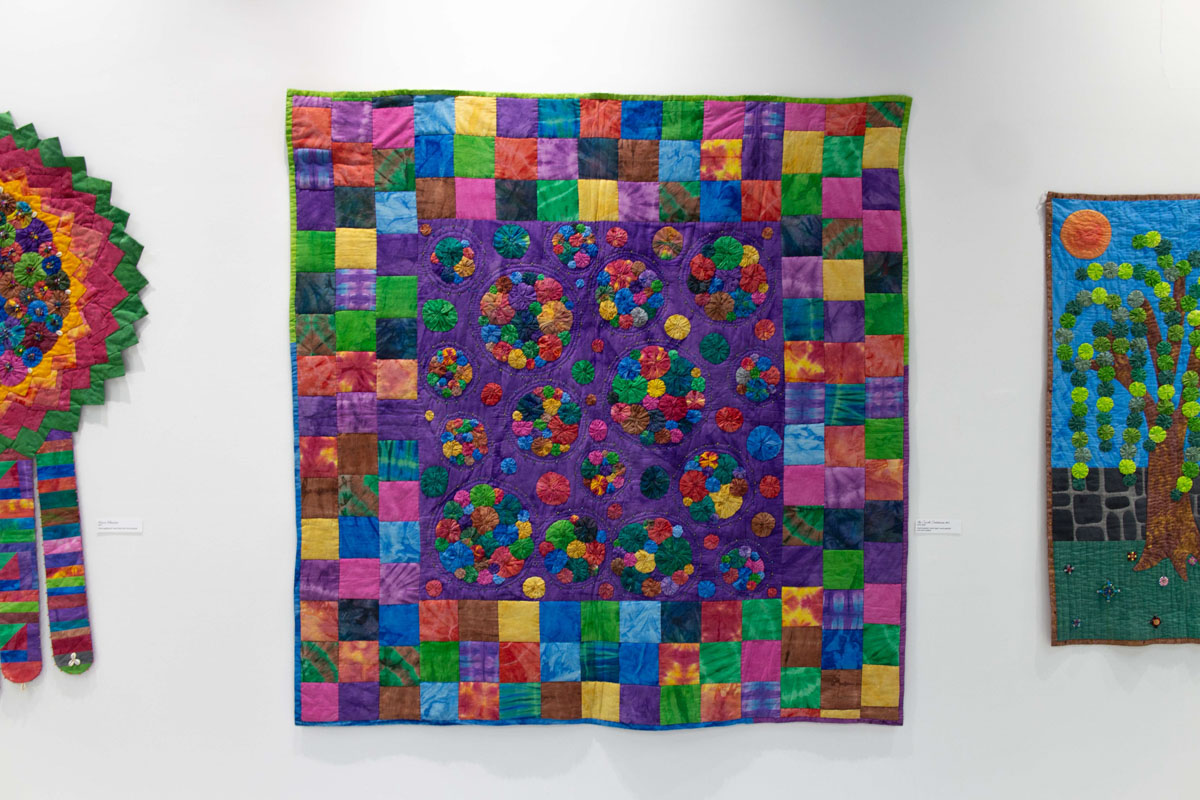
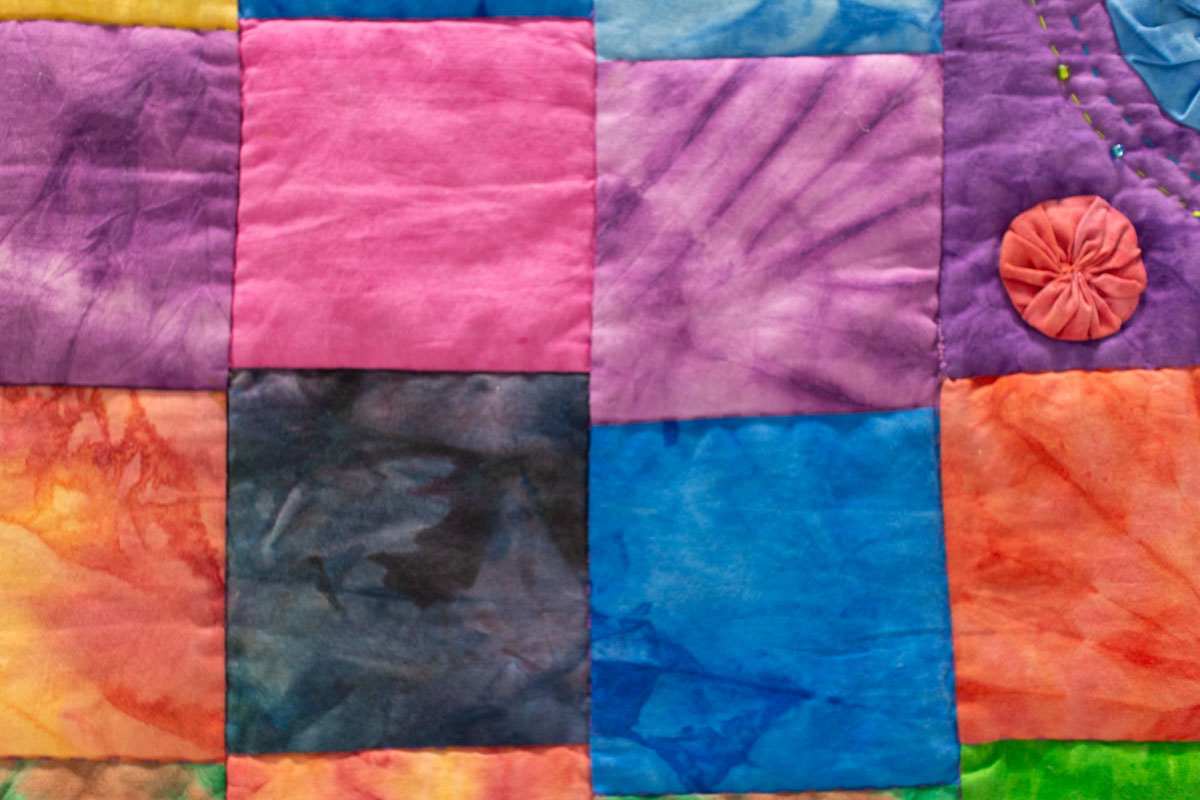
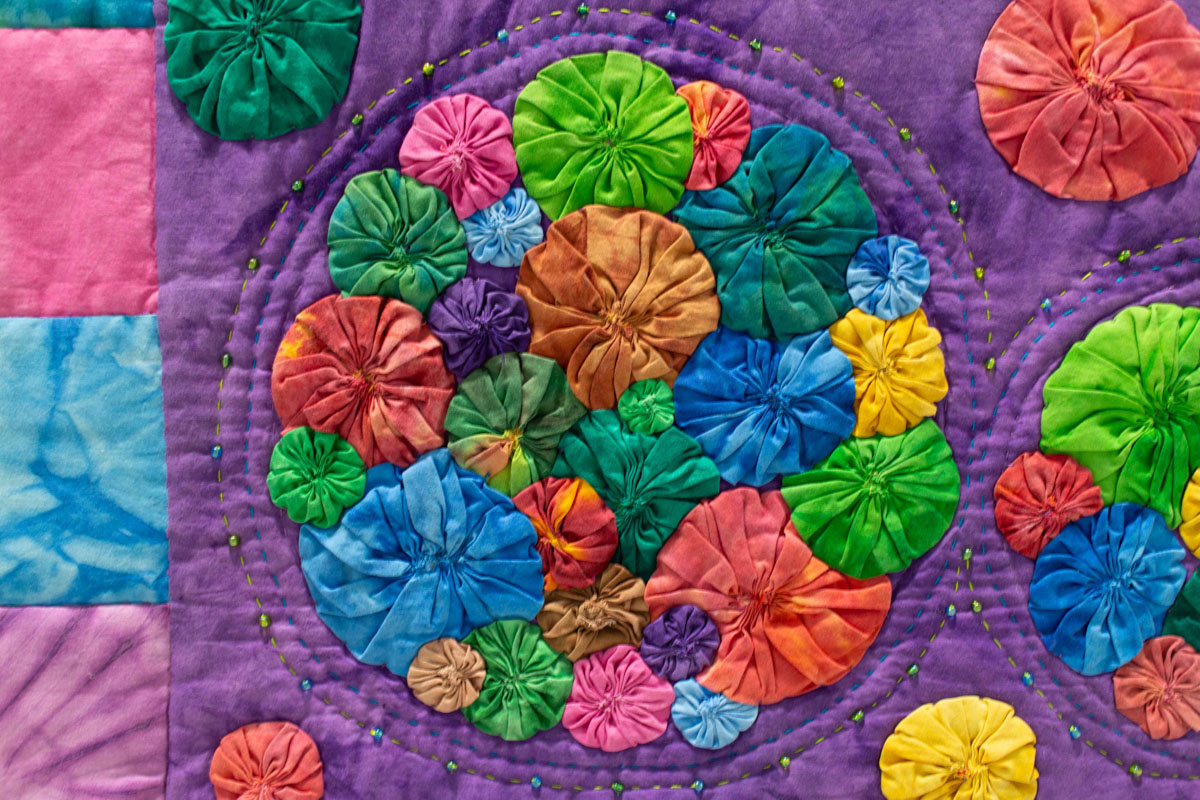
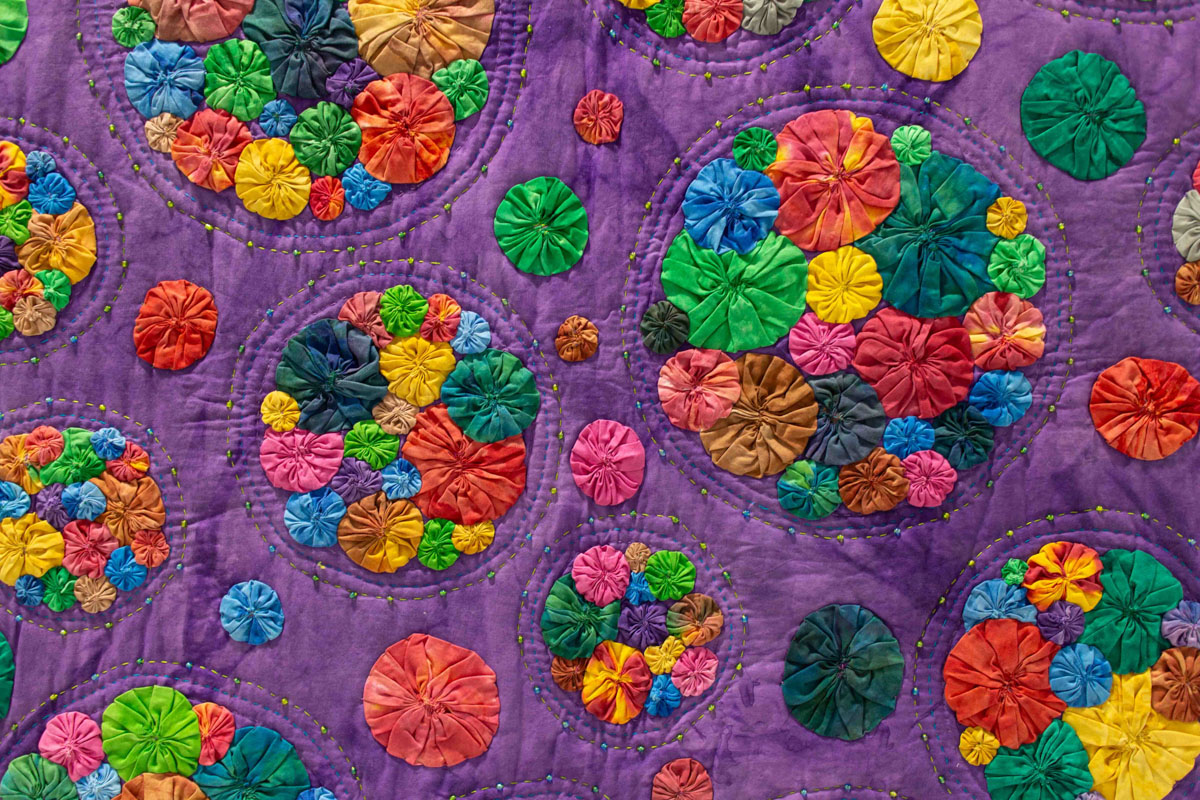
The Circle Continues 2 (2005-6) is one of the largest artworks in the exhibition. A roughly 5-foot square, the quilt is chromatic pandemonium. Using highly saturated colors such as violet, sunflower, sapphire, emerald and fuchsia on small pieces with near-random sequencing, the competition for the viewer’s attention is fierce. But there is organization. Each edge of the quilt measures five nine-patch blocks — a foundational quilting pattern consisting of nine equal-sized fabric patches — creating a square within a square. The inner of these two squares contains circular groupings of circular patches, affixed to a violet background and puckered, like a flower about to unfurl. The geometry of these blocks brings much-needed structure to the otherwise riotous artwork. It is easy to understand how the nine-patch blocks could be educational tools — with their simple construction and seams — but looking closely reveals they are anything but a perfect example. The size of the patches constantly varies; their corners frequently misalign. What reads as structure from afar is a series of irregularities. But this does not detract from them because quilting is known for its improvisation. Using various scraps and swathes, and constantly adding to a piece, early quilters always worked irregularly. Choosing to work this way, Johnson intertwines history and technique, teaching without speaking.
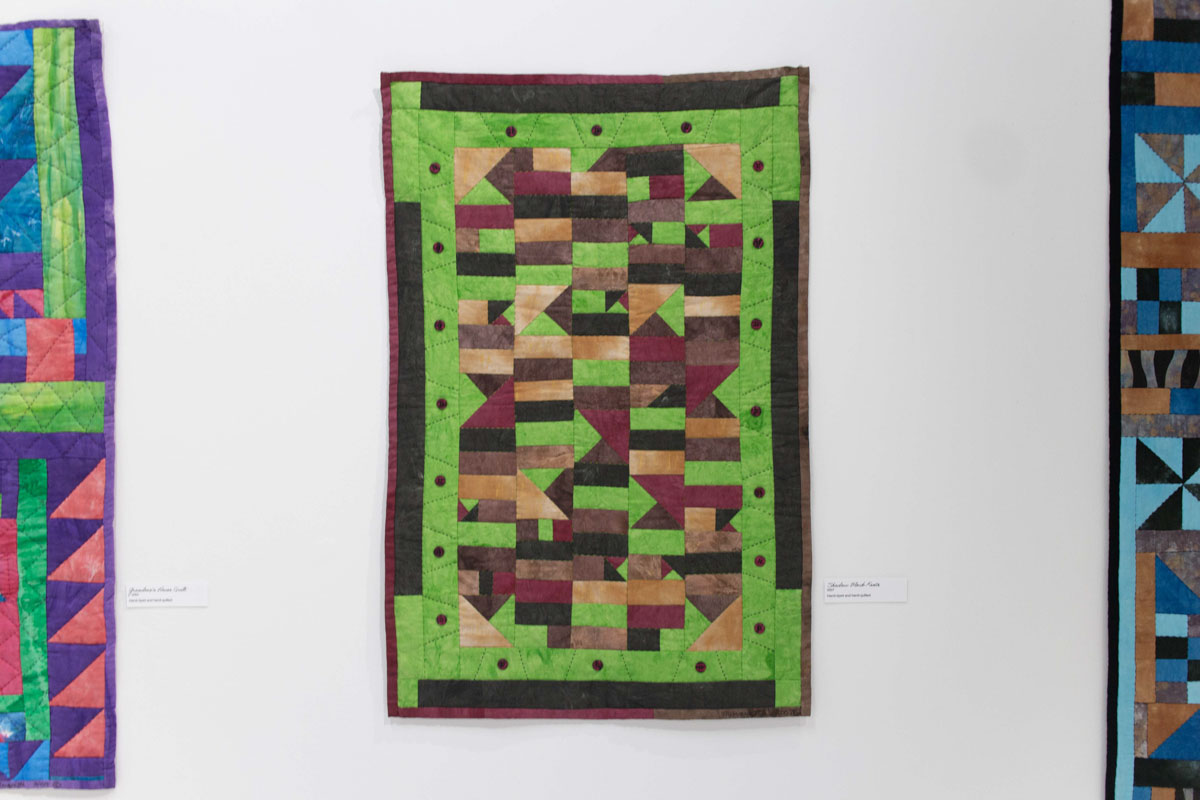

Across the gallery hangs Shadow Block Kente (2007). Small, red buttons and thin, black bars float on a sea of lime green, surrounding a central, rectangular block of patterning that dominates the composition. The center is comprised of square patches subdivided into rectangles and triangles in sand, wine, mocha and lime. Regularly using the background color causes the patterning to partially dissolve, but sand-colored triangles in each corner of this central block act as a frame, poking out and retaining structure. Kente is a Ghanaian weaving technique, made on narrow, horizontal looms and designed in square blocks. The thin, long textiles of kente inspire reverence and respect due to their historical use by royalty. This artwork is not kente cloth, but the reference in the title, and the use of its patterning, implicates kente. Quilting, with its natural improvisation and adaptability, allows Johnson to interlace two places, collapsing history and geography. In this light, the quilt’s palette of sand, wine, mocha and lime seems like a slight recoloring of the Pan-African flag, with its gold, red, green and black. The multicultural knowledge implicit in Shadow Block Kente reframes Johnson’s educational practice: Not only did she teach how to quilt; she also taught through quilting.
The exhibition title, Threads of a Living Legacy, is properly reverent of the late artist, and it serves as a sly double entendre. Johnson herself leaves behind a living legacy, as the exhibition makes evident. And her quilts themselves are a living legacy — they cleverly share knowledge and reflect multiculturalism.
::

Leia Genis is a trans artist and writer currently based in Atlanta. Her writing has been published in Hyperallergic, Frieze, Burnaway, Art Papers and Number: Inc. magazine. Genis is a graduate of the Savannah College of Art and Design and is also an avid cyclist with a competition history at the national level.
STAY UP TO DATE ON ALL THINGS ArtsATL
Subscribe to our free weekly e-newsletter.

PLEASE SUPPORT ARTSATL
Your Gift Sustains the Coverage You Count On!
Related Posts