In ‘Reel Portraits,’ Michael Kalish builds images of classic stars from the film strips that made them famous
Three decades after he first started making art from license plates, the Atlanta-born artist turns classic cinema reels into luminous portraits.
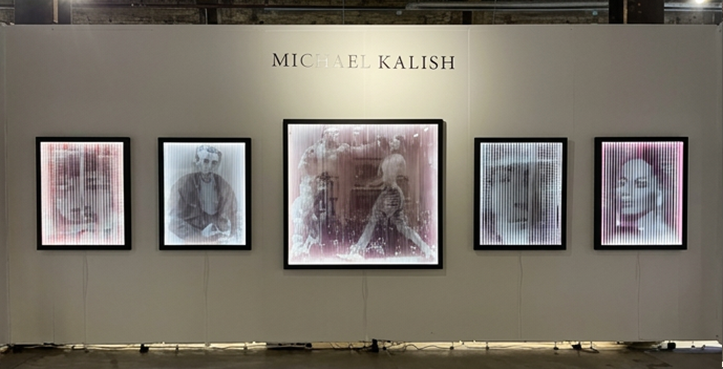
Atlanta native and Los Angeles-based artist Michael Kalish had a double-wide booth displaying his Reel Portraits collection at the Atlanta Art Fair at Pullman Yards a few weeks ago. The pop-up gallery beckoned visitors to reconsider not only what they were seeing but how they were seeing it. From a distance, recognizable celebrity faces emerged in striking detail. There was a portrait of John Lennon, another of Jimi Hendrix. Roughly a dozen works hung on the space’s three walls, each illuminated from behind, casting the stars’ faces in glowing white light and contrasting shadows.
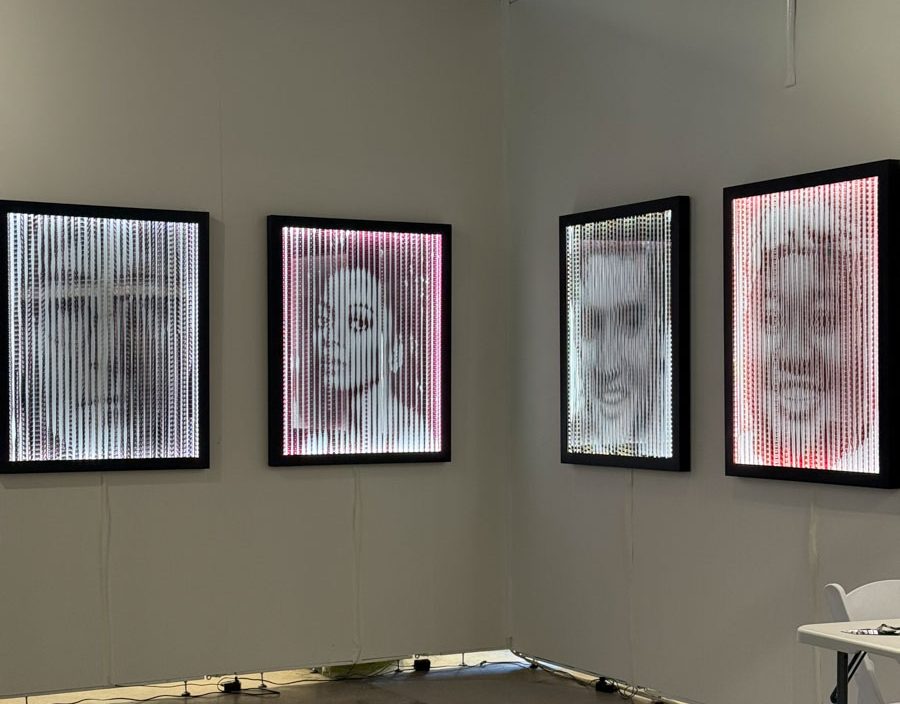
Up close, though, those same portraits dissolved as viewers examined how they were made — with vertical slats of plexiglass, each containing tiny strips of original motion picture film. Each frame of the film preserved fragments of the stories that once projected across theater screens. If you were one of the lucky fair-goers visiting Kalish’s booth, you received a complimentary signature gold magnifying pendant to examine the frames more closely.
Kalish’s booth stood out at the Fair for the way it drew visitors in, then kept them leaning in to study the tiny stills that, from a step back, became faces.
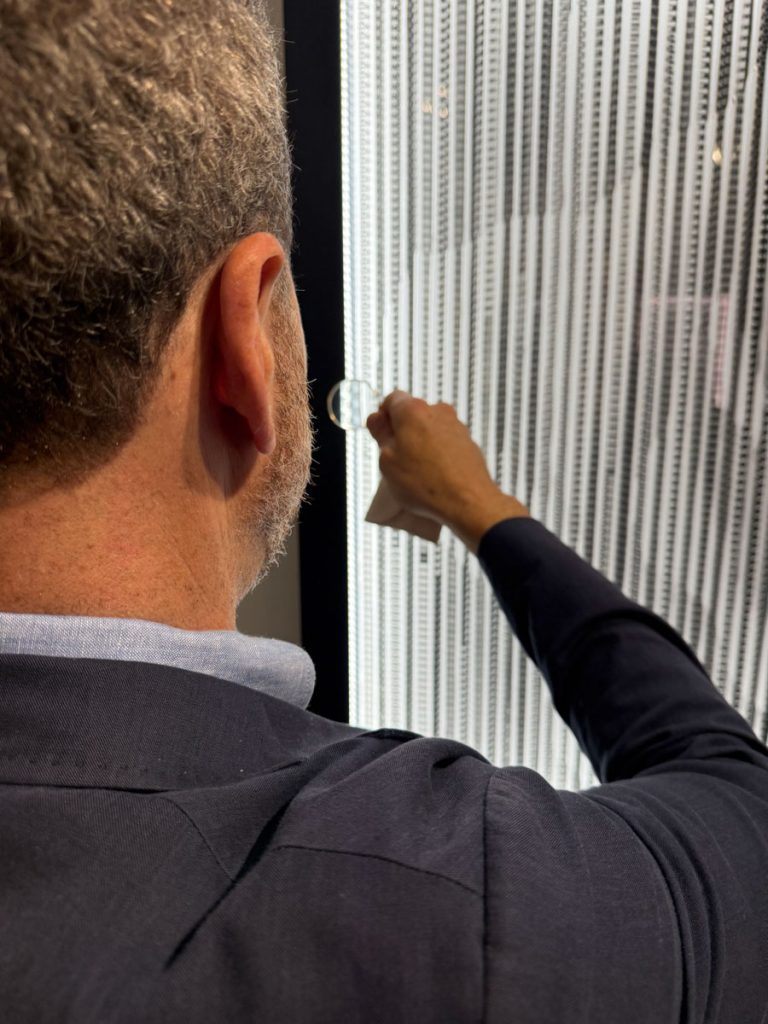 A viewer uses a tiny magnifying lens to look at the frames of an old film strip used to create a larger portrait.
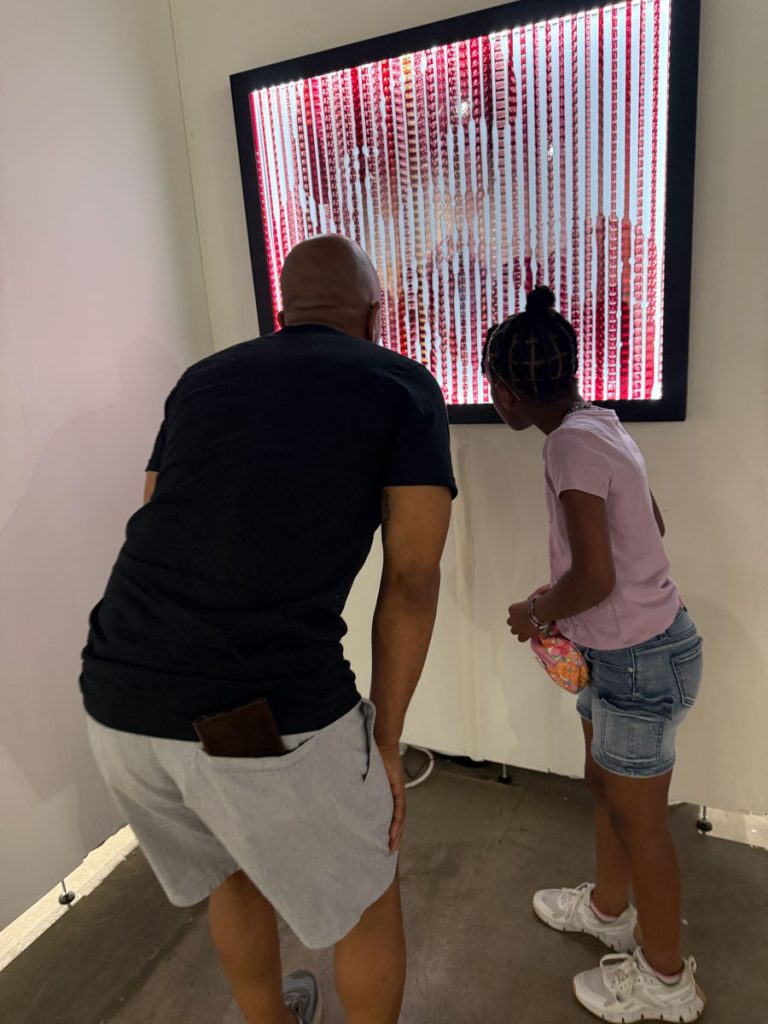 Visitors at Michael Kalish’s booth at the 2026 Atlanta Art Fair examine one of his portraits made from film reel.
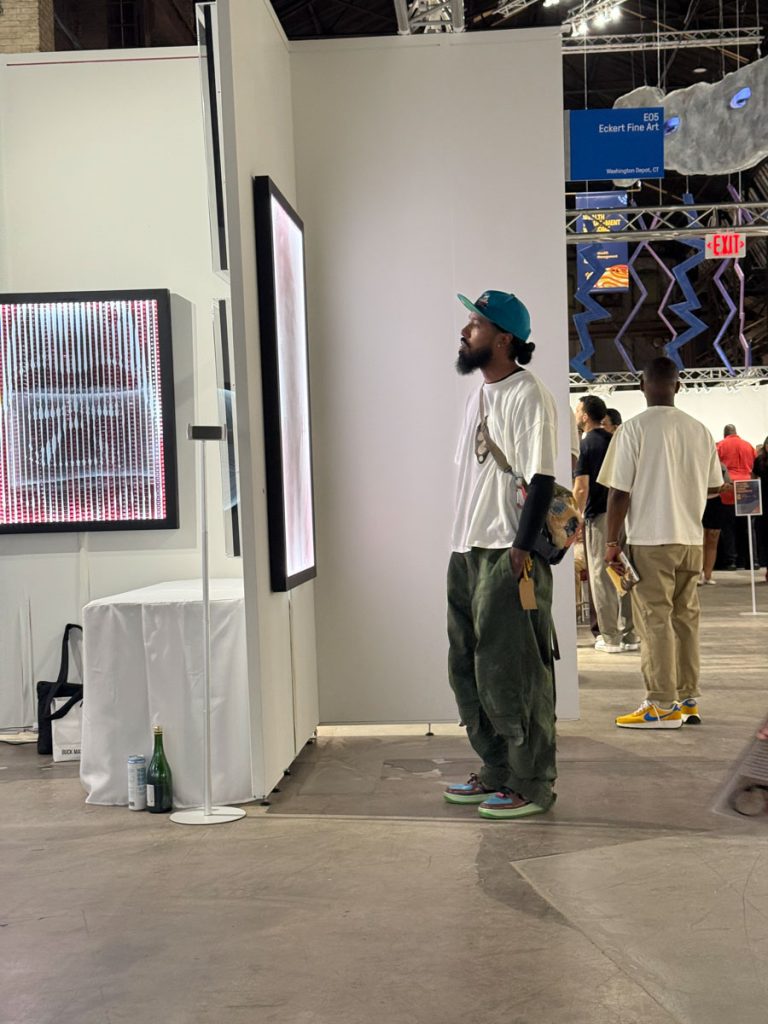 A visitor at the 2026 Atlanta Art Fair gazes at one of Michael Kalish’s Reel Portraits. Photo courtesy of Michael Kalish.
Kalish has spent more than three decades turning discarded objects into art. But in recent years, he has been drawn to vintage film reels. He’s drawn inspiration from the material that once brought Hollywood’s greatest stars to life. For Kalish, the journey from rusted objects to reels is less a departure than a continuation of his lifelong fascination with re-invention. Transforming materials into something new is characteristic of Kalish, whose unconventional artistic career began in Georgia with an unlikely medium — the American license plate.
Born in 1973, Kalish grew up pursuing athletics and eventually played college baseball. Yet beneath his competitive ambitions was a creative curiosity waiting to surface. When his baseball career ended, he found himself questioning what would come next.
Then he encountered a South Dakota license plate.
He glimpsed the plate from a moving car and was captivated by its colors, individuality and distinctly American character. He felt compelled to start collecting discarded plates. He recognized the artistic possibility inherent in objects most people regard as scrap metal. Rather than disguising their imperfections, Kalish embraced them. He began crafting American flags and portraits of icons such as Elvis Presley and Marilyn Monroe, letting the dents, rust and faded paint of each plate become part of the image.
Though the film reels in his latest work carry a different cultural significance than license plates, the pieces echo a similar revelation. Roughly seven years in development, the collection emerged from Kalish’s love of classic cinema and his desire to make something that revived old film. Through auctions, private collectors, museums and film libraries, he acquired original 16mm and 35mm motion picture reels, many damaged, incomplete or otherwise unsuitable for projection. He then painstakingly separated and manipulated the film strips, arranging their alternating passages of light and darkness into portraits that appear almost photographic from a distance.

Among the collection’s subjects are James Dean and Audrey Hepburn, whose performances have remained fixtures of American cinema for generations. Kalish’s renditions of Hepburn include imagery from Breakfast at Tiffany’s and Love in the Afternoon, while his portrait of Dean incorporates material from Rebel Without a Cause. For Kalish, who has admired Dean since childhood, obtaining damaged footage from the film was a creative milestone. Yet, the collection is as much about preservation as it is about celebrity.
“I’m a huge believer in second chances,” he explains in Second Chances: The Reel Art of Michael Kalish, a short documentary in which he describes how films that could no longer fulfill their original purpose can find another life in visual art.
The sentiment extends beyond cinema. His broader practice includes Raise the Caliber, a sculpture created from reclaimed firearms as a statement against gun violence, and Illuminating a Path, a public artwork honoring the transformative power of education. Earlier this year, some of his works, including Astrid, Frosted Roses, Nude in Repose and Vino, were exhibited at Carousel Fine Art in Buckhead, where Atlantans can go see his work in the gallery’s collection.
Throughout his career, Kalish has moved between intimate portraits and monumental public installations, with work entering the collections of the Coca-Cola Corporation, Ford Motor Company and the Tampa Museum of Art.
Yet, despite the scale of his accomplishments, he seems to return often to his core fascination with re-inventing discarded materials.
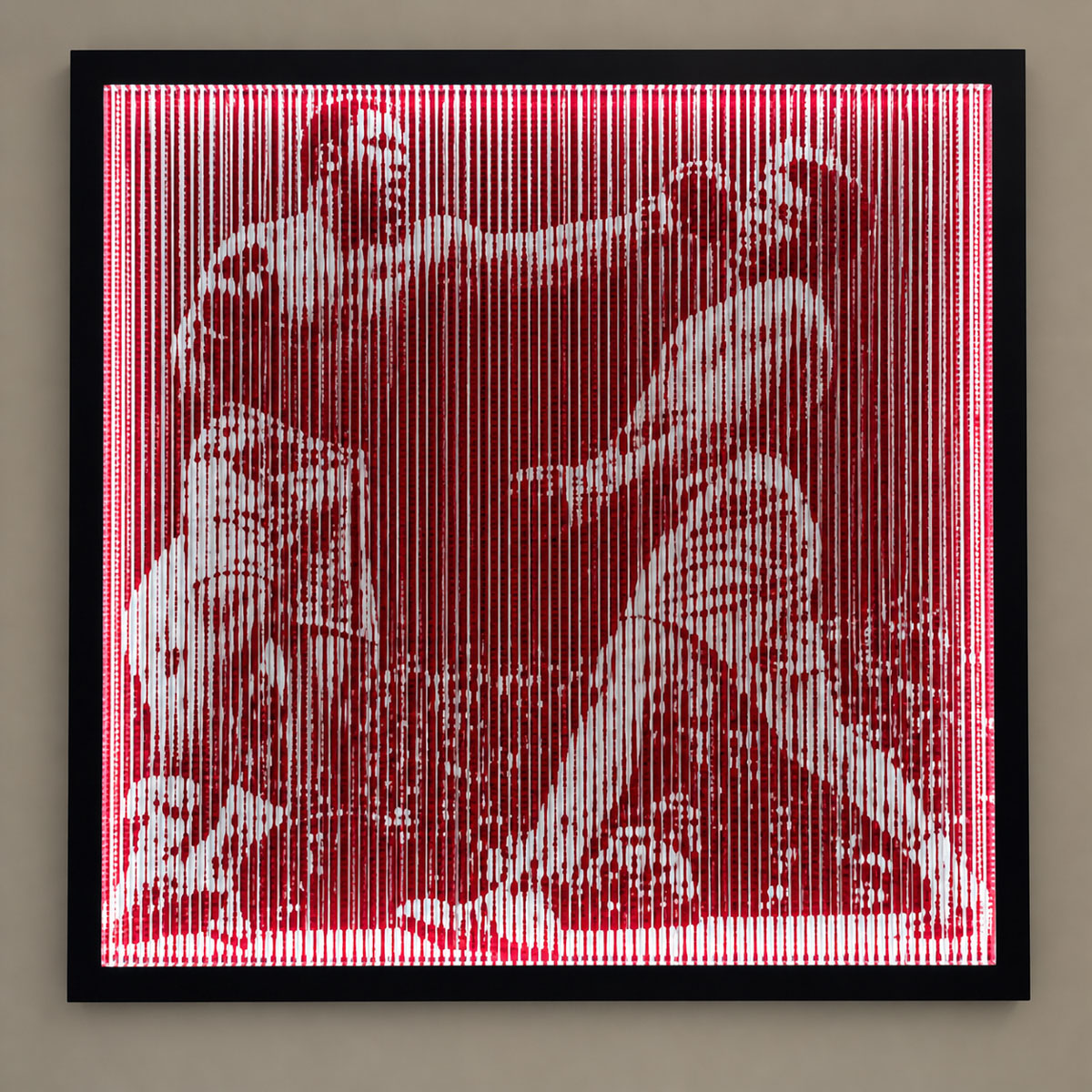
In Reel Portraits, the past is neither erased nor simply preserved. It is rearranged, allowing familiar faces to emerge from the physical remnants of their own cinematic histories. The viewer must move, reconsider and discover what was present all along.
“I feel like I’ve been passed a baton,” Kalish says, acknowledging the filmmakers and performers whose work preceded his own.
Perhaps that is the enduring thread of his practice. Where others see an object that has exhausted its usefulness, Kalish sees another possibility. And after more than 30 years of transforming what has been left behind, he continues to demonstrate that an ending can also be a beginning.
::

Brittany Mackins is an Atlanta-based writer and creative with a deep love for the intersections of art, healing and community. Blending her background in journalism, brand storytelling, creative writing and event production, she writes to honor the stories behind the art, the lived experiences, emotions and cultural roots that shape creative expression. Her lens centers diverse artistry in all its expansive forms.
STAY UP TO DATE ON ALL THINGS ArtsATL
Subscribe to our free weekly e-newsletter.

PLEASE SUPPORT ARTSATL
Your Gift Sustains the Coverage You Count On!
Related Posts