‘The Egyptian Book of the Dead’ is interpreted through art in ‘Skeletons Become Children’
Curated by Renee “rEN” Dillard, a multidisciplinary artist known for exploring themes of philosophy and Afrofuturism, Skeletons Become Children brings together 23 artists in conversation with one of the oldest surviving bodies of funerary literature.
Commonly called the Egyptian Book of the Dead, the collection of spells and writings was known to ancient Egyptians as the Book of Coming Forth by Day. Each artist selected a word, sentence, passage, page or chapter as the foundation for an original work. The results are on view through October 17 at the Emma Darnell Aviation Museum.
Dillard had been exploring the text in his own practice for nearly two years before developing the exhibition. A mentor introduced him to a version titled Awakening Osiris, translated by Normandi Ellis. The language was so dense, he recalled, that he could read only a few pages at a time.
Soon, its imagery began appearing in his work.
For Dillard, the exhibition became a way of expanding that experience beyond himself. He considers the text an important connection to ancient African spiritual history and a framework for thinking about what it means to transition from one state of being into another.
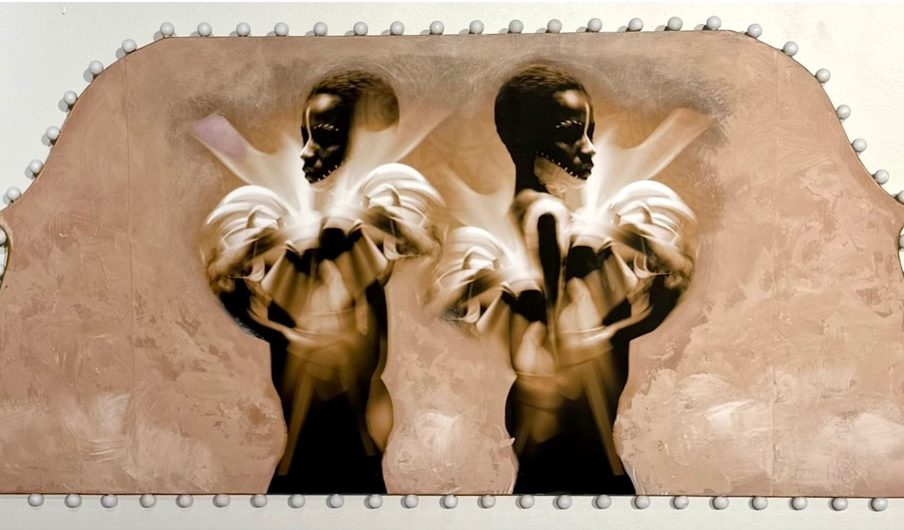
That transition becomes literal in Gerald Byrd’s Anubis as the Judge of Truth. Byrd depicts two friends who have died, imagining Anubis escorting them into the Duat, the realm the dead enter on their journey into the afterlife.
In Egyptian mythology, the deceased’s heart is weighed against the feather of Ma’at, a symbol of truth and cosmic order. A heart light enough to balance the feather is permitted to continue its journey. Byrd transforms that ancient ritual into something intimate. Rather than treating death as an abstraction, he gives his friends a guide.
Scarabs scattered near the figures deepen the work’s attention to renewal. The beetle, associated with regeneration in ancient Egypt, reproduces within a ball of dung from which new life eventually emerges. Something discarded becomes the vessel for transformation.

Within the context of Skeletons Become Children, that cycle begins to feel less like a distant myth than a metaphor for the repeated deaths and rebirths contained within an ordinary life.
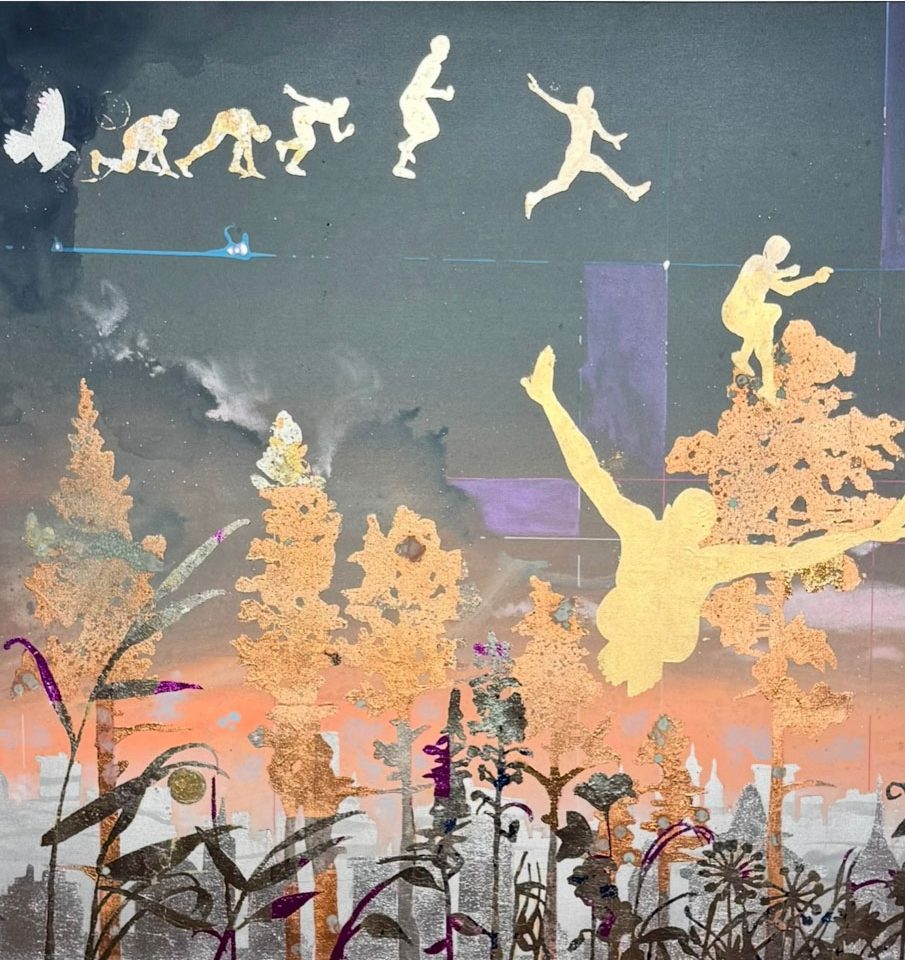
Dillard’s own contribution similarly collapses ancient and contemporary worlds. His mixed-media work considers Heru, or Horus, and the movement between human and divine forms. Against a modern cityscape, the figure passes through states of existence before returning to a falcon-like spiritual form. Dillard incorporates unconventional materials, including comic book imagery and dyed silver, pulling an ancient story into the visual language of the present. The image recalls another mythology of transformation — flight.
In Toni Morrison’s Song of Solomon, flight becomes tangled with freedom, ancestry, escape and the possibility that Black people might transcend the conditions intended to contain them. Dillard’s figure seems to hover within a similar question. What happens when the body is no longer the boundary of who we are?
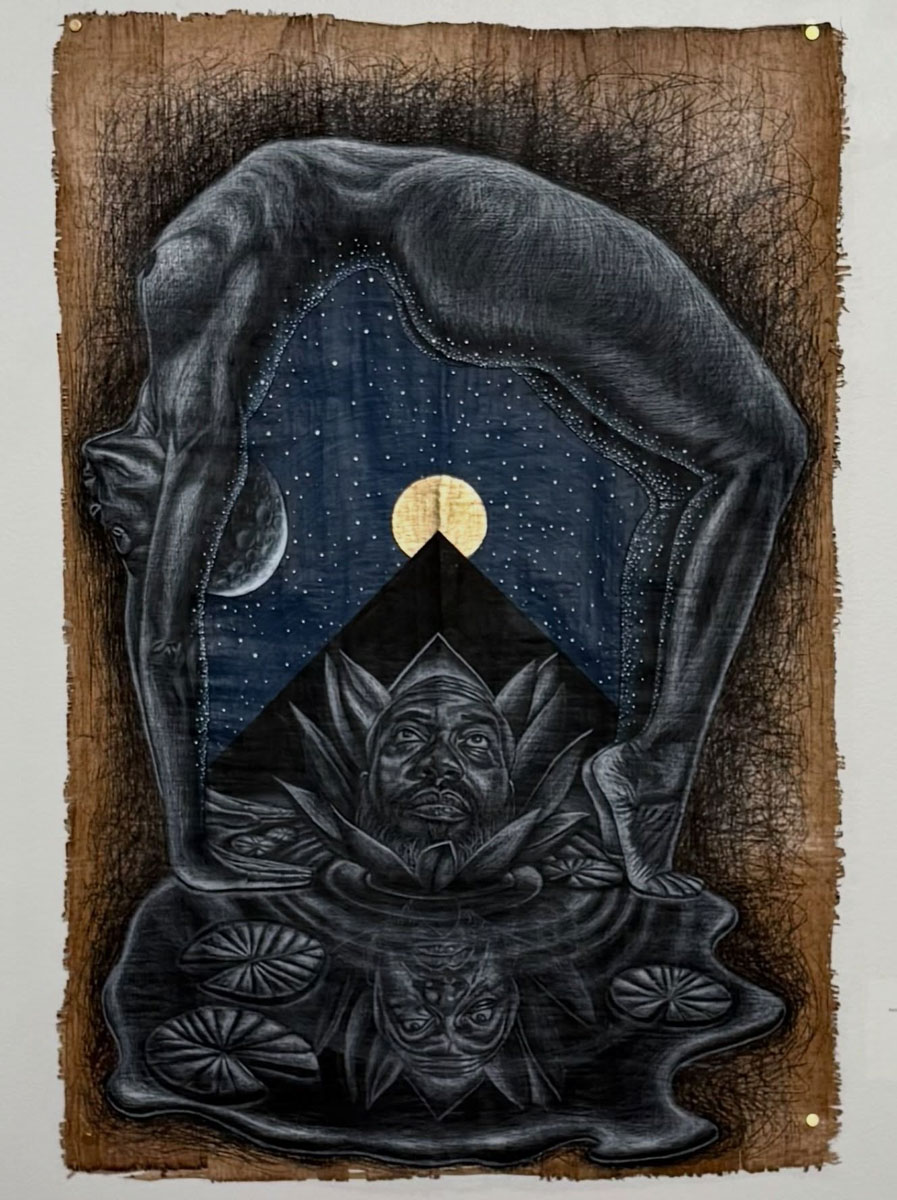
Elsewhere, reflective surfaces, reaching hands and portal-like imagery push the exhibition toward ideas of divination and alternate realms. Throughout the gallery, a scannable QR code alongside the work it inspired contains the passage of each piece, allowing source and interpretation to remain in direct conversation. Viewers can see not only what each artist created but the distance traveled between a centuries-old passage and its contemporary response.
With the featured artists, no singular interpretation of death, transformation or spirituality dominates the exhibition. Instead, the show becomes a chorus of possibilities.
That multiplicity is where Skeletons Become Children is most compelling. It does not require viewers to subscribe to one understanding of what happens after death. Its more interesting proposition concerns what happens before it.
How many selves can a person shed within one lifetime? How many beliefs, wounds, identities and fears can be released before the heart becomes lighter? Perhaps becoming a child again does not mean returning to innocence. Perhaps it means returning to possibility, to the version of ourselves that had not yet learned to believe transformation was impossible.
The skeleton, after all, is not simply evidence of death. It is the very structure that has been carrying us all along.
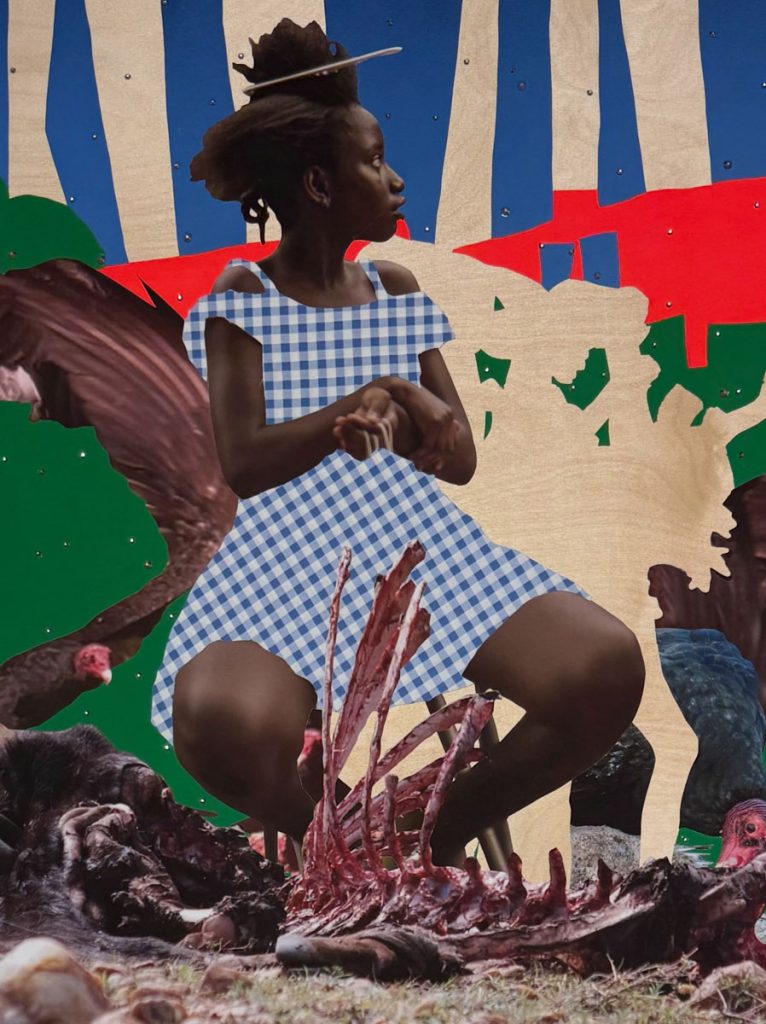
Skeletons Become Children is on view through October 17 at the Emma Darnell Aviation Museum and Conference Center, 3900 Aviation Circle NW in Atlanta. Visit fultonarts.org for viewing information and hours of operation.
The 23 artists with works in the exhibition include: Melissa Alexander, Alfred Conteh, Aaron Henderson, Steve Allen, Ren Dillard, Etienne Jackson, Chanell Angeli, Sam Dunson, Marryam Moma, Thom Bess, Maurice Evans, Tracy Murrell, Barbara Brenner, Rachel Garceau, Navin Norling, Courtney Brooks, Shanequa Gay, Wilay Mendez Paez, Gerald Byrd, Oscar Harris, Kevin Sipp, Billy Clifton-Strawn and Tisha Smith.
::
Brittany Mackins is an Atlanta-based writer and creative with a deep love for the intersections of art, healing and community. Blending her background in journalism, brand storytelling, creative writing and event production, she writes to honor the stories behind the art — the lived experiences, emotions and cultural roots that shape creative expression. Her lens centers diverse artistry in all its expansive forms.
STAY UP TO DATE ON ALL THINGS ArtsATL
Subscribe to our free weekly e-newsletter.

PLEASE SUPPORT ARTSATL
Your Gift Sustains the Coverage You Count On!
Related Posts