

Review: In ‘Divas, Blues, and Memories,’ Beau McCall stitches together legacy and cultural monuments
Did they know they’d be remembered, immortalized and exalted?
Divas blossom in nearly impossible conditions, like roses pushing through concrete. In Beau McCall: Divas, Blues, and Memories, beauty rises from grief, and memory becomes an act of devotion. Having lived through the cyclical love and loss of friends, family and idols within the LGBTQIA+ community in the ’70s, McCall understands survival as both burden and inheritance. Music and fashion did much more than entertain; they helped birth the martyred diva, an empowering archetype forged in resilience. They represented people worthy of more than the bare survival they fought so hard to claim. They were worthy of life.

Built from a legacy of cultural excellence, the exhibition unfolds inside of the Hammonds House Museum, where artists of African descent are honored and uplifted. It is the former home of the late Dr. Otis Thrash Hammonds, who restored the dilapidated Victorian house after purchasing it in 1979. The house holds history in its bones and is an appropriate setting for an exhibition about memory, as this show both shouts and gathers.
Arriving in Harlem in the late 1980s with little more than a duffel bag and a jar of buttons, Beau McCall, later dubbed “The Button Man” by American Craft, built a career transforming humble fasteners into powerful works of visual and wearable art rooted in culture and social commentary.
Through his work, McCall claims the right to not only be seen but also to be carefully studied, heard and adored. He resurrected the very divas he admired, those who shimmered through the darkness in sequin, glitter and eye-popping hair and makeup. The exhibit showcases how brightly they shone, how colorfully they lived, how loudly they sang and how unapologetically they loved. The diva emerges here as a blueprint for Black flamboyance and the refusal of erasure.
And then there is the tenderness.
What does it mean for a Black man to create softness? To craft divas and to preserve memory through domestic craft? It is an act of rebellion, a reclamation and honoring of one’s selfhood. In a world that often polices masculinity, McCall’s hand-stitched work is a quiet defiance. It embodies patience. As I studied the pieces detailed with hundreds of hand-stitched buttons driven through thick denim, I could only imagine the time and consideration required to craft such a piece. From selecting each button, considering color and weight, pushing the needle through heavy cloth repetitively — this is slow, devotional work.
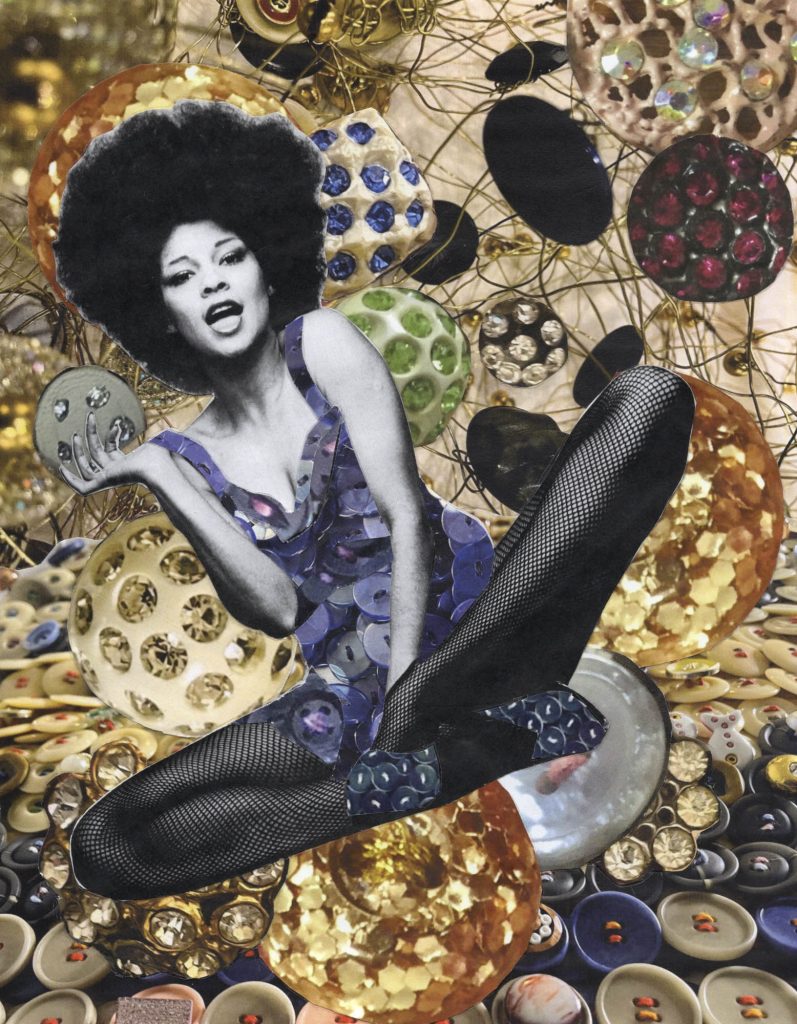
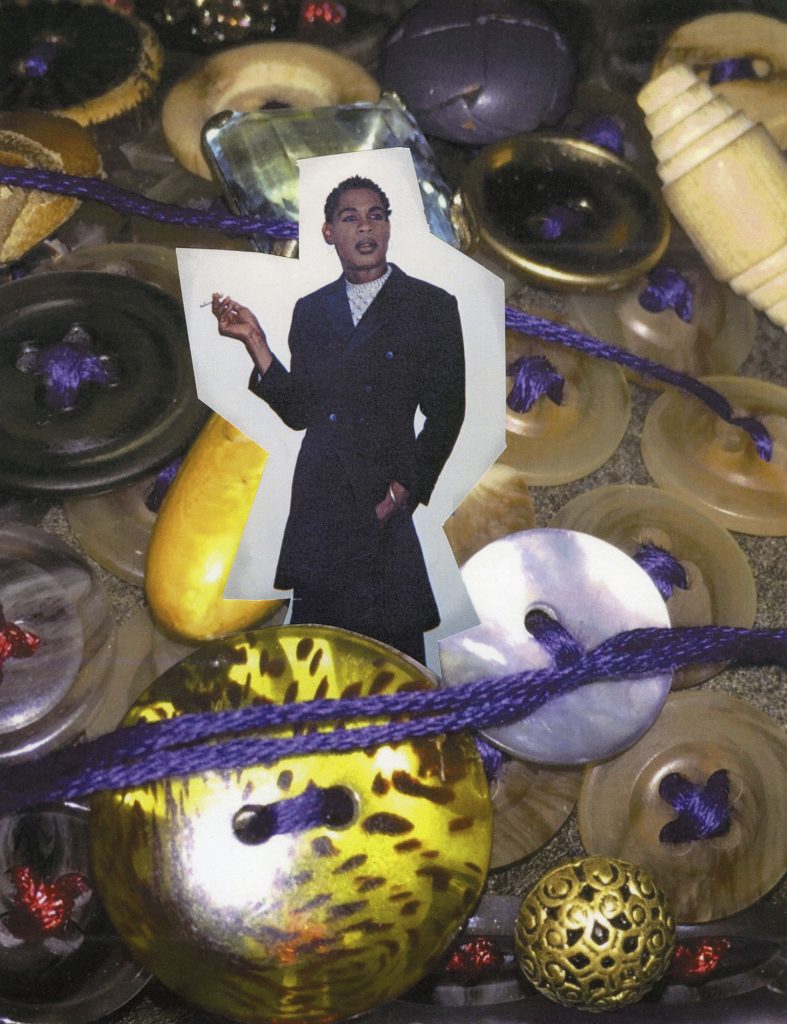
Buttons hold things together. They sit over the heart, travel the spine, close gaps between fabric and flesh. In McCall’s hands, they become witnesses. Collages merge photographs with buttons, beads, cassette tapes, handwritten playlists, African masks and figurines. He builds textured altars to cultural memory. Portraits honor iconic figures such as Patti Labelle, Diana Ross, Donna Summer, Betty Davis and others — stars who taught Black people and the LGBTQIA+ community how to be both seen and felt.
McCall personalized shades of blue in thrifted blue jean jackets embellished with crystalized and flat monochromatic buttons on pieces titled Button Yoke: Blue I and Button Bolero: Blue.
Blue becomes more than color; it becomes mood. It becomes the blues.

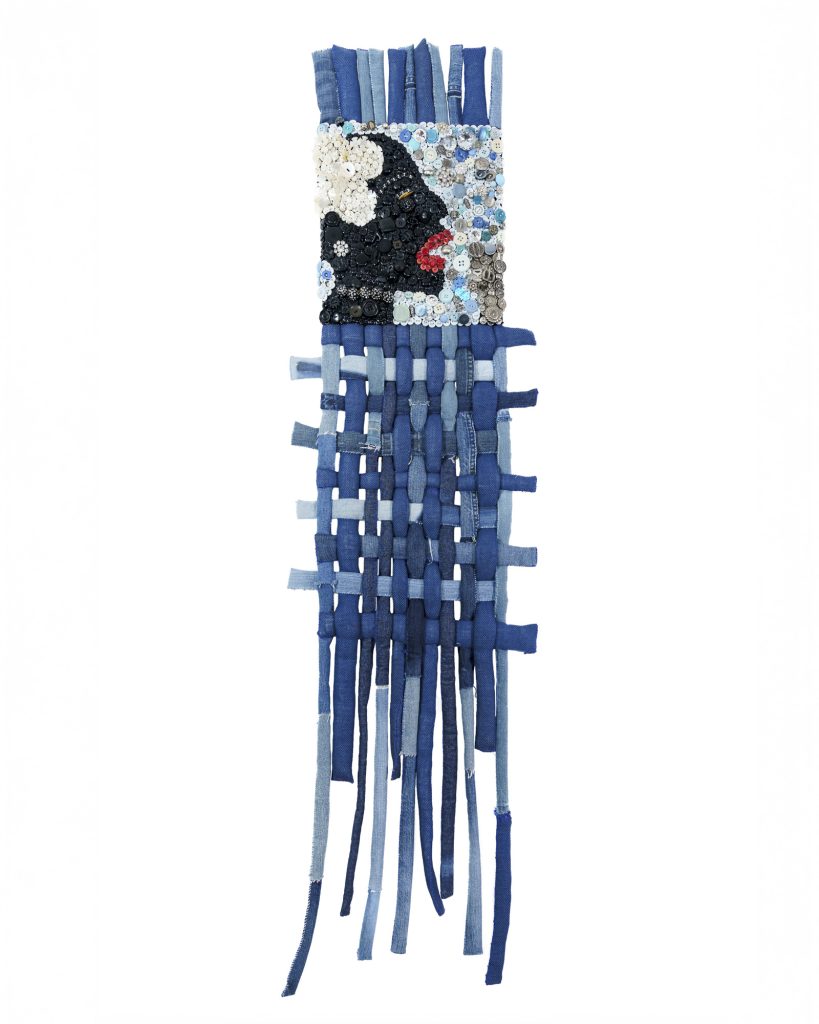


A burlap and denim tapestry titled Billie’s Blues immortalizes the legacy of Billie Holiday, whose lips sang in shades of vibrant red, with a flower in her hair made of mother of pearl, Swarovski crystal and metal rhinestone. For this piece, McCall referenced Holiday’s status as an openly bisexual woman and included a personal quote explaining her importance to the LGBTQIA+ community, saying, “At first, I wasn’t a big fan of Billie, but, as I got older and experienced my share of heartache, I came to understand and appreciate the raw emotion of her music. It was healing for me and so many others.”
On a blue wall above a white fireplace, a quote from Holiday reads: “The blues to me is like being very sad, very sick, going to church, being very happy. There’s two kinds of blues. There’s happy blues, and there’s sad blues.” Here, the blues feel less like a genre and more like a language of survival. It evokes collective processing of devastation and joy that are deeply intertwined.
McCall’s exhibition fills three main rooms downstairs and continues upstairs, where memories of friends who have transitioned stand beside images of musical icons. In one piece from the Diva Worship series, Donna Summer appears crowned in voluminous curls, her face framed by gold rhinestones, neutral buttons, a shimmering disco ball and gorgeously gaudy 1970s splendor.
A documentary detailing McCall’s long artistic career plays on a loop in the furthest room to the left on the first floor of the museum. In the film, McCall’s life reads as a heartfelt story of determination, love, creativity and creative calling, while detailing the public’s ridicule, praise and loves that are lost and found again. After an extended period of feeling uninspired, he spoke of returning to his craft when his partner, Souleo, called him back to the light. Souleo curated the exhibition and is featured in the documentary modeling several pieces from McCall’s work over the years. Here, the message is clear. He’s still here, still creating, still stitching memory into permanence.
Beau McCall: Divas, Blues, and Memories will be on view at Hammonds Art Museum until June 28.
::
Brittany Mackins is an Atlanta-based writer and creative with a deep love for the intersections of art, healing and community. Blending her background in journalism, brand storytelling, creative writing and event production, she writes to honor the stories behind the art, the lived experiences, emotions and cultural roots that shape creative expression. Her lens centers diverse artistry in all its expansive forms.
STAY UP TO DATE ON ALL THINGS ArtsATL
Subscribe to our free weekly e-newsletter.

