In Downtown Atlanta, Eddie Farr’s sculpture lights the path forward at The Stitch
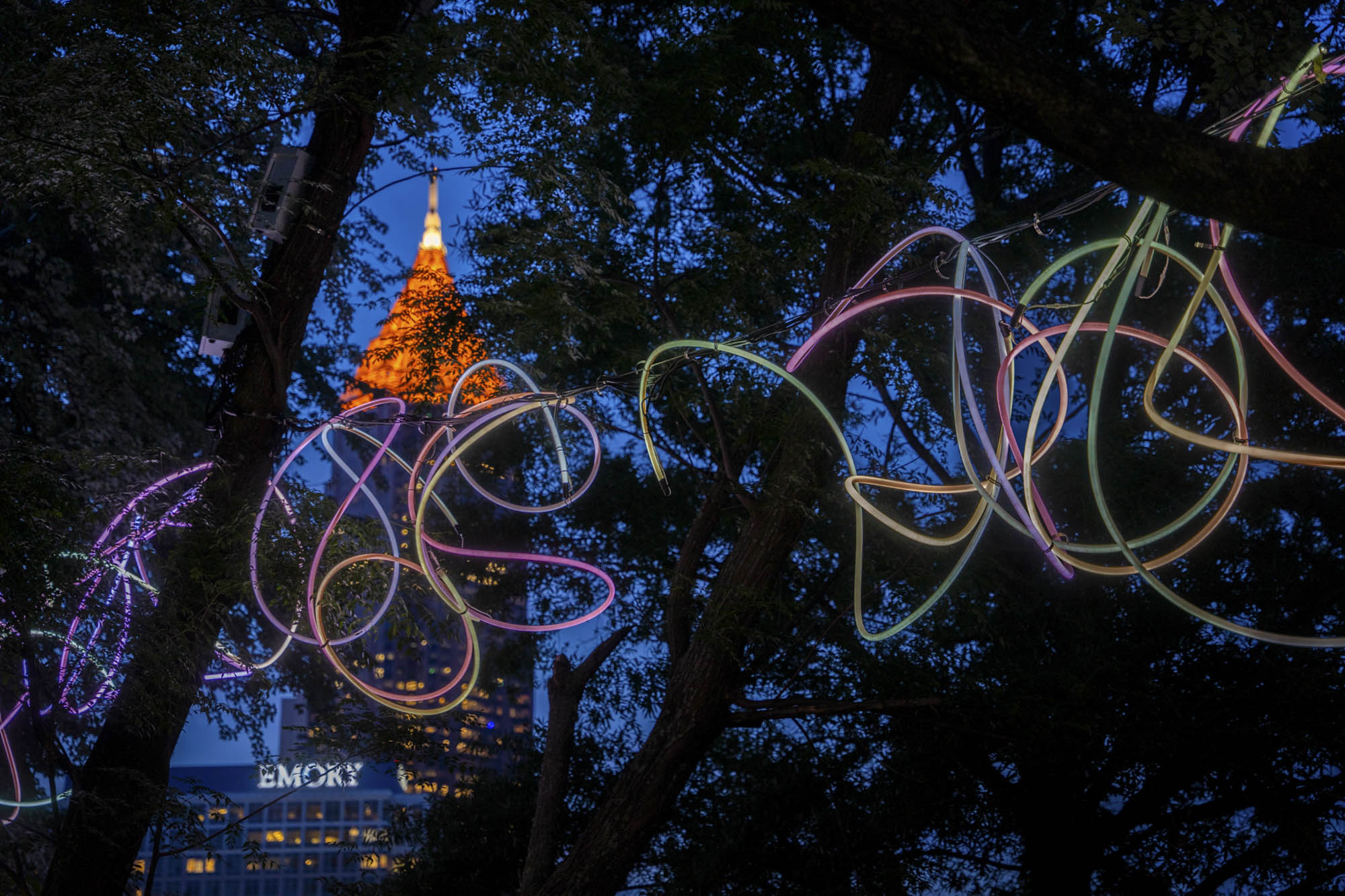
What We Weave, a sculpture composed of around 300 feet of LED tubing powered by 2,700 watts, now sits in the tree canopy at the Mayor’s #1 Park in North Downtown. It’s the first of many works to be realized for a future installation at The Stitch, debuting at the site on June 10. Eddie Farr, the artist who created the piece, provided for Arts ATL more details about the What We Weave and what inspired it.
“You can’t think of Atlanta without thinking of all the Civil Rights activists who have come from here,” said Farr, citing the work of John Lewis, Martin Luther King Jr. and Ivan Allen, the former mayor who championed desegregation. “It’s really hard for one person to change the trajectory of anything,” he continued, noting that while the average person might not have the power and influence of these leaders, one can still speak kindness and hope into the world. That’s the spirit of what he hoped to embody with this new work.

Farr explained that the twisting, undulating LED strips represent words suspended in the air. He was inspired by light painting, an art form that fuses long-exposure nighttime photography, with a light source becoming the brush to paint in the air. When the shutter closes, a remnant of the light’s motion is visible in the frame, becoming a sort of reminder of the movements of the light through the space. Artists have used this technique to write words in the air, create figures and plenty of other creative applications in photographs. Farr’s concept takes this ethereal motion and makes it real, becoming a physical manifestation that has the ability to linger in sculptural form.
“It’s like a little mantra,” he said, noting the idea of floating words is deeply personal — a reminder of one’s own perspective, agenda and impact. It’s a visual reminder of what has been done and the potential for better things to come. “I still find wonder and joy in the world, you know.”
While the LED light tubes themselves display white light, he has also rigged them up with a sort of gramophone that resembles a crumpled quilt. When visitors speak into it, the light strands change color according to the vocal range of the person speaking. Those with a higher-pitched voice will result in cooler colors, while those with lower voices will see warm tones. He imagines that the public can speak hope into the world through his work. “People can speak their hopes for Atlanta, their hopes for the South and for the future. That’s how I would like people to interact with it.”


The construction of this interactive light sculpture was a result of a team effort, and Farr explained that his personal practice has evolved to a place where communal effort is an essential part of the process. Farr was one of the artists who was impacted by the fire at South River Art Studios last year, and the decimation of his studio and all of his tools and existing works caused significant disruption to his creative practice. Following the fire, The Hambidge Center offered Farr studio space where he was able to continue creating his works that require around 50 feet of outdoor space to pull the LED lights through the tubes. “It was really difficult, honestly, doing this one. Just, you know, it’s been about six months and still, honestly, I haven’t processed it too much, because I’ve been just so busy.”
So, for this project, Farr took on a more directorial role and enlisted fellow artists to construct the piece. For What We Weave, Farr’s former graduate advisor John Thompson made the audio components and processing software, Hannah Hendricks built the power and data cables, Ryan Clark did the lighting design and Julia Hill and George Long helped to sculpt the tubes and install the piece. Farr began ordering the parts in mid-April, working with his team to construct it until installation earlier this week.

Stitch CEO Jack Cebe also spoke with ArtsATL about the overall project and the role of arts in the scope of the final design. “When I was at Tech, I was looking out at this vast stretch of highway known as the Downtown Connector, crossing it every day to get to class and studying transportation engineering,” recalled Cebe. “It kind of got the wheels turning, like, what if there is a better way to use this space for more civic purposes, for community-building.” He began looking into similar concepts in other cities such as the Millennium Park in Chicago, The Rose Fitzgerald Kennedy Greenway in Boston and the Klyde Warren Park in Dallas. “They really kind of blend into the urban fabric,” he said.
In all of these instances, single-use transportation corridors were capped and transformed into multi-use civic sites and parks. Cebe sees The Stitch project — which has been in the works for years but on pause until recently, pending funding and other logistics — as an opportunity to build an entirely new neighborhood in the heart of the city. At the heart of the plan is a new 17-acre park, programmed with community events and art installations and incorporating housing elements as well.
Cebe cited numerous benefits to introducing a park for residents of the new housing there as well as neighbors, from civic engagement to wellness, community-building and mental health. Economically, a nearby park also has a positive impact on neighboring property values, and adding trees and green space also helps offset heat island effects caused by large spans of impervious surfaces.


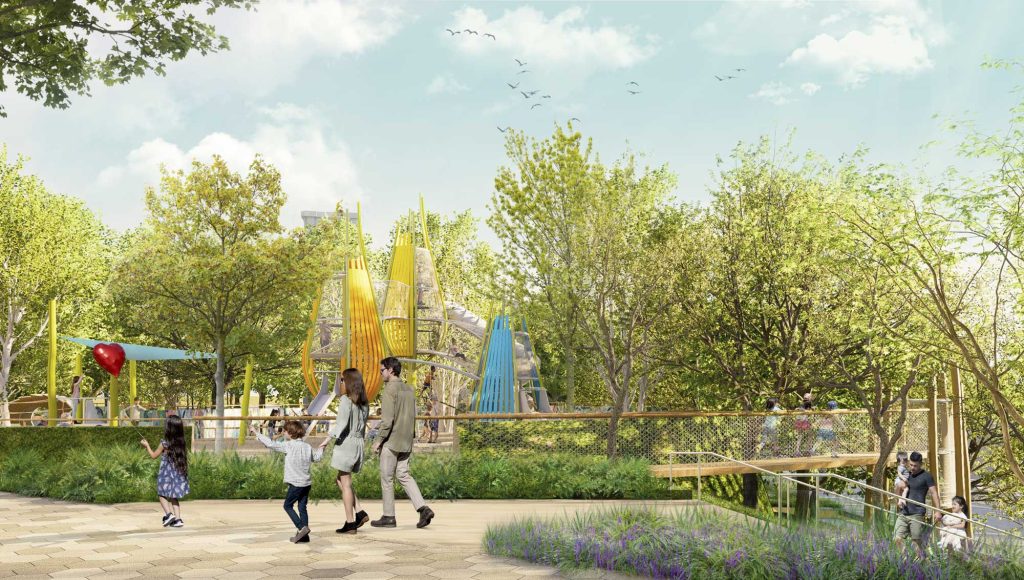
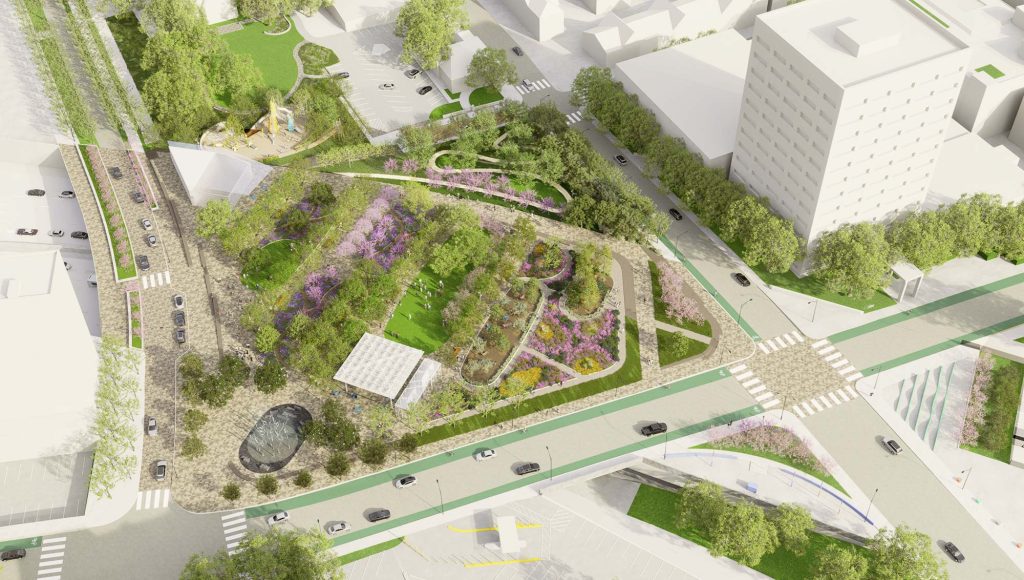
“We are effectively putting a green roof over the interstate,” said Cebe. He hopes the construction will be a net positive for all and says he doesn’t anticipate massive disruptions or complete closures of the interstate during the construction process. Admittedly, that process is going to take quite some time, and Farr’s sculpture serves as a sort of visual launchpad for the imagining of The Stitch’s future as a cultural destination. “It shows that things are happening and that there’s new life being breathed into that area,” said Cebe.
The Stitch Inc. is a fairly new organization that has formed only in the past few months, and installations like Farr’s are part of the overall master plan for The Stitch, which will eventually result in a new neighborhood and green space. While additional details are still unfolding, Cebe’s enthusiasm for the project is undeniable. He anticipates that, once completed, the site will house not only housing and green space but also a variety of art that will make the place feel like home — including sculptures, murals and activations. Cebe has worked with Downtown Atlanta Inc. to conceptualize the artistic elements of The Stitch, and it was through their past collaborations with Farr that What We Weave has come to be the first work installed at the site.
For now, What We Weave is in place but still unlit until a grand unveiling on June 10 from 7 p.m. to. 9 p.m. at the Mayor’s #1 Park, 120 Ralph McGill Blvd. NE. The event will be open to the public and will offer first glimpses into an ambitious project that Atlantans have been cautiously hopeful would come to fruition for many years.
::

Isadora Pennington is senior editor of art + design and dance. An experienced writer and photographer with a deep love for the arts, Isadora founded the Sketchbook newsletter with Rough Draft Atlanta in 2022. She is also president of the Avondale Arts Alliance and director of the Avondale Arts Center.
STAY UP TO DATE ON ALL THINGS ArtsATL
Subscribe to our free weekly e-newsletter.

PLEASE SUPPORT ARTSATL
Your Gift Sustains the Coverage You Count On!
Related Posts