Virtuosity and stunning grandeur on display as Johns Creek Symphony takes flight
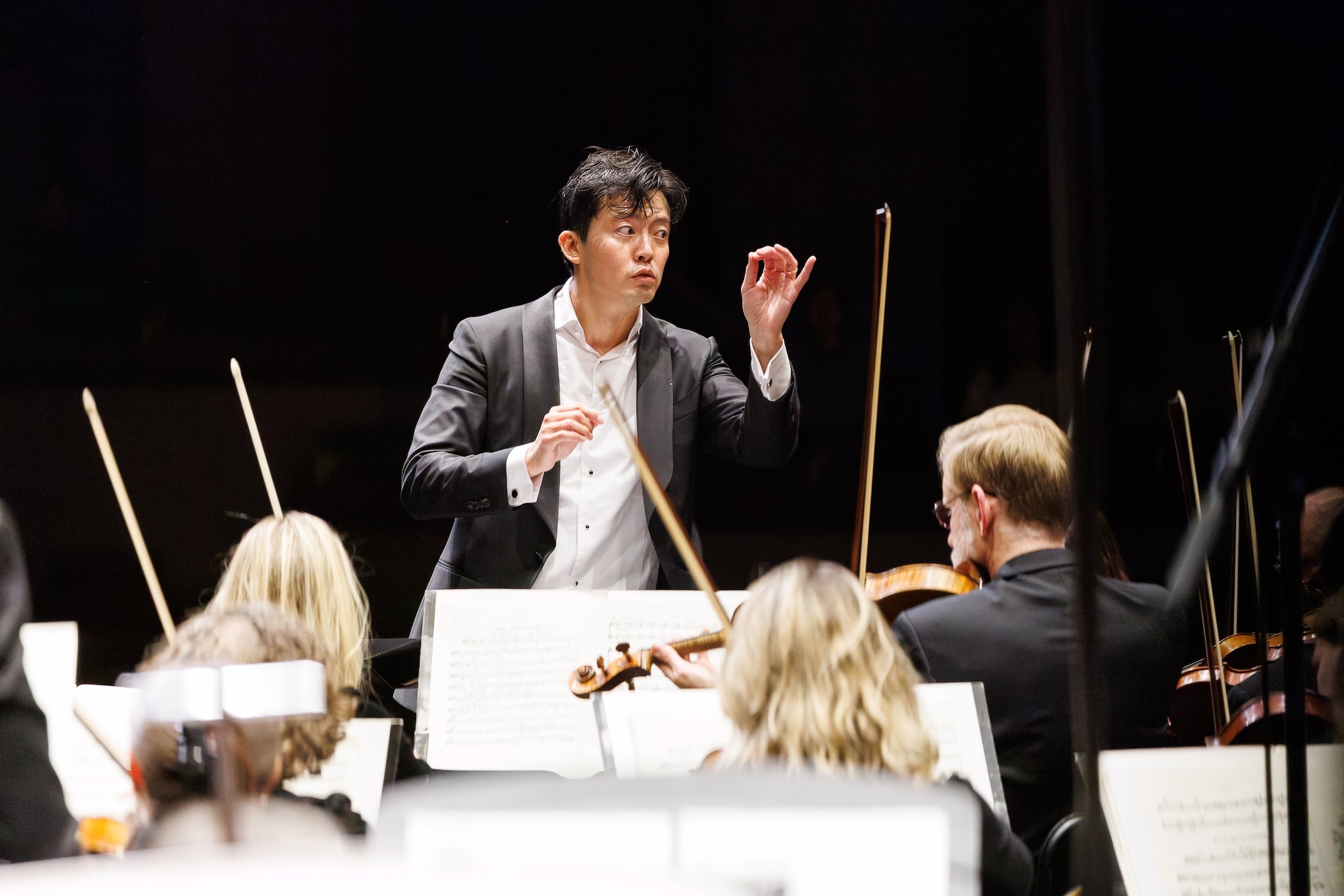
The Johns Creek Symphony Orchestra assembled Friday, October 9, at the Sandy Springs Performing Arts Center for Taking Flight, an evening of Tchaikovsky and Stravinsky introduced by what proved to be the evening’s most striking moment.
JCSO conductor Henry Cheng has been vocal about his enthusiasm for new and avant-garde experimentation in the classical realm — but always with a penchant for finding the melodic and the listenable. As much as I’ve campaigned for classical ensembles to venture down new roads, it comes with the risk of unearthing the unlistenable. As I’ve always maintained: All too often in classical music, “modern” is secret code for “no melody.”
That has proven not to be the case with the Cheng era of the JCSO, which plumbs the depths of everything from spaghetti westerns to contemporary K-pop hits and has consistently returned with listenable and innovative works that go down smoothly. In the case of October 9, that new upset to the establishment apple cart came in the form of Christopher Tin’s “Songo di Volare (The Dream of Flight),” the main theme from the computer game Civilization VI.
With support from the highly respected Michael O’Neal Singers, “Songo di Volare” opened the concert with an arresting display of transcendent majesty that spoke as much to modern sensibilities as to the classical antiquity it is meant to dramatize. Developer Sid Meier’s Civilization series is an epic tale of humanity’s cultural development throughout the ancient world and into the modern era. As such, Tin’s stirring score instantly blesses the mind’s eye with visions of marble statues and pristine coliseums presided over by Olympian deities.
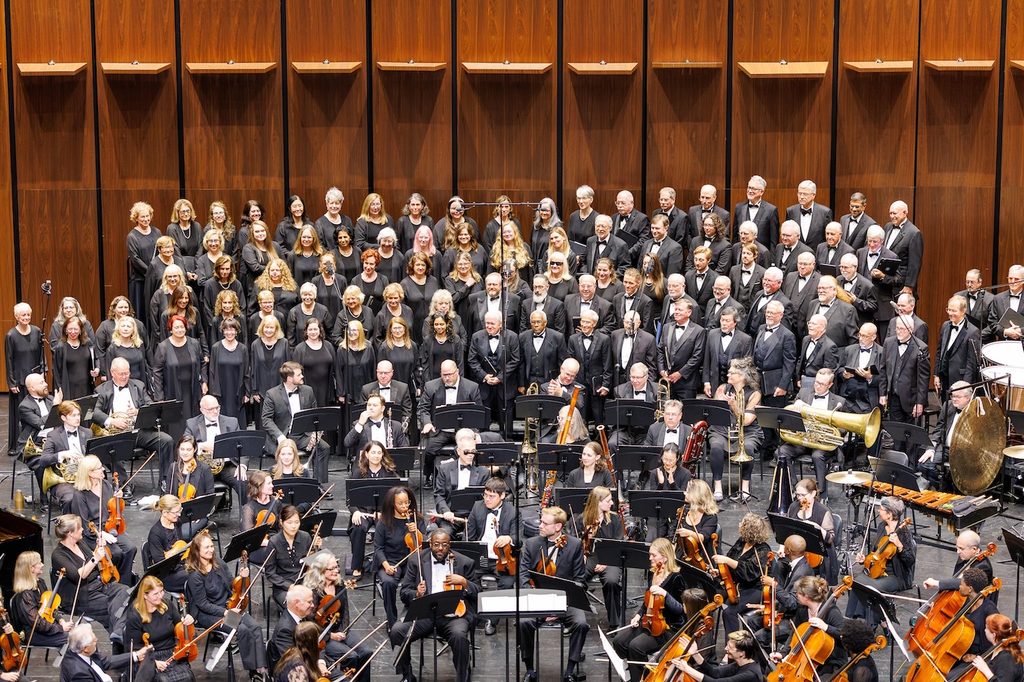
From a compositional standpoint, the piece succeeds by standing in two harmonic worlds while compromising neither. The instrumentation is arranged around fairly modern notions of harmony: modern chordal structures built around root-fifth intervals and the sort of parallel motion that is verboten in traditional classical writing but commonplace in jazz and rock and roll. That modernism is juxtaposed with a choir that is arranged along the lines of choral music in the classical tradition. The combination is nothing short of astounding and creates the kind of epic Hollywood effect that we commonly associate with soundtrack composers like Vangelis or Two Steps From Hell.
In concert, the Michael O’Neal Singers gave the piece all the stunning grandeur it demands. There is something marvelous in this choir’s cohesion that goes beyond a seasoned ensemble merely benefiting from great acoustics. It’s the kind of precisely balanced unity that comes from a group of deeply interwoven personalities. One is given to feeling like they don’t just sing as a unified whole but think as such as well. The result is a choir whose individual singers become the ambulatory limbs of a graceful behemoth.
Tin’s work was fascinating, intoxicating and over entirely too soon. It’s only a few minutes’ worth of music and a sublime overture, but it left me wanting more. I would have happily experienced the entire Civilization VI soundtrack, though I suspect Cheng and company are wisely rolling such things out in controlled doses.
Violinist Simon Zhu joined the JCSO for Tchaikovsky’s Violin Concerto in D major, Op. 35. Despite the bar being set astronomically high with Tin, Zhu managed to emerge as the evening’s shining star. His tonal command of the instrument was effortless — like a high-wire act done by an acrobat so seasoned it seems like an afterthought. I was preparing to draft a review extolling what had to have been the end result of decades upon decades of unwavering commitment to the instrument, only to find that he was born in … 2001. Mastery at such a young age made the evening’s performance seem all the more superhuman.
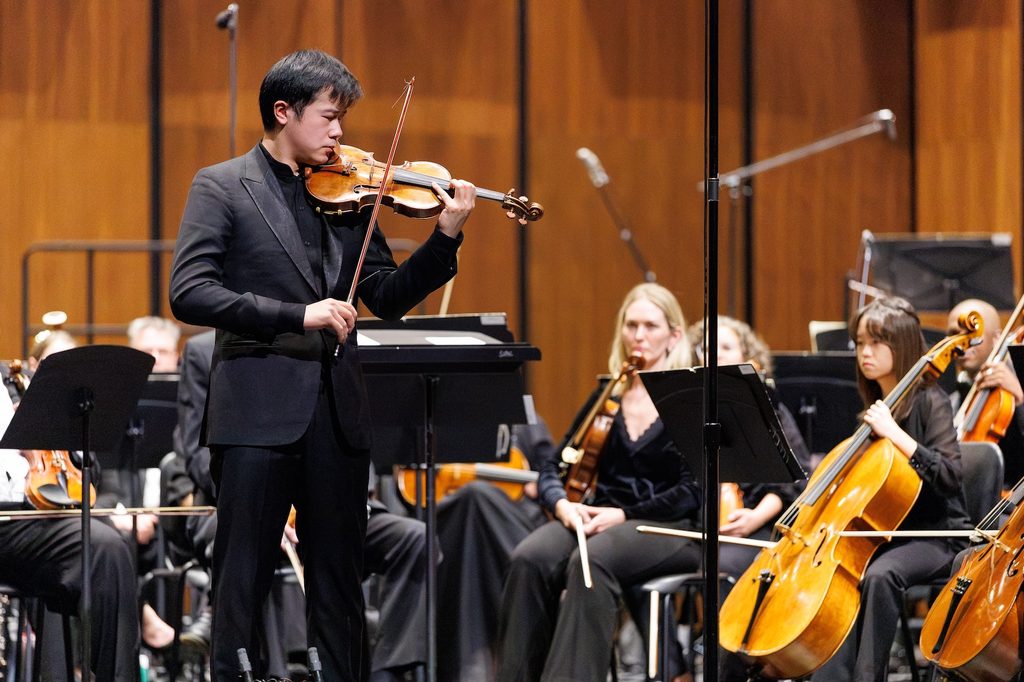
Zhu knows how to communicate with the orchestra and how to sit just on top of it so that he commands the melody while still seeming only to emerge from the ensemble as an amoebic pseudopod, protruding from but never breaking out of a larger organism. That awareness makes his solos seem less like delivering a dramatic monologue and more like an actor who knows how to command in the course of a group scene. Listening to him consciously downplay expected moments of intensity to make subsequent build-ups pay off all the more demands comparisons to Alan Rickman and Gary Oldman as much as to Itzhak Perlman.
The audience gave Zhu a rapturous standing ovation after just the opening allegro moderato. “And now for the second and third movements,” laughed Cheng from the podium.
Zhu closed, as is so often the case, with a solo encore. Normally, I detest the practice, but he’d chosen Paganini’s 24th Caprice, a personal favorite and one that I’d spent countless hours learning on the guitar. His virtuosity was such that murmurs of amazement arose from the crowd throughout, and it made for a satisfying listen.
The evening’s second half was devoted to Igor Stravinsky’s The Firebird, a far more dense and harmonically challenging piece than the preceding ear candy. I can find no fault in the performance, as the JCSO carried it off impeccably and with all the fiery passion it demanded. Nevertheless, I was yearning throughout for more from Civilization to the point that it colored my interest in Firebird’s far more familiar territory. As Smokey Robinson so astutely observed, a taste of honey is worse than none at all.
::

Jordan Owen began writing about music professionally at the age of 16 in Oxford, Mississippi. A 2006 graduate of the Berklee College of Music, he is a professional guitarist, bandleader and composer. He is currently the lead guitarist for the jazz group Other Strangers, the power metal band Axis of Empires and the melodic death/thrash metal band Century Spawn.
STAY UP TO DATE ON ALL THINGS ArtsATL
Subscribe to our free weekly e-newsletter.

PLEASE SUPPORT ARTSATL
Your Gift Sustains the Coverage You Count On!
Related Posts