Tim Davis’ ‘Normaltown’ marks a new era for The Warehouse: its first exhibition from outside its collection
When Tim Davis was 7 years old, his parents split and he moved to Athens, Georgia, from upstate New York. He, his mother and sister landed in the Normaltown neighborhood when his mother was hired as a librarian at the University of Georgia. In this new environment, he felt everything but normal: displaced, disoriented, foreign and poor. Around that time, someone gave him a Mickey Mouse camera; he began letting it lead him through situations he couldn’t otherwise handle. The camera gave him strength.
Only one photograph still exists from that time. It, among many of his other works, is now on view at The Warehouse on Atlanta’s Westside as part of his solo exhibition Tim Davis: Normaltown.
About three years after snapping that picture on his Mickey Mouse camera, Davis left Georgia. For decades afterward, he wanted to go back, but something always intervened. In one instance, he had a bus ticket in hand but broke his ankle playing basketball with the woman who is now his wife. He finally returned in 2019, and, for the next six years used his camera — a tool devoted to capturing the outside world — to reckon instead with his inner life. His discoveries from that time period now hang at The Warehouse, where they will be on view through January 9.
Tim Davis: Normaltown is a new approach for a space that has long shown only the private collection of John and Sue Wieland. For the first time, the organization has brought in an outside artist’s body of work, on loan rather than drawn from its holdings. It is also the first curatorial arrangement for Saskia Benjamin, director since September 2025 and a longtime arts administrator. The show offers a peek into Benjamin’s vision and the organization’s future.
“Tim was the ideal first,” Benjamin says. “Bring somebody from outside in.”

The Warehouse itself, plain and unassuming from the outside, surprises with its scale alone. It houses more than 375 works by nearly 300 local, national and international artists. The work orbits a single theme of house and home, with most pieces dating from the 1970s to now. The holdings run especially deep in photography. For more than a decade, the collection lived in the retrofitted former furniture warehouse, seen by invitation only.
In 2024, however, The Warehouse started opening its doors to the public one Saturday per month.
With dozens of distinct gallery spaces, The Warehouse scale makes it easy to mistake for a museum.
This cadence hints at what The Warehouse is — and isn’t. It has galleries, wall labels and docents, and the level of quality makes it easy to mistake for a museum.
“It’s an arts organization, so people more immediately want to compare it to something like the High,” Benjamin says. “But it’s a family-run business.”
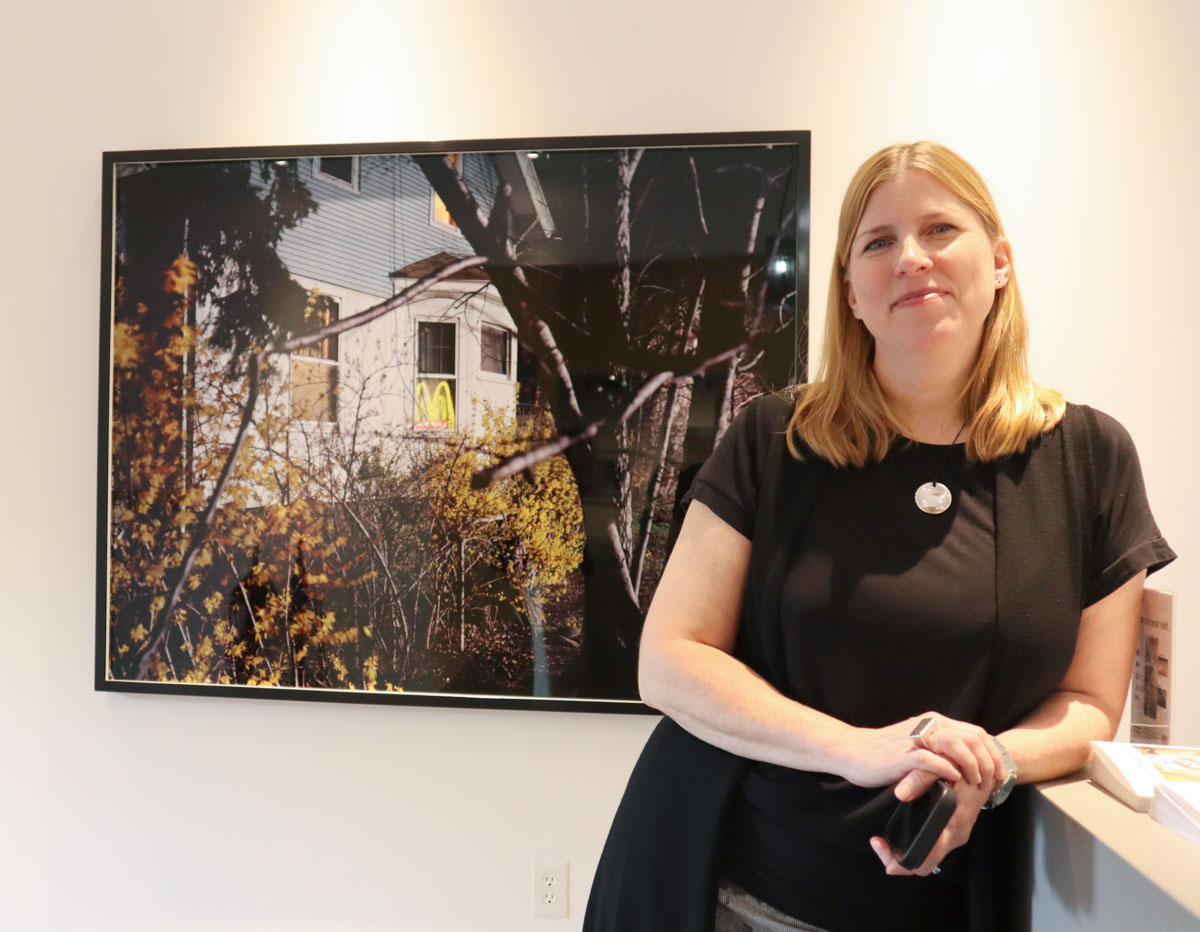
By Benjamin’s account, Davis arrived the way the best projects do: with pieces falling into place. She heard about his Normaltown project through a colleague who had worked with him on a commission in Kentucky. The body of work was published in a book from Atlanta’s Fall Line Press, with an album to go with it.
The timing felt like a sign. The Warehouse already owned a Davis photograph, which hangs right by the front door, and it had just come back from being reprinted after fading.
“His whole story was about homecoming,” Benjamin says, “and I was like, well, there we go.”
An exhibition hadn’t been part of Davis’ plan for the book. Benjamin called him anyway. She also asked him to choose pieces from the collection. He picked 12 works around the theme of nostalgia, each with its own narration, gathered as “A Walk with Artist Tim Davis” on the Bloomberg Connects app.
Visitors reach Davis’ show only after walking through the entire Warehouse collection, so by the time they arrive at the foot of Davis’ photography, they have digested the vocabulary for the Warehouse’s house and home theme.
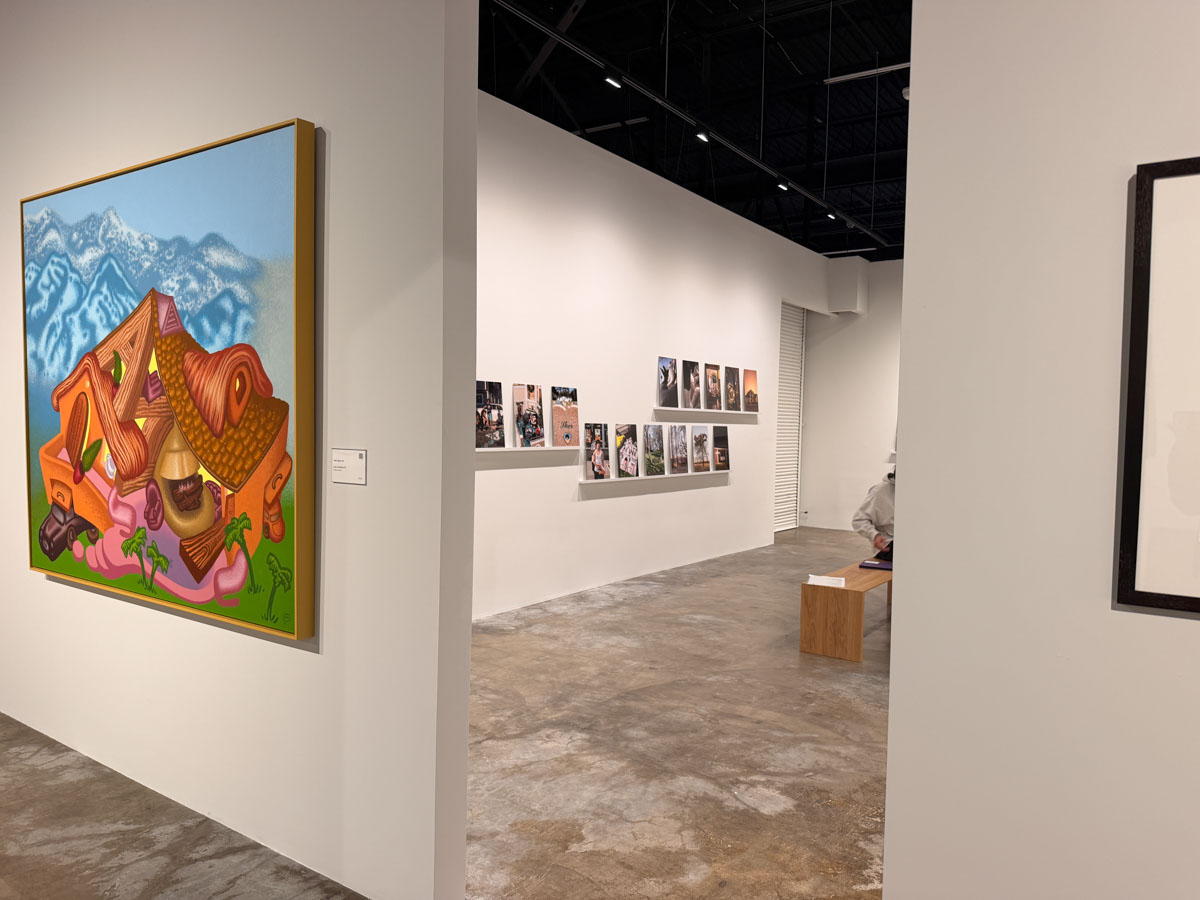
Davis’ photographs, dye sublimation prints on aluminum, glow under the brightest light in the building. The pieces are set along shelves modeled around his habit of displaying the records he and his friends are listening to. The room feels akin to a basement hangout, but nevertheless carries a sense of levity as a project born from loss.
Davis builds meaning through contrast: the everyday beside the extreme, a close detail beside a whole scene. McMansion Lit by Hydroponic Farm (2022) foregrounds the facade of a manicured, seemingly new home. It immediately calls to mind photographs of new construction by Atlanta artist Fredrik Brauer, who is also in the collection.
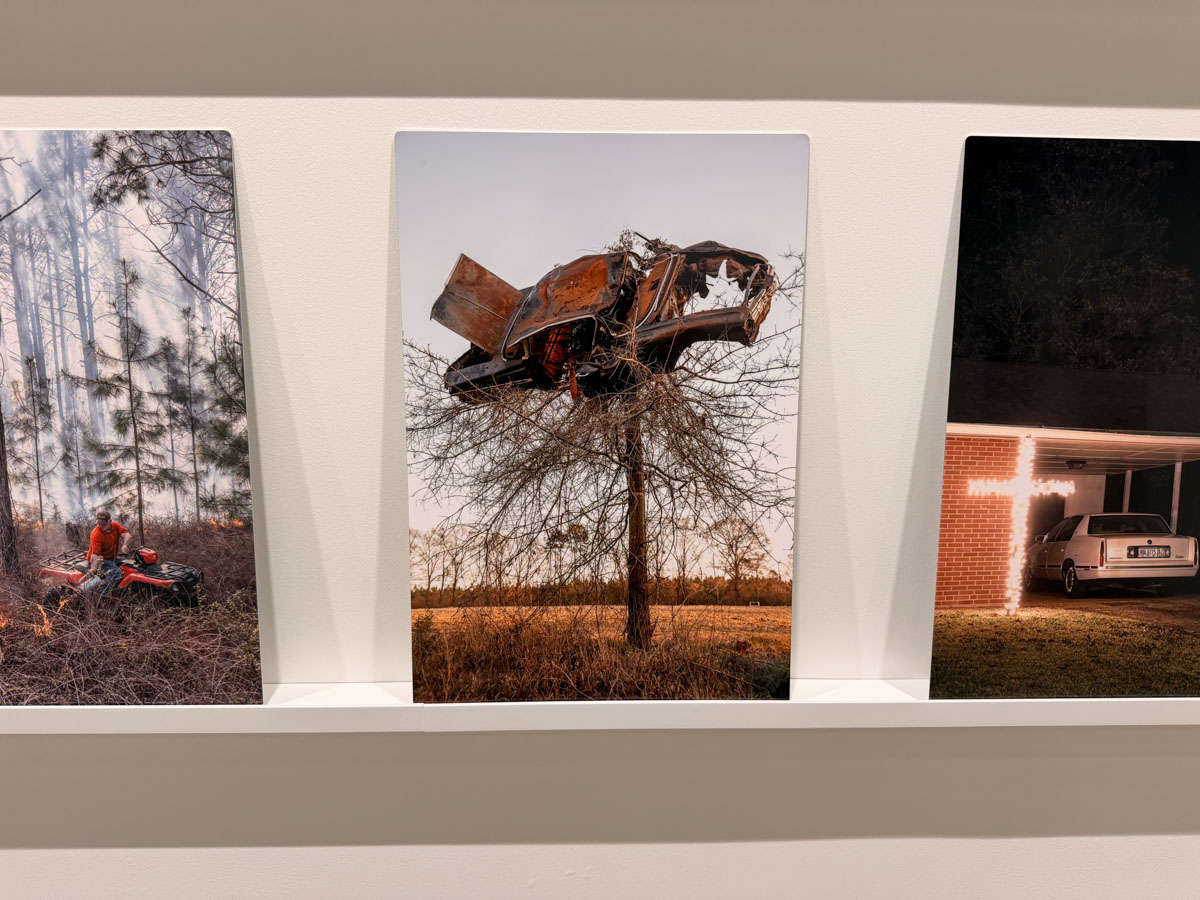
Car in Tree, Lumpkin (2022) shows the other end. Upstairs, in what Benjamin calls “the disaster room,” Mitch Epstein’s Biloxi, Mississippi (2005) depicts a tattered mattress. Textiles hang in storm-stripped tree branches, embedded in a scene of debris. Together, the two works reveal the building’s arcs: homes in structure and chaos at the start and end of their lives.
One of the more tender moments comes in Wonderful Life (2020), which was shot at an Athens screening of holiday classic It’s a Wonderful Life. Davis paired it with Nina Leen’s 1944 photograph Teenagers “Necking” in a Movie Theater from the collection. Both hold the same small-town energy, timeless and old-timey at once.
“The cinema is the only public religion I’ve ever taken part in,” Davis says in his app commentary.
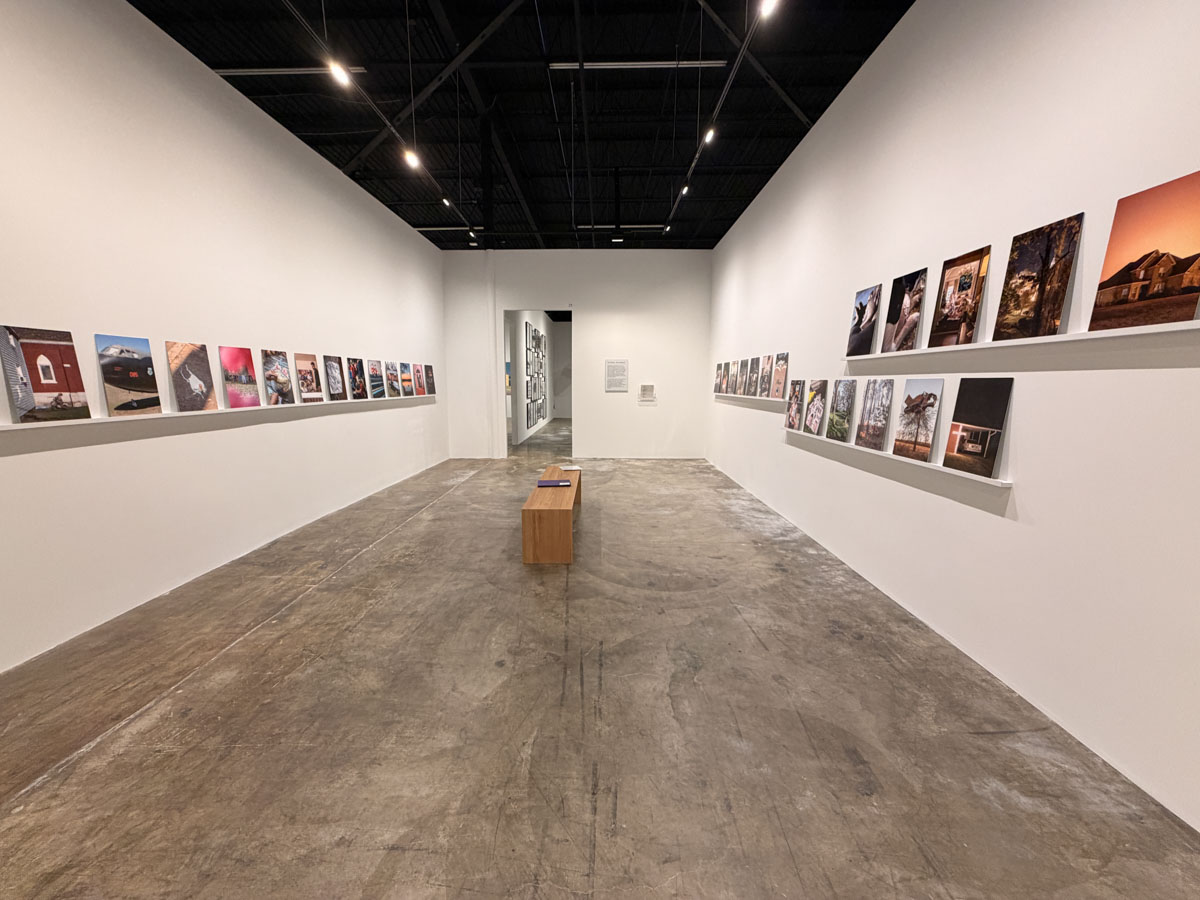
If anything holds back, it’s the installation. Elsewhere, The Warehouse stages its collection with gusto: rooms built to an artist’s specs, works that make a visitor feel enormous one moment and tiny the next. In a building full of adventurous hangs, one long run of shelves with same-scale prints feels restrained, especially for a body of work built on contrast. Varied sizes, or a few images set apart, might have let the heavier ones breathe in a more impactful way. Still, it’s an inviting first step for a collection learning to open up.
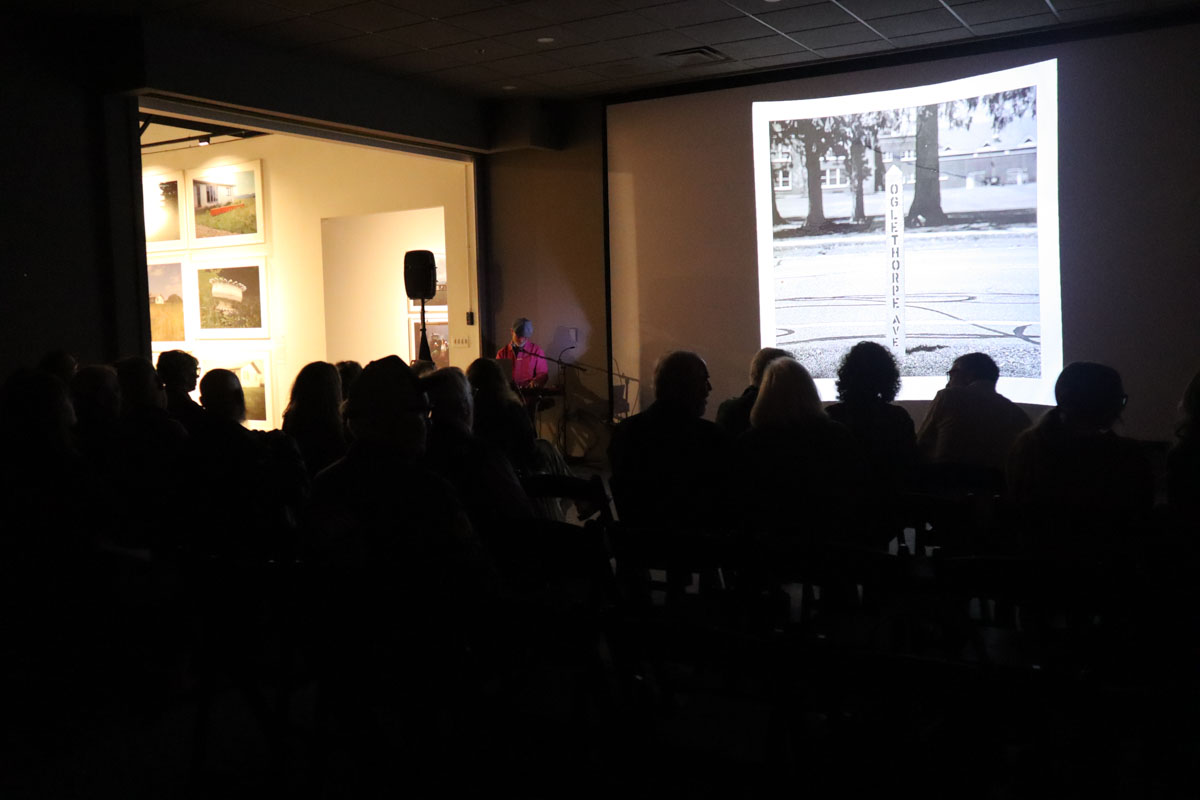
Asked for an artist talk, Davis had other ideas. He had been developing a performance built around the project’s album and had already staged it at Yale. As Benjamin tells it, his answer was that it was a musical. “I was like, OK, cool. Sure,” she says.
The October 24 performance played to an intimate room in The Warehouse’s theater. Most guests came by direct invitation: artists Benjamin thought would get something from hearing him, including collectors of his work, educators and the Fall Line Press crew. In a new move, the organization also opened the invitation to its email list. “He knows what he’s doing,” Benjamin says. “My job is to provide the platform and step back.”
Her case for a time-bound show is about urgency. A permanent collection invites passivity and feelings of, “I missed it this month, but it’ll be there next month.” An end date gives people a reason to come now. More temporary exhibitions will follow, Benjamin says, and one thing is certain: “The next one will not be a solo artist show.”
Normaltown is a show about finally going home. It’s a fitting first for a space that kept its doors closed for years and is now inviting people inside.
Tim Davis: Normaltown is on view through January 9, 2027, at The Warehouse, 1643 Chattahoochee Ave. NW. Open to the public 10 a.m. to 5 p.m. on the second Saturday of each month, with docent tours at 10:30 a.m. and noon. Admission is free; reservations are required only for groups of 10 or more. Children under 10 are not permitted.
::
Jasmine Hentschel is the founder and publisher of GULCH magazine, an independent print publication archiving Atlanta’s visual arts and culture scene. A digital designer and creative strategist, she launched GULCH to spotlight local artists, build community and explore the economics of Atlanta’s creative ecosystem.
STAY UP TO DATE ON ALL THINGS ArtsATL
Subscribe to our free weekly e-newsletter.

PLEASE SUPPORT ARTSATL
Your Gift Sustains the Coverage You Count On!
Related Posts