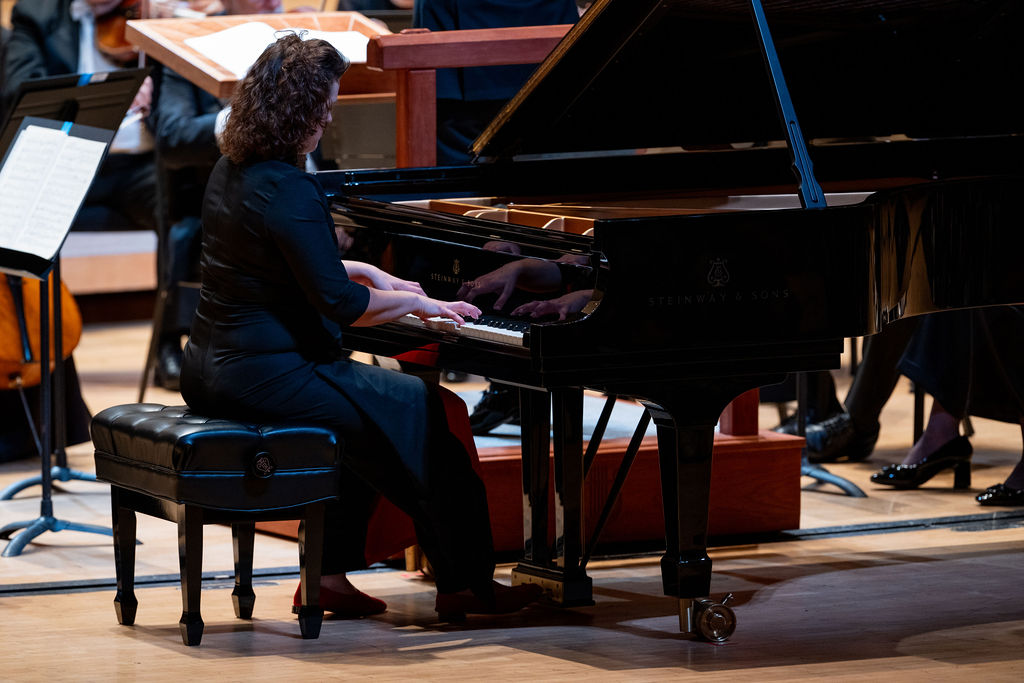
Anna Geniushene shines again as ASO takes on Schumann and a lengthy Bruckner
The pianist and artist-in-residence is as captivating performing Schumann’s Piano Concerto as she was with his friend Brahms.
::
The Atlanta Symphony Orchestra’s November 19 concert, an evening of Robert Schumann and Anton Bruckner, proved to be engaging and effective, even as the latter composer’s Symphony No. 5 in B-flat major strained attention spans in its prolonged grandiosity. Nonetheless, this proved to be one of the ASO’s more satisfying recent evenings.
Opening with Schumann’s Concerto in A minor for Piano and Orchestra, Op. 54, the evening echoed the ASO’s November 5 performance with the Bach opener that featured a smaller, less encumbered orchestra delivering a cheerful and fluid first act. But a more direct reference came in the form of a returning champion, pianist Anna Geniushene, who had been on hand for the earlier concert. That performance had seen her tackle Johannes Brahms — to great effect — and, as such, the return for Schumann seemed entirely appropriate.
Most classical enthusiasts know the legendary Schumann/Schumann/Brahms love triangle to the point that it scarcely needs repeating, but, in summary: Young Robert Schumann, then a law student yearning to pursue music full-time, meets Clara Wieck, his piano teacher’s 11-year-old daughter, who becomes his friend and muse. They become engaged on her 18th birthday and then fight a furious legal battle to overrule the objections of Clara’s father. Years of matrimonial bliss follow, and Robert Schumann begins mentoring Johannes Brahms, who becomes equally smitten with Clara. Robert suffers a mental breakdown and goes to live in an asylum. Brahms moves in to help Clara with domestic duties while wrestling with feelings for his best friend’s wife, and, like sand through the hourglass, so are the days of their lives.
It’s the sort of limerent entanglement that would make Danielle Steel proud, but, as it relates to the current moment, I couldn’t help but think that Geniushene formed a sort of performance art tesseract between the two nights. In my commentary on her previous performance, I’d commended her ability to handle the brash, often chaotic passages with a precision that seemed to be taxing her considerably.
My thoughts were brought back to that embodiment of the manic fury at the heart of Brahms in the way Geniushene handled the strident opening piano phrases. It was as if a synaptic passage had opened between the two composers by way of a pianist who understood how the telepathic interplay of their deep friendship and conflicted hearts intersected.
Schumann’s Concerto in A minor precedes the association with Brahms, but the conceptual through line presented by Geniushene remains valid nonetheless: that hint of chaos that undergirds the majesty and melodicism of both composers. It’s overt in Brahms and sublimated in Schumann but readily apparent in both of them.
Beyond her handling of the solo sections, Geniushene seemed cognizant of the fact that much of the piano’s appeal in Schumann’s concerto is down to how it interacts with the larger ensemble. The rapidly cycling arpeggios that surround and intersect with the orchestra are a ballet in a wilderness of strings and horns, and the delicate ebb and flow of those cyclical runs was as captivating as the commanding solo sections.
Thus, Geniushene is two for two in my book and a presence I will always welcome back to the ASO stage. The evening’s second half, though masterful in its execution, stumbled only in performing a piece that is pompous and exhausting when played in full.
Buckner’s Symphony No. 5 in B-flat major is full of brilliant moments, but laid end-to-end, they get lost in a sea of disjointed peaks and valleys. Most appealing in the piece are these dramatic, monstrous buildups in the overall intensity that seem to swell up before we’ve fully comprehended what’s happening. It’s like being in the presence of someone who is seething with anger, and we don’t fully realize what is happening until moments before they explode.
The ASO handles those moments with extraordinary clarity, and tonight it was as mesmerizing as it was intimidating to hear. It’s not the playing of instruments with furious abandon but the masterwork of layered restraint that eventually boils over.
Those sections almost justify performing the work in its entirety — but only almost. The problem with the piece as a whole is that three of the four movements open with adagio sections. The result is a heavily disjointed work that seems to start from scratch again and again. From a listening standpoint, this is exhausting: Instead of feeling like we are ascending a single mountain, we are made to do it over and over again, climbing ever higher and with less stamina each time.
Thus, the only real critique of the evening was the full performance of such a draining piece. Selections would have sufficed; the last two movements are easily the most captivating.
Taken as a whole, the concert was a refreshing return to form for the ASO. As much as I’ve recently questioned whether its adherence to the classics in their post-Robert Spano incarnation has left it stagnating, tonight had me wondering if the real issue might be the mono-focused deep dives into the full catalogs of single composers (first Beethoven and now Brahms). The ASO thrives with variety, as tonight clearly evidenced.
::

Jordan Owen began writing about music professionally at the age of 16 in Oxford, Mississippi. A 2006 graduate of the Berklee College of Music, he is a professional guitarist, bandleader and composer. He is currently the lead guitarist for the jazz group Other Strangers, the power metal band Axis of Empires and the melodic death/thrash metal band Century Spawn.
STAY UP TO DATE ON ALL THINGS ArtsATL
Subscribe to our free weekly e-newsletter.

PLEASE SUPPORT ARTSATL
Your Gift Sustains the Coverage You Count On!
Related Posts