
Steve on TV: Guillermo del Toro’s return to form and a hysterical weirdo
Also, a show Pete Hegseth called “woke garbage,” while Hollywood tries really hard to make Glen Powell happen.
::

Toxic daddy issues get a high-Gothic workout in Frankenstein, the Mary Shelley novel that’s been a touchstone for all of writer-director Guillermo del Toro’s films. Coming to Netflix on November 7 and currently in theaters, his adaptation is largely faithful in spirit to the 1818 book, while advancing the action three decades into the Victorian era. Into this period brocade, it weaves relevant 21st-century threads of intergenerational trauma. It’s a horror show, a bloody visual feast and, in its last moments, a moving study of remorse and forgiveness.
Oscar Isaac plays defiant scientist Victor Frankenstein. He tells his side of the story from a ship icebound in the Arctic, besieged by the nameless monster he stitched together from stray body parts and animated in his lab. (The spectacular production design is by Tamara Deverell.)
Obsessed with being, as the novel’s subtitle puts it, a modern Prometheus, he admits, “I never considered what would come after creation.” In the wake of Victor’s victorious re-animation experiment, he becomes an extreme version of a first-time father, gazing in dismayed exhaustion at the household chaos caused by a newborn.
In this case, that baby is the 6-foot-5-inch Jacob Elordi, giving a physical performance that deftly balances the adorable first discoveries of an infant with all the peril of a giant, muscular man. Victor’s failure to connect with his creation, followed by his cruel rejection, is the movie’s melancholy engine.
In the second half, Elordi’s Creature tells his side of things. As he escapes to a forest, the movie draws on fairy tale imagery from illustrator Gustave Doré and the Romantic landscapes of painter Caspar David Friedrich. It’s here, hiding in a farming family’s home, that the Creature learns to read (Paradise Lost is a key text) and observes the human kindnesses his creator never showed. His horrified realization — that he’s a “child of a charnel house” — is countered by the old blind patriarch’s reassurance, “You are my friend.”
The film’s strong cast includes double Oscar winner Christoph Waltz as Victor’s chief benefactor and Mia Goth as Elizabeth, a true Goth girl. Her character is given more edge and agency by del Toro than by the novel’s own 18-year-old author, Shelley. But Elizabeth’s unlikely bond with the Creature works more as a great idea; onscreen, Goth and her director never quite sell it. Minor flaw.
While it won’t supplant my personal favorites (The Devil’s and Backbone Pan’s Labyrinth), Frankenstein is a return to form for del Toro, following accomplished but meh films like The Shape of Water and Nightmare Alley. It’s a signature fusion of blood, brains and heart.
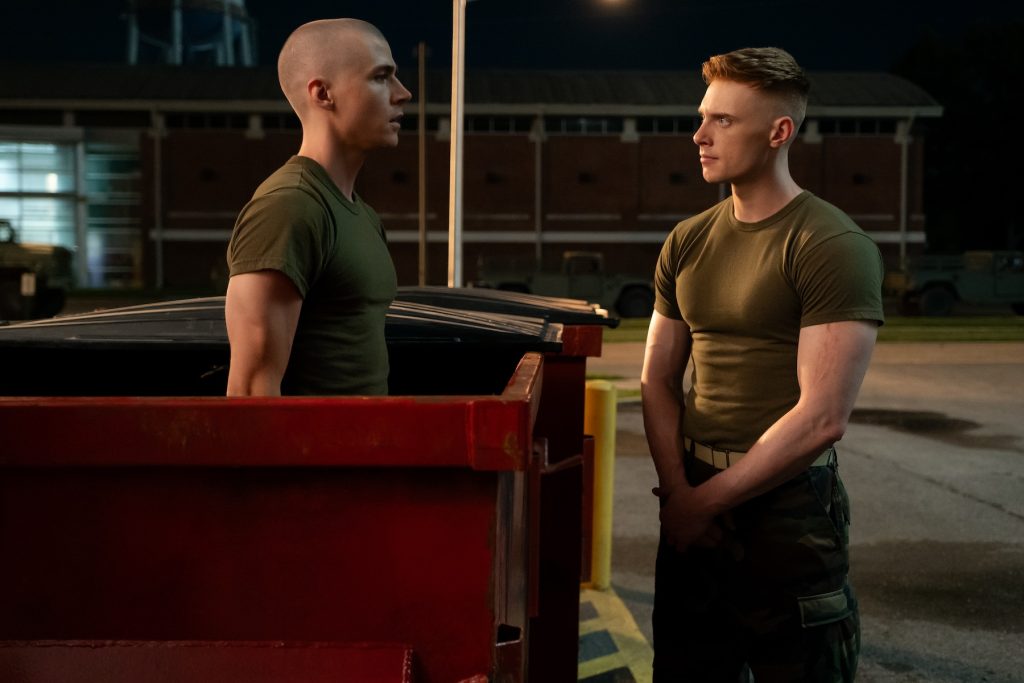
Also on Netflix, based on Greg Cope White’s 2015 memoir The Pink Marine, the Netflix boot-camp drama Boots has provoked the expected, macho pearl-clutching from Pete Hegseth’s Pentagon, calling it “woke garbage.” The irony is, the show is fundamentally a tribute to the camaraderie and rigors of Marine life. White himself didn’t just go through training; he served six years as a sergeant in the Corps during the 1980s, when a whisper of same-sex interest could get a soldier sacked. He knows the territory. That means that Boots inevitably dramatizes one big paradoxical fact about military life: It’s innately a very homoerotic environment, but perforce a homophobic one. (The word shouted the most in training is “kill,” after all, not “kiss.”)
Miles Heizer plays White’s stand-in, Cameron, an 18-year-old Texas boy raised by a flighty, self-absorbed single mom (Vera Farmiga). Encouraged by best buddy Ray (Liam Oh), the only friend who knows he’s gay, Cameron signs up for the 13-week Marine boot camp at Parris Island. It’s 1990, years before even the weak-kneed compromise Don’t Ask Don’t Tell policy. Cam has to be super-careful where his eyes wander, especially in the communal showers.
As the enlistees compete and bond under the rigorous physical and psychological challenges of the camp, Cameron’s chief antagonist arrives in the form of drill sergeant Sullivan (Max Parker), a fierce, sculpted martinet who prowls through the hallways with a precision poised between automaton and panther. He’s the physical epitome of the Marine ideal. And you can pretty much guess his big secret before it’s fully revealed.
Dramatically, Boots has some core weaknesses. It builds up one character to the proportions of a dark angel, torn by operatic conflicts with his sexuality, identity and duty, then … literally removes him from the playing field. Likewise, the show can’t decide if Farmiga — wonderful and underused — is comic relief, flawed heroine or villain. Also, the yo-yo movement between friendship and antagonisms among the boot camp grunts (primarily Cope, Ray and a latecomer named Jones) becomes repetitive. But you could argue that the yin-yang vacillation and the built-in contradictions of military life might be a feature of the show and not a bug.
HULU
It was shot in Atlanta, so I was really wanting to root for Chad Powers. Based on a series of short films starring Eli Manning (who cameos in episode 3), it stars Glen Powell as Russ Holliday. A spoiled quarterback, he gets canceled after blowing the Rose Bowl for his team and knocking over a kid in a wheelchair on the sidelines. Eight years later, after life on the celebrity D-circuit (hello, Masked Singer), he plots an improbable career revival. Using prosthetics he swipes from his dad, a Hollywood makeup artist, and putting on a bad Southern accent, he presents himself as one Chad Powers. (The disguise is as convincing as Clark Kent’s glasses.)
Showing up for a players’ open call at a fictional Georgia college, Russ/Chad makes the team. He manages to fudge the fact that he’s not an enrolled student with the help of team mascot Danny (Frankie Rodriguez) and the coach (Steve Zahn, whose bottled mania is underserved by the so-so scripts). Plus, of course, there’s the obligatory coach’s daughter, Ricky (Perry Mattfeld), who might as well be wearing a Prickly Love Interest T-shirt.
Chad Powers wants to be a mashup of Mrs. Doubtfire (Russ drives past a poster for the film while driving around his dad’s studio lot) and especially Ted Lasso. It plays as artificially engineered as that sounds. I gave up halfway through the six episodes. But as Tricia, entitled chair of the team’s booster trust (and a Southern variant of Hannah Waddingham’s soccer team owner on Lasso), Atlanta native Wynn Everett brings boozy, deep-fried flavor to her scenes.
As for star Glen Powell … well, for me, he’s a lot like the wannabe catchword “fetch” in Mean Girls. He’s the latest actor the Hollywood hype machine keeps insisting is The Next Big Thing. OK, he’s agreeable enough, but I’m not buying it. Or his show.

NETFLIX
Every couple of months, I’ll have what I call a process nightmare — a convoluted dream that requires me to perform certain tasks (solving formulas, arranging objects) that I don’t completely understand and fail to complete on a deadline. Those dreams are exhausting. So is A House of Dynamite.
The Hurt Locker’s Oscar-winning director Kathryn Bigelow, working from Noah Oppenheim’s bare-bones script, throws us into a regular morning (the characters are presented in vigorously “normal” tableaux, chatting about last night’s game and rushing through breakfast) when hell breaks loose. A nuclear missile is detected heading to the U.S. Midwest, launched from somewhere in the Pacific. There’s only 20 minutes for the nation’s leaders to deflect, destroy or answer its destruction with world-ending strikes of our own. Those 20 minutes play out from three different viewpoints; each of the movie’s segments ends before the bomb explodes. It’s a case of destruction interruptus. And it’s a lousy viewing experience, possibly because it is made with tremendous directing skill and a sterling cast that includes Rebecca Ferguson, Idris Elba, Jared Harris, Greta Lee, Jason Clarke and Kaitlyn Dever — all the actors working very hard to make an impression against the movie’s machinery.
The problem is, there’s nobody to invest in and no resolution. Panic is the whole point. The movie is all talking heads, shouting out military jargon and D.C. acronyms most viewers won’t understand. In all three depictions of the same scenario, the chain of command and “failsafe” weaponry that are supposed to keep us secure buckle under the stress. The film’s fictional administration is a relic of the recent past, with undamaged branches of government, led by a sane president (played by Elba). Considering how an actual nuclear crisis might play out in the Washington that has been compromised over the last 10 months, House is a nightmare in ways Bigelow and her collaborators never intended.
The Netflix documentary The Perfect Neighbor has earned more buzz than it can easily sustain. Captured mainly from police officers’ bodycams, CCTV footage and interrogation room cameras, it follows the two-year story of a paranoid white woman in Ocala, Florida, named Susan Lorincz, who called the police nonstop about neighborhood kids, all Black, who played on the street in front of her rental home. The kids, understandably, referred to her as The Karen. One night, Lorincz shot one of the kids’ mothers, Ajike Owens, dead through a closed door.
The documentary is an indictment of the ways Florida’s “stand your ground” law can be wielded as a justification for excessive force. And yes, when Lorincz is arrested after the shooting and then released on bond, Black friends of Ajike say, “If it was us, we would be in jail.” More than an exposé of societal racism, though, for me, Neighbor underscores a couple of other problems.
It’s an object lesson in the ways basic civility has eroded. Neighbors no longer understand the responsibilities (and joys) that come with being neighborly. There’s also a delusional element to Lorincz that makes me think the film is about another, unaddressed crisis: adequate, well-funded support for those with mental issues. The lady was/is clearly sick. It’s a sad story all around.

So is The Woman in Cabin 10, for totally different reasons. After the disastrous adaptation of The Woman in the Window starring Amy Adams, and the Kristen Bell spoof The Woman in the House Across the Street from the Girl in the Window (both Netflix films), I sorta thought we’d be done with these based-on-bad-airport-books Woman movies.
Keira Knightley stars in the latest, based on a Ruth Ware novel. She plays Guardian journalist Laura Blacklock, who prides herself on writing about serious topics like the plight of Kurdish women. She suspends that pride to go on a cushy junket, sailing in a private yacht with billionaire couple Richard and Anne Bullmer (Guy Pearce, in the latest rich-heel role, and Lisa Loven Kongsli). Their destination is Norway, where Anne — dying of leukemia — plans to announce a new cancer-research foundation. Only … in private, Anne tells Laura she has other plans for her money. Shortly after that, Laura thinks she sees an unknown woman pitched overboard in the middle of the night. But nobody believes her.
Those fellow passengers include a louche rock star, other rich jerks (including Ted Lasso’s Hannah Waddingham) and Laura’s ex-boyfriend, a playboy photographer (David Ajala). There’s also a physician on board (Art Malik), who perpetuates the theory that Laura is suffering from journalistic PTSD.
And so, for much of the movie, she’s treated like a hysterical weirdo. (You can’t blame them; Knightley cranks her performance to 11.) Nobody believes her story. And that, I guess, is the secret power of these narratives, in a world where women may feel gaslighted by the men and colleagues around them, claiming their observations or feelings are somehow wrong. Fair enough. Just give me a better plot and a believable character in the next inevitable entry in the Woman series.
I didn’t have room to go into them, but if you’re looking for other things to binge, I recommend HBO Max’s Task, the latest from the creator of Mare of Easttown (set again in the heavily accented patch of Pennsylvania where people eat at Wawa and go to “fahder-dorter dances” at the high school); director Rebecca Miller’s five-part Apple TV+ documentary Mr. Scorsese, about the great man who directed her husband Daniel Day-Lewis a couple of times; and Hulu’s The Lowdown, the savory, Tulsa-set Ethan Hawke mystery, wrapping up its eight-episode run on November 4.
::
Steve Murray is an award-winning journalist and playwright who has covered the arts as a reporter and critic for many years. Catch up to Steve’s previous column here.
STAY UP TO DATE ON ALL THINGS ArtsATL
Subscribe to our free weekly e-newsletter.

PLEASE SUPPORT ARTSATL
Your Gift Sustains the Coverage You Count On!
Related Posts