Review: Music, dance tell doomed love story in Atlanta Baroque’s ‘Dido & Aeneas’
In theater, as in life, you can often point to a moment when a love story turns tragic, of words misunderstood or promises broken. In the Atlanta Baroque Orchestra’s production of Henry Purcell’s opera Dido and Aeneas, the romance starts to unravel after a goth drag queen sings the fate-sealing line: “The Queen of Carthage, whom we hate!”
In a deliciously over-the-top scene, our Morticia Addams-like sorceress and her evil witches plot against the legendary Dido in her doomed affair with Aeneas, a hero of Troy.
Celebrating its 25th anniversary, the ABO partnered with the contemporary dancers of staibdance and with Georgia State’s University Singers for a delightful production of Dido and Aeneas. The ABO billed the show as the period-instrument ensemble’s “most ambitious project to date” and performed it twice over the weekend at Emory’s Glenn Memorial Chapel, repeating this evening at Spivey Hall.
The late 17th-century opera is lean and lasts about an hour. Its origins and intended audience — the king? A girls’ school? — are murky. There are just a few characters, and it can be effective with minimal staging and decor. In the ABO production, with staibdance founder George Staib as stage director and co-choreographer, the action unfolded smoothly and with smart attention to detail. In casting and attitude, the show zipped along with youthful vigor — fresh, energetic and fun.
Nahum Tate’s libretto tells a poignant variation of an eternal story: A woman is loved and abandoned by a foreign military man who prizes duty over honor — from Ariadne and Theseus in Greek mythology to Puccini’s Madama Butterfly in the 20th century. Whatever his true motives, the guy is invariably a selfish cad, and the woman, now stripped of virtue, has no life worth living.
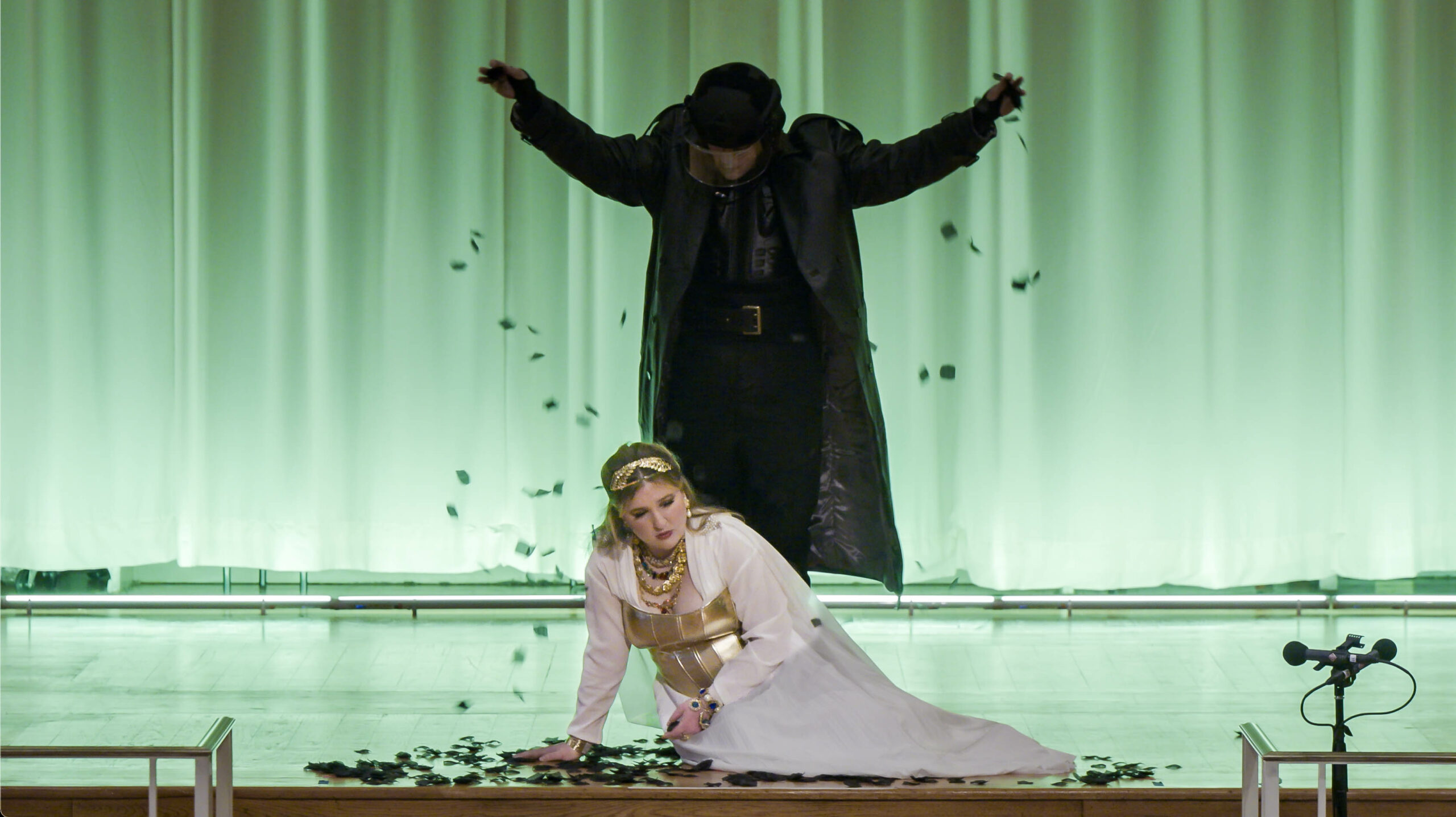
That’s where Purcell’s Queen Dido begins the opera: a sad woman already tormented by her fate. Soprano Hannah De Priest, making her debut in the role, offered an endearing, broken Dido — even before she actually yielded to Aeneas’ advances. De Priest’s voice is supple, focused and lovely in her middle range, where most of the role sits. Noble in character and voice, she connected the opera’s beginning with its end.
In her final lament, “When I am Laid in Earth” — one of the most famous arias in the history of opera — she articulated Dido’s plea, “Remember me, but ah! forget my fate” with tender pathos. De Priest’s lyrically crisp enunciation, especially the “t” consonant in the word “fate,” somehow made her suffering all the more vivid. (Across the evening, Glenn Chapel’s acoustic made it difficult to catch all the words. But De Priest’s articulation cut through the sonic reverberance.)
Michael Galvin, with a booming bass voice, effectively stole the show as the jumbo-sized drag-queen sorceress. Wearing a comically vulgar black skin suit with a long black wig and stiletto heels, he towered over everyone in height and sang with a voice twice as large. Galvin is a fast-rising opera singer on traditional stages and, as a club persona, performs as the burlesque character Donatella Fermata. Here, for the first time, he combined both sides of his art in one unforgettable character. When Galvin was on stage, you thought it would surely be impossible to hear or see it done better. (John Merritt and Sheri Latham designed the memorable costumes, often with surprising fashion combinations and imagery drawn from many eras, from antiquity to the go-go ’60s to today’s pop culture.)
But the opera’s real villain isn’t the sorceress and her trickery but our hero Aeneas. Brian Giebler, with a bright tenor voice, strutted on stage as a bad boy, a sort of Mad Max motorcycle punk with a face tattoo, sneering and callous. As he seduced Dido, you sensed his insincerity, even as the scene was charmingly presented: As the lovers sat together, Daniel Swenberg, playing a Baroque guitar, walked across the stage to serenade them. Still, Geibler’s manner and singing suggested that Dido would not be his last conquest.
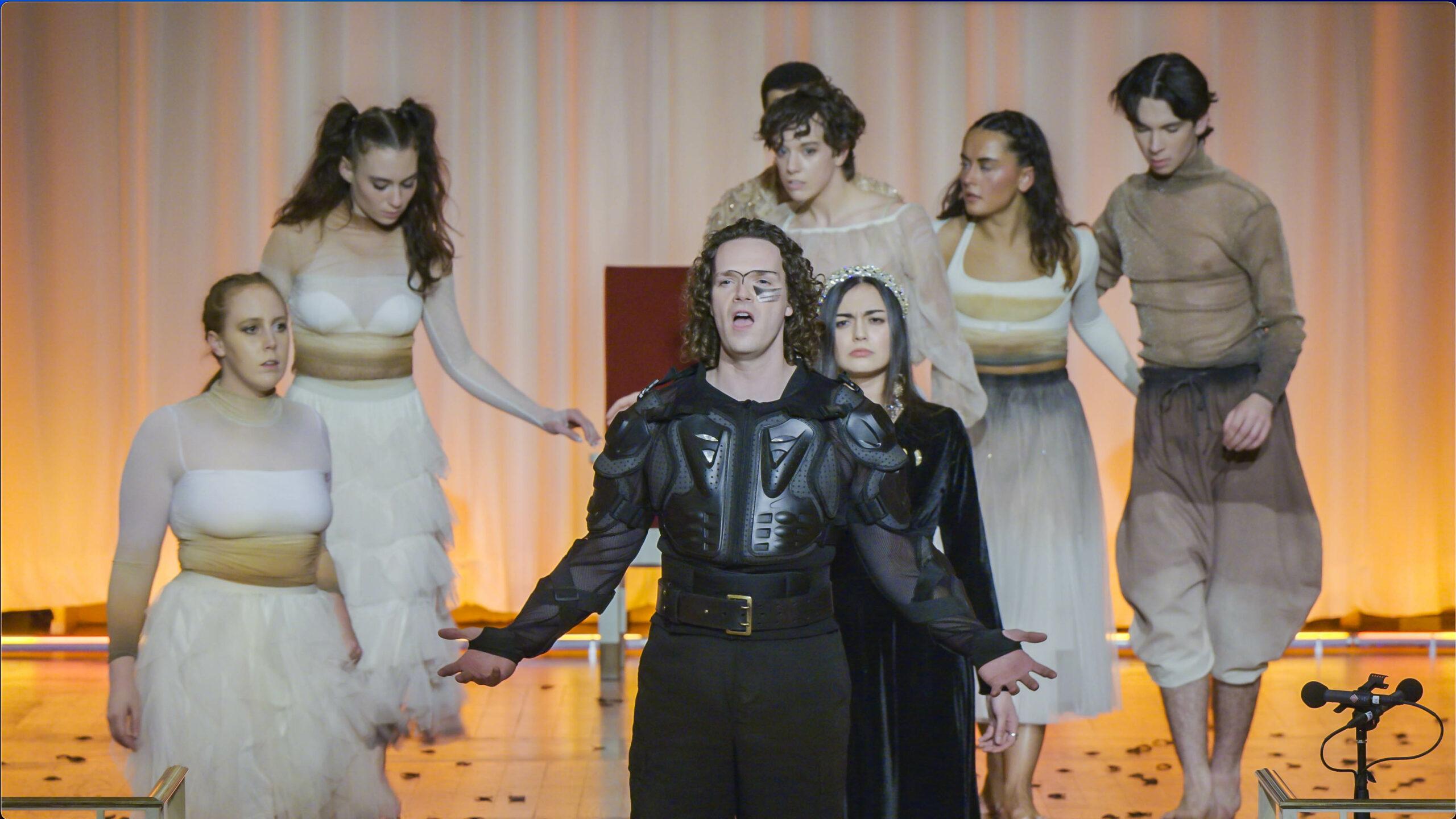
In George Staib and Sarah Hillmer’s choreography, the six members of staibdance, some of them talented students, danced an elegant combination of Baroque, ballet and athletic, free-flowing contemporary styles. They were often at their most compelling when expressing the characters’ emotions and psychological states. The standouts were Bailey Jo Harbaugh and the troupe’s two young men, Zac Pritts and Henry Koskoff, who were the most crisp and graceful in movement as well as most attuned to the music.
The orchestra was led by ABO Artistic Director Julie Andrijeski, a violinist who’s also a noted Baroque dancer. The ensemble’s casual virtuosity and tight rhythmic sense gave the music a springy, dance-like physicality. Across the performance, everything felt organic and flowing.
Another key element of the evening’s success came from the smaller singing parts. Dido’s attendant, Belinda, gets many of the opera’s most hummable tunes, and soprano Andréa Walker sang them beautifully, with clarity and poise. The two witches, Wanda Yang Temko and Morgan Watts, snarled and cackled with malicious delight.
The 12-voice chorus, prepared by Deanna Joseph, was superb in look and sound. Dressed in velvety black and alert to the stage action, they’d sway to the music and react to the drama, turning their heads to watch the dancers in motion or gawking in shock as Aeneas fled the stage. A young soprano, Juliana Bolaño, stepped out of the choir to sing the Spirit, one of the evening’s many enchanting moments.
::
Pierre Ruhe was the founding executive director and editor of ArtsATL. He’s been a critic and cultural reporter for the Washington Post, London’s Financial Times and the Atlanta Journal-Constitution and was director of artistic planning for the Alabama Symphony Orchestra. He is publications director of Early Music America.
STAY UP TO DATE ON ALL THINGS ArtsATL
Subscribe to our free weekly e-newsletter.

PLEASE SUPPORT ARTSATL
Your Gift Sustains the Coverage You Count On!
Related Posts