
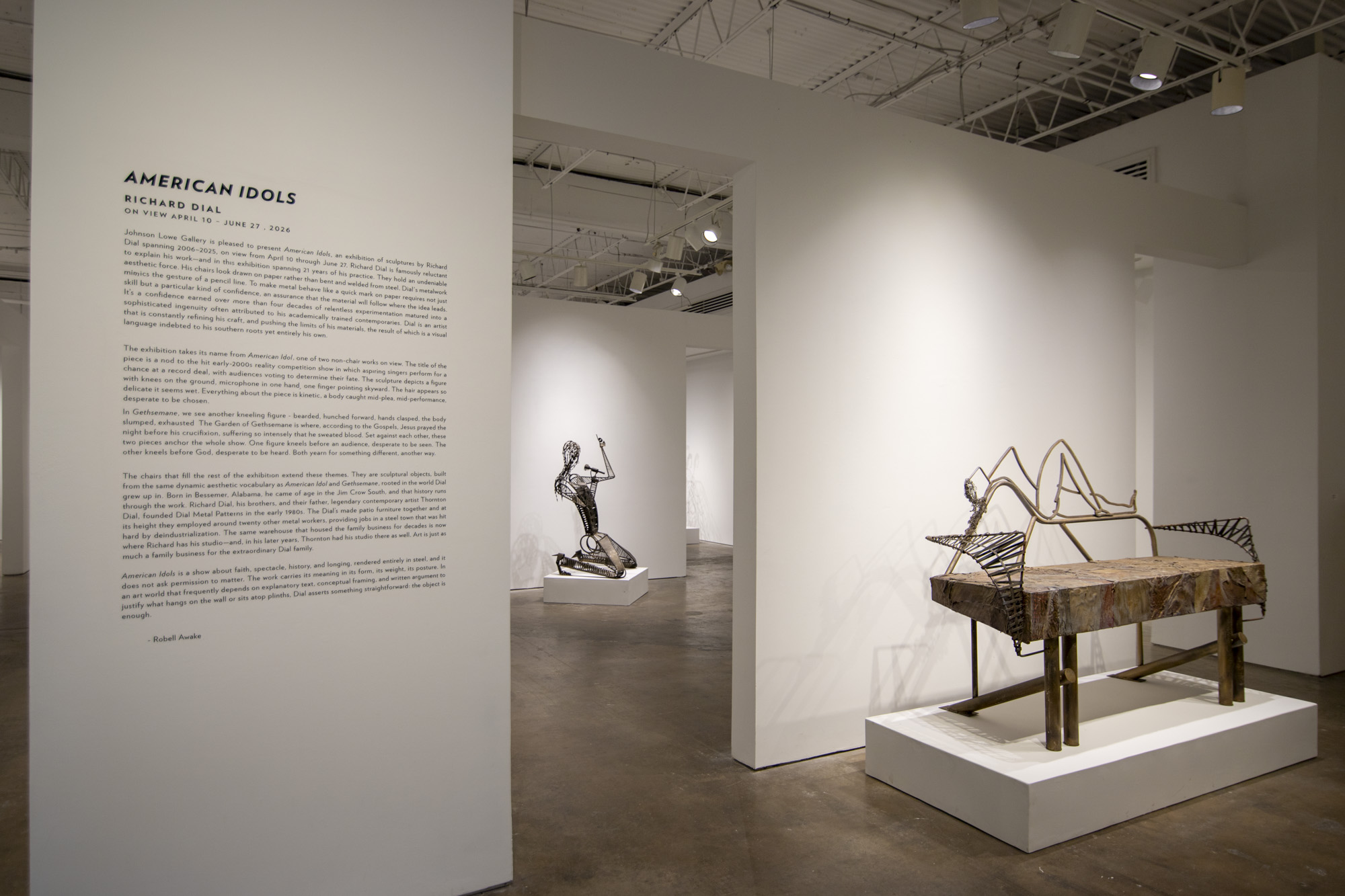
Bent steel, twisted metal: the visual language of Richard Dial at Johnson Lowe Gallery
Johnson Lowe Gallery presents American Idols, an exhibition of works by Richard Dial, on view now through June 27. The collection features steel and fabric sculptures spanning two decades of the artist’s life. The son of famous late American artist Thornton Dial, Richard shares some aesthetic and material similarities with his father, though expressed in a style that is uniquely his own.
The show takes its name from one piece in particular, American Idol, which features a figure that is on its knees, holding a microphone. Inspired by the hit television series, the character — rendered out of welded and bent steel — appears to be singing, its curled ringlets of hair delicately cascading over its shoulders while pointing one finger up to the sky, triumphant.
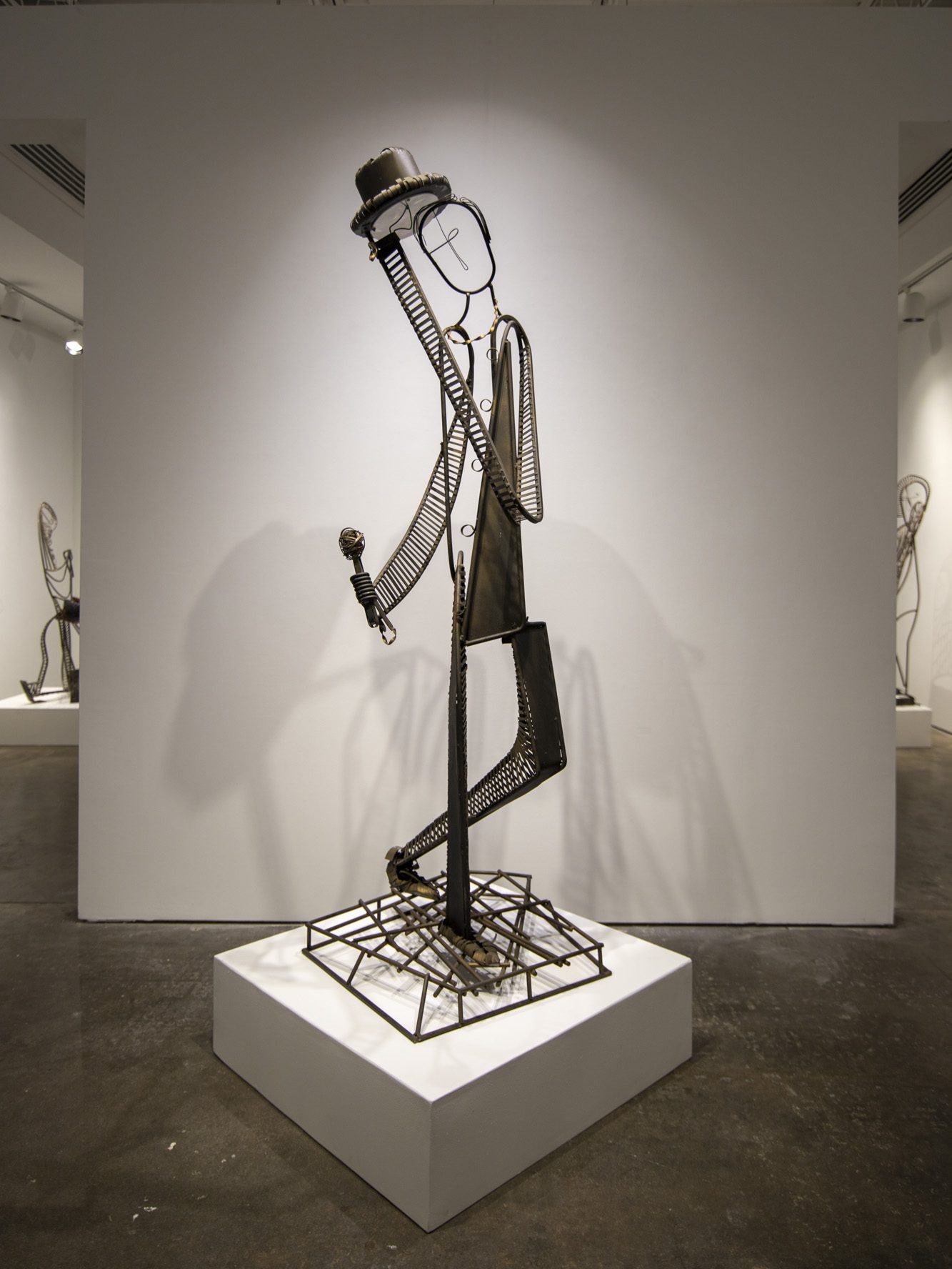
The only other non-chair sculpture in the space is Mr. Bojangles, also a musician, who tips his hat as if to thank an audience for listening to a performance he had just concluded. Meticulous steel bands comprise the figure’s arms and legs, interspersed with solid steel plates in some areas. Motion is, in this piece, undeniable. His pose is jaunty and confident, though the simplified face lacks some of the detail of other sculptures. In a way, the negative space in Mr. Bojangles’ face makes it especially impactful, as it is easier to imagine the faces of any number of real, living musicians in its place.
One of my favorite pieces in this exhibition is undoubtedly Looking Back, an oversized steel and burlap chair that appears to casually lean to one side as if captured in mid-conversation. The sculpture’s legs are wrapped with ribbons of steel, and a bristly texture is wound around the structure of the figure’s back. Its hands grasp the armrests, thick steel rods bent to resemble human fingers. One of the most charming aspects of this piece is the head and face, which are considerably smaller and out of proportion with the rest of the sculpture. A curly mop of steel hair adds to the piece’s personality, while its open mouth and small eyes lend a comical scale that made me feel instant affection for this curious figure.
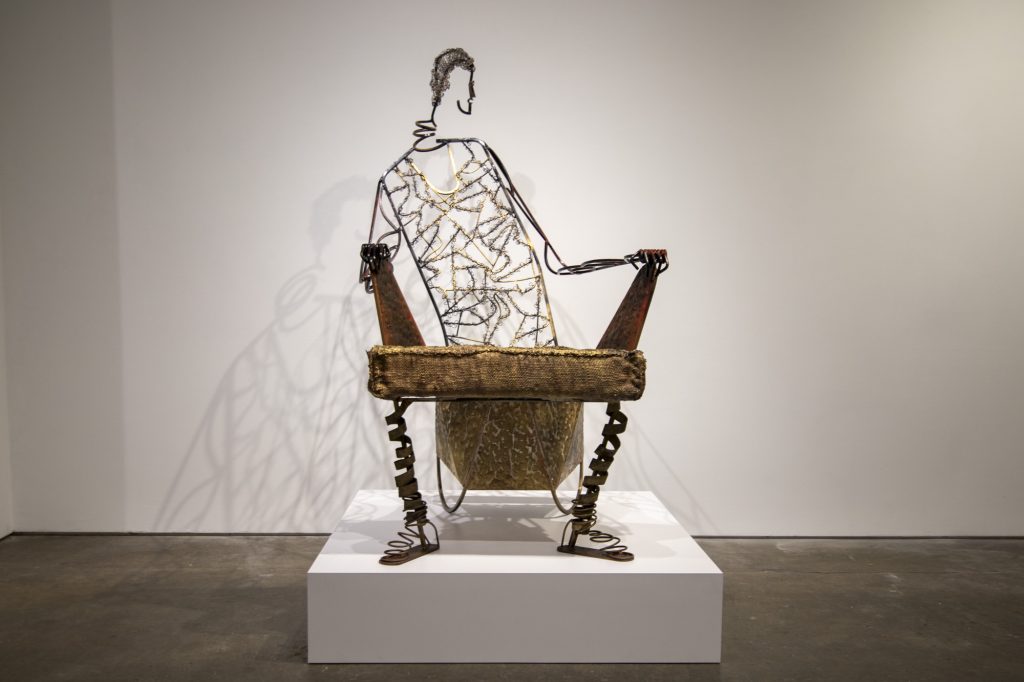
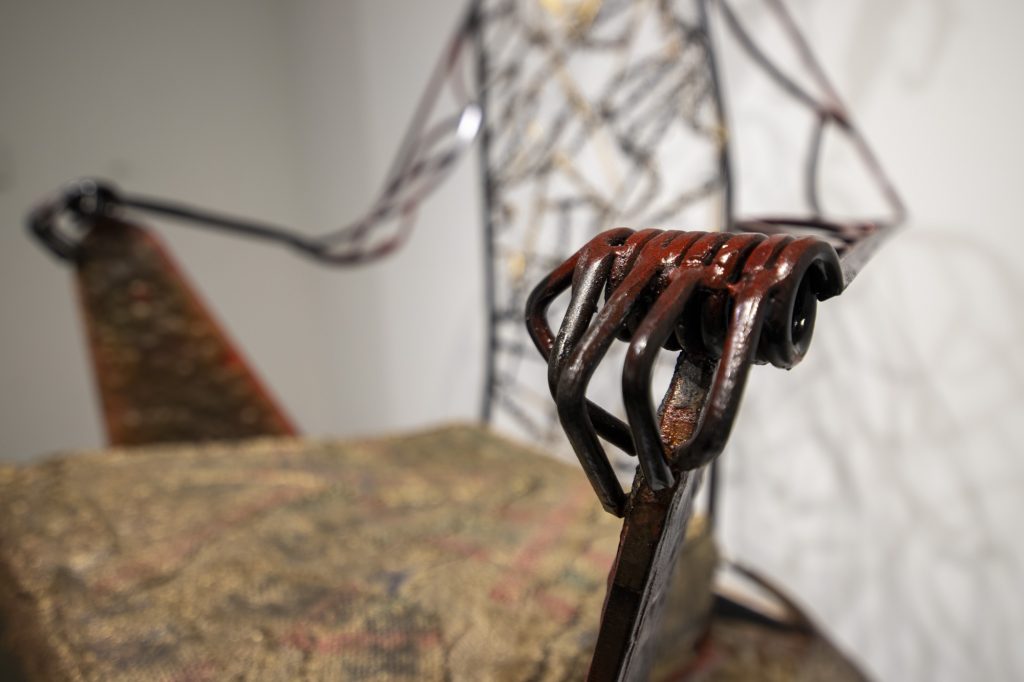

Meanwhile, Master’s Chair strikes with a different sentiment — not fun or funny — instead quite poignant and dark. In this piece, four figures are dramatically bent over, their faces near the ground, their backs becoming the armrests of the chair. The fabric seat in the middle features bold black over dark red fabric, and the back of the chair itself is made with an overlapping woven texture of steel. At the headrest, two wires are tightly coiled on either side of the piece, lending the sculpture an undeniable tension.
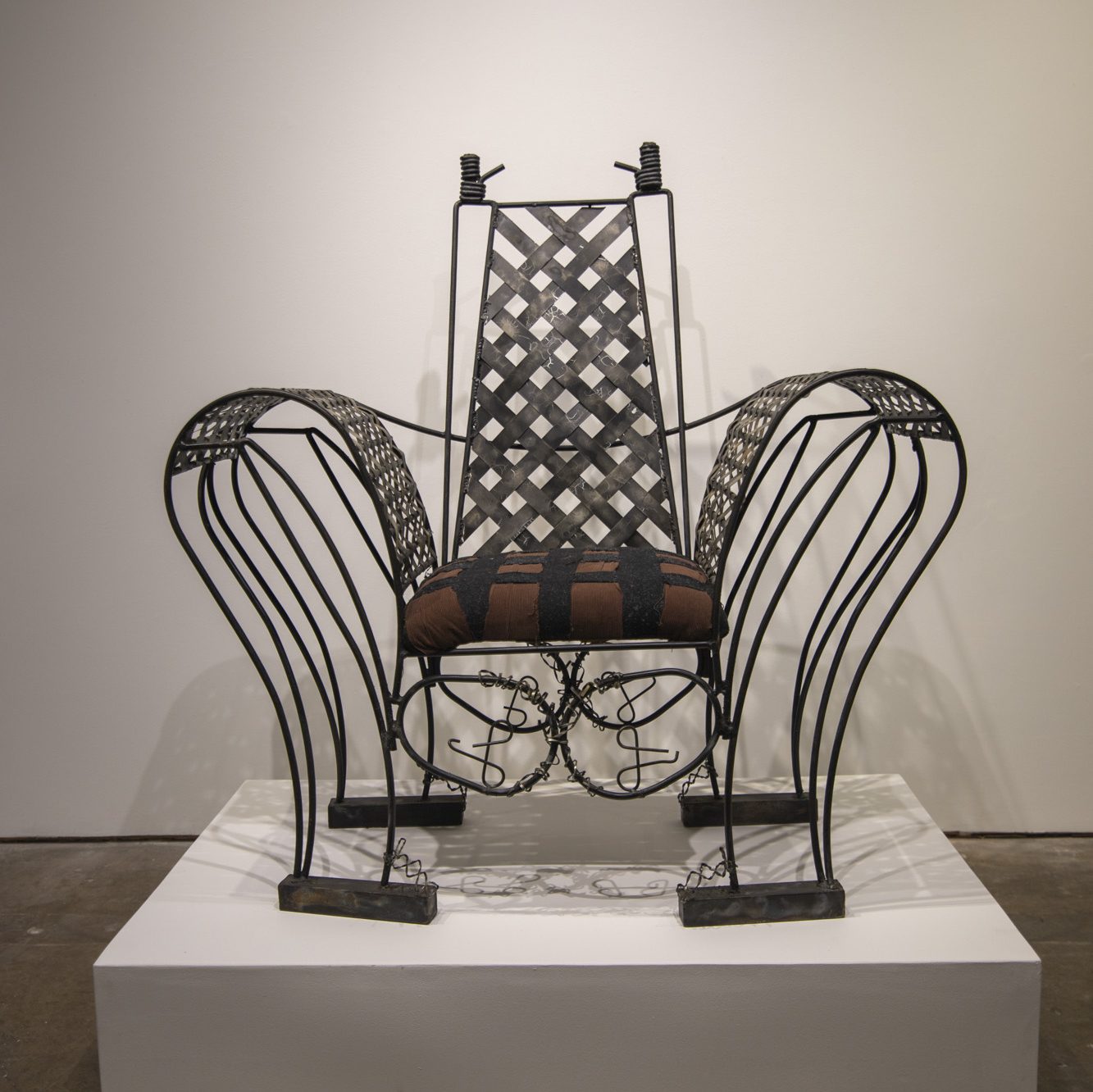
Though the Master’s Chair figures’ faces are simple, constructed of only one solid line that makes up two eyes and a mouth, one can’t help but feel somber when taking in this sculpture. It speaks of oppression, restraint and of a kind of resignation to circumstance that stands out as markedly different from the lighthearted nature of many of the other pieces in the show.
In the exhibition text, the artist’s ability to bend steel to look like drawn lines is highlighted as an indication of Dial’s deep knowledge of the material and techniques. Indeed, many of the sculptures in American Idols contain steel that has been rendered as almost squiggly in nature, which pairs nicely with the straight lines and even spacing of the bars and bands used for the figures’ structures. In some, the faces aren’t evident right away — not until you look a bit longer, allowing your eyes to travel along the lines until recognizable shapes come through. The deep, rusty tones employed even in the fabric, some of which looks almost metallic in its finish, give all of the works an industrial feel.
Born in Bessemer, Alabama, Richard and his brothers and father founded Dial Metal Patterns in the early 1980s, where they made patio furniture together. At the company’s height, they employed around 20 metalworkers, which provided sustainable income for members of a community suffering in the wake of de-industrialization. That same warehouse later became Richard’s and his father Thornton’s art studio, bringing the whole family’s artistic legacy full circle.
Though many of the works in American Idols are chairs, I can’t imagine anyone would want to actually take a seat on any of them. For one thing, they are clearly sculptures, but they also have an almost standoffish nature about them. While it may be shaped like a chair, it doesn’t inspire the idea of comfort or of relaxing. Instead, I found myself drawn closer to inspect the details, fascinated by the methods Dial used to assemble and affix these metal pieces together.
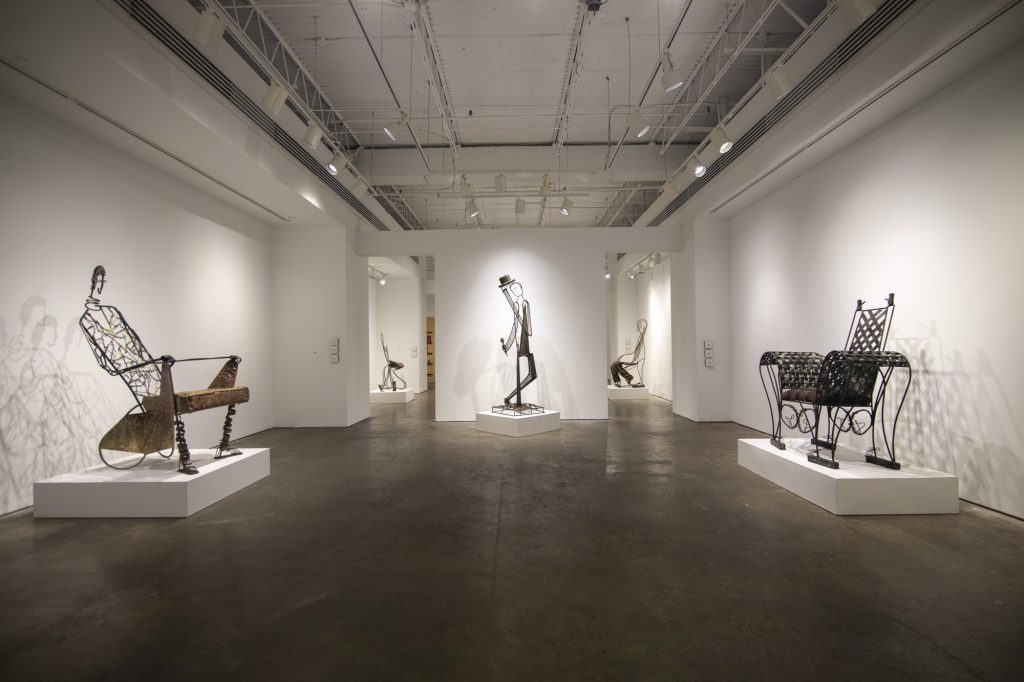
I could almost imagine myself there, in the studio, watching as Dial used intense fire to heat these metal pieces until they were pliable enough to become hair, and hands and feet. I wished I could ask him about the eyes — why some were so small, as in Looking Back, and others were so loose, as in Exhausted in Love.
It was also particularly moving when I caught a glimpse of one of Dial’s father’s pieces hanging on a wall in the back storage room of the gallery, titled The Dream of the Handicapped Woman (Escaping the Jungle). To see the juxtaposition of the two was striking and emotional, as it is possible to draw direct parallels between the application of fabric materials, the color palette and even figures hidden within. To witness the way that art carries through the generations of the Dial family in one gallery setting was an unexpected gift.
The works in American Idols do an excellent job of showcasing the many ways that Richard Dial manipulates industrial materials into powerful artworks that inspire feelings of empathy, dread, resignation, contemplation, love and hope.
Richard Dial’s American Idols will remain on view at Johnson Lowe Gallery through June 27.
::

Isadora Pennington is ArtsATL’s senior editor of art + design and dance. An experienced writer and photographer with a deep love for the arts, Isadora founded the Sketchbook newsletter with Rough Draft Atlanta in 2022. She is also president of the Avondale Arts Alliance and director of the Avondale Arts Center.
STAY UP TO DATE ON ALL THINGS ArtsATL
Subscribe to our free weekly e-newsletter.

