
French designer Jérôme Kaplan creates magic for Atlanta Ballet’s ‘Coco Chanel’
When Paris-based designer Jérôme Kaplan was commissioned to create the costumes for Coco Chanel: The Life of a Fashion Icon, the new full-length ballet based on the life of Gabrielle “Coco” Chanel, he procrastinated.
“Walking in Chanel’s footsteps was extremely intimidating for me, almost paralyzing,” he told ArtsATL via email recently. “Doing Chanel on stage is clearly impossible!”
But Kaplan made it possible. His experience as a designer for choreographers such as Alexei Ratmansky and ballet companies across the globe gave him a strong foundation. And he was delighted when Coco’s choreographer, the acclaimed Annabelle Ochoa, approved of his ideas. Ochoa is very familiar with portraying famous women with distinctive sartorial styles: Among the dozens of ballets she has choreographed are one about Eva Perón and another about Frida Kahlo.

Coco will have its American premiere February 9 through February 17, when Atlanta Ballet performs it at Cobb Energy Performing Arts Centre. The full-length work is a three-way co-production, the first of its kind for Atlanta Ballet. It had its world premiere in March 2023 with the Hong Kong Ballet and will enter the repertoire of Australia’s Queensland Ballet in October.
The ballet tells the story of Chanel’s controversial life, from a child born into poverty in France in 1883 to a savvy, opportunistic businesswoman with wealth and international success. She had affairs with powerful men, among them the Duke of Westminster, Igor Stravinsky and, during World War II, a high-ranking Nazi intelligence officer. She was also a Nazi spy.
In an era when women had little power, Chanel did what she had to do to free herself from her past and free women from the long skirts, bulky sleeves and corsets of the fin de siècle period. Her best-known silhouettes are simple, straight and sleek. “Chanel liberated women’s movements,” Ochoa says.
Designing costumes for an historical figure, particularly a fashion icon like Chanel, requires a unique kind of vision.
Kaplan didn’t replicate her designs but instead created a strong visual impression of them. Haute couture dresses, he explained, feature well-made finishes and details designed to be seen close up, but a stage costume must have a strong impact that can be seen from the back of the theater.
“We have to exaggerate the details,” Kaplan stated. “Also, we must flatter the dancers’ bodies as much as possible. We sometimes ‘cheat’ so that the dancer appears thinner, with longer legs, a slimmer waist.” An haute couture dress embodies the “truth” of a garment, Kaplan wrote. A stage costume succeeds when it gives an impression of that garment from afar. “That’s the artifice.”
Artifice also plays a role in the scene where the actress Gabrielle Dorziat walks into Chanel’s shop wearing a heavy, corseted ballgown with a long train. Emily Carrico, one of the dancers who portrays the designer, describes what happens next.
“We deconstruct it,” says Carrico. “We pull off the sleeves and the skirt so she is left wearing just a straight dress. Annabelle was very specific about the way we do this. She wants the audience to see how pivotal Chanel’s fashion was.”

Colleen McGonegle, Atlanta Ballet’s costume director, says Kaplan took these very straight silhouettes and made them dancer friendly. “The shapes are different from what our dancers are used to wearing, but they are very danceable, even though on the hanger they don’t appear to be,” she says. “They are all are very non-traditional compared with other ballet costumes.”
The seamstresses’ dresses hew to the same sleek aesthetic of Kaplan’s overall vision, even though they are not Chanel designs. McGonegle says Kaplan inserted a large kick pleat in the back of their skirts so the dancers can move easily.
Perhaps Chanel’s most memorable contribution to women’s fashion was the little black dress.
The original design, McGonegle says, had long sleeves made of solid black fabric. Kaplan used black mesh for the sleeves instead, so the dancers’ arms in port de bras, such an important part of ballet technique and dramatic expression, can be seen clearly.
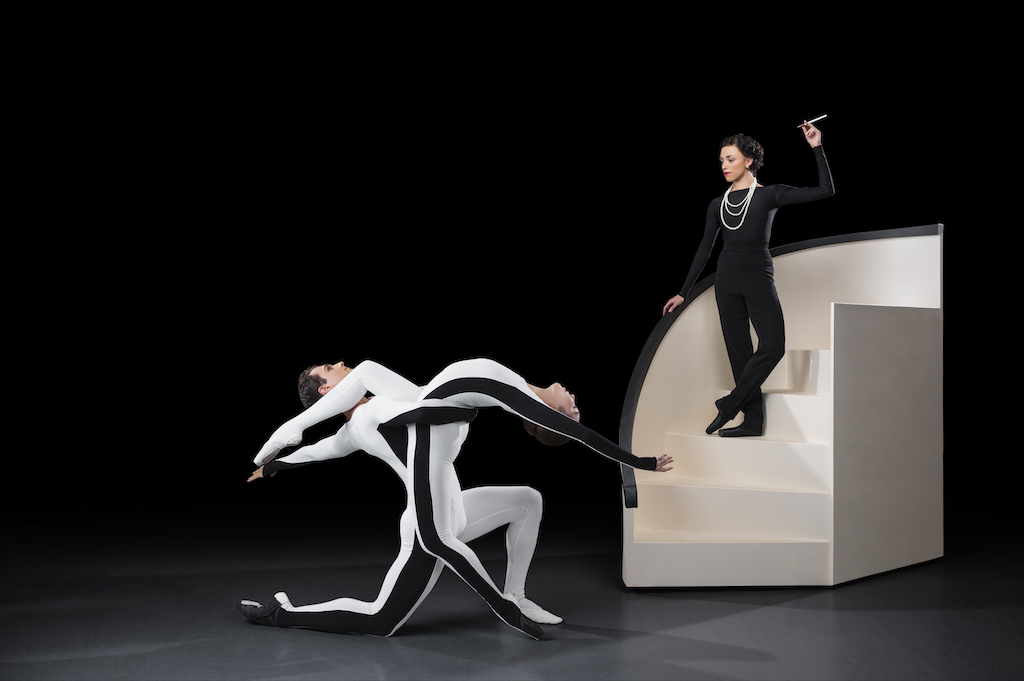
Most of the costumes feature fluidity and lightness, simple lines and a limited color palette starting with white and black, the colors of the Chanel No. 5 perfume box.
Kaplan designed striking black and white unitards for the two dancers who together form the shape of the famous Chanel logo — two intertwined Cs — and his set design with its dramatic staircases has a similar palette of cream and black. So when the dancer portraying Pierre Wertheimer, one of Chanel’s financial backers, comes on stage in a bold red, double-breasted suit, it makes a statement.
When Coco premiered in Hong Kong, the reviewer for the South China Morning Post wrote: “Kaplan’s costumes are ravishing, not only in their beauty and subtle homage to Chanel but in the way they express character, mood and period.”
Atlanta Ballet will perform Coco Chanel: The Life of a Fashion Icon the weekend of February 9-11 and again on February 16 and 17.
::
Gillian Anne Renault has been an ArtsATL contributor since 2012 and senior editor for Art+Design and Dance since 2021. She has covered dance for the Los Angeles Daily News, Herald Examiner and Ballet News, and on radio stations such as KCRW, the NPR affiliate in Santa Monica, California. Many years ago, she was awarded an NEA Fellowship to attend American Dance Festival’s Dance Criticism program.
STAY UP TO DATE ON ALL THINGS ArtsATL
Subscribe to our free weekly e-newsletter.

