Review: Merely Players’ ‘Disgraced’ is an engrossing 90 minutes with an uncomfortable premise
Five years after 9/11, when there was still a quiet undercurrent of fear and paranoia eroding trust between Muslim Americans and their neighbors, playwright Ayad Akhtar hosted an intimate dinner party at his home in Harlem, New York, with his then-wife and two friends — one European, one Jewish.
Somebody said, “Islam: Discuss,” Akhtar recounted to Playbill in a 2014 interview.
“I don’t think any of them knew I was Muslim,” he recalled.
At that time, Akhtar, whose parents are both Pakistani, had erased all obvious traces of his Muslim identity to assimilate better as a Milwaukee-bred American living in New York.
His debut play Disgraced — now onstage at Merely Players Presents in Doraville through May 3 — was inspired by that dinner party.
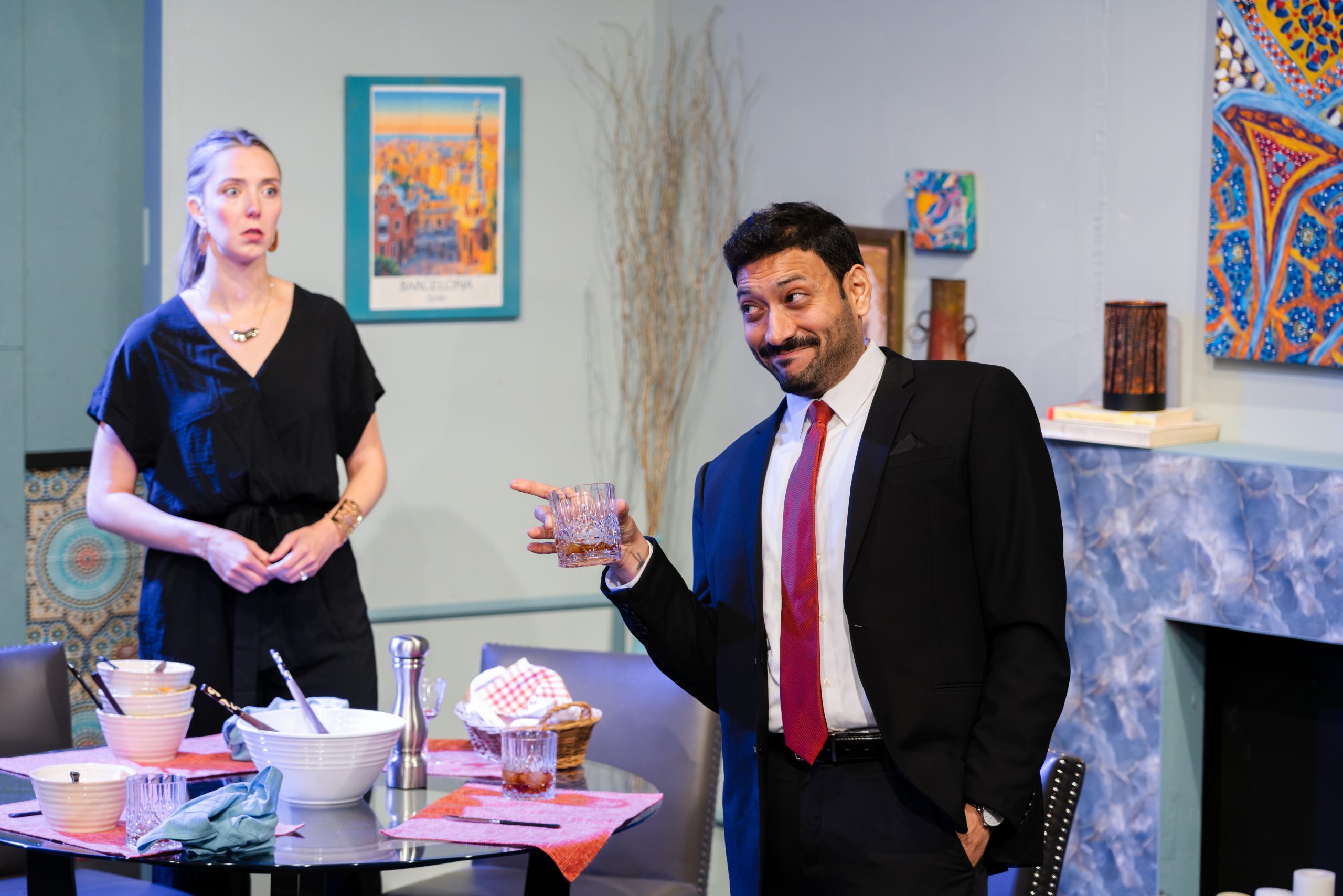
Directed by Joanie McElroy, the entire 90-minute play with no intermission unfolds inside the Manhattan apartment of Amir Kapoor (Si Rajadhyax), a brash and outspoken attorney, and his very white, very blonde wife Emily (Kiarra Donnelly), an artist.

Kapoor is not Amir’s real last name. It is an Indian surname he adopted to cover up his own Pakistani Muslim identity because Amir is determined to make partner at his Jewish-owned law firm. Early on, the audience sees Amir stressed, working on a Saturday, yelling over the phone. His work comes first, he demonstrates, as he rejects his wife’s affection and denies her sexual intimacy.
Emily is an eager artist who has recently found her niche referencing Islamic art forms in her own work. She waxes poetic about Islamic patterns, how sacred and underappreciated they are by the Western world. She uses her Islam-inspired art to vie for a spot in a show at The Whitney Museum. She could be — and later is — accused of “Orientalism” for capitalizing on a culture she doesn’t belong to.
Amir and Emily’s apartment (Set design by Tonya Moore) boasts a view of the New York City skyline. Magazine-worthy wedding photos of Amir and Emily adorn multiple shelves to make sure visitors know they are a happy couple. A minibar proudly displays a bottle of expensive Macallan, with highball glasses at the ready for guests.
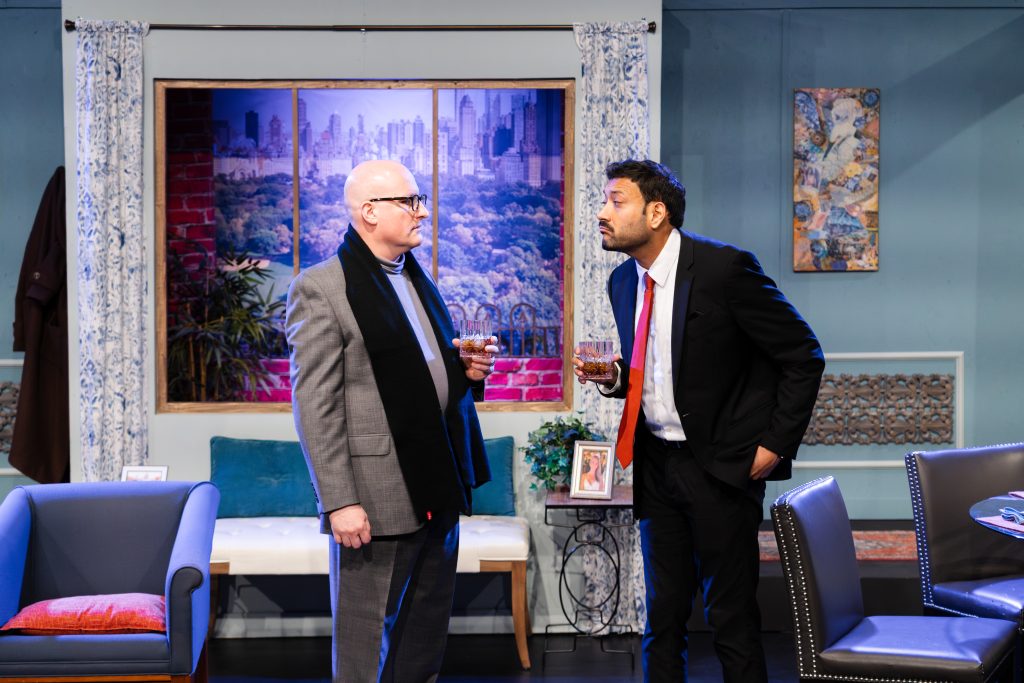
As they both push to advance their careers, Amir and Emily host a dinner party for Isaac (Greg Fitzgerald), a Jewish art curator for The Whitney, and his Black wife Jory (Maya Garner), who is also Amir’s colleague and another lawyer competing for partner at the firm.
It is during this dinner — among a Jew, a Black woman, a white woman and a Muslim — that friendly intellectual discussion spins wildly out of control.
Unlike the much subtler discomfort of the real-life dinner party Akhtar hosted that inspired the play, the fictionalized soiree loses any semblance of civility. The unspeakable thoughts usually kept contained are unleashed. Theatergoers can be heard shifting in their seats and gasping in response to the unfettered offenses hurled among characters. There are no more filters.
There are some comedic moments to offer relief, particularly delivered by Garner, but they aren’t given much breathing room.
A subplot also unfolds throughout the play involving Amir and his much younger nephew, Abe (Fabian Andrade). Like Amir, Abe has discarded his given name Hussein for an Americanized persona. When a Muslim religious leader is accused of a crime he didn’t commit, Abe and Emily challenge Amir to help with the man’s legal defense. Amir firmly declines, worried that exposing his Muslim identity could threaten his aspirations as partner at the firm. The publicized trial offers fodder for discussion at the dinner party and influences a turning point in the plot. It also influences Abe’s perspective, which grows more sympathetic toward Islam and less tolerant of American ways.
The play keeps a brisk clip, making 90 minutes go by fast. The production is engrossing and intense throughout. The most obvious critique, however, is that such intensity is sustained rather than built.

Amir comes out the gate edgy, irritable and, frankly, unlikable. There is no real pet-the-dog or save-the-cat moment to endear the audience. His loud, disgruntled energy from the start leaves little room for his anger to escalate over four scenes. In turn, the climactic ending falls a bit flatter than it should. Had there been more simmer before the boil, it may have felt more believable.
This is true, too, of the relationship between Amir and Emily. If there were more felt moments of tenderness or warmth near the beginning, there would be something more to lose — more emotional ground to travel.
Surprisingly, the character transformation that feels the most powerful is Abe’s.
Even without a steeper arc, the Merely Players Presents production does its intended job. Akhtar has said he wanted Disgraced to release “a kind of trouble into the audience that they can’t let go of.” The production does exactly that, sticking in the mind long after one leaves the theater.
Where & When
Disgraced is at the Merely Players Presents theater through May 3. Tickets, $25.
3785 King Ave., Doraville, Ga.
::

Danielle Charbonneau is a former Arts and Entertainment reporter for The Atlanta Journal-Constitution turned full-time freelancer. She covers a broad range of topics ranging from art, theater and dance to film, travel and events. She holds both a bachelor’s in print journalism and an master’s in specialized journalism in the arts from the Annenberg School for Communication and Journalism at the University of Southern California.
STAY UP TO DATE ON ALL THINGS ArtsATL
Subscribe to our free weekly e-newsletter.

PLEASE SUPPORT ARTSATL
Your Gift Sustains the Coverage You Count On!
Related Posts