Review: ‘In My Defense, I was left Unsupervised’ by Trey Dowell at Tennessee Gallery
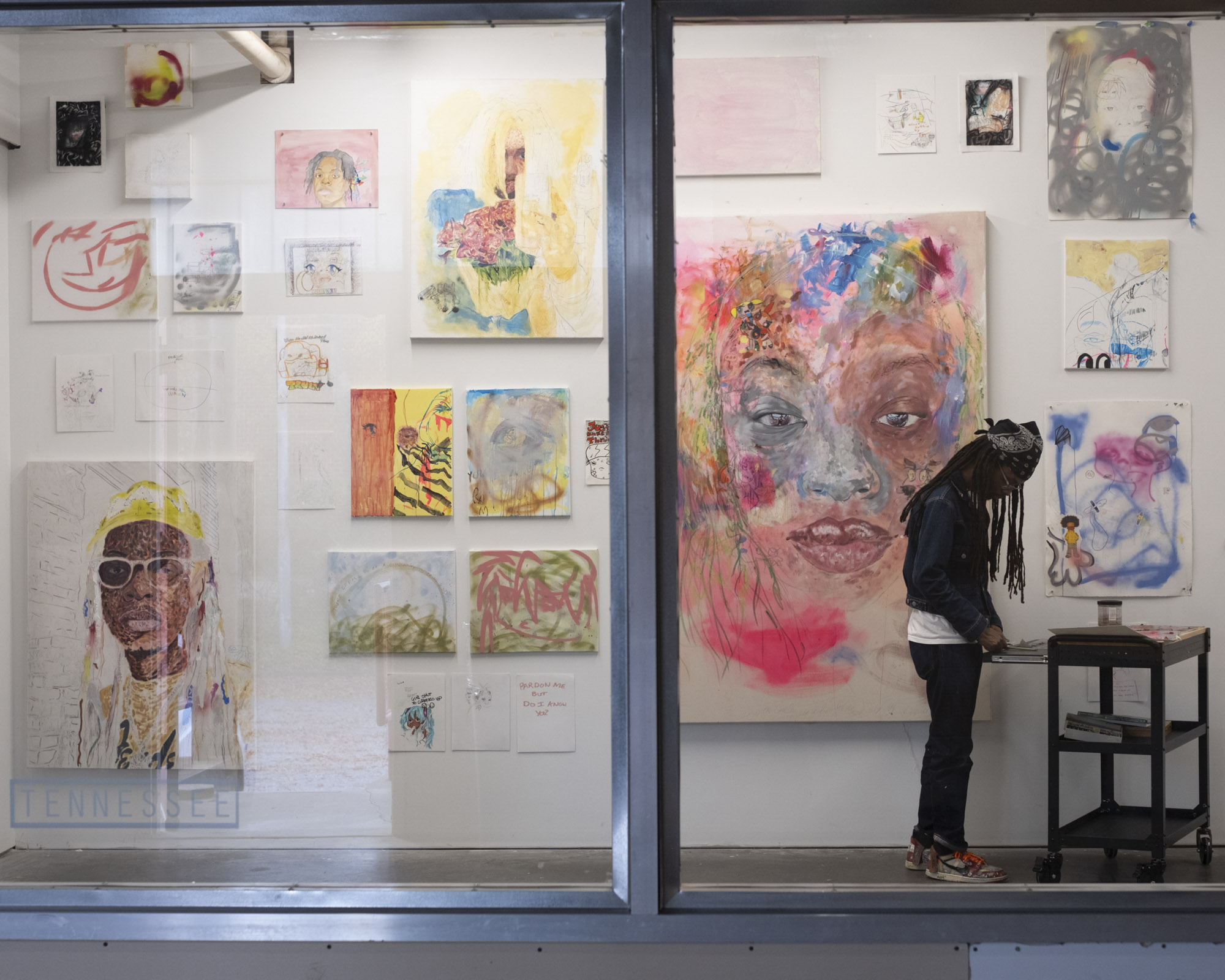
What does it mean for a show to take itself less seriously? I said this to Trey Dowell while standing inside Tennessee Gallery, surrounded by the sprawling constellation of his exhibition, In My Defense, I Was Left Unsupervised. I meant it as praise — a way to name the installation’s looseness — but later I realized the phrase smuggled a hierarchy I didn’t intend: that “serious” art belongs only to polished frames, rigid installs and pristine surfaces. I had underestimated the work because its informality fooled me. That sleight of hand, I now see, is part of the point. Why do we instinctively grant authority to art that looks disciplined? And why should improvisation be read as absence of thought rather than a different logic of world-building?
The gallery felt like a breathing sketchbook, an installation that foregrounds process over product. Papers pinned with magnets, taped edges lifting, easels hung with improbable precision. Paint, collage, colored pencil, marker and graphite coexist like an ecosystem instead of a hierarchy. Portraits lean into doodles and stylized writing. The room seemed to inhale and exhale its own making. Dowell added and rearranged elements as we spoke, performing a continuous creation.
As we spoke, Dowell was mid-revision, adding new details and rearranging others. The exhibition behaved like a live organism — half show and half performance, visible to anyone walking past the gallery’s large windows. Dowell’s work refuses the static finality we often mistake for seriousness; instead it insists on permeability. The show constantly accumulates, shrinks and grows in a constant flux.
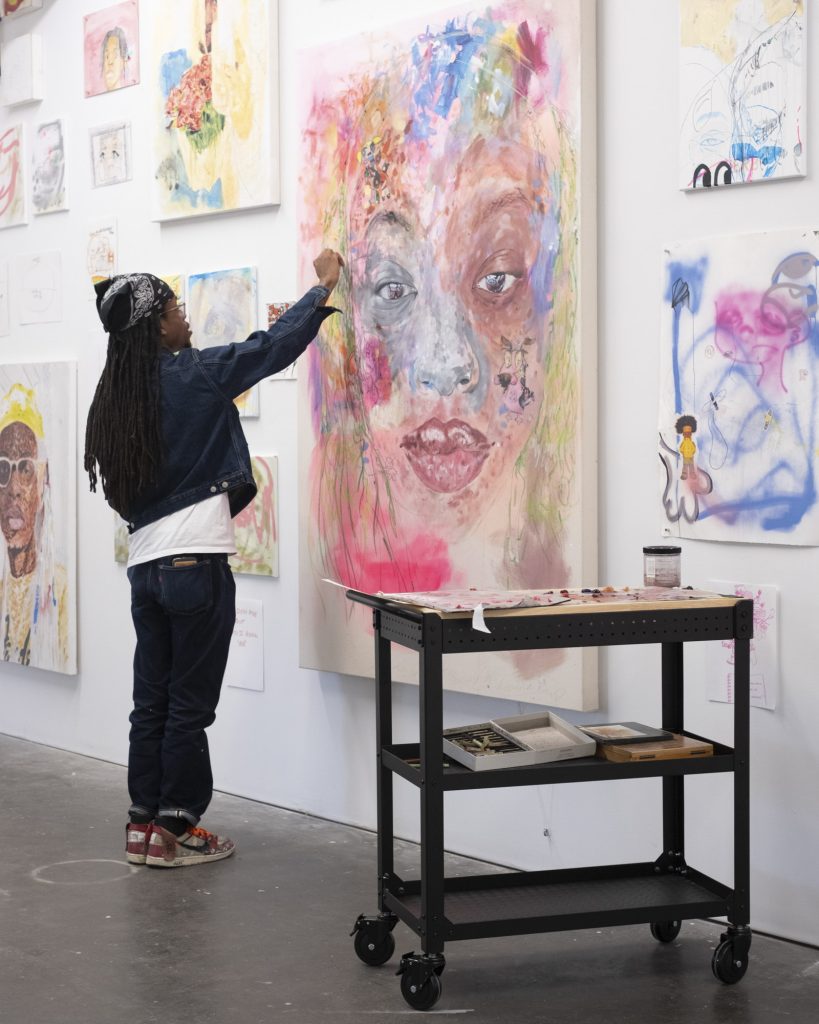

In thinking about Dowell, I return to the mythic figure of the “Atlanta artist” — the maker who creates by any means necessary. Dowell’s process is inseparable from biography, especially the formative scarcity that shaped his earliest engagements with drawing. “Having limited materials growing up,” he told me, “I would steal paper . . . or if my mom confiscated drawings from other kids, I would draw over them. I didn’t have the same markers they had, so mine looked different. And I was like, ‘Oh, that’s pretty neat.’”
In Dowell’s practice, necessity became method, and method crystallized into philosophy. The salon-style density of the installation extends those early improvisations. The result is not orderly, not precious but insistently producing a wall of memory and a crowd of ideas. His work exists between myth and material fact. Atlanta’s “by any means” ethos is often framed as this narrative of heroic self-invention, but Dowell’s biography and this exhibition exhibit the material infrastructures underlying this myth: the scarcity of opportunity, the improvisations forced by limited arts funding and the repurposed materials that have shaped generations of Southern Black artists. Dowell renders these conditions not through didactic exposition but through form: creased edges, visible masking tape and a dense accumulation that resists polish while asserting the rigor of improvisation.
His reference points — Yoshitomo Nara, anime, early-internet cartoons, classical figuration — appear not as pop-culture ornament but as a record of a Black Gen Z childhood in Atlanta. What looks like eclecticism is its own kind of archive, in which cartoon bodies coexist with meticulously rendered Black physiognomy. Here, the social and psychological layering of contemporary Black subjectivity is made literal through the layering style he developed as a child.
What Dowell constructs, ultimately, is not simply an exhibition but an autobiographical ecology — an environment in which the distinction between artist and artwork collapses. The exhibition doesn’t just represent Dowell. Instead it is him. It is a self-portrait that does not rely on likeness but rather on the accumulation of habits, histories, references and marks. In My Defense, I Was Left Unsupervised participates in a lineage of Black aesthetic practices where self-representation becomes inseparable from the objects and processes that scaffold everyday life.
The most striking works in this exhibition are the portraits where Dowell sharpens his attention to eyes, noses and mouths. Faces present highly rendered features with eyes that appear to be almost made of glass, capable of reflecting your likeness. The precision functions not only as a stylistic choice but also as a critical intervention. Within a long art-historical lineage that has caricatured, softened or otherwise distorted Black facial structure, Dowell insists on specificity. His figures take on a ghostly quality, as if to acknowledge that representation can only approximate a subject’s inner multiplicity. The portraits become sites of converging ideas, memory, digital residue, cultural debris, intimacy and social history all packed tightly into the same surface.
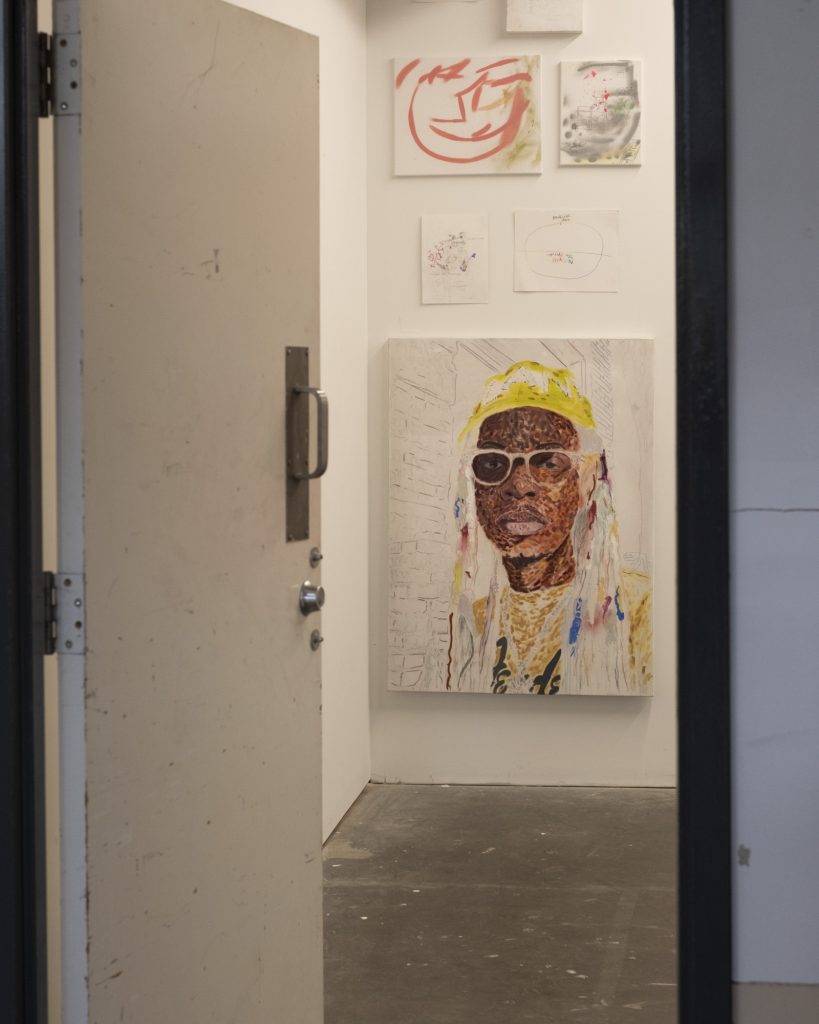
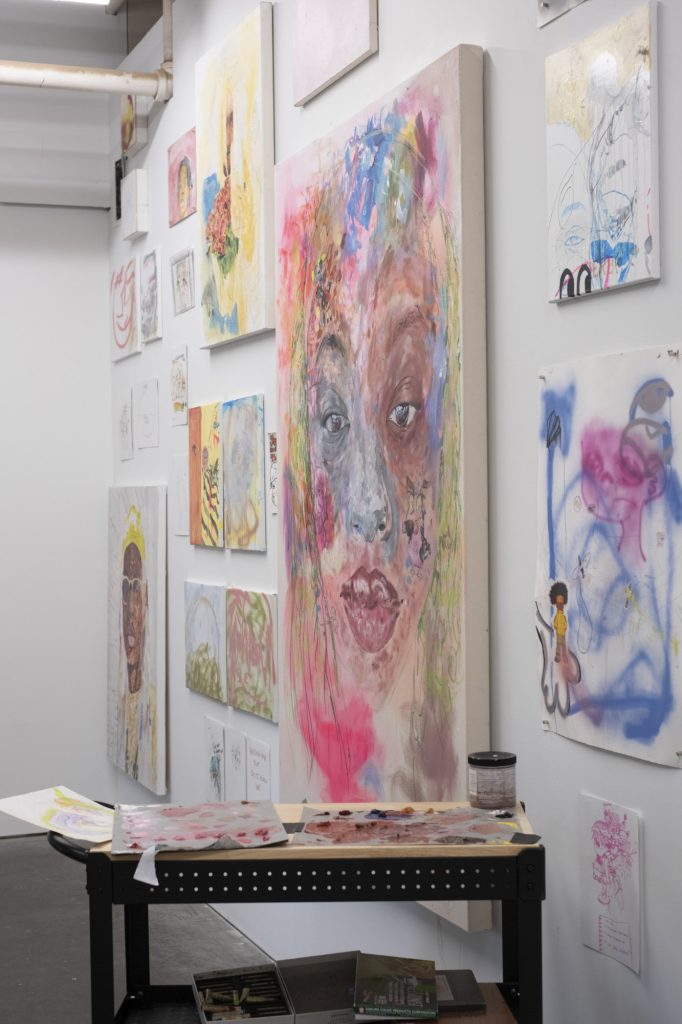
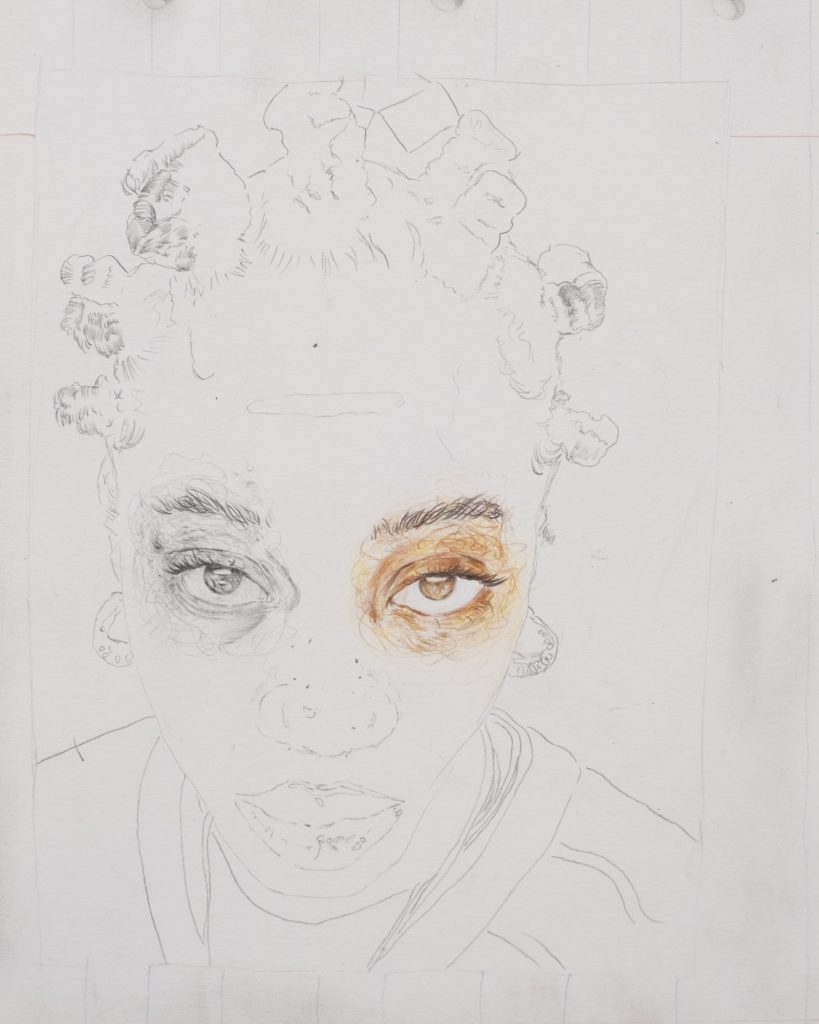
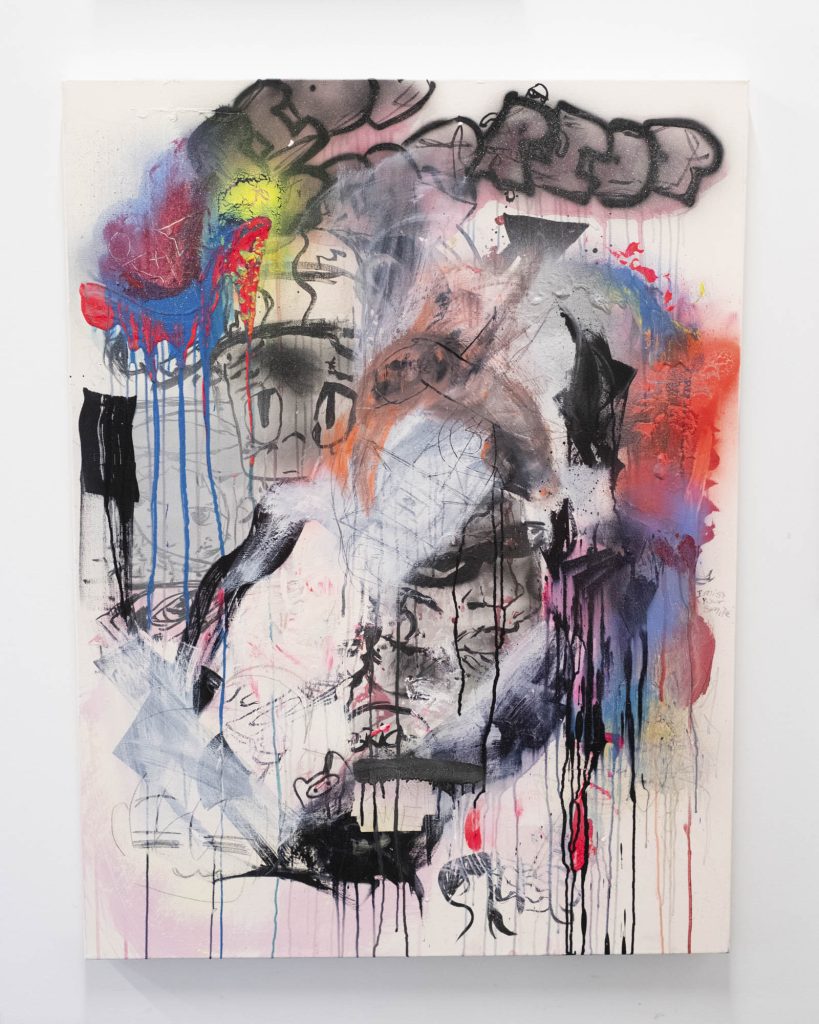


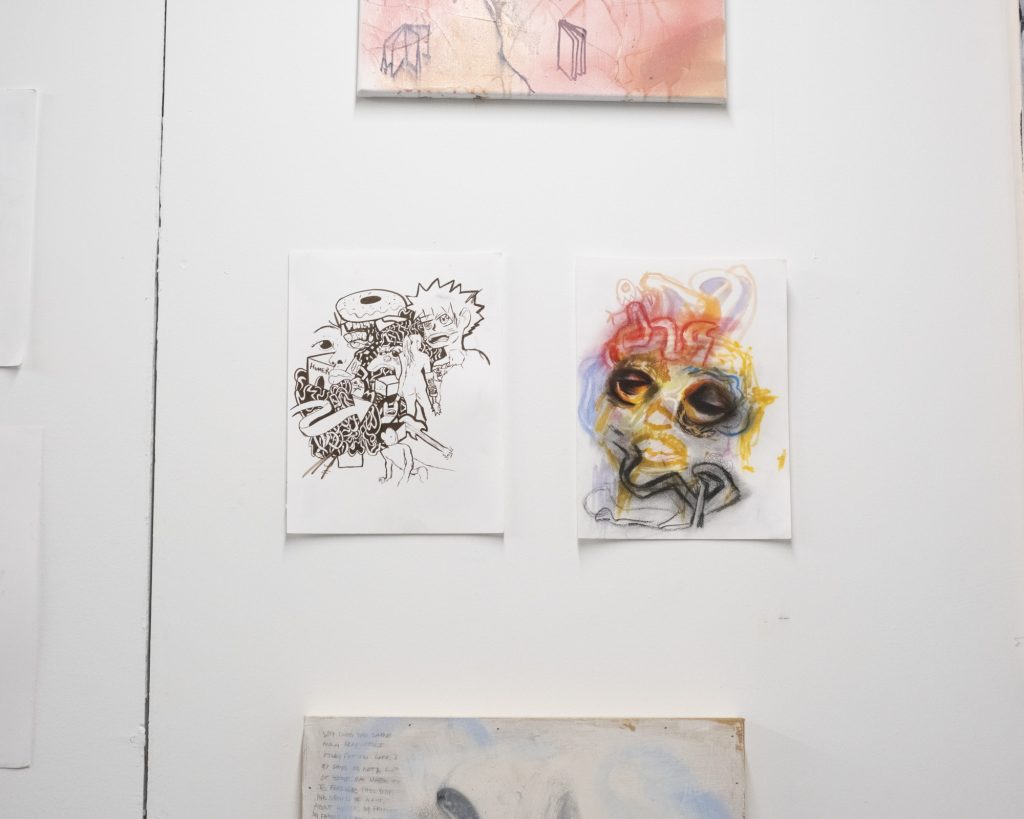
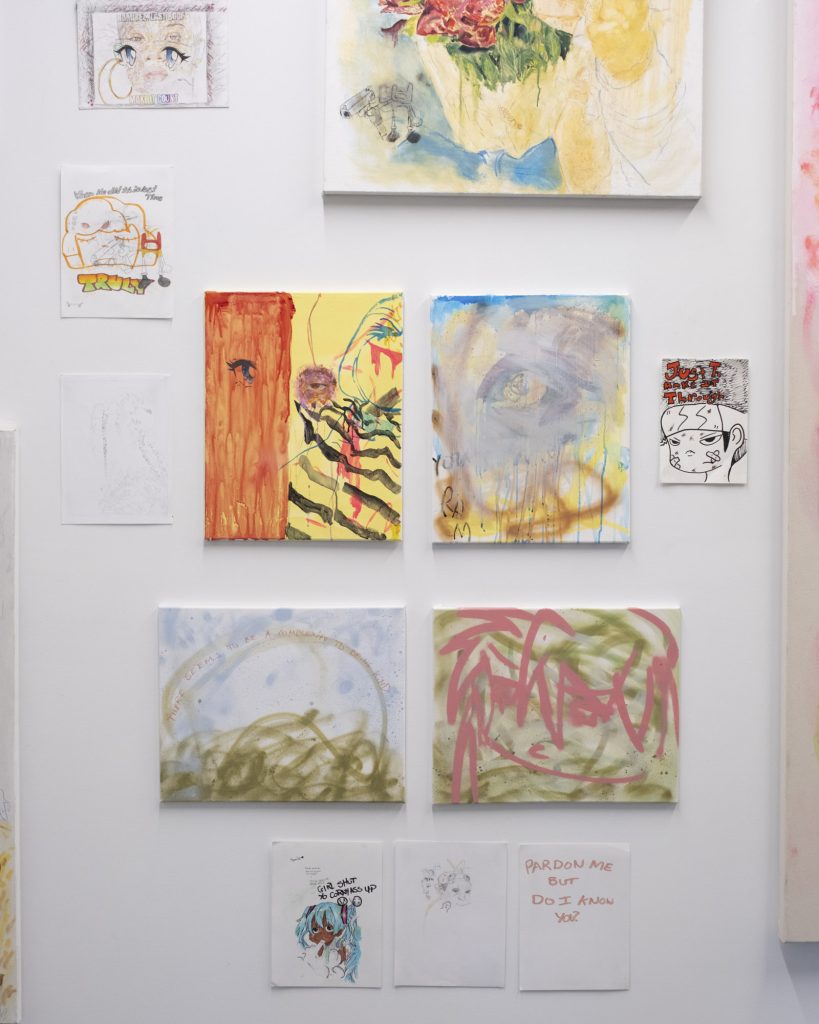
In My Defense, I Was Left Unsupervised takes itself seriously enough to discard the performance of seriousness, and, in doing so, it reveals something about how we read art, how quickly we mistake informality for ease and how often we overlook the rigor embedded in improvisation. The informality here is not a lowering of stakes; it is one of the pillars that allows the show to exist not as a statement but as a representation. The exhibition doesn’t just depict Trey; it behaves like Trey. It is expansive, restless, layered — an extended self-portrait built from people he has encountered, cartoons he grew up with, pop-cultural imprints and a reverence for Black culture that refuses sentimental flattening.
Dowell’s work reminds us that Black creativity has long emerged from the space between deprivation and invention — that the mythic Atlanta artist is both real and manufactured. And that an artwork can be unfinished, unguarded, unsupervised and still profoundly, rigorously serious.
In My Defense, I Was Left Unsupervised is on view by appointment only at Tennessee Gallery through December 5.
::

Montenez Lowery is a multidisciplinary Black American artist working in Atlanta and utilizing pinhole photography to explore identity, cultural memory and the complexities of interpersonal relationships. Lowery is interested in photographic material and process and how they can be incorporated to enrich the themes he tackles. Lowery earned a BFA in photography from the Ernest G. Welch School of Art & Design at Georgia State University. He was awarded the Larry & Gwen Walker Award and shortlisted for the Sony World Photography Awards student competition.
STAY UP TO DATE ON ALL THINGS ArtsATL
Subscribe to our free weekly e-newsletter.

PLEASE SUPPORT ARTSATL
Your Gift Sustains the Coverage You Count On!
Related Posts