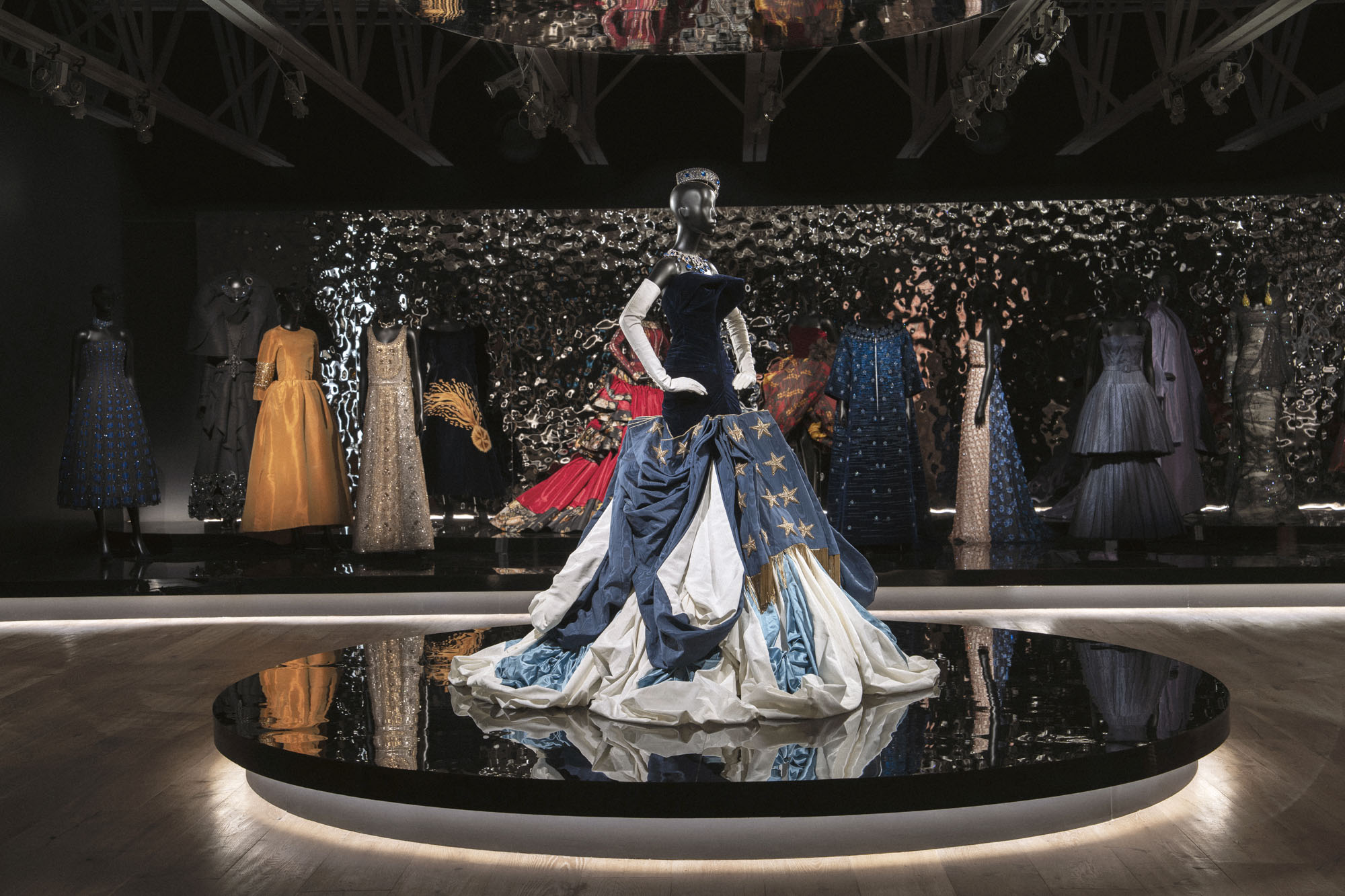
SCAD FASH’s ‘Dior: Crafting Fashion’ exhibit tracks couture through the ages
Dior: Crafting Fashion, on view at SCAD FASH through August 23, brings together a selection of breathtaking garments alongside supplemental materials from the Dior archives to chart the fabled couture house’s history. Unfolding over seven thematic sections and organized by exhibition curator for Christian Dior Couture Hélène Starkman, the exhibit showcases how Dior and his successors have stayed true to a specific aesthetic while pushing fashion into new and sometimes startling directions.
Given the luxury house’s tremendous success, it may be hard to believe that its founder, Christian Dior, was, to borrow a metaphor from his beloved pastime of gardening, something of a late bloomer. As a young adult, Dior went through a series of false starts. To appease his parents, he studied political science by day, slacking off at night among the circle of artists who gathered at the Boeuf sur le Toit cabaret.
For a time, he studied music and toyed with the idea of becoming a composer. Eventually, he opened an art gallery, on condition that the family name would not appear above the door. “To have one’s name over a shop was considered by my parents to be the lowest degree of social shame,” he said in his delightful 1957 memoir. While initially successful, the gallery fell on hard times, as did his father’s highly profitable fertilizer manufacturing business, during the Great Depression.
It was not until 1946 at the age of 41 that Dior established his couture house. At long last, he became an overnight success. His first line, dubbed “The New Look” by Harper’s Bazaar Editor Carmel Snow, was a sensation.
A reaction against the austerity and sexlessness — “this dearth of imagination,” he called it — of the Occupation, the “En8” (figure 8) and “corolle” (ring of petals) silhouettes harked back to the Belle Epoque of Dior’s childhood. The standout design of the collection was the Bar Suit Jacket in ivory shantung. With its generous peplum flaring over a full-length black pleated wool skirt, the design created an hourglass or figure 8 silhouette. The very yardage required to construct the skirt, pad the hips and cinch in the waists of The New Look led rival Coco Chanel to quip that Dior did not so much dress women as upholster them.

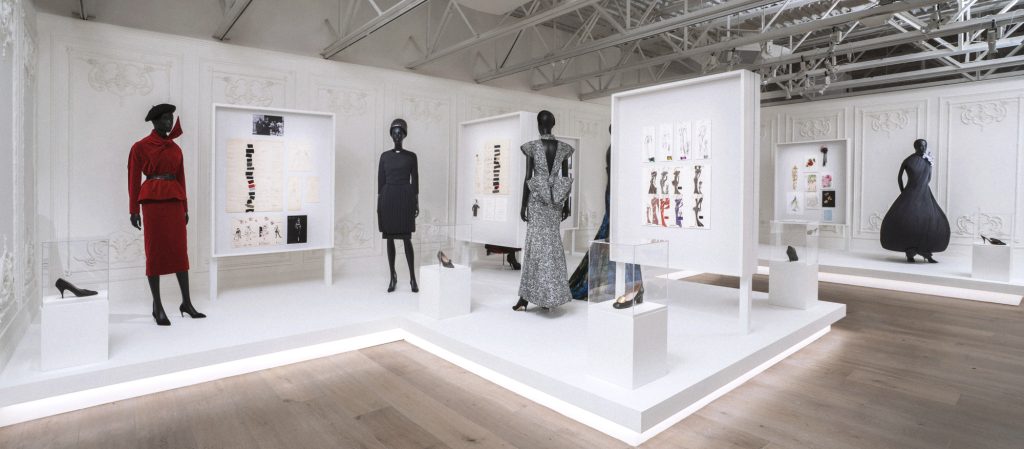
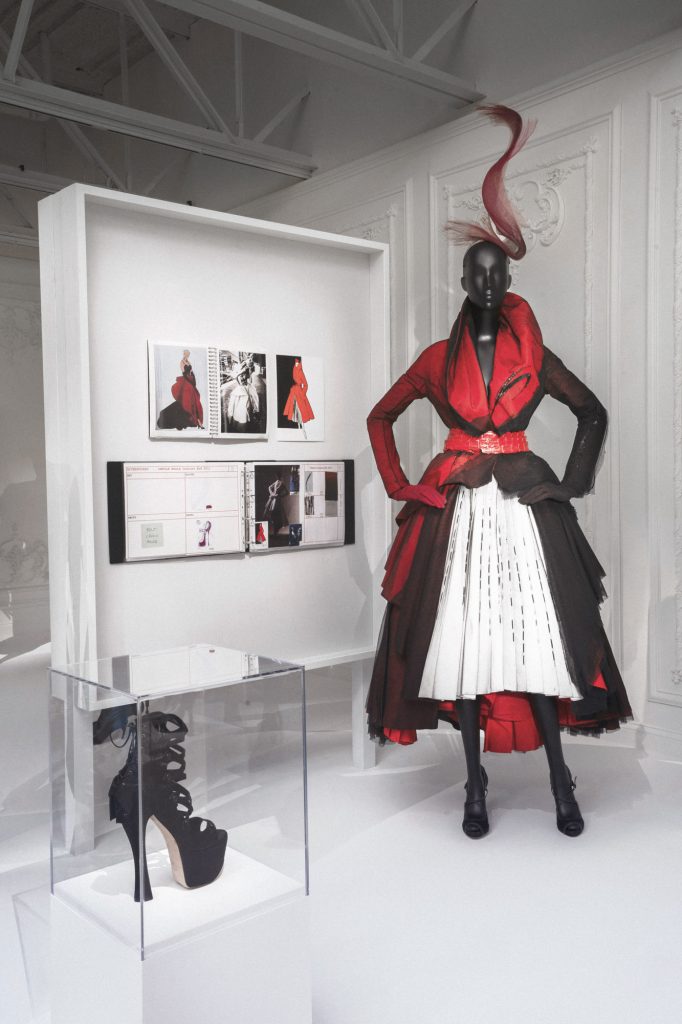
Pathways to Creation, the opening section of Dior: Crafting Fashion, offers an overview of the creative process, displaying a selection of gowns from Dior and his successors alongside the sketches, mood boards, magazine illustrations and artworks that inspired them.
Kicking off the section is a beautiful two-piece formal suit in red cotton velvet from 1949 designed by Dior himself, another iteration of The New Look. The belted jacket with rounded shoulders and signature peplum fanning out over a below-the-knee skirt re-interprets the template that his successors — including Yves Saint Laurent and Marc Bohan, both hired by Dior himself, and current Artistic Director Jonathan Anderson — have continued to reimagine and re-invigorate over the years.
Dior’s nostalgia for the Belle Epoque extended beyond his appreciation for its aesthetics. In Dior: The Biography (2008), Marie-France Pochna quotes Suzanne Luling, Dior’s trusted head of publicity, as having said that what Dior wanted “was to revive tradition but with a contemporary slant,” and a large part of reviving tradition for Dior meant preserving the meticulous old-world artisanal techniques of clothing construction. Everything was, and still is, done by hand.
Dior: Crafting Fashion highlights this important feature of the luxury house by bringing us Inside the Ateliers, displaying a variety of toiles, white muslin test garments prepared by the petites mains, the highly skilled seamstresses and tailors who painstakingly construct by hand the elaborate and ornate garments. It’s this esteem for precision and heritage craftsmanship that made Raf Simons, the Belgian minimalist who was brought in to helm the brand in 2012 following John Galliano’s spectacular flameout, such a good fit for Dior. His jacket and skirt in charcoal Prince of Wales checked wool, included in this section, capitalizes on the house’s tradition of neat, clean, classic design and meticulous construction.
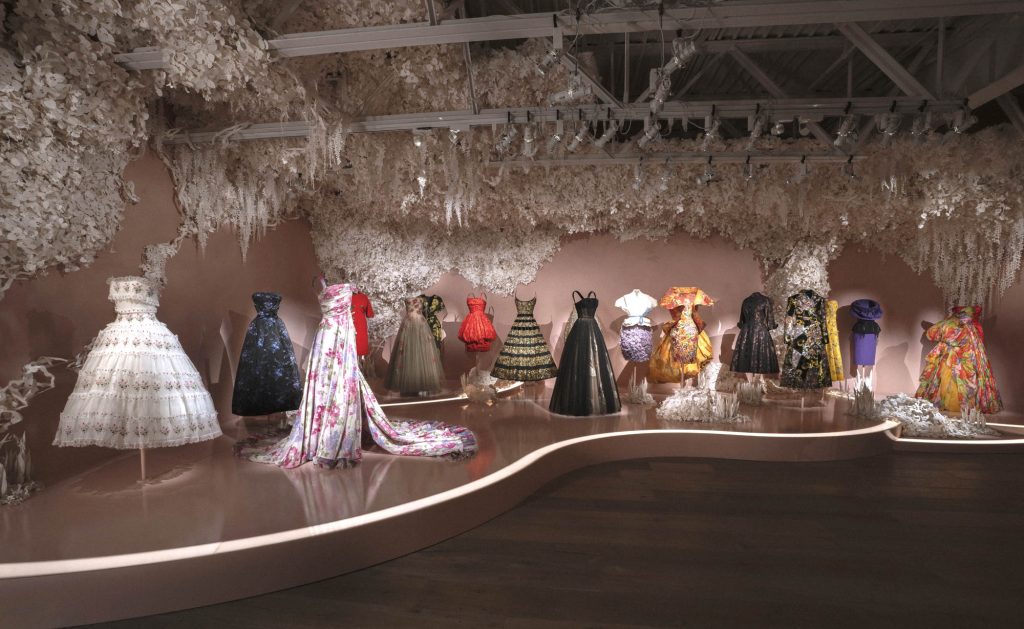
From the muted tones of Inside the Ateliers, the exhibit opens onto the breathtaking section titled The Dior Gardens, the centerpiece of the exhibit. Bathed in a pink glow with flowers hanging from the ceiling, dresses and gowns from the line’s various designers pick up on one of Dior’s favorite motifs: flowers.
There’s much to admire, but it’s particularly interesting to see how the exhibit casts various designers in a new light. For example, the ball gown in tulle and flower embroidery from 2017 by Maria Grazia Chiuri, Dior’s first female creative director, is a real eye-opener. Known for her headline-grabbing slogan T-shirts, the ball gown with crushed silk flowers — like the evening gown in luscious puce jacquard silk from the Autumn/Winter 2018 collection included in the later section, The Dior Show — reveals Chiuri to be a masterly designer of elegant formal wear with an acute knowledge of textiles.
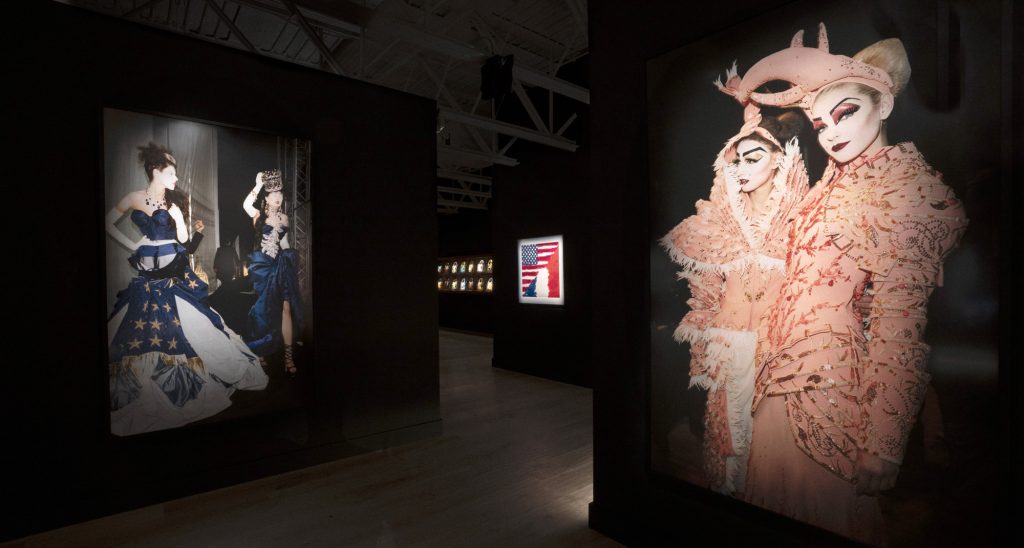
It’s the house’s other Italian stylistic director, Gianfranco Ferré, who perhaps benefits most from appearing in this context. Formally trained as an architect, Ferré took over Dior’s helm in 1989. He introduced the Lady Dior handbag in 1994, a highly successful line that gets a section of its own in the exhibit. Perhaps because he came up in an era before social media and the advent of the superstar designer, Ferré has been rather underappreciated. His designs included here — for example, the lovely evening gown in embroidered silk from 1996 — show a delicate and subtle theatricality that anticipates the more overt, over-the-top designs of his successor, Galliano, whose famous Diana slip dress from 1996 makes an appearance along with a couple other of his more show-stopping looks.
The exhibit concludes with a room devoted to Stars in Dior, paying tribute to Hollywood icons who wore the brand, including early adopters like Rita Hayworth, Elizabeth Taylor and Marlene Dietrich, the latter supposedly insisting to Hollywood producers, “No Dior, no Dietrich.” Stars in Dior makes for a fitting conclusion to this spectacular exhibit, given that the house’s current director, Jonathan Anderson, has made no secret of his intention to establish even more of a presence in Hollywood. The first designer to be named head of both Dior’s women’s and men’s collections since Dior himself, Anderson’s lean into Hollywood glamour is, as he sees it, bringing Dior full circle.
Dior: Crafting Fashion will remain on view at SCAD FASH through August 23.
::

Robert Stalker is an Atlanta-based freelance writer who writes about modern and contemporary art.
STAY UP TO DATE ON ALL THINGS ArtsATL
Subscribe to our free weekly e-newsletter.

PLEASE SUPPORT ARTSATL
Your Gift Sustains the Coverage You Count On!
Related Posts