The High Museum of Art presents Isamu Noguchi’s playful, useful works in ‘I am not a designer’
Ambitious in concept and scale, the High Museum of Art’s Isamu Noguchi: I am not a designer is a bold exhibition that explores the fluid boundaries between art and design through the work of this iconic 20th century artist. Noguchi (1904-1988) had a deep multidisciplinary practice not encumbered by siloed categories such as sculpture, furniture design, industrial design, architecture, crafts, public art or stage design.
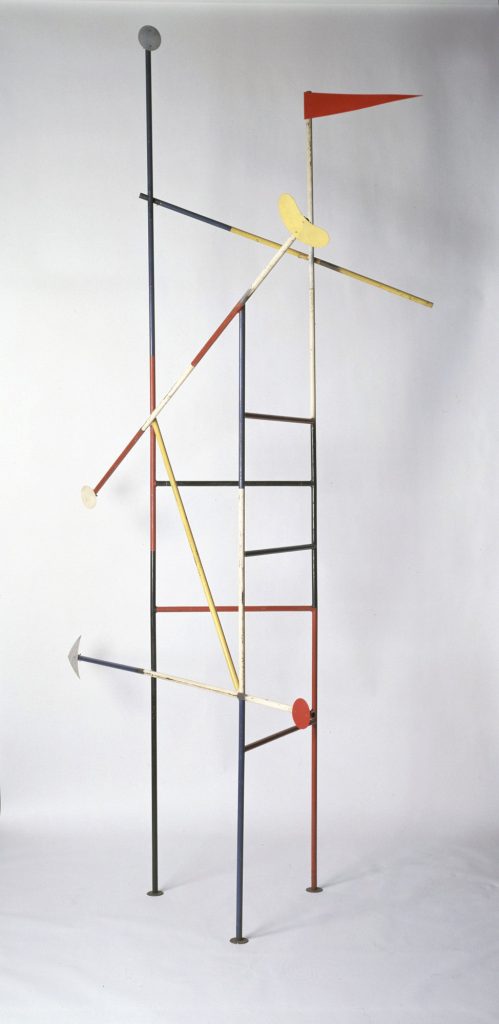
Whereas Noguchi is particularly noted for his sculpture, he is equally famous for his multiples, functional works, ambitious public art and architectural and civic projects. Not unsurprisingly, his long artistic career is defined by collaborations with avant-garde practitioners such as architect Buckminster Fuller, choreographer/dancer Martha Graham and modernist design companies such as Herman Miller and Knoll.
Noguchi’s statement “I am not a designer” is drawn from a 1949 radio interview for which only a transcript exists. We don’t fully know Noguchi’s intent as he spoke these words, but, as this exhibition proves, he “doth protest too much.” Not the first artist to have an expansive design practice (think Michelangelo or Bernini), Noguchi laid the groundwork for many 20th and 21st century artists and designers who have blurred the boundaries between art and design.
As co-curator Monica Obniski, the High’s curator of decorative arts and design, eloquently states: “Today we think about design as expansively as Noguchi thought about design during his lifetime — or to put in another way, what Noguchi broadly classified as sculpture is something far closer to what we now understand as design.”
At the introduction to the exhibition, Obniski, along with her co-curator, independent scholar Marin R. Sullivan, invites visitors “to consider: Was Noguchi indeed a designer?” The answer to this provocative question is certainly yes.
Critical to delving into the arc of his long career is understanding Noguchi’s biography. Born of a Japanese poet father and a white American writer mother, Noguchi spent his youth in both the United States and Japan. This biracial and bicultural upbringing ultimately shaped an aesthetic that balances Western and Eastern art and design. Noguchi instinctively understood that boundaries between the two are fluid.
I am not a designer dramatically opens with Song of the Bird, a 1958 pair of marble and granite sculptures created for a pivotal yet unrealized design in collaboration with architect Gordon Bunshaft for the Lever House in New York. The sculptures, which were meant to be site specific, are a homage to modernist sculptor Constantin Brâncuși (1876-1957), for whom Noguchi served as studio assistant in Paris from 1927 to 1929. Brâncuși had a deep affinity with Asian art, bonding him to his young apprentice. As quietly balanced organic columns, Song of the Bird is a quintessential example of Noguchi’s fluid approach to artmaking.
With more than 200 works that span industrial design, furniture, lighting, stage designs, ceramics, costumes, models and maquettes, photographs and archival materials, I am not a designer is broadly organized thematically and chronologically. Relevant biographical facts are integrated into the three overlapping themes.
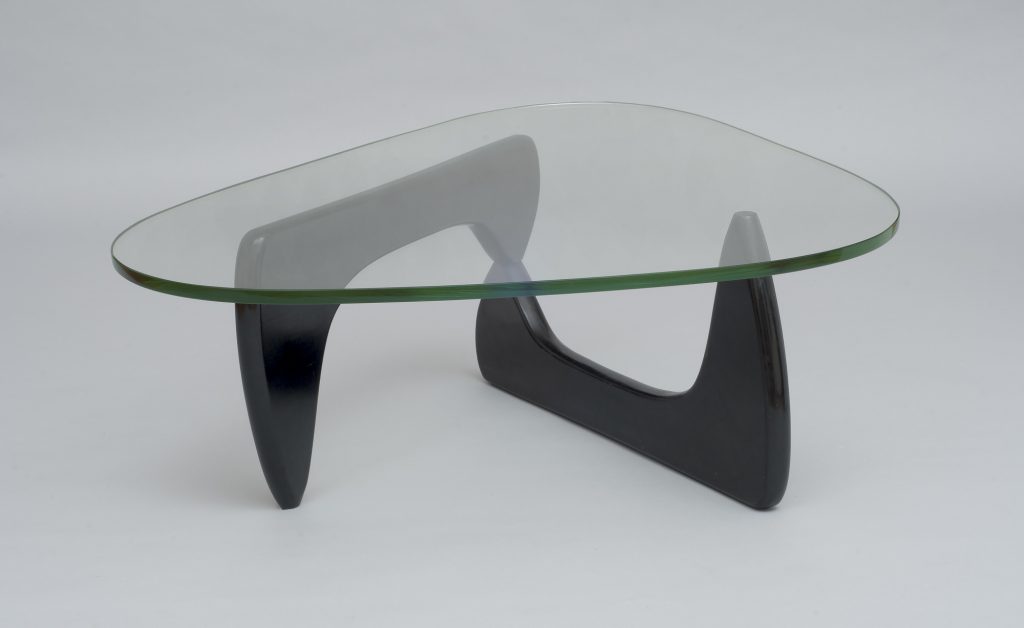

Making Multiples includes examples of Noguchi’s commitment to producing objects that synthesized his vision of art with social and utilitarian functions. For example, in 1937, he designed the Radio Nurse, a Bakelite baby monitor for the Zenith Radio Corporation. Iconic furniture still in production includes the IN-50 coffee table, designed for Herman Miller in 1944, and the Knoll-manufactured rocking stools, designed in 1955.
The second section, Elements of Architecture, further elucidates the elasticity of Noguchi’s practice and his commitment to modernism, as well as his many collaborations with architects and artists. His design vocabulary and interest in columns, walls and ceilings are well represented by objects and archival materials, including documentation of his lunar ceilings that meld lighting and sculpture.
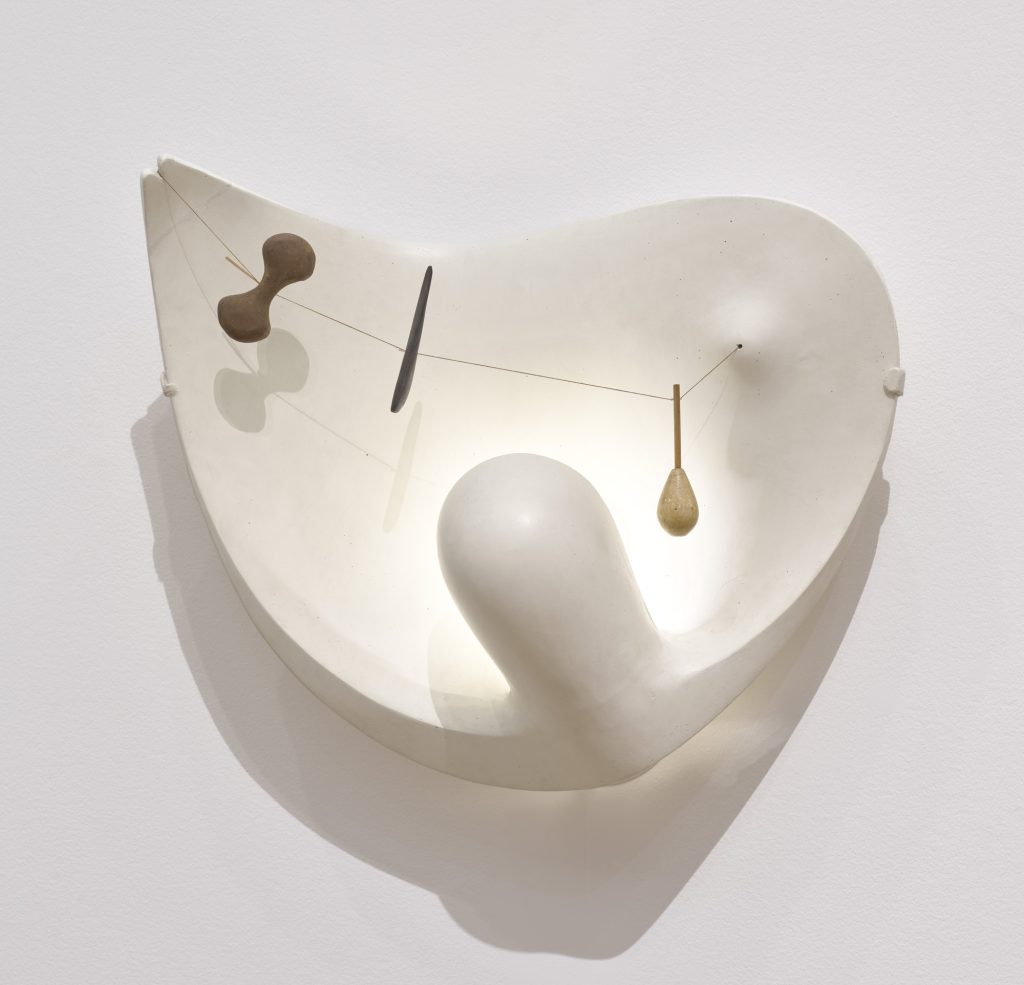
One highlight is the 1943-44 Lunar Landscape, on loan from the Hirshhorn Museum — an example of sculptures in which Noguchi spread magnesite, a cementing material commonly used in construction, over armatures covered in burlap in which light bulbs and other electrical components could be concealed. Thrilling is the 1955 set for Seraphic Dialogue, designed in collaboration with the Martha Graham Dance Company.
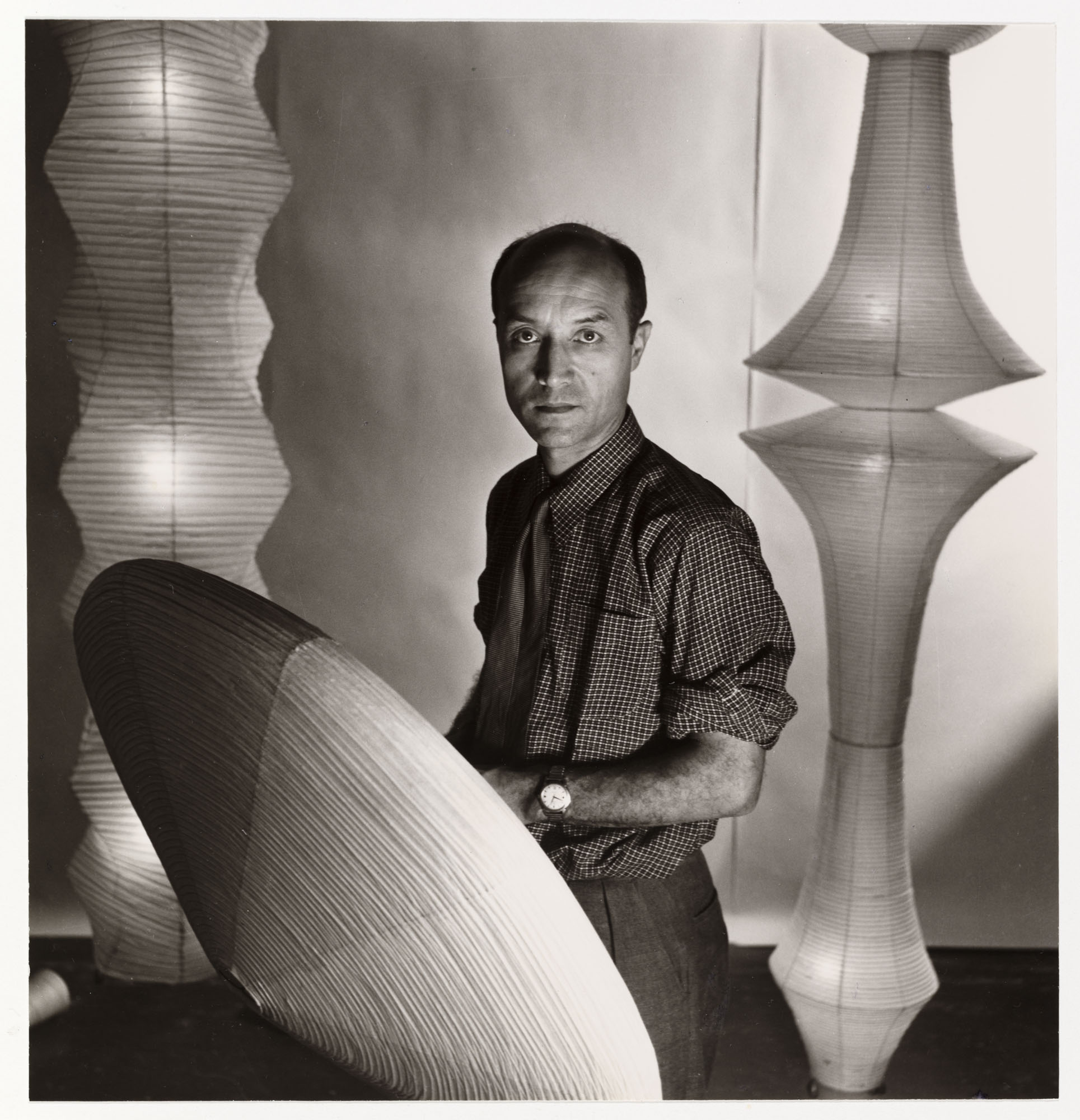
As noted, Noguchi had a lifelong interest in illumination, and these lighted examples are interspersed throughout the exhibition. Still in production are akari light sculptures (akari means light in Japanese), which one can buy in the High’s gift shop. Inspired by Japanese lanterns, these elegant and weightless light fixtures are crafted with bamboo and washi paper using traditional techniques. Beginning in 1951, Noguchi designed more than 100 models, many of which are integrated into the exhibition.
Once again, it is important to think about Noguchi’s complex relationship to Japan. In 1942, he self-deported to the Poston War Relocation Center in Arizona, with the idealistic desire to be of service in the camps by using his skills to design and build structural improvements. Not to be realized, he left the camp after six months — examples of those plans are on display in the exhibit.
In 1950, Noguchi returned to Japan after an absence of nearly 20 years and would travel there annually for the rest of his lifetime, further impacting his hybrid, bicultural practice. I am particularly taken with the ceramics and furniture he produced there that are grounded in traditional Japanese crafts and design. These visits often resulted in collaborations with Japanese architects, including with Kenzō Tange for an unrealized design for the Hiroshima’s Peace Memorial Center.
Designs associated with the Peace Memorial Center are included in the third section of the exhibition, Shaping Spaces. Here we also learn about his experimentation with landscape design, including UNESCO’s Jardin Japonais (installed in 1956 and restored in September of 2025) in Paris as well as civic plazas, including a decade-long redevelopment of Detroit’s riverfront, documented here with models, drawings and other visual materials.
Last but not least, and particularly relevant to Atlanta, the exhibition discusses Noguchi’s interest in playgrounds, which he viewed as social sculpture that can integrate art into daily life. He began planning playgrounds for New York City starting in the 1930s, but none were ever realized.
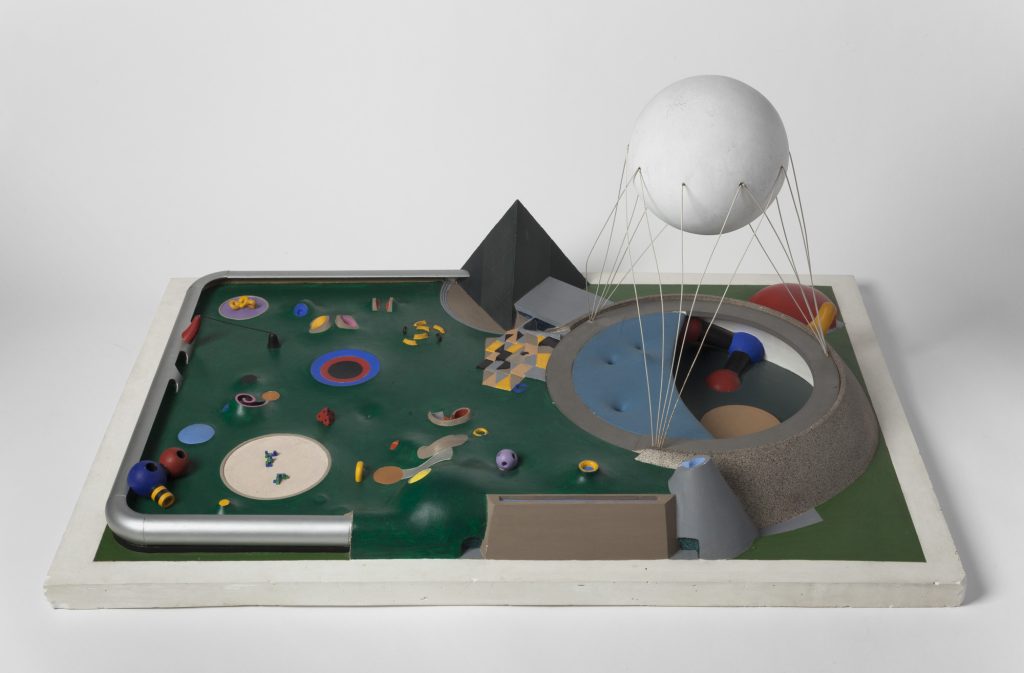
Designed by Isamu Noguchi with Pavilion Associates: Peter Floyd (American, 1922–2015), Shoji Sadao (American, 1927–2019) and John McHale (British, born Scotland, 1922–1978), Model for U.S. Pavilion Expo ’70 [unrealized], 1968, plaster, wire and paint, The Isamu Noguchi Foundation and Garden Museum, New York. Photo by Kevin Noble / The Noguchi Museum Archives, 147232. © 2026. The Isamu Noguchi Foundation and Garden Museum, New York / Artists Rights Society (ARS), New York.
It took the vision of Gudmund Vigtel, director of the High Museum of Art, working with the city of Atlanta to realize the only Noguchi playground to be built during the artist’s lifetime. Conceived as a bicentennial gift to Atlanta, Noguchi’s Playscape opened in Piedmont Park in 1976. A model is on display, as well as a photograph of Noguchi at the site taken by Atlanta’s own Lucinda Bunnen. Given the park’s proximity to the museum, why not walk over there and participate in play for yourself?
Isamu Noguchi: I am not a designer is both a delightful and demanding exhibition with a hand-in-glove design that underscores the exhibition’s narrative. The exhibition will be traveling once it closes on August 2 in Atlanta: a coup for the High and for Atlanta.
::

Louise E. Shaw has been a curator and arts administrator based in Atlanta for more than 45 years. She was an intern at the High Museum when Playscapes was dedicated in 1976.
STAY UP TO DATE ON ALL THINGS ArtsATL
Subscribe to our free weekly e-newsletter.

PLEASE SUPPORT ARTSATL
Your Gift Sustains the Coverage You Count On!
Related Posts