Review: Dancing, boxing and post-colonial trauma in Julio Medina’s new work
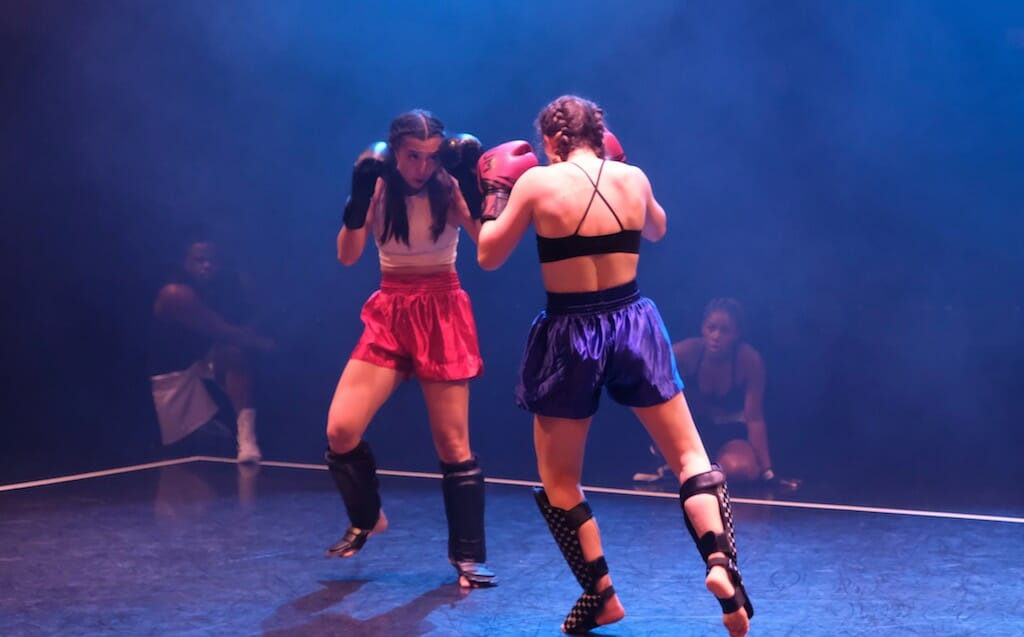
In 2020, Julio Medina became the first professor to teach hip-hop in Emory’s dance department and last Saturday, at the black box studio space at the Schwartz Center for the Performing Arts, the essence of hip-hop fused with Muhammad Ali’s “float like a butterfly” footwork in the premiere of Medina’s desahogo:undrown.
desahogo:undrown was one of three works on the program, joined by a remounting of Medina’s Ridge and guest choreographer Nadya Zeitlin’s Archs & Textures DWTN, adapted from a work performed earlier this year at Underground Atlanta and Hardy Ivy Park downtown.
It was hard to believe that Medina’s two dances were choreographed by the same person. Ridge (2021), co-created with Jasmine Jawato, is a dynamic, abstract duet, opening with the breath and comprising tightly organized and repeated movement phrases: rapid, propulsive arm swings, bent knee dips with the torso rounded in contraction, panther-like crawls across the space and double rolls along the floor.
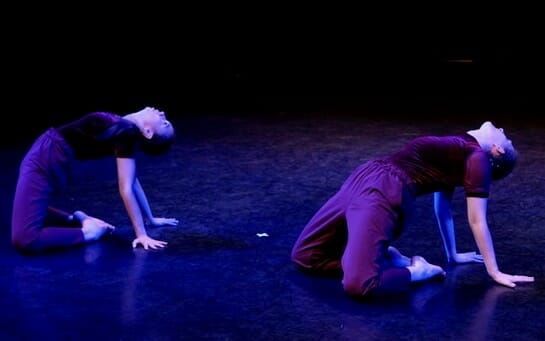
Julianna Feracota and Jacque Pritz, both beautiful dancers, moved in unison as if they were one body. After their initial high-energy sequences, they lay face down, their breath now not initiating movement but pumping unasked for from their lungs after their intense outpouring of energy. It was a treat to be in a space small enough that this intimate aspect of dance could be both seen and heard.
Both rolled onto their backs and then, what a surprise, Feracota rolled on top of Pritz in a soft embrace, and the latter began to laugh. Such a tender moment. The work ended with each of them taking turns in reaching an arm along the floor, as the other carefully placed her head in the other’s palm. It was gently, exquisitely moving.
Fast forward to desahogo:undrown. The work began as the audience was getting seated after the intermission. The dancers marked out a boxing ring with tape. A punching bag was hung in a far corner. Special-effects fog wafted through the space like cigarette smoke. Twelve dancers, in a variety of colorful shorts, T-shirts and athletic shoes, taped their hands, jumped rope, jogged in place, warming up for the big fight. Just when it felt they had prepped for long enough, the work began to develop.
 Throughout the piece, the dancers sometimes wore boxing gloves, sometimes not. Sometimes they sparred with one another, sometimes not.
At one point, they stood motionless in a circle, fists raised, sequins on their black, see-through boxing robes twinkling in the light. Occasionally one of them rang the boxing bell in one corner. Two dancers engaged in an intense kickboxing fight.
And all the while, one dancer — the choreographer himself — pummeled the punching bag in the corner. Again and again and again.
Was this just an illustration of how boxing can be seen as dance? Or an opportunity to teach dancers how to box? It seemed that way until one dancer was lifted up by the others and spoke. “I am not your prey,” I heard, although she said much more.
Another dancer was lifted up the same way and spoke. The performance was in the round, so it was hard to hear what was said when the dancers were facing the other directions.
Then I read the program note: “Striking a bag, or a person, will not heal an individual from post-colonial trauma or capitalist oppression. But the discipline and play inherent to the art form give you the skills and confidence to advocate for yourself, support another, respectfully disagree, and learn when to rest.” Interesting that Medina refers to boxing as an art form. It was certainly presented that way Saturday, with dancers, not sports professionals, doing the boxing, some more confidently than others.
After the performance, I asked Medina for the text. “I am not your enemy. I am not your inferior. I am not your alien. I am not your criminal. I am not your prey. I am not your labor.” I wish I had been able to hear that during the performance, because it was the crux of the piece. The Spanish word in the title, desahogo:undrown, means relief. Relief from oppression perhaps. Undrown – saving your own life. Being able to breathe.
Desahogo:undrown featured some of Atlanta’s finest, and familiar, contemporary dancers: Walter Apps, Atarius Armstrong, Patsy Collins, Porter Grubbs, Feracota and Pritz among them. Kiera O’Reilly and Andre Lumpkin were standouts.

In the last two years, Nadya Zeitlin has become known for her outdoor, site-specific works around the Sol LeWitt sculpture on Highland Avenue, at the skatepark in the Old Fourth Ward and at venues in downtown.
Her adaptation of Archs & Textures DWTN Saturday was really a trio: for Meg Gourley, Raina Mitchell and a collection of small white boxes. The driving sounds of Nine Inch Nails accompanied their play with the boxes and their comedic, mimed conversation, each using a box as a phone. One used the boxes as building blocks; the other knocked over her creation. It wasn’t clear what the boxes represented but the dancers came together at the end with one box pressed between them. A resolution of sorts, delivered with humor and care.
::
Gillian Anne Renault has been an ArtsATL contributor since 2012 and was named Senior Editor for Art+Design and Dance in 2021. She has covered dance for the Los Angeles Daily News, Herald Examiner and Ballet News, and on radio stations such as KCRW, the NPR affiliate in Santa Monica, California. In the 1980s, she was awarded an NEA Fellowship to attend American Dance Festival’s Dance Criticism program.
STAY UP TO DATE ON ALL THINGS ArtsATL
Subscribe to our free weekly e-newsletter.

PLEASE SUPPORT ARTSATL
Your Gift Sustains the Coverage You Count On!
Related Posts