Review: New Terminus ballet a wealth of clever ideas and rich production values
Will robots someday populate video arcades? Can manipulation of our brains change our behavior? How does our brain produce jumping jacks?
Those are some of the questions explored in Terminus Modern Ballet Theatre’s Step the Brain Along a Path, a new contemporary ballet that premiered Friday at Ferst Center for The Arts.
The hour-long work was choreographed by Troy Schumacher with input from a bevy of scientists at Georgia Tech and Emory University, but as soon as the curtain rose it became clear that this is the work of an even bigger multidisciplinary team: Alex Somers created the pulsating electronic score, Sergio Mora-Diaz developed the brilliant set design, Ben Rawson did the evocative lighting, and the eight barefoot Terminus dancers embodied and animated the heady brew of brain science. (Mora-Diaz also designed Schumacher’s Translation, which Terminus performed, and ArtsATL reviewed, in November 2018.)
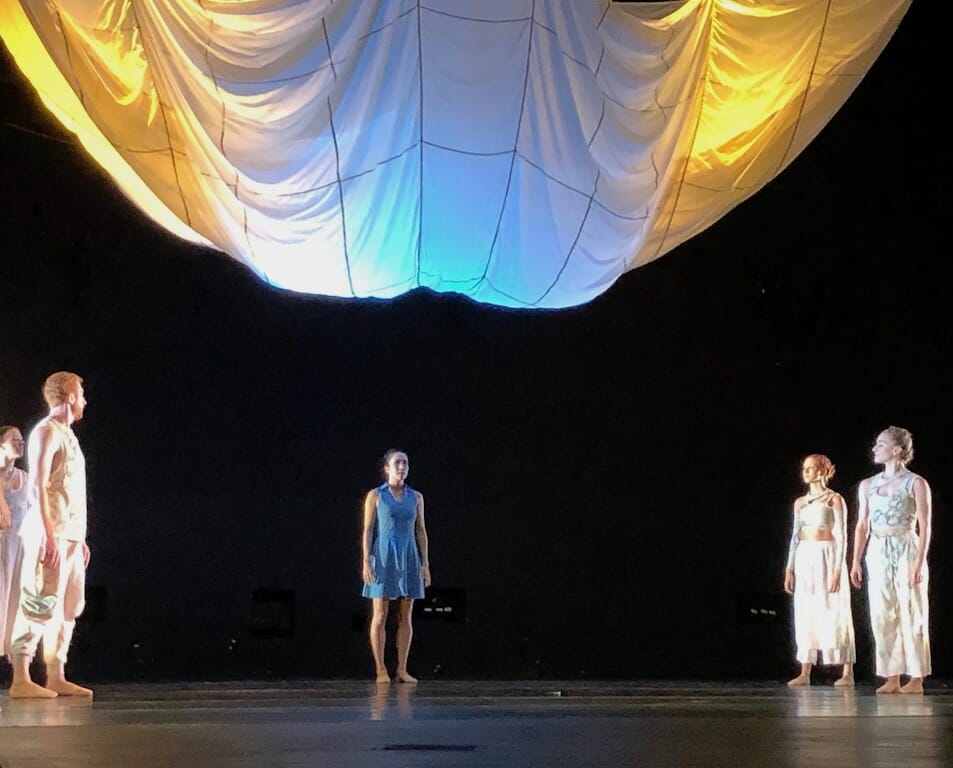
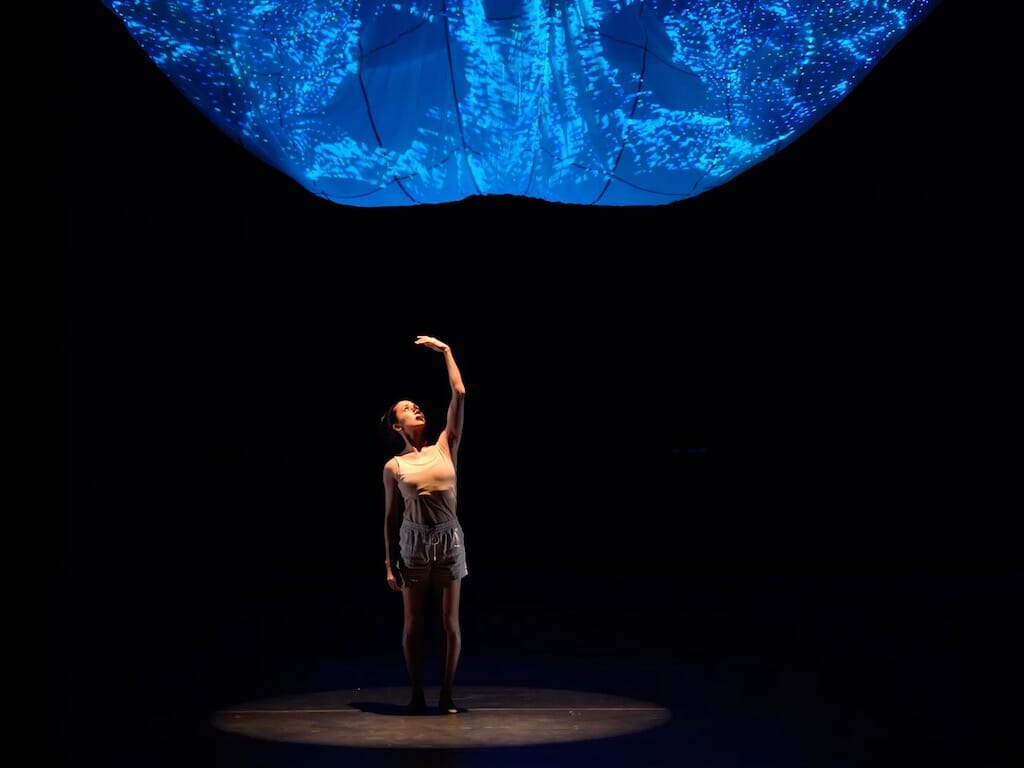
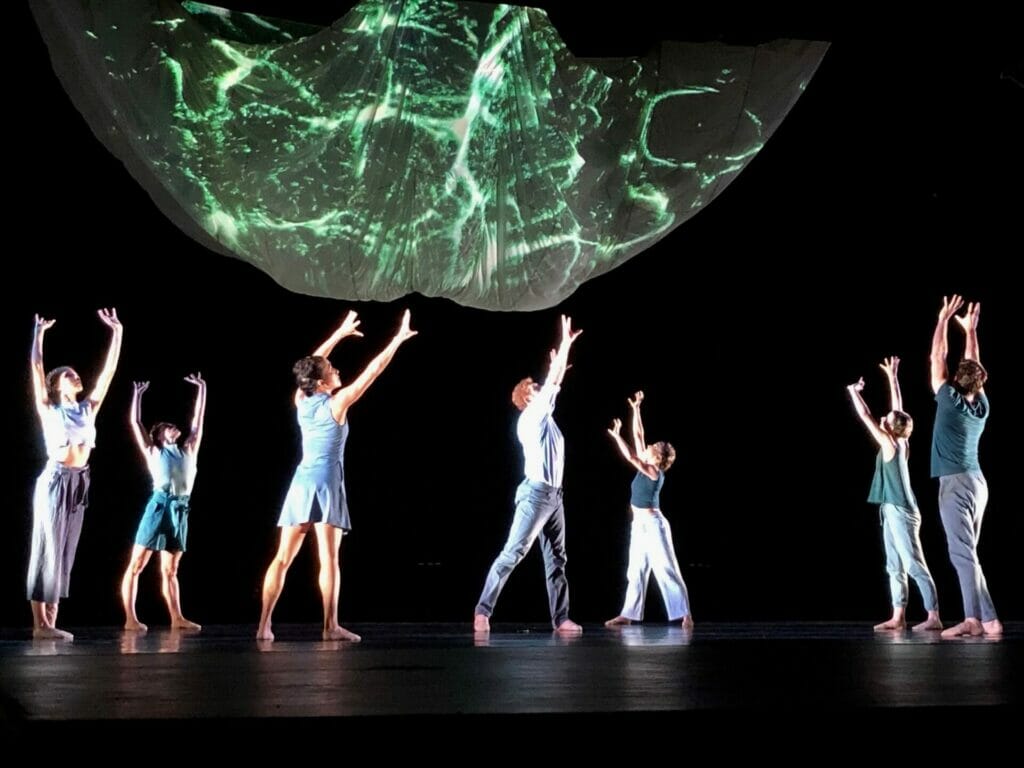
First, the physical set: A huge piece of white fabric hung from above like a semi-deflated, upside-down parachute. It glowed with different colors throughout the piece — shocking pink, electric blue, lime green, rainbow colors. The back wall became a video screen on which white threads like neurons moved, coming together and moving apart. The scrim at the front of the stage acted as another screen, this one for the written word. It was hard to see all the words and section titles, they came and went so quickly, but one section title was “Inside the Hippocampus.” Am I any the wiser about the hippocampus? No, but the point was clear – this ballet is about the brain.
Before the ballet began, artistic director John Welker stepped in front of the curtain, with Georgia Tech Arts director Aaron Shackelford, and directed the audience to take a survey on our phones with questions like “Would you consider using a brain machine interface to improve your daily life?” and “If you could remember one moment perfectly, what would it be?”
We were given a few minutes to complete the survey, the answers to which were later projected on the scrim. This may sound like a lot of intellectually clever stuff, not dance, and to a certain degree it is, but some ballets depend on a unique environment for their existence. This is one of them. You can’t separate the movement from its setting in Step the Brain — and have it make sense — any more than you can in The Nutcracker, only here the environment isn’t a Victorian home at Christmas or the land of snow, it’s the brain.
One theme in Step the Brain is the desire of four main characters to change something about themselves: Rachel Van Buskirk’s character asked for greater physical control; Heath Gill wanted greater emotional control; Laura La Russa was trying to slow down time and Christian Clark’s character was searching for memories of someone he had lost.
The work opened with Van Buskirk alone in a tight circle of light, moving her hands and looking at them as if pondering how and why they moved. To the left of the stage, a huddle of dancers in white tops and flowing pants acted as sort of Greek chorus of neurons, reaching arms upward, shimmying arms and shoulders in a staccato rhythm.
One section featured Van Buskirk encircled by four other dancers. She became a body responding to neural messaging. One dancer lifted the right arm. Van Buskirk did too, at exactly the same time. Another dancer lifted the left arm, same thing. By the end of this section, Van Buskirk was doing jumping jacks, as each dancer/neuron around her executed just one part of the action. Clever. In the section about a future amusement arcade, Van Buskirk was a robot brought to life by dancers placing something — computer chips? — in her brain. Thought-provoking.
As for movement vocabulary, some phrases were repeated throughout the work, especially in the group sections: for instance, one arm above the head, opening to the side in half a classic port de bras, as the body leaned and curved into a back attitude. Or the dancers standing as if playing the piano, or perhaps counting with their fingers. There were also a couple of lovely, innovative duets.
Arionne Gordon arrived on stage later in the work, dressed in a demure, light blue dress. A 12-year-old student at the Terminus school, Gordon was a standout in her brief solo — confident, technically solid, and able to project and engage the audience.
As the ballet drew to a close, the cast changed into varying shades of blue and joined together in a joyful finale, as if each of them had met their goals and balanced their brains.
As always, the Terminus dancers were technically strong, although Schumacher’s choreography is designed for mood, not obvious virtuosity. Anyone looking to be deeply moved, however, was likely disappointed. Aside from Gill’s solo, in which he writhed on the ground as if experiencing a sort of emotional exorcism, the dancers didn’t wear their hearts on their sleeves — instead, they wore their neurons on their arms, legs, fingers and torsos.
In the last couple of years, Terminus has performed ballets created by their talented in-house choreographers and grounded in story (The Poet, Marley Was Dead To Begin With, Everything is Waiting) or joyful companionship (Roam).
Step the Brain Along a Path is a ballet of a different hue — interesting, cerebral, aloof. It may not be everyone’s cup of tea, but it deserves a place in the Terminus repertoire because it celebrates collaboration, because it’s a rich tapestry of movement, light, sound and visual imagery, and because it stretches the company in thought-provoking ways.
::
Gillian Anne Renault has been an ArtsATL contributor since 2012 and was named Senior Editor for Art+Design and Dance in 2021. She has covered dance for the Los Angeles Daily News, Herald Examiner and Ballet News, and on radio stations such as KCRW, the NPR affiliate in Santa Monica, California. In the 1980s, she was awarded an NEA Fellowship to attend American Dance Festival’s Dance Criticism program.
STAY UP TO DATE ON ALL THINGS ArtsATL
Subscribe to our free weekly e-newsletter.

PLEASE SUPPORT ARTSATL
Your Gift Sustains the Coverage You Count On!
Related Posts