‘Cosmic Assassin’ uses flamenco to process Julie Galle’s dance with breast cancer
Julie Galle, a flamenco artist and owner of Atlanta-based Berdolé Flamenco Production, was face-down in an MRI machine when she conceived the idea for her new evening-length work Cosmic Assassin.
“I realized the cold head of the MRI had a rhythm,” Galle recalled. “There are tons of sounds and noises in that machine, but the cold head makes a sound like ‘swoosh-ah, swoosh-ah, swoosh-ah,’ and, before I realized it, I was composing footwork and different dances to that rhythm, just as a way to take my mind off of things.”
As the machine clacked and whirred around her, Galle had no idea how much time she had left to dance or make dances. She was undergoing an MRI-assisted biopsy to determine whether her recently-diagnosed breast cancer was treatable and, if so, what potentially lifesaving but possibly grueling regimen of surgery, chemotherapy or radiation she would have to endure over the coming months or years.
At that moment, when she confronted the unknown, Galle said dance emerged as the path through it. She didn’t stop dancing while awaiting her prognosis, but she didn’t take contracts unless she knew she could cancel or call in a replacement if the situation required. When she began treatment, without sharing the details, Galle explained to friends and colleagues that she needed to take a break from many of her creative and professional commitments.
“I’ll have a comeback show,” she told them. “And so I made my promise to them. That’s what Cosmic Assassin is, the project that I put out there for myself and the fulfillment of a promise I made to others.”
Galle drew the work’s title from a conversation she had with a friend and fellow cancer survivor about how, even if one survives it, the disease can decimate important aspects of the self by depriving a person of abilities that feel as essential as breathing — such as dancing for Galle.
“That’s what I call a cosmic assassin,” the friend told her. “When something unexpected and unknown just comes out of nowhere and takes away your ability to do your thing.”
More than two years after diagnosis, Galle said she is immensely grateful to show, as oncologists phrase it, “no evidence of disease” and still “do her thing.”
In addition to Berdolé, Galle also directs A Través, the nonprofit that produces the annual Atlanta Flamenco Festival, which took place this year on August 8 and August 9. She not only produced and choreographed but is also dancing in Cosmic Assassin, which will premiere at Emory University’s Performing Arts Studio on Friday and Saturday, October 2 and October 3 at 8 p.m.
In addition to a promise fulfilled, Cosmic Assassin is also a gift, from Galle to herself and the audience and from her close friends within the international community of flamenco artists to her.
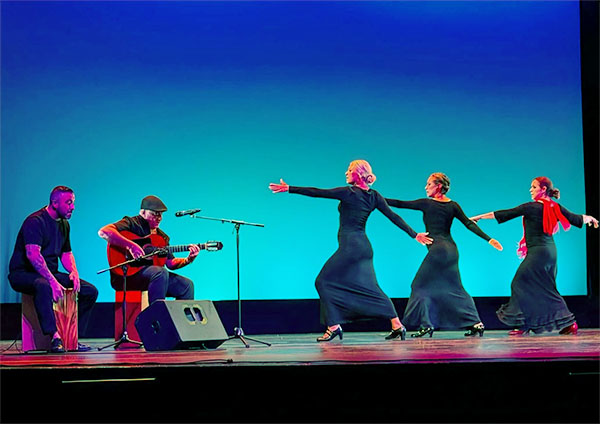
Antonio Arrebola, a dancer originally from Malaga, Spain, who is now based in Dallas, assisted with the choreography and will join her on stage along with eight other dancers from Atlanta, Kansas City and Dallas. Miami-based, Argentinian-born guitarist and composer Cristian Puig created original music, which he will perform live with Atlanta-based guitarists José Chirinos and Rouzbeh, percussionist Emrah Kotan and singers Macarena de Jerez and Joselito de La Paquera, who are flying in from Jerez, Spain, for the week of the performance. Sandra Hughes, the award-winning producing artistic director and founder of Gateway Performance Productions in Atlanta, is directing the show.
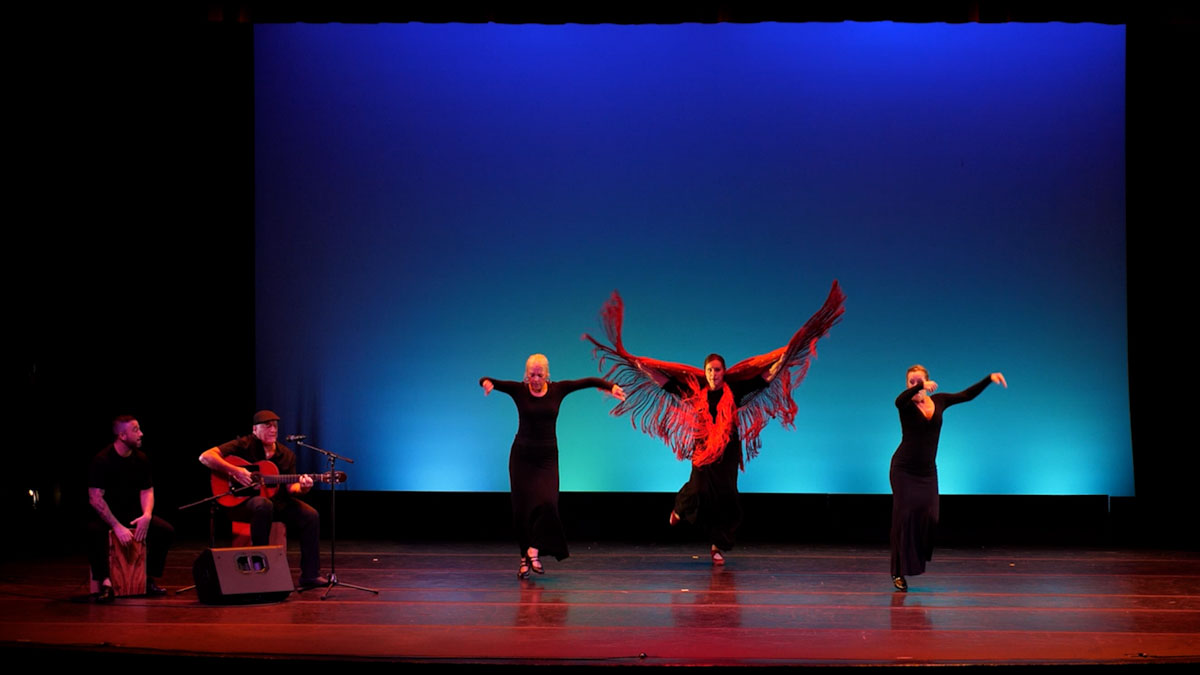
Galle describes Cosmic Assassin as a work anchored in tradition, created and performed by dancers, musicians and singers who have spent their lives studying flamenco and honing their craft.
“There’s a connection in flamenco between the movement and the music designed to bring artists and audience to this culminating, climatic moment marked when everyone cheers ‘olé,’” Galle explained. “Even though we’re using some different vocabulary, we are still within that musical structure, so the audience will still experience the emotional journey they expect from a flamenco concert.”
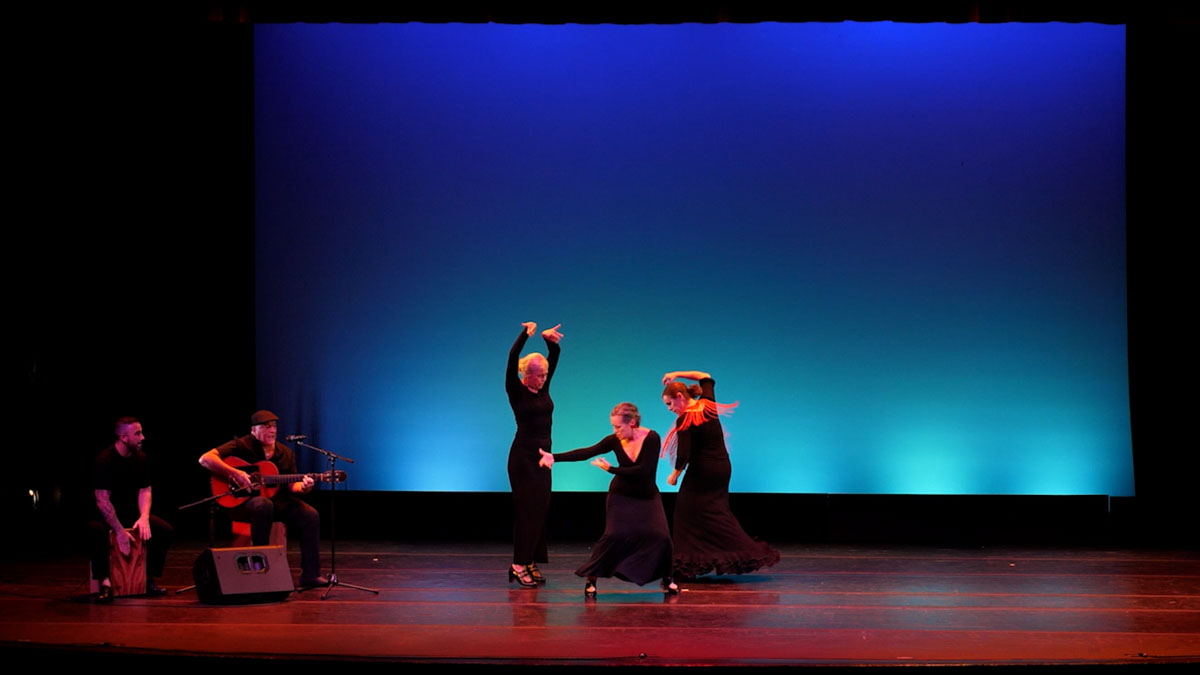
During rehearsal, Galle and fellow dancer Elena Markham demonstrated mastery of traditional flamenco technique, using arms and the gaze to define and command space around the torso where their nimble, twirling hands plucked at the air like starfish. Seeming to defy gravity, the pelvic core became a steady point anchoring the rest of the body through their gliding paseos, rapid footwork, dizzying turns and directional shifts.
Even with only two dancers and recorded music, one could sense within Cosmic Assassin’s choreography a greater rhythmic cycle that determined how melodic and percussive lines would transfer between the ensemble of dancers, musicians and singers. The dancers’ gliding promenades would erupt suddenly into a hailstorm of tapping heels and toes, their shoulders and hips almost floating above their furiously active feet. Gradually, the intervals where steps and clapping palmas marked time like a metronome became shorter, while the periods of cascading contratiempo lengthened, building toward catharsis with a progression familiar to anyone who has heard the ecstatic crescendo of a symphony or seen the explosive finale of a fireworks display.
With these classical elements of flamenco, Cosmic Assassin interweaves sounds and gestures from contemporary concert dance. Much of the new movement that Galle has fused with flamenco vocabulary was inspired by the rehabilitation exercises prescribed by her physical and occupational therapists as she recovered from seven surgeries over a period of roughly 18 months.
The score incorporates electronic composition that Rouzbeh created from sampling the sound of the MRI cold head.

Along with the skirt and scarf that compose a traditional flamenco dancer’s costume, Galle dons a futuristic piece of medical equipment known as a cold cap. Both women and men undergoing chemotherapy use cold-capping to freeze the scalp to prevent uptake of the drugs in that area and mitigate hair loss. It’s an expensive procedure, one that is only just starting to be covered by insurance. Galle subsidized her own cold-capping with a grant from the nonprofit HairToStay.
“ was dealing already with so many changes to my body,” said Galle. “So I pulled the ticket and went for cold-capping partly out of curiosity but also just because if it did work, I could have a bit less change. I surprised myself a little with my vanity and the fact I did actually care about what I looked like while going through everything.”
Cosmic Assassin explores the complex emotions, including the vanity, that Galle felt along the way — fear, pain, resilience and even joy.
“I was surprised by all of the support I received from friends who brought meals, went for walks, climbed up and pulled something down from this really tall shelf, accompanied me to chemotherapy more than once and even fixed the cold-capping machine once when it broke down,” Galle said. “I knew that I had friends. I just didn’t know I had such great friends, and then I saw that same network of support around other people getting their treatment.”
For Galle, Cosmic Assassin is ultimately an exploration of how art and community can sustain us, even when it feels like the world has been upended by crisis.
“It’s motivating to know these people helped you get this far,” she said. “And they’re counting on you to get through to the end.”
Cosmic Assassin. October 2 and October 3 at 8 p.m. Emory Performing Arts Studio, 1804 N. Decatur Road, Atlanta. Tickets cost $25 and can be purchased here.
::

Robin Wharton studied dance at the School of American Ballet and the Pacific Northwest Ballet School. As an undergraduate at Tulane University in New Orleans, she was a member of the Newcomb Dance Company. In addition to a bachelor of arts in English from Tulane, Robin holds a law degree and a Ph.D. in English, both from the University of Georgia.
STAY UP TO DATE ON ALL THINGS ArtsATL
Subscribe to our free weekly e-newsletter.

PLEASE SUPPORT ARTSATL
Your Gift Sustains the Coverage You Count On!
Related Posts