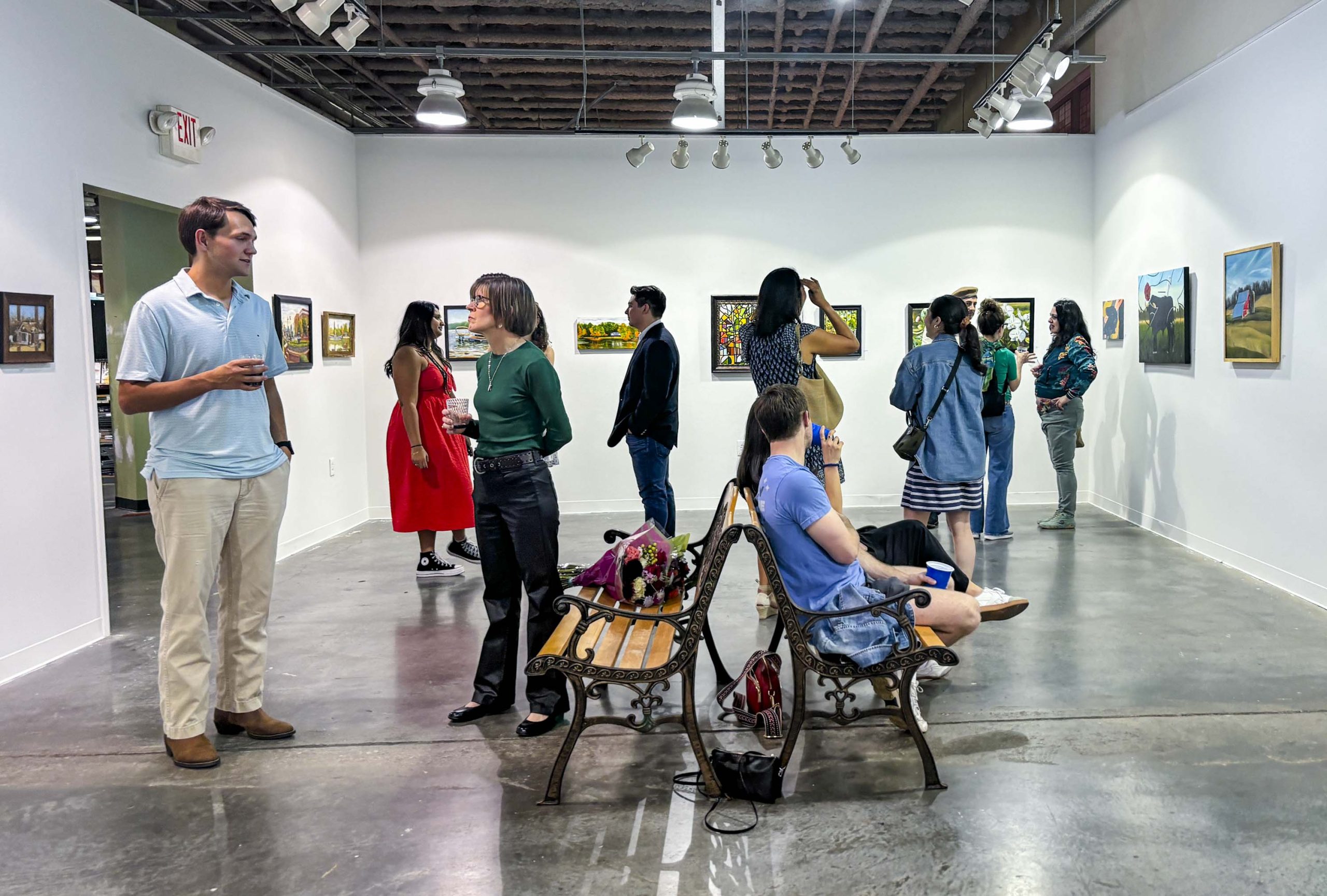
Playing with light: Armando Chacón and Dominic Bozzuto in ‘Off the Beaten Path’
Off the Beaten Path opened on March 7 at Limelight Gallery, located inside of Binders Art Supplies and Frames in Buckhead. The dual show features local artists Armando Chacón and Dominic Bozzuto. The works — including a mix of lyrical landscapes, plein air impressionistic nature scenes and striking paintings of horses — were inspired by unexpected and moving moments.
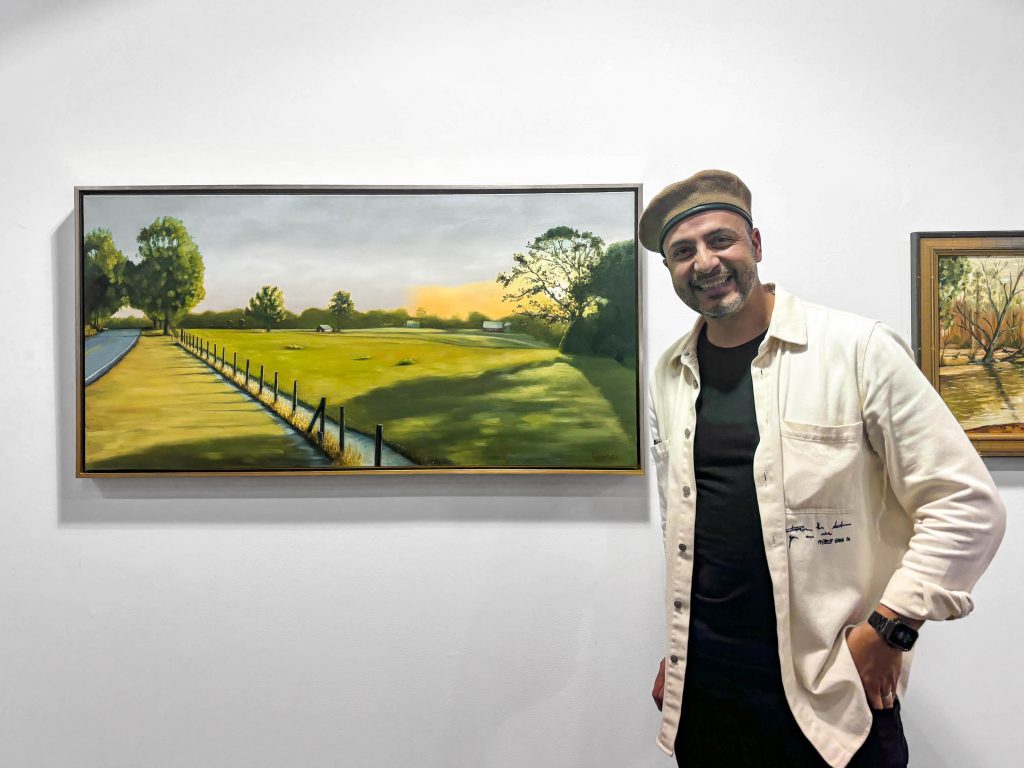
“The idea behind the theme is to discover places that you don’t always gravitate to,” said Chacón.
Guatemalan-born American artist Chacón’s work combines surrealism with realism, through which he explores culture, identity and spirit. Over his decades-long career, he has exhibited throughout the Southeast as well as participating in an artist residency at the Bakehouse Art Complex South Florida.
Meanwhile, oil painter Bozzuto’s work focuses on the beauty of rural life. Inspired by four years in Southwestern Pennsylvania and largely self-taught, Bozzuto has been drawing for as long as he can remember and started painting with oils five years ago.
While at a fair celebrating Binder’s 70th anniversary last year, Chacón noticed the similarities between his paintings and Bozzuto’s, so he suggested the idea of a joint exhibition. Chacón points out that Bozzuto is 24, which is the same age he was when he had his first solo show.
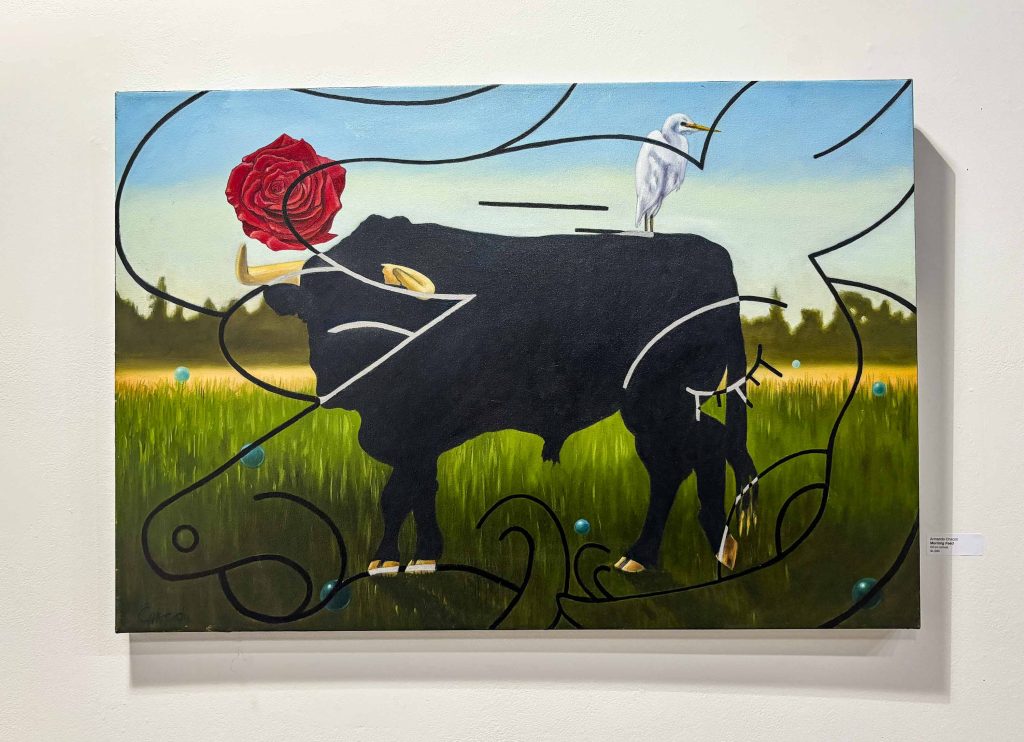
Among the selections for this show, Chacón’s Morning Feed stands out as an example of the artist’s penchant for blending surrealism with realism. He shared that the rose represents the roses thrown at a bull when it is killed by the matador according to the Spanish bullfighting tradition. The bird perched atop the bull indicates a real-life situation. And, finally, a beautiful and ghostly outline lingers over the bull, as if traced or lifted from the neighboring painting titled Sleeping Bull. The outline acts as both a makeshift frame and an actualized entity brought into the picture — or perhaps a bridge between worlds. There is something poignant about the juxtaposition of the solidity of the bull and the ethereal outline that overlays it.
In many works, Chacón incorporates orbs, which he said represent the soul. At times they are hidden within the painting and require a closer look to discover. “To me, just to see the soul as a non-ending object, kind of like continuous. It doesn’t have corners,” Chacón explained.

In a way, inserting these tiny, self-contained, continuous symbols into the frame helps the work live on. For example, an orb appears front and center in Monk for Peace, a recent piece inspired by the 2,300-mile “Walk for Peace” led by Buddhist monks through Atlanta just a few months ago. Chacón says that this painting marks a new style — featuring a figure with no head and arms — and has become part of his new series featuring figures with orbs as heads, which is meant to evoke the soul.
His plein air pieces capture still lifes of Atlanta scenes that are at once quintessential and yet often overlooked. There’s an entrance to Piedmont Park, a lovely scene from within the Atlanta Botanical Garden and a rendering of the grand Chattahoochee River, which snakes through the Northwestern edge of the city, but, for many city-dwellers, is seldom glimpsed and felt.
Chacón paintings make use of light, color and layers to transmit complex emotions. One of his favorite colors, yellow-ochre, was impossible to unsee everywhere once I noticed it. It shapeshifts through works set in each season: mustard in the spring and summer scenes, somber in the winter and golden-hued in the fall.
Bozzuto’s recurring image, the barn, was inspired by his time spent in the countryside of Pennsylvania. “We were at the border of suburbia and farmland, going on morning walks or evening walks, and I got to see these amazing views that I never saw growing up.”
In Bozzuto’s striking Farmhouse Sunset, light glows faintly inside a building beyond a partially broken fence, echoing the diffused, orb-like sun. “One of the things that I noticed when I was working on this exhibit — this gallery, making these pieces — was that we tend to take for granted a lot of the little things. This barn was like two right turns outside my house, and I just couldn’t believe I hadn’t paid attention to it,” Bozzuto said.
Chacón’s surrealist lens inspired Bozzuto to experiment with his own work. “I found myself working that out in my own work as well, trying to find elements that I could take it in a little bit of a different direction and find what I wanted to say in the piece,” Bozzuto said.
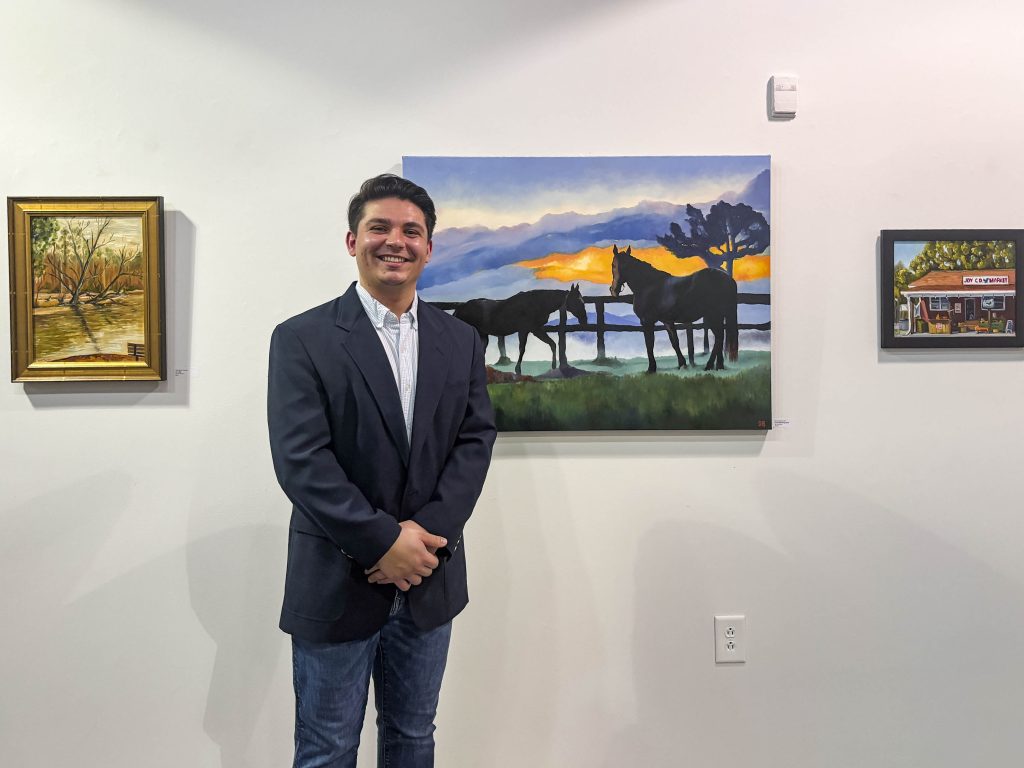
In the Morning Light evokes a liminal and fantastical place. Bozzuto says he was inspired by the sight of a tender moment between a horse and her colt early one morning. In creating the magic of the piece through the illusion of shadow and highlights, he workshopped the piece with Chacón and incorporated new techniques.
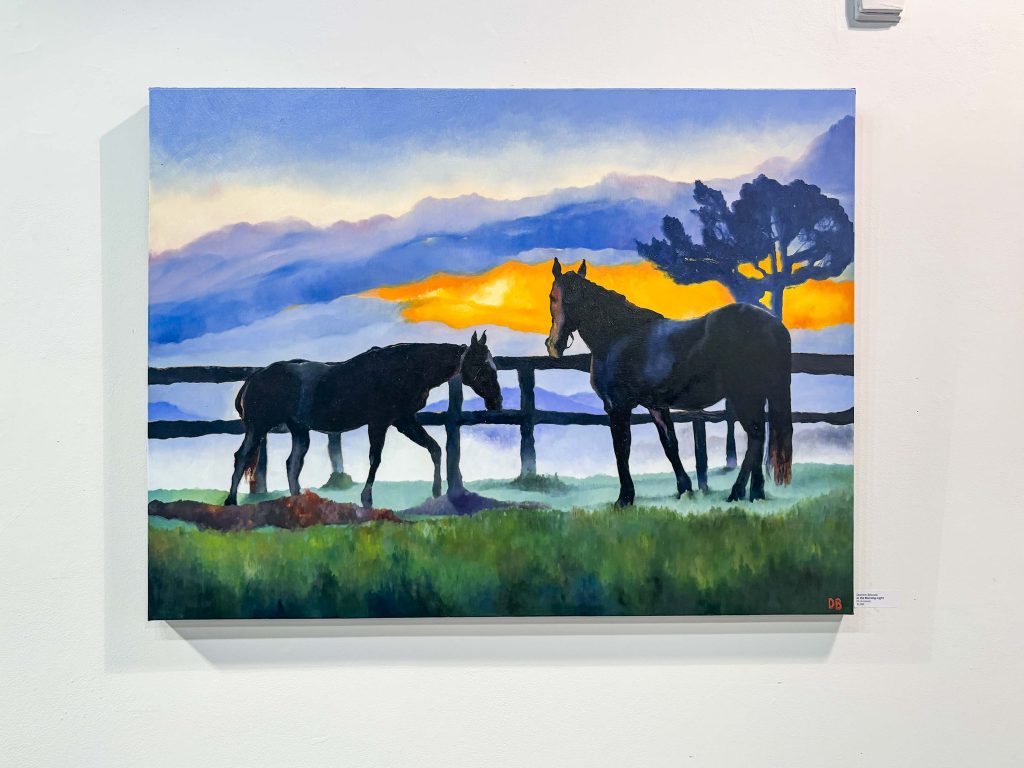
“It was a beautiful sunrise, but the colors from the grass and everything weren’t necessarily there. And so I just wanted to play with it a little bit, as far as colors,” said Bozzuto.
Chacón began exploring plein air painting 25 years ago, when a Ukrainian artist encouraged him to step outside his studio to join him outside to paint. Then began his fascination with capturing light. When painting nature, he likes to paint everyday scenes that stop him in his tracks without necessarily seeking them out.
Chacón says that Forest I was inspired by the stained glass windows of a church he once saw in Barcelona. The geometric shapes form a forest scene, set in the autumn, the changing leaves signaled by vibrant oranges and reds. Vertical lines represent trees, and faint flashes of purple in the sky come together to embody a playful embodiment of dimensions and light.
“I purposely left some strokes loose,” he said, and pointed to a portion on the bottom where brushstrokes are more visible. “That gives them more dimension, instead of being just flat or one plane.”
In the poster for the exhibit there is a field, the sky and the possibility of light, and I considered that perhaps it is this very interest in playing with light that links the two artists. Certain motifs recur across their work — Chacón’s orbs, Bozzuto’s barns. Sometimes central, sometimes subtle, their presence feels like questions. At the opening, visitors seemed to sense it as they lingered with each piece and moved in their own individual orbits through the room.
Off the Beaten Path will remain on view through March 28.
::

Mitali Singh is a writer whose work has appeared in ArtsATL, The AJC, The Creek and The Emory Wheel. She is passionate about storytelling, the outdoors and exploring the intersections between the arts and culture. She received a B.A. in English and Creative Writing and Environmental Science from Emory University.
STAY UP TO DATE ON ALL THINGS ArtsATL
Subscribe to our free weekly e-newsletter.

PLEASE SUPPORT ARTSATL
Your Gift Sustains the Coverage You Count On!
Related Posts