Photographic works in ‘Passing Glance’ challenge assumptions, loosen tethers to realism
For many years, the Goat Farm Arts Center has served as one of Atlanta’s most recognizable creative landmarks, a place where artists, performers and audiences mingled amid repurposed industrial buildings and sprawling studio spaces. Today, the neighborhood surrounding Foster Street is entering a new chapter. New residential development has brought additional activity to the area, The Museum of Contemporary Art of Georgia is preparing a major new facility at the site, and a growing cluster of artists and exhibition spaces is helping re-establish the district as one of the city’s most compelling destinations for contemporary art.
Among the additions is the The Pollinator Art Space, founded by Atlanta artist Sabre Esler and located on the Goat Farm campus. Its upcoming exhibition, Passing Glance, demonstrates exactly the kind of ambitious and thoughtful programming that can help transform a neighborhood into a cultural destination.
Juried by Nicole Lampl, curator at The Westmoreland Museum of Art in Pennsylvania, and organized by Pollinator Art Space Co-director Sean McCormick, Passing Glance brings together 28 artists whose work incorporates photography while deliberately pushing beyond conventional photographic practice. According to the exhibition statement, McCormick was inspired by photographer Emmet Gowin’s observation that “photography is so tethered to reality that the imagination seems repressed.” The exhibition seeks to challenge that limitation by showcasing artists who use photographs as starting points rather than finished products, and the result is an inventive new perspective on photography that frees the medium from its documentarian constraints.
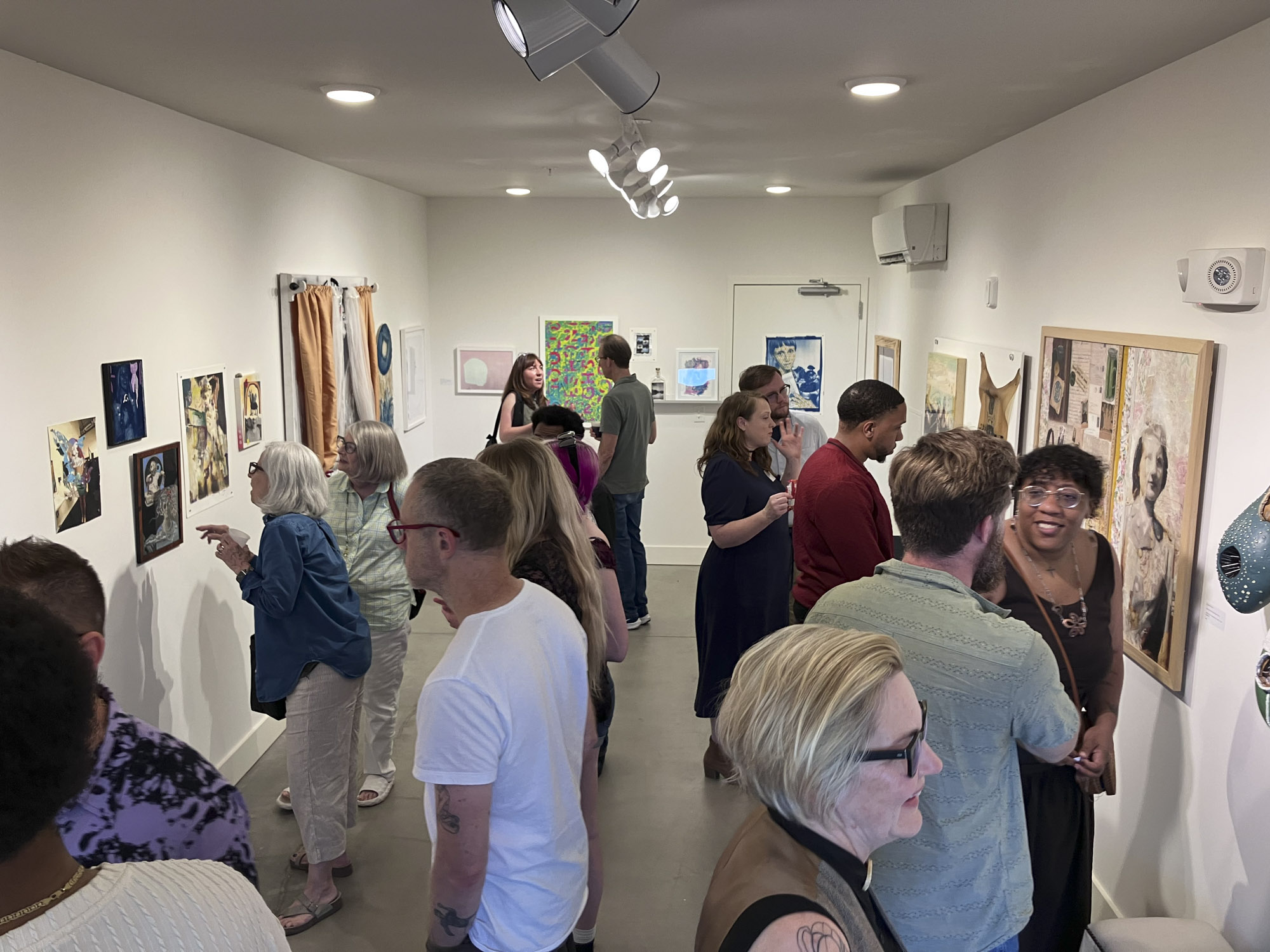
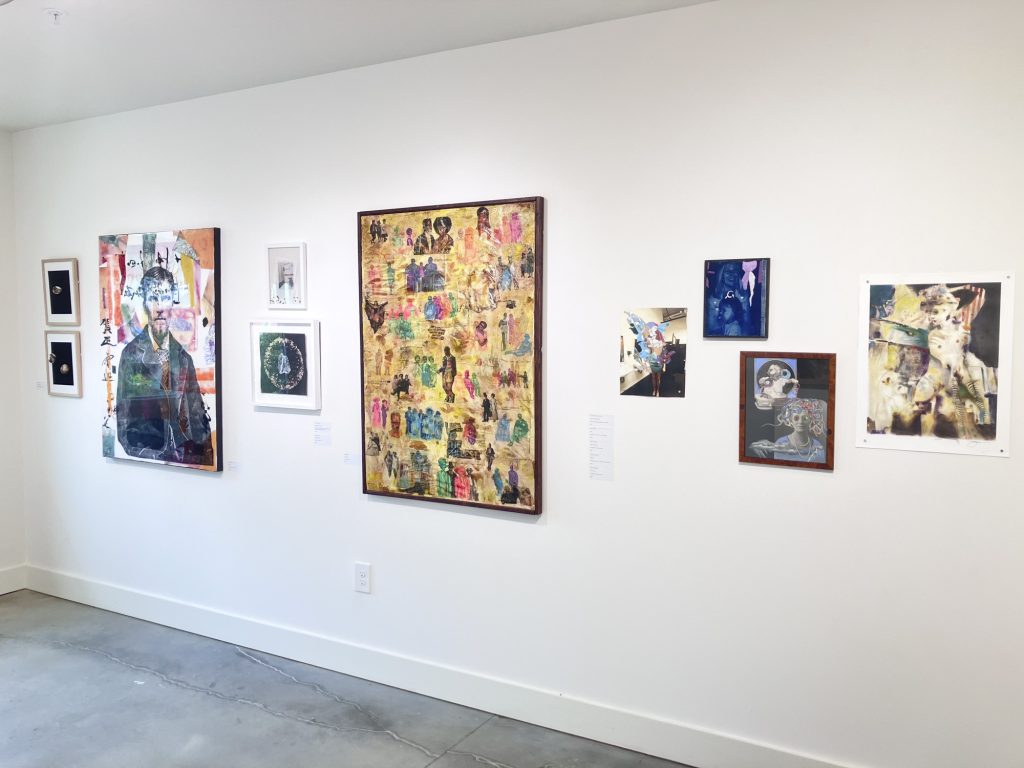
What becomes immediately apparent upon entering the gallery is that very little resembles what most viewers expect from a photography exhibition. Traditional framed prints are largely absent. Instead, photographs are stitched, painted, transferred, collaged, sculpted, pinned, layered and transformed into objects that occupy a space somewhere between photography, painting, assemblage and sculpture.
The exhibition’s title, Passing Glance, refers to those unexpected moments that catch our attention and compel us to look more closely. The works here reward exactly that kind of sustained observation.
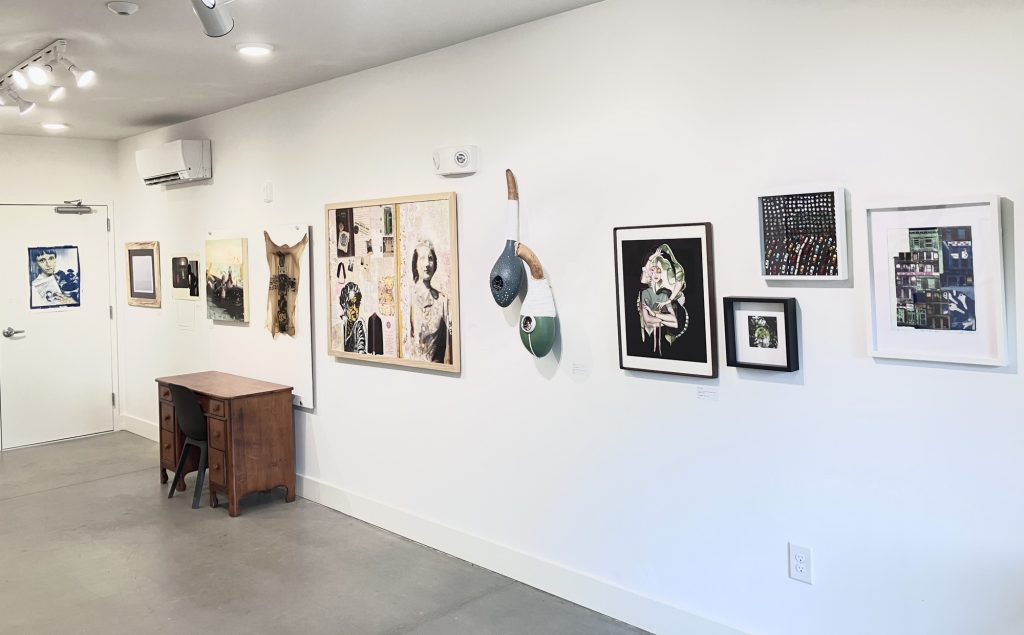

One of the exhibition’s most memorable pieces is Melanie Shaw’s Isolated on the Connector. At first glance, it appears to be a miniature traffic scene enclosed within a shadow-box frame. Closer inspection reveals that Shaw has deconstructed an archival photograph of Atlanta’s Downtown Connector and transformed it into a delicate assemblage of punched photographic fragments suspended by specimen pins. Tiny hand-painted automobiles weave through the composition; some are trapped in congestion while others appear to dart between lanes.
The piece is clever, meticulously crafted and unmistakably Atlantan. Yet beneath its humor lies a pointed observation. As Shaw notes, the work highlights the irony of a space designed to connect people while remaining filled with isolated individuals commuting alone through the heart of the city. What could have been a simple photograph of traffic instead becomes a sculptural meditation on urban life, movement and disconnection.
Melissa Brown’s What Comes First may be the exhibition’s most fragile work, both physically and emotionally. Brown transfers Polaroid images onto actual eggshells, creating portraits that seem perpetually on the verge of breaking. The process itself is remarkable; emulsion lifts are already delicate objects, but placing them onto eggshells introduces a new level of vulnerability.
Brown’s artist statement explains that the series reflects her anxieties and hopes surrounding motherhood. The eggshells become powerful metaphors for possibility, protection and uncertainty. Looking at them, one cannot help but think about how difficult they would be to transport safely, and that practical concern ultimately reinforces the work’s conceptual strength. These photographs are not merely images of people — they have become objects that embody fragility itself.
Kiki Olmeido’s cyanotype portrait Ana similarly demonstrates how photographic processes can be expanded through the artist’s hand. Created through a collaborative process with women who are navigating questions of identity, migration, motherhood and self-determination, the work begins with a photographic portrait which is then transformed through cyanotype printing and hand-applied ink interventions. Most striking are the patterned markings that cross the subject’s skin. The marks and prints function almost like maps, stitching together histories of geography, family and cultural inheritance. The result occupies an intriguing space between portrait photography, drawing and printmaking.
Kevin Brassard’s Patterns pushes even further into mixed-media territory. Built from photographs, transfers, collage, paint, marker and more, the work barely resembles a conventional photograph at all. Layers accumulate across the surface, creating visual depth and texture that pull the piece toward painting and assemblage. Brassard’s stated interest in combining old and new materials is evident throughout the work, which invites viewers to construct their own narratives from its fragments. For Atlanta viewers, the vibrant layering and material richness may feel familiar, as the piece evokes the large-scale mixed-media works frequently displayed throughout Hartsfield-Jackson Atlanta International Airport.
Among the exhibition’s largest and most theatrical works is Rolando Vázquez’s I Am Waiting For You. The Cuban-born artist draws inspiration from a little-known piece of cultural history — promotional images of nude women that once appeared inside boxes of cigars sold in Cuba. Vázquez enlarges one such image and transforms it into an immersive assemblage framed by curtains and theatrical elements, effectively turning the photograph into a peep show. The work forces viewers to become aware of their own act of looking. What was once a small image intended for private consumption becomes instead a public spectacle. Themes of seduction, mortality, desire and memory intertwine as the photograph transcends its original function and becomes something entirely different.
Collectively, these works demonstrate the success of McCormick’s curatorial premise. Photography has long occupied a complicated position within contemporary art; because of its direct relationship to reality, it is often understood as strictly a medium of documentation and evidence. And yet, the artists in Passing Glance repeatedly and successfully challenge that assumption. Here, photographs become sculptures, and portraits become objects. Documentary images become narratives, and surfaces become sites of intervention and transformation.
Rather than treating photography as an endpoint, these artists approach it as raw material.That fluid approach lends Passing Glance a refreshing sense of experimentation. At a moment when billions of digital photographs are produced and consumed every day, the exhibition asks what happens when artists physically engage with photographic images again — cutting them apart, painting over them, transferring them onto unexpected surfaces and rebuilding them into entirely new forms.
The answer, as this exhibition demonstrates, is that photography can become truly imaginative again.
Passing Glance succeeds not only as a group exhibition but also as a persuasive argument. If photography is indeed tethered to reality, as McCormick suggests, the artists gathered at The Pollinator Art Space have found numerous ways to loosen those bonds. Their works remind us that, yes, photographs can document the world, but they can also invent new ones.
For an emerging gallery situated within one of Atlanta’s most promising cultural districts, that is an impressive statement of purpose. Passing Glance will be on view June 4 through July 25. The gallery is open Fridays and Saturday from 11 a.m. until 3 p.m., along with viewings by appointment.
::
Matthew Terrell works as a writer, artist, filmmaker and educator in Atlanta.
STAY UP TO DATE ON ALL THINGS ArtsATL
Subscribe to our free weekly e-newsletter.

PLEASE SUPPORT ARTSATL
Your Gift Sustains the Coverage You Count On!
Related Posts