Review: Demetri Burke’s exhibit at MINT features delicate, mysterious portraits
An energy crackles through each piece of Demetri Burke’s solo show, And Then We Heard the Thunder, currently at MINT gallery. It weaves through a series of paintings of figures that are caught in seemingly private or unguarded moments. These figures merge in and out of vast abstract backgrounds, leaving us uncertain if they are being submerged in, or emerging from, a mysterious source.
Burke is a MINT Leap Year Artist. And Then We Heard the Thunder, on show through February 19, is the first solo exhibit from MINT’s 2021-2022 Leap Year Artist lineup. Serving as MINT’s flagship program, the Leap Year program provides many amenities (including a solo show) for a rotating selection of five emerging artists from the Atlanta area.
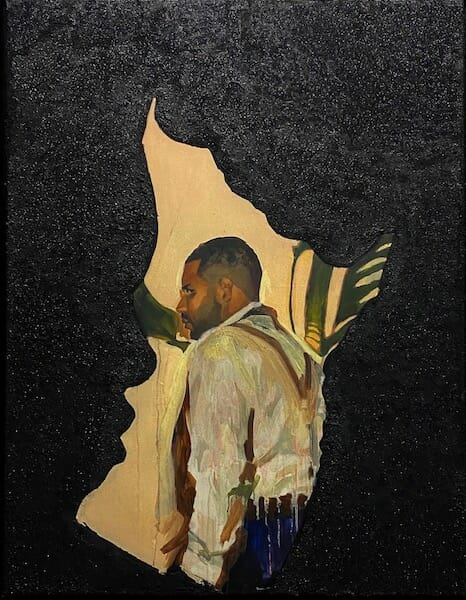
Burke utilizes many painterly techniques, including paint drips, luminescent light washes and obfuscating elements of collage. He uses an array of techniques for a number of figures in settings that seem to slip out from under them as they fall in and out of an indefinable void.
The figures in Burke’s paintings reveal a sense of vulnerability because they are depicted turned away from viewers or lying in repose. Almost all are dressed in what looks like formal wear. In “I am the sign of the letter and the designation of the division,” one could almost hear voices whispering between a silhouette of two figures huddled together, framing a third in the distance.
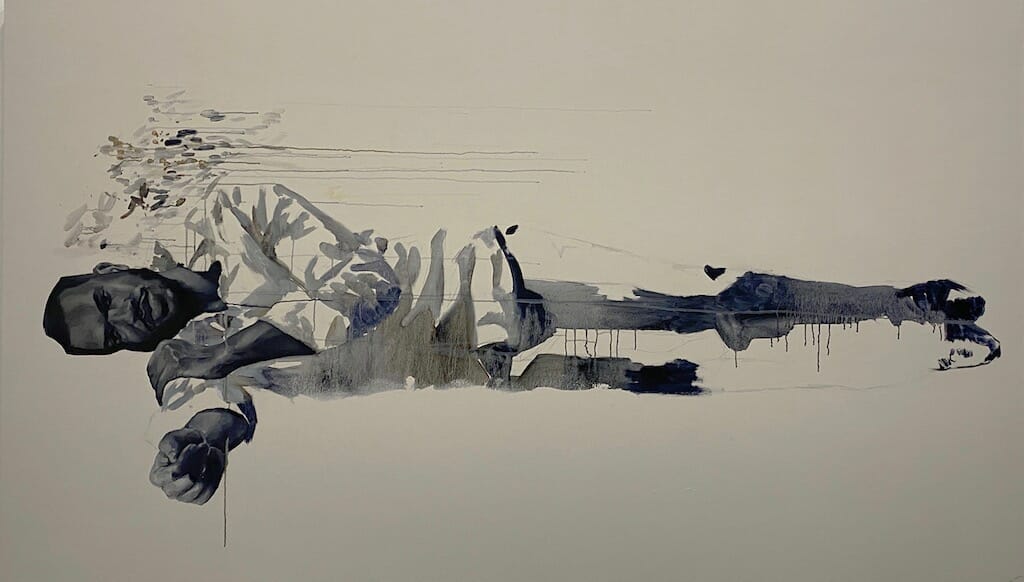
“And beauty smiled” portrays, in life-size proportions, a figure lying horizontally among an abyss of empty open space. Parts of the figure appear to be washed away with dried paint drips coming forth in multiple directions, indicating it was rotated as Burke worked on it.
Mixing portraiture with complete and utter blankness would almost seem frightening if Burke’s approach wasn’t so delicate. The way he paints his figures gives a feeling of weightlessness to them, as if they float through paint. Through embracing this sense of vulnerability in the paintings, Burke is able to impact us with such resoluteness. A certain confidence in this display of vulnerability draws us in, transfixing us in an unspoken exchange.
Burke demonstrates not only a sense of vulnerability within his figures but also in the methods he uses to illustrate them. A range of materials and media from DVD covers, to sequins, to grainy and rough-textured paint are riddled throughout the exhibition. It is as if Burke is peeling back the components of his paintings to reveal paint, paper and preliminary sketches across a number of surfaces.
His treatment over layers of paper is distinctive, with each depicting its own scene or obfuscating one. The varying mediums and surfaces used are evident, disclosing each painting’s materiality like an act of confession. Burke’s paintings are honest in their construction and profound simplicity while carrying the weight of these evocative scenes.
While the paintings at times appear sparse, this ultimately allows us to focus on the very intentional decisions Burke makes in terms of what does show through. What is it about these moments that cut through an immaterial abstraction, where things become vivid and the image sharper? The answers to these questions are not apparent and this is what makes the work fascinating.
Burke demonstrates tact with what is and isn’t shown between the figures and with the materiality of these paintings and their abstract domains. Burke’s choices as to what is or isn’t revealed draw us further in. In “Pushing aside poppy stems,” a reclining figure lies within a matte black background, fastening an earring. Only a few parts of this figure are visible as they emerge from the stark backdrop. As when our eyes adjust to a dark environment, we are given but the tip of the iceberg with this figure.

We are given enough information to understand what we are shown but not so much that it holds our hands the whole way through. It leaves us guessing, looking and searching for more, capturing the moment before we truly see what is in front of us. In this moment of possibility much has yet to be defined. It is a beautiful thing that Burke is able to tap into with his paintings throughout the show.
This body of work and the way it portrays its subject matter proves that less can be more. The parts, as opposed to the whole image, offer a more compelling foray into the genre of portraiture, and it’s through this that Burke works his magic.
The works have a poised and collected quality to them. Burke captivates us with this elegant grouping of works that reorients typical subject matter within portraiture while playing in and out of a realm of abstraction. What ends up being emphasized, per his artist statement, is a sense of anticipation. And Then We Heard the Thunder leads us into uncharted territory with these works, tenderly illuminating the moments before a seemingly long-awaited epiphany or realization, leaving us curious as to how and what will unfold next.
STAY UP TO DATE ON ALL THINGS ArtsATL
Subscribe to our free weekly e-newsletter.

PLEASE SUPPORT ARTSATL
Your Gift Sustains the Coverage You Count On!
Related Posts