“Extension of Nature” brings moving art to downtown Atlanta’s digital billboards
Looming over four separate downtown Atlanta streetscapes, a series of digital billboards have played host to an art intervention in the urban space that is unfolding at monumental scale. Extension of Nature, produced by Arts & Entertainment Atlanta and organized by curator Birney Robert, features the work of 10 artists that commandeer outdoor advertising space — not for commerce but for creative expression.
Extension of Nature (through July 31) asks what the possibilities are for artists to re-orient the commercial space of billboards to look away from commerce — and from the built environment — and instead to contemplate the natural environment and the planet itself.
With this motivating question, each of the four billboard locations is devoted to one of four themes drawn out by Robert: plants and seeds; plastics and waste; imaginary environments; and relationships.

Margaret Mitchell Square is the site of the “plants and seeds” collection. Here, Peter Bahouth’s video in triptych, Vent (2016-2023), stands out. Typically working on the intimate scale of stereoscopic viewing contraptions (think high-end View Masters,) Bahouth goes large, presenting gushers of what looks like smoke in saturated hues billowing through dense foliage.
The color combinations — purple, green, blue, fuchsia — are so heightened as to appear at once seductive and dangerous. It’s as if an abused Earth has risen to seek revenge. Mark Leibert’s Bloom (2005) similarly casts blooming flowers. Rotoscoped from a 1950s Monsanto Chemical Company ad in flat, bright colors, they both are alluring and slightly uncanny.
Iman Person’s New Air (2021) presents unassuming globes of wild, weedy plants in a desert environment, blowing stiffly in a breeze. We can imagine pollen spores, thistles, seeds and all manner of contingent life taking flight in a moment. For Person, this flight also is tied to notions of memory, global movement and diaspora.
All the videos in Extension of Nature are necessarily short, sandwiched between much longer and generally glitzier advertisements. How the artists engage motion and stillness therefore matters a great deal in creating breathing room for the work to exist.
Prana by Daniel Phelps (2023) engages movement by seeming to animate an entire segment of the north-facing facade of the hotel Reverb by Hard Rock. In a stunning feat of digital trompe l’oeil, a rusted and disused cellphone tower appears to sway from within the building before being reclaimed by a relentless growth of vegetation. An almost lyrical pas de deux plays out between natural forces and man-made intrusions. As a kind of aesthetic Easter egg, the work’s illusion is most satisfying only after making a trek down to the most significant patch of undeveloped, open land in the area.
The Reverb billboard houses the “imaginary environments” themed works. These include the Phelps work as well as Inspired Action Design’s Photosynthetic Diodes (2023) and Chanell Angeli’s Soul Mother (2023). Inspired Action Design’s work features a shimmering mosaic of animated tesserae that flow and assemble into organic, plant-like shapes. And Angeli’s flowy, collage-like composition depicts Black women in loving mutual attention, both embodying and engulfed in richly colored flora. Angeli’s typical practice of using tactile and sculptural elements is translated here to architectural scale.
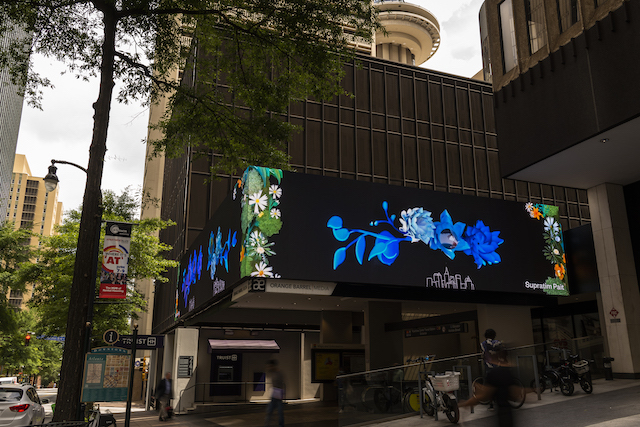
Just outside the Peachtree City MARTA station, Supratim Pait’s Bread & Butter (2023) and Close (2023) are in some ways the inverse of Phelps’ Prana. Within the kaleidoscopic animation of Bread & Butter’s blooming 3D digital flowers, small vignettes of daily urban life erupt and retreat: people on the street, a lively discussion, joined hands. In Close, a couple dances in silhouetted outline. Both works, falling under the “relationships” rubric, suggest nature as a metaphor for urban experience or perhaps even a cradle for it as we humans figure out our relationships with each other and the wider world.
A trio of works at 101 Marietta tackle ideas around plastics and waste. Sculptor, installation artist and environmental activist Pam Longobardi has been shining a light on the issue of plastics in the Earth’s oceans since 2006. In Drifter’s Project Sites (2008-2013), Longobardi reveals the process of dredging plastics out of the ocean through documentary film stills.
The video closes with a rapid-fire montage of worn and discarded plastic trinkets retrieved from the sea: scarcely identifiable items such as combs or a spatula that have taken on the patina of an archaeological find. Longobardi imbues the artifacts with a timeless beauty, even as they signal disaster for the Earth.
Rounding out the theme of plastics and waste, Bojana Ginn’s Plastic Gene (2022) sculptures explore the use of organic and synthetic polymers in abstract forms, and Kevin Beasley’s micro-documentary, Bulk Amnesty (2023), puts a spotlight on city of East Point garbage collectors as they retrieve the bulk refuse shunted off by residents.
At mostly under 30 seconds, the videos in Extension of Nature are too short to expect the kind of space required for extended contemplation. But for the alert viewer, they are perhaps enough to punch a small hole in the thrum of daily existence. They provide a “wait, what was that?” moment as an unfamiliar image flashes across a screen. And in that moment, in an intake of breath before the next onrush of life, the creative voice of the city rings out.
::
Cinqué Hicks is a Warhol grant-winning art critic and writer who has written for Public Art Review, Art in America, Artforum.com, Artvoices and other national and international publications. He has served as senior contributing editor of the International Review of African American Art and as interim editor-in-chief of Art Papers. He was the founding creative director of Atlanta Art Now and producer of its landmark volume, i.
STAY UP TO DATE ON ALL THINGS ArtsATL
Subscribe to our free weekly e-newsletter.

PLEASE SUPPORT ARTSATL
Your Gift Sustains the Coverage You Count On!
Related Posts