‘Bullfrogs’ opera jolted audiences with musical madness
To call the theatrical experimentation that is Majid Araim’s Regarding Bullfrogs and Universal Power Dynamics an “opera” is to stretch the outer limits of the word.
Atlanta composer and multi-instrumentalist Araim premiered this new opera December 12 and December 13 in the First Existentialist Congregation of Atlanta’s hall. For the musically adventurous, it was a surrealist spectacle to behold.
Performers festooned in simple black clothes with ominous forest creature masks cavorted on a darkened stage as Araim’s aggressively unorthodox music burst forth from members of the Atlanta Improvisers Orchestra. The result was a frequently chaotic and always haunting spectacle whose success hinged on the viewer’s willingness to abandon all expectations and stylistic boundaries.
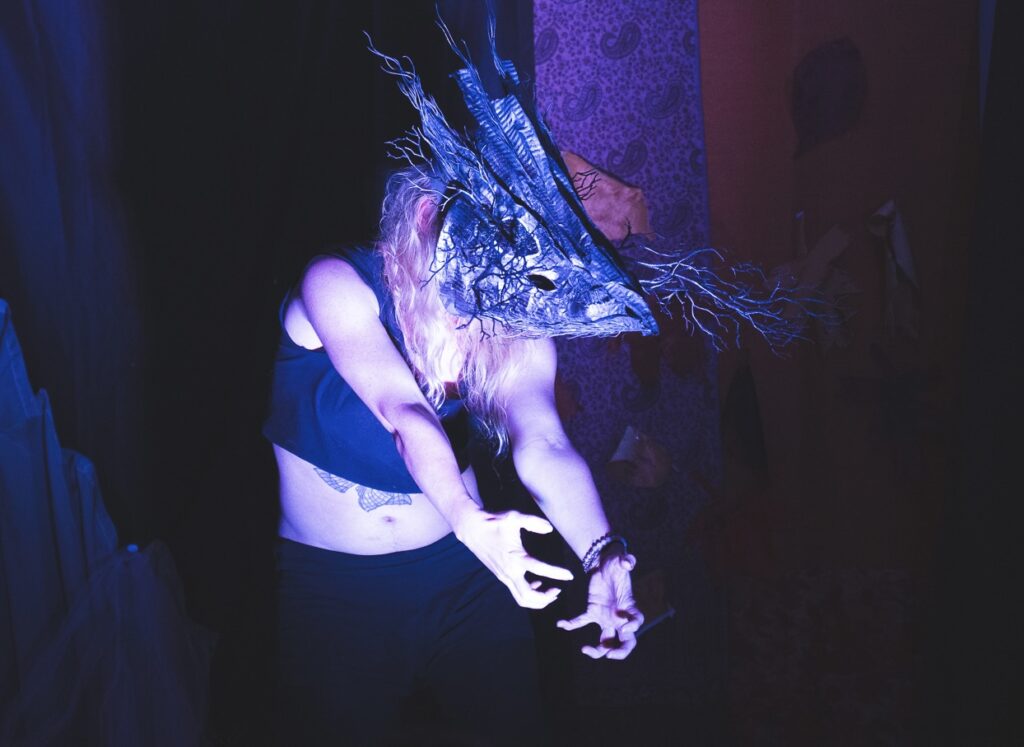
The appeal of Regarding Bullfrogs began with its visual spectacle. Set designer Priscilla Smith’s backdrop was minimalist and mainly served to accentuate the stage lighting, but it provided ample room for the costumed performers to move about in masks designed by Katya Kouznetsova.
These masks, with their uncanny ghoulishness, gave the music, story and interpretive dance that surrounded them a centerpiece to build around. The characters — wild animals and assorted mystical beings — drifted in and out of the shadows in unsettling constructs that called to mind the nightmare realms of David Lynch and Lars Von Trier.
It cannot be overstated just how much Kouznetsova’s designs worked to sell Regarding Bullfrogs as a performance piece. They were both unnerving and captivating, and that dichotomy served as the visual anchor for an hour of severely odd musical madness.
The performers — outstanding among them multimedia artist Hazel Cline and glo dancer Zandia Covington — moved through a series of feral contortions while their pre-recorded vocals (triggered by Araim from the orchestra below) told of an animal kingdom confronting trials and tribulations that bore a striking resemblance to the societal setbacks and cultural iniquities being reckoned with in today’s human world.
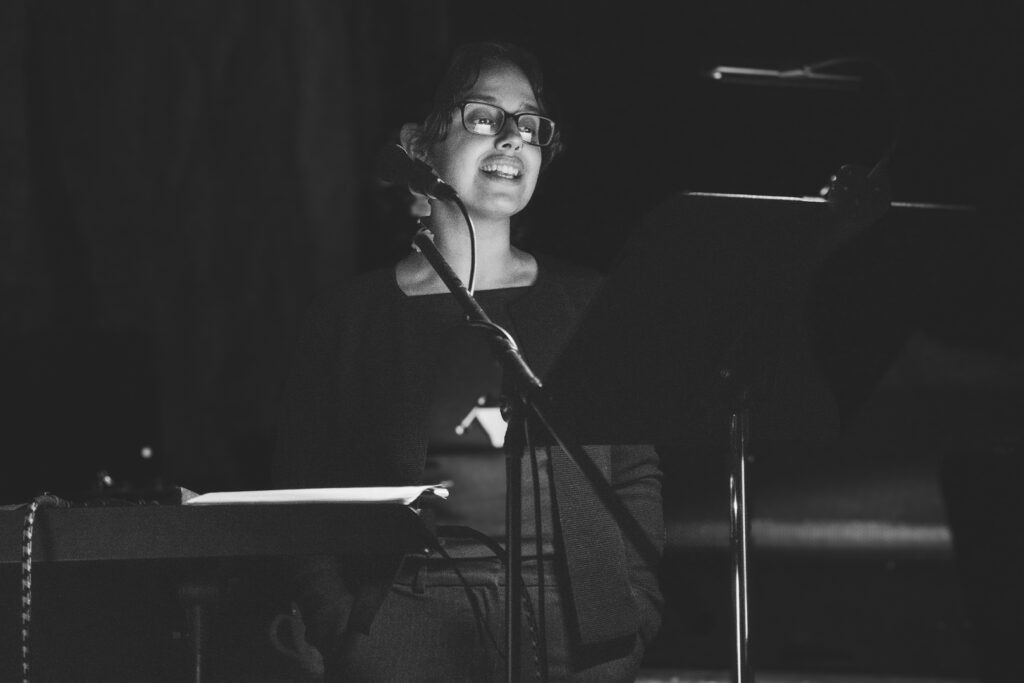
“Folks seem to really not understand how people live that aren’t just like them,” said Araim of the piece’s themes in a conversation after the show. “People have a hard time coming outside of themselves to witness anything foreign. My hope is that people go home and ask themselves questions.”
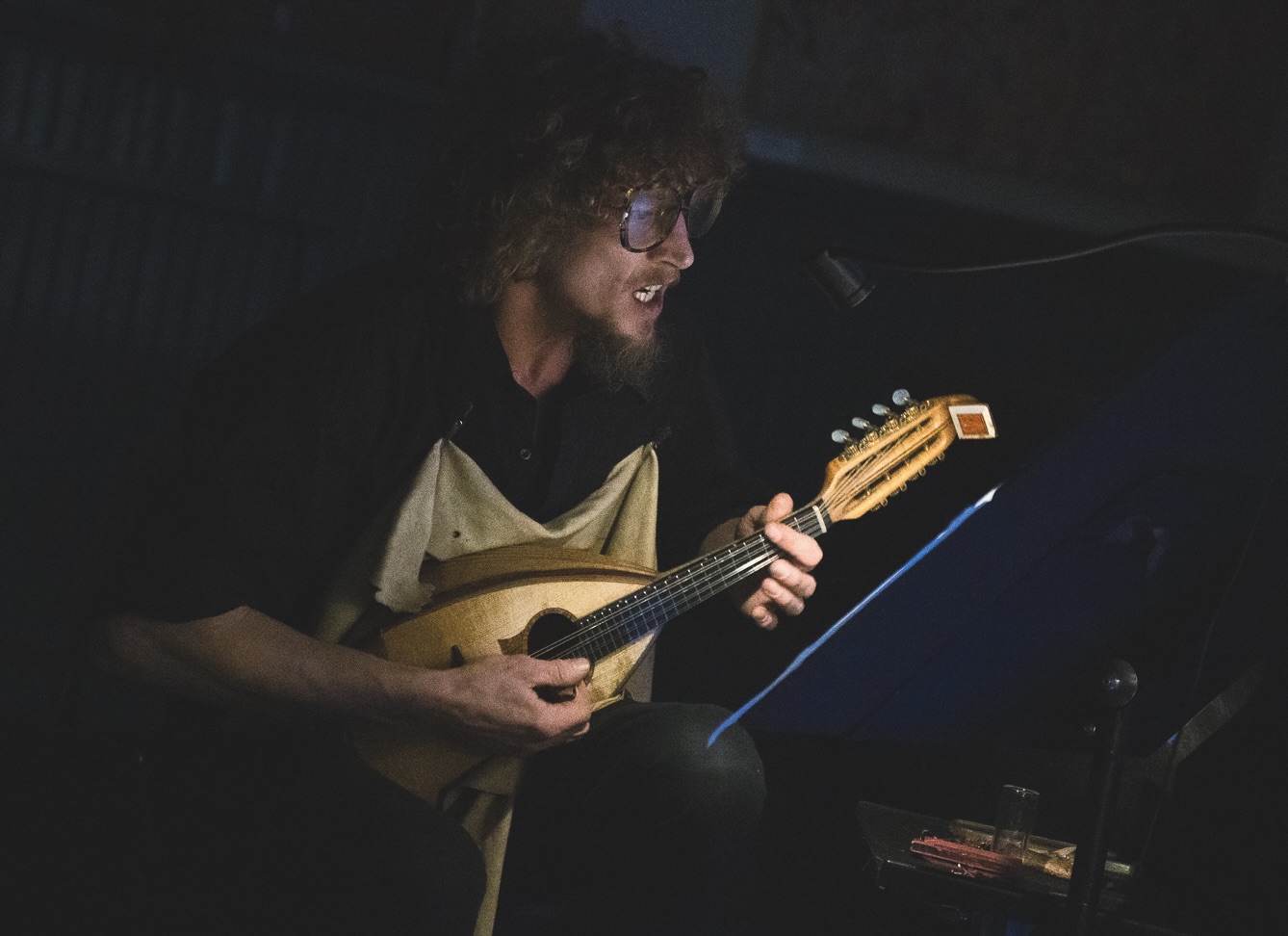
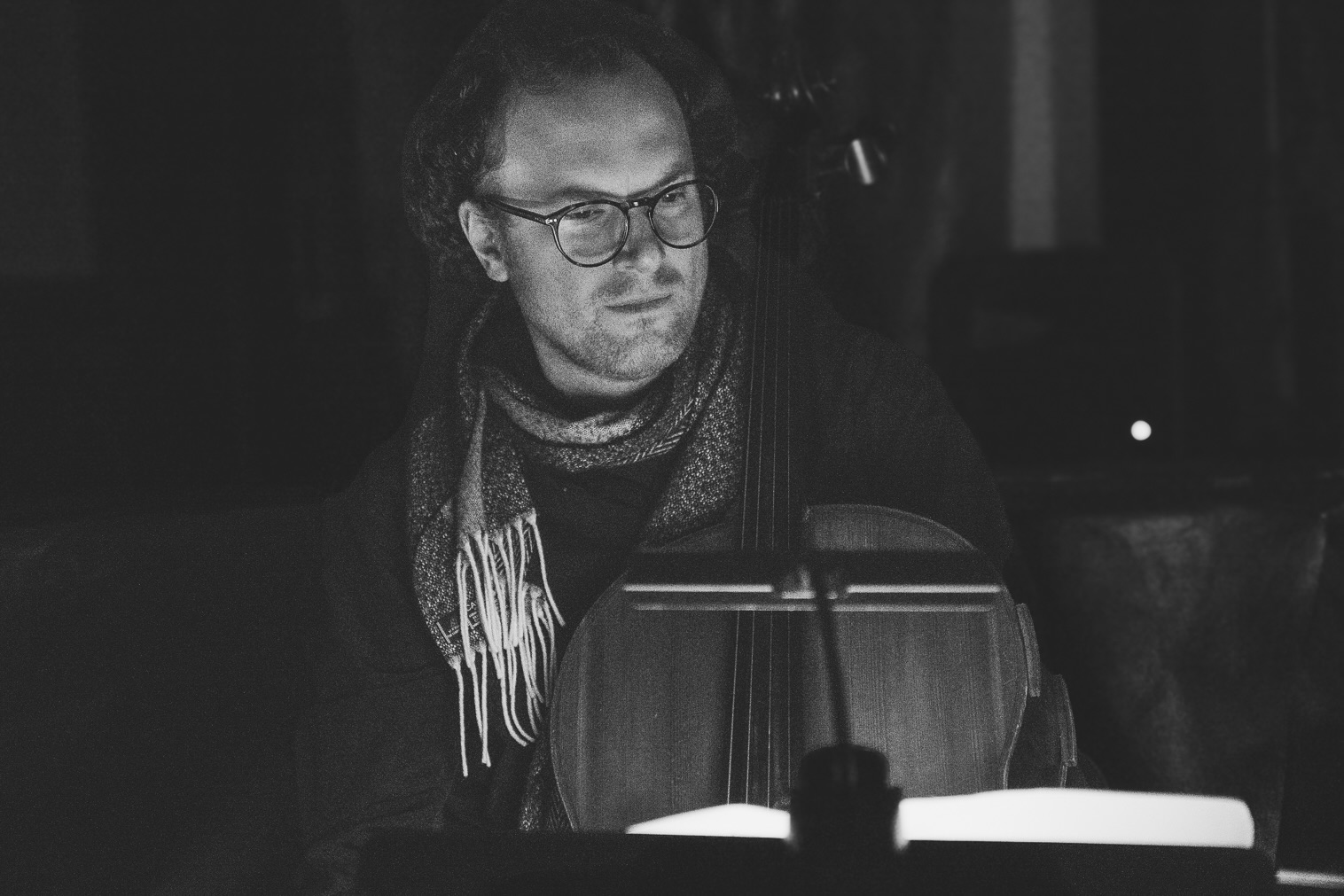
Assisting Araim in that endeavor was an orchestra consisting of Jeff Albert on bass trombone, Benjamin Shirley on prepared cello, Paul Stevens on percussion, and Araim on mandolin, voice and sampler. Rounding out the ensemble was vocalist and electronics manipulator Monique Osorio who narrated the proceedings.
The music was the piece’s most polarizing aspect. Sometimes there were moments of harmonic, textural and rhythmic brilliance. Other times it felt like the inmates were running the asylum. The players seemed to be working off of an internal cohesion that wasn’t immediately apparent to the audience. Long, mournful trombone phrases and expansive cello soundscapes shared space with a bevy of percussion sounds that existed more to accentuate the unfolding drama than to provide a rhythmic undercurrent.
Words like “demented” and “jarring” are compliments when describing what unfolded in the atonal auditory strangeness of Regarding Bullfrogs; the instruments seemed to attack each other as often as they worked together. But it all served to create a darkly beautiful dream world that immersed the listener without overstaying its welcome.
Araim is hesitant to say too much about his influences but mentioned modern composers Roscoe Mitchell, Anthony Braxton and George Crumb. It’s clear that he wants Regarding Bullfrogs to exist in its own stylistic headspace — not that it could exist anywhere else.
While Regarding Bullfrogs succeeds as experimental musical theater, that success will only be appreciated by a select few audiophiles and eccentrics. Fans of The Residents or Rock in Opposition acts like Henry Cow will find the nightmarish world of auditory and visual disarray captivating, while attendees looking for something familiar will be confused and disoriented.
That’s the constant gamble with experimental music: When it pays off, it takes listeners on a journey into the outer reaches of creativity but can leave even open-minded listeners confused when it fails. As such, the true litmus test for the experimental composer is the creation of avant garde work that is able to connect with mainstream audiences without abandoning its conceptual integrity. Mike Oldfield’s Tubular Bells or Philip Glass’ Koyaanisqatsi are great examples.
By contrast, Regarding Bullfrogs will likely satisfy only the outer fringes of concertgoers. It will be interesting to see if Araim ever produces a composition that reaches mainstream audiences and extremists alike.
::

Jordan Owen began writing about music professionally at the age of 16 in Oxford, Mississippi. A 2006 graduate of the Berklee College of Music, he is a professional guitarist, bandleader and composer. He is currently the lead guitarist for the jazz group Other Strangers, the power metal band Axis of Empires and the melodic death/thrash metal band Century Spawn.
STAY UP TO DATE ON ALL THINGS ArtsATL
Subscribe to our free weekly e-newsletter.

PLEASE SUPPORT ARTSATL
Your Gift Sustains the Coverage You Count On!
Related Posts