
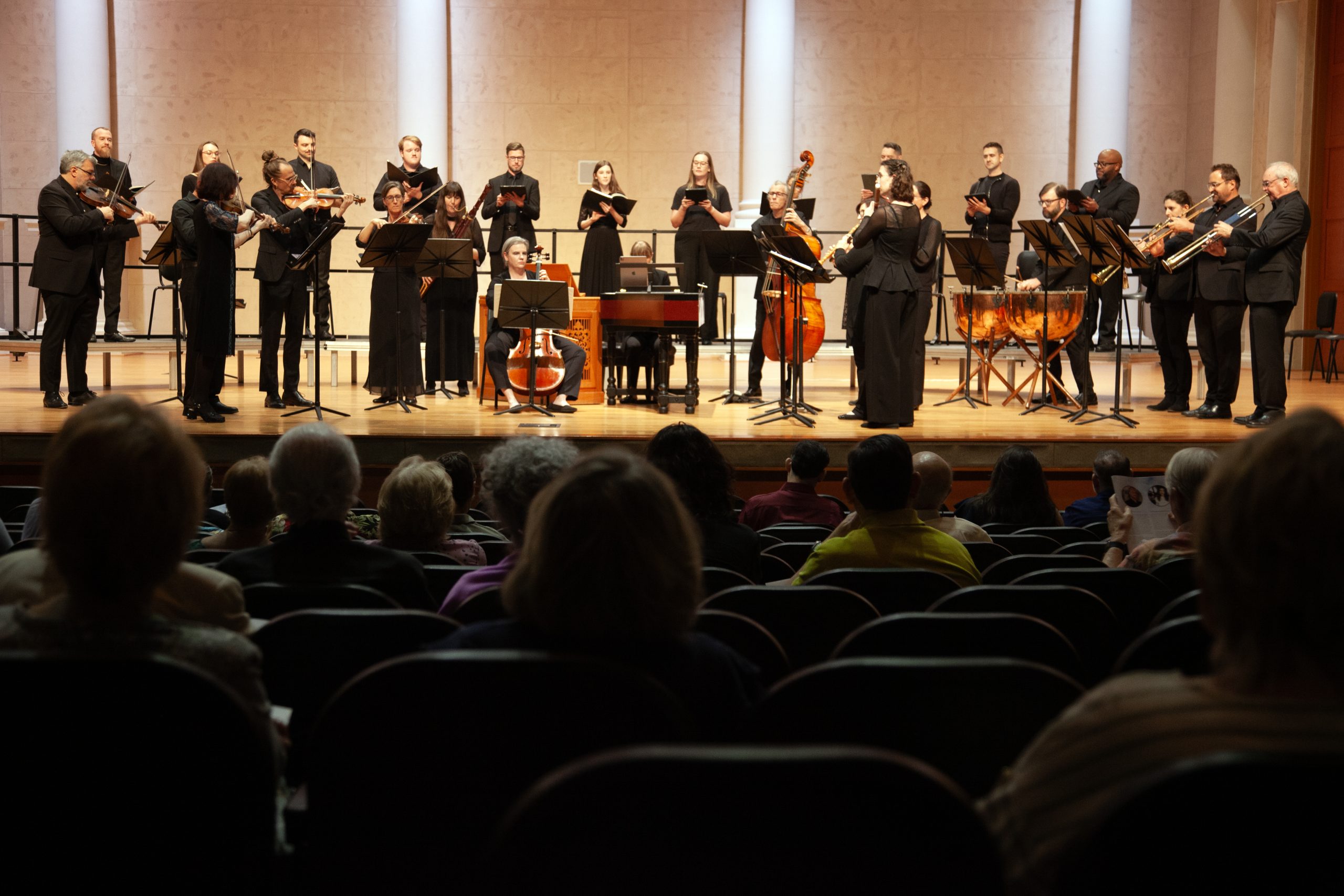
Atlanta Baroque Orchestra breathes fresh vigor and vitality into time-worn material
There’s been a recent surge in online content demonstrating how Bach’s music would have sounded on the instruments of his time. It does seem odd that the instruments modern listeners most closely associate with the composer — modern pianos, strings and woodwinds — sound nothing like what he actually had in mind. That core discrepancy seems to be a motivating force for organizations like the Atlanta Baroque Orchestra who perform such works on period-accurate instruments.
My thoughts were full of those recent viral videos as I went into the ABO’s April 18 performance of Ascension Oratorio, a program first played April 17 at Glenn Memorial Church with a third and final performance to follow on April 19 at Lutheran Church of the Ascension in Savannah. Those videos showcase the uncanny sonic realm that emerges when harpsichords, clavichords and the like are played without the appropriate acoustic accommodations: Chords sound brash and smushed together, melodic notes are tinny and tedious and the whole experience feels like only a jumbled echo of the transcendent glory we normally associate with Bach.
A scheduling oversight of my own had resulted in my attending the Lassiter Concert Hall performance, and I went in concerned that I would be doing the ABO a disservice by hearing the concert in the paltry confines of a high school auditorium. Memories of my own teenage years in such spaces — with their booming, cavernous acoustics that seemed intentionally designed to warp the listening experience — left me wondering what musical contortions awaited.
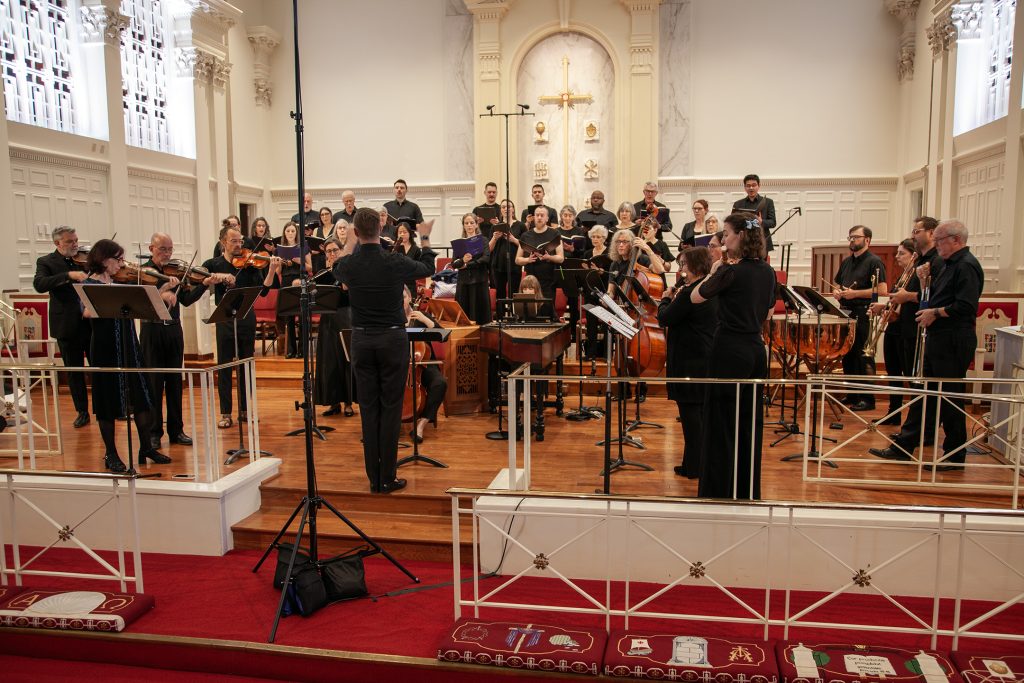
I needn’t have worried: Lassiter Concert Hall proved to be a sprawling pantheon of transcendent acoustic architecture that served to address my concerns. I was wholly unaware that there were public high schools in this country with concert halls that could stand alongside Emory’s Schwartz Center for their pristine acoustics and lavish design.
That stellar acoustic space gave the afternoon’s opener, George Philipp Telemann’s Concerto for 3 Trumpets and Timpani, TWV 54:D3, the kind of rousing pomp and circumstance it deserves. The harpsichord was chipper and robust, the horns warm and sonorous and the winds intersected with the strings in a mutually complementary manner. It was a testament to how much instruments from the time period relied on the space itself.
The afternoon’s second piece, cantata Ihr Lieben, glaubet nicht einem jeglichen Geist, GWV 1140/45, was dominated by an engaging performance from tenor Thomas Cooley, whose deep, resonant tone remained tastefully restrained and conversational throughout. That sort of gentle relatability served as a reminder that for all its regal trappings, this is still an intimate, personable art form not all that removed from the folk stylings of the day.
The acoustics were less helpful to flutist Ellen Sauer Tanyeri, whose wooden instrument lacked the piercing tonal strength of its silver-plated successor and thus was mostly lost among the other players. Her featured piece, Johann Sebastian Bach’s Orchestral Suite No. 2 in B minor, BWV 1067, was thus lacking in melodic presence. When Tanyeri did break through the larger ensemble, her performance was warm and enjoyable despite all the sonic obfuscation.
Bach’s Ascension Oratorio made up the afternoon’s second half and featured vocal soloists Michael Dauterman (baritone), Doug Dodson (countertenor) and Carrie Anne Wilson (soprano) alongside the returning Cooley and members of the Glenn Memorial UMC Chancel Choir. Dauterman, in stark contrast to the previous featured performers, came out loud and proud with a powerhouse delivery that threatened to obscure his accompanists completely. It was an arresting display of strength but also proof that the delicate balance of volumes in a baroque performance could tilt too far in the opposite direction as well. Dauterman fared better during the later trio with Cooley and Dodson.
Of all the afternoon’s vocal soloists, Dodson emerged as the most riveting. His soaring, falsetto-laden tone seemed less the product of a human voice than of a soul in the midst of divine possession. Wilson, by contrast, delivered a more conservative performance that echoed Cooley’s earlier restraint. It might have lacked the transcendent grandeur of Dodson, but it was a solid feature in its own right.
The Ascension Oratorio is written as a celebration of Christ’s ascension into heaven with all the divine majesty that implies. Where my recent commentary on the Atlanta Symphony Orchestra had criticized a moribund performance of Bach’s Mass in B minor, this afternoon found the Atlanta Baroque Orchestra breathing fresh vigor and vitality into time-worn material. The concert closed with a rousing rendition of the hallelujah chorus from Handel’s “Messiah,” a thematically appropriate close to a song cycle that soared ever upward.
::

Jordan Owen began writing about music professionally at the age of 16 in Oxford, Mississippi. A 2006 graduate of the Berklee College of Music, he is a professional guitarist, bandleader and composer. He is currently the lead guitarist for the jazz group Other Strangers, the power metal band Axis of Empires and the melodic death/thrash metal band Century Spawn.
STAY UP TO DATE ON ALL THINGS ArtsATL
Subscribe to our free weekly e-newsletter.

PLEASE SUPPORT ARTSATL
Your Gift Sustains the Coverage You Count On!
Related Posts

