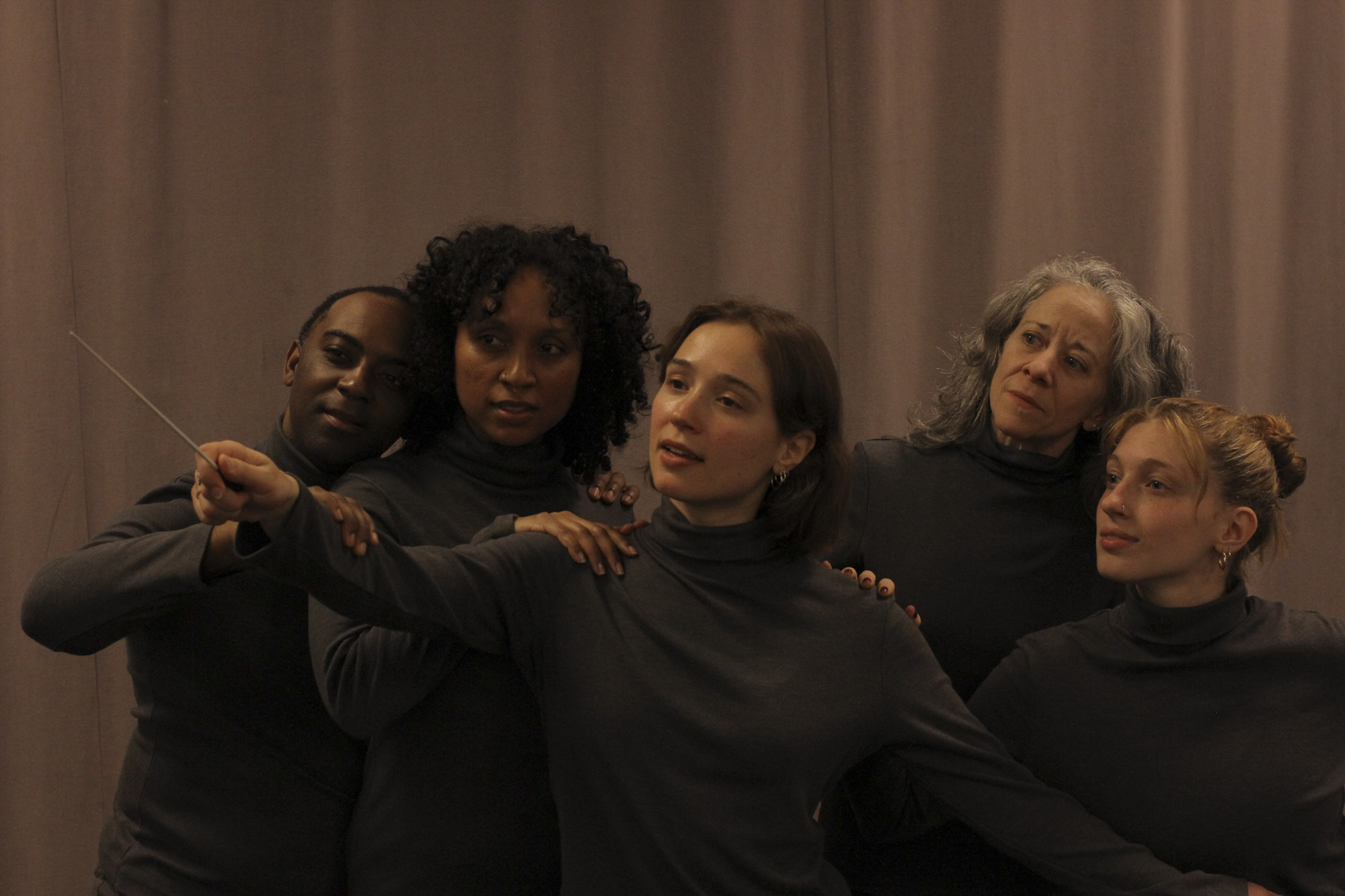
Rhythms of change: Emory Arts Dance Fellow Madelyn Sher explores what it means to conduct and be conducted
Madelyn Sher — born, raised and based in New York — is Emory University’s second arts fellow in dance. Her new work, A Note That Bends, will premiere on Friday and Saturday, April 24 and April 25 at the Schwartz Center for Performing Arts dance studio. The performance promises to offer a delightful demonstration of the magic that happens when working artists are given an opportunity to join the sprawlingly diverse and densely-networked community at a modern research university.
“Being on a college campus is amazing. There are so many resources here,” Sher told ArtsATL. In addition to working as a dancer and choreographer, she has training in music and musical theater passed down from her father, a jazz musician and teacher. Sher also honed her skills through education at Fiorello H. LaGuardia High School of Music & Art, the Macaulay Honors College at CUNY Lehman and Smith College, where she earned her MFA in choreography and performance.
Soon after arriving in Atlanta, Sher decided to audition for Emory’s University Chorus. “It has been great to have another creative outlet that involves a community of more than a hundred other singers,” Sher said. “I didn’t immediately know how that decision would impact my work this spring, though, until we performed Beethoven’s Ninth Symphony in October.”
The chorus does not join in the Ninth for the first three movements, so for approximately 45 minutes, Sher and the other singers had to sit, listen and watch the musicians play. “I worried it was going to be boring, but it was riveting! Not only because the musicians were amazing and that music is incredible but because I was fixated on the conductor’s movements.”
Soon after, Sher met with conductor Paul Bhasin, Donna & Marvin Schwartz professor of music and director of orchestral studies at Emory, to talk to him about where the gestural impulse comes from and how he learned to communicate through movement while conducting. He invited her to audit his conducting class, which she has been doing this spring while immersed in the creative process for A Note That Bends. The work explores what it means to conduct and be conducted and how those ideas might be communicated through dance.
“This is how I often work,” said Sher. “Once I have an idea, I just say: You know what — we’re going to dive in with more questions than answers.”
With four other dancers, Sher has combined improvisational research methods with techniques and vocabulary drawn from contemporary concert dance and the theatrical tradition of butoh to explore the conventions of musical performance. She considers how the stage is set, how the musicians behave, how they communicate through gesture as well as sound, how they cohere as an ensemble of bodies engaged in creating a single and ephemeral piece of art and how those conventions compare with other performing arts disciplines like dance and theater.
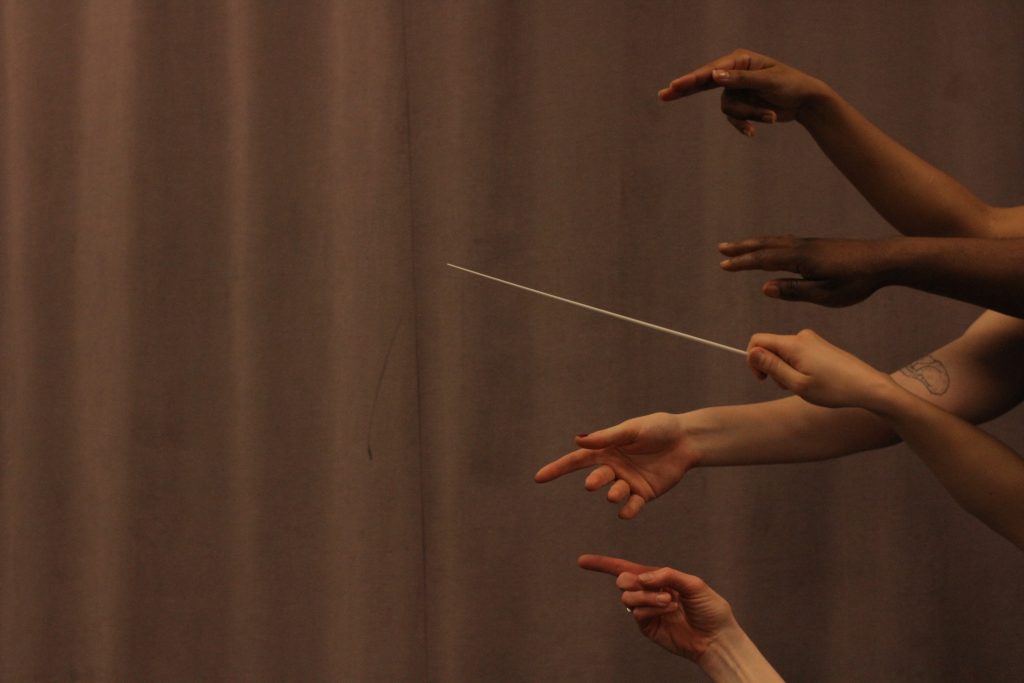
“I’m not necessarily interested in representing conducting or the orchestra or the chorus,” Sher explained. “It’s more about bringing to the forefront how we [use non-verbal communication] to impose our will on other people.” She said the process also brought into focus the important devices on the periphery of performance — like the cues of the conductor or the subtle shifts in posture of the first chair in a section — that remain invisible to the audience but play a crucial role in how they experience the show.
“So, for example, there’s a whole section of the piece that deals with stage directions, and the dancers are speaking these usually imperceptible words into the space. I’m curious about what that does.”
Watching, reflecting upon and then writing about a studio visit to observe Sher’s process has been — appropriately, given the title of the piece — mind-bending. In addition to collaborating dancers Amber Lux Archer, Lilia Cardosi, Corian Ellisor and Kristin O’Neal, Sher has brought in New York-based songwriter, singer, composer and instrumentalist Ryan Wolfe to create an original score, Kennesaw State University Assistant Professor in Dance Kristopher Pourzal as dramaturge, Atlanta-based dancer and artist Hayley Newell as costume designer and Emory dance faculty Gregory Catellier as lighting designer.
During rehearsal, Sher moved between her place within the performing ensemble to the front of the studio where she reviewed video captured on her laptop so she could offer notes to the other dancers and, possibly, her own alternate dancer persona.
Performing in and choreographing a work at the same time can be a risky proposition. Some artists have trouble retaining a bird’s-eye view and may unintentionally center their own experience of the work as a performer, as a consequence missing what other dancer-collaborators bring to the meaning-making process.
Sher appeared to be navigating her dual role thoughtfully and efficiently, however, and for this piece and this process, taking that risk makes sense. After all, in some musical performances, soloists conduct from their places at their instruments, actors and directors oscillate from behind to before the camera and jazz bands and improvisational theater troupes take their cues from one another as their art evolves in real-time.
Sher is also a pleasure to watch as a dancer. Her movement is supple and expressive, and she has a graceful, quietly-assertive presence — at least in this piece — that complements the personae Archer, Cardosi, Ellisor and O’Neal have evolved for A Note That Bends.
Ellisor and O’Neal are both frequent solo performers who have mastered the art of humor in dance, from subtle to clownish. As part of this ensemble, they became centers of gravity around which scenarios and groupings coalesced before breaking apart only to converge again in another configuration.
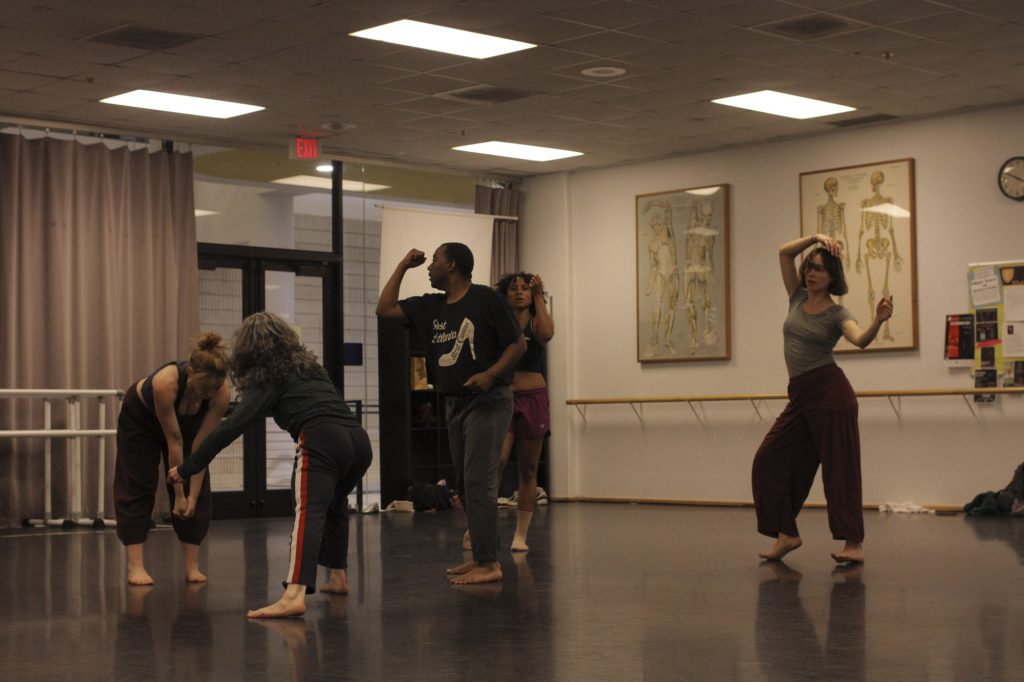
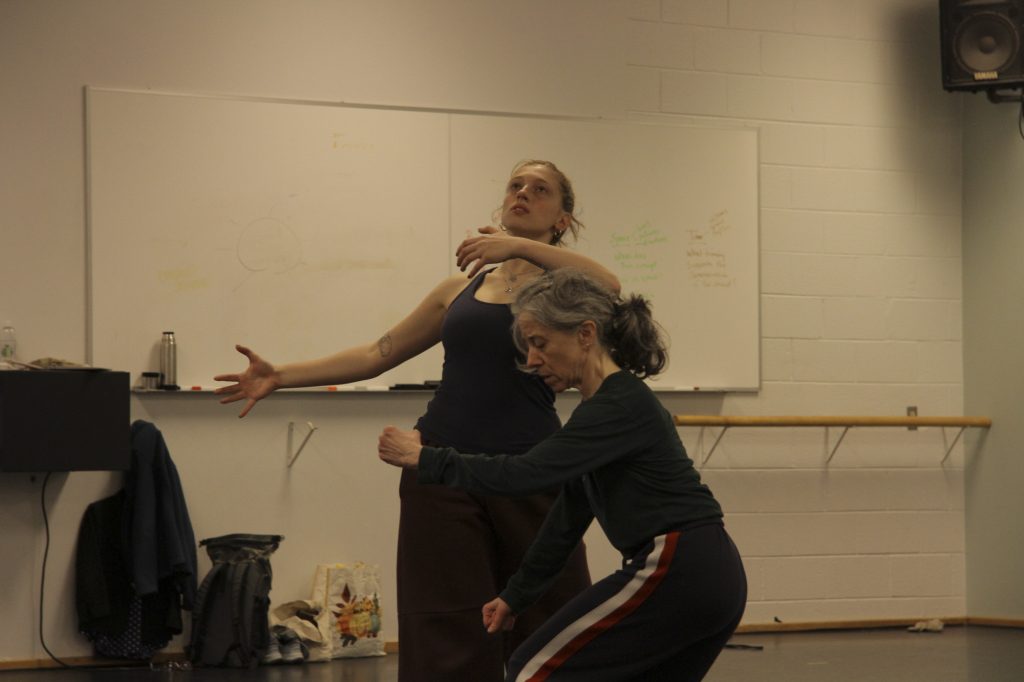
Archer, Cardosi and Sher deftly avoided the easy trap of playing “straight men” to Ellisor and O’Neal as tricksters. Instead ,they drew attention to their own interpretations of curiosity, experimentation and play as all five dancers interacted with the folding chairs that served as set and props.
At first, the chairs were just chairs, arranged in three concentric semi-circles, as if set up for a musical concert. Over the course of the rehearsal, though, the dancers engaged with them as stages, pedestals, obstacles, walls and even instruments.
Glimpsed in process, A Note That Bends is coming together as a richly generative work. It combines dance, spoken word, chorus and instrumental music to create what, depending on the spectator’s frame of mind, might be experienced as a thought-provoking meditation on language as performance or a playful experiment in multi-disciplinary storytelling.
On stage, Sher’s latest work will almost certainly be of interest to performance art enthusiasts and experts alike. You can experience A Note That Bends for yourself on Friday, April 24, and Saturday, April 25, during the Arts Fellow Concert at the Schwartz Center for Performing Arts.
::

Robin Wharton studied dance at the School of American Ballet and the Pacific Northwest Ballet School. As an undergraduate at Tulane University in New Orleans, she was a member of the Newcomb Dance Company. In addition to a bachelor of arts in English from Tulane, Robin holds a law degree and a Ph.D. in English, both from the University of Georgia.
STAY UP TO DATE ON ALL THINGS ArtsATL
Subscribe to our free weekly e-newsletter.

PLEASE SUPPORT ARTSATL
Your Gift Sustains the Coverage You Count On!
Related Posts