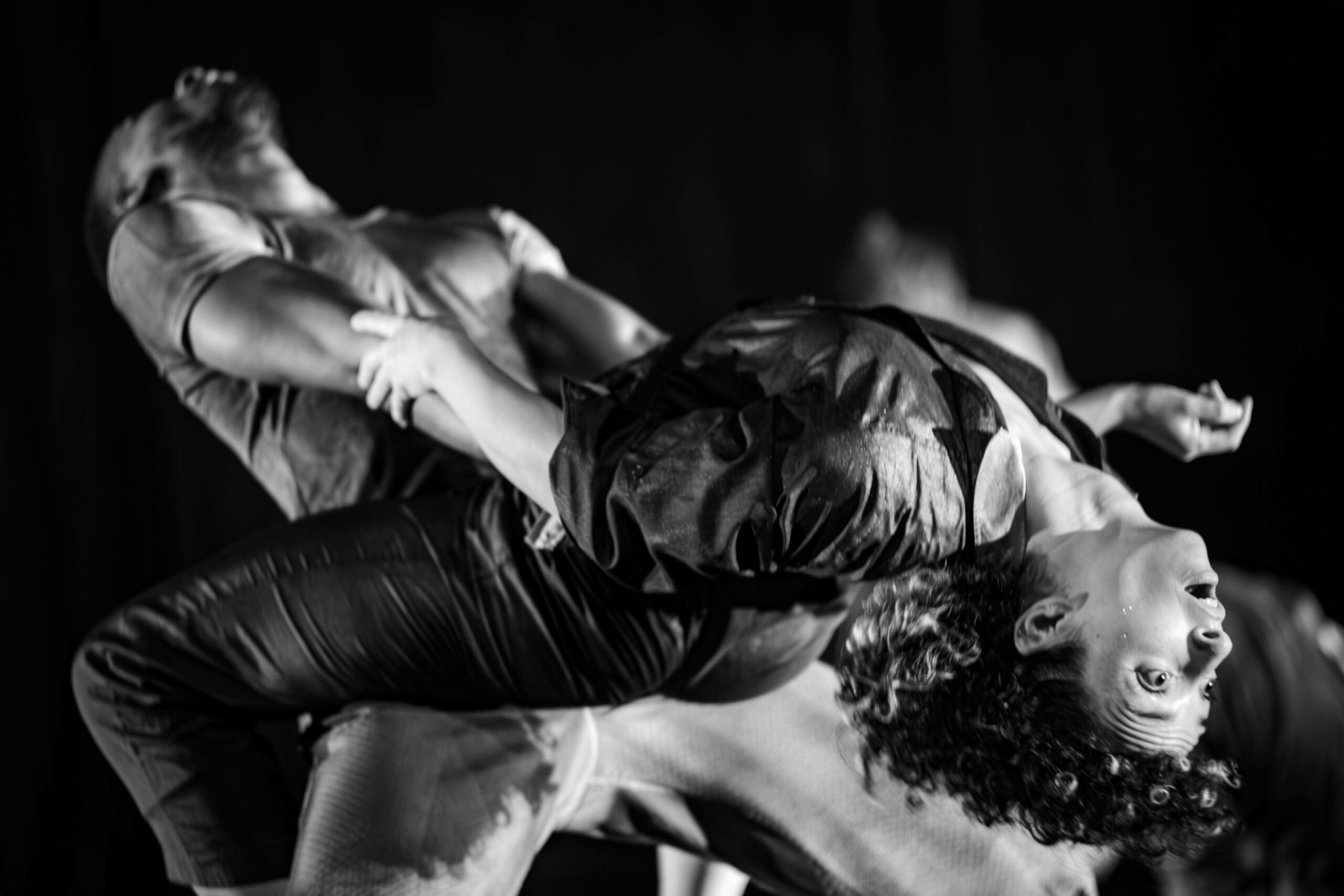
Annalee Traylor dance work looks for chaos in the control
Watching the Saturday, April 27, performance of Annalee Traylor’s this thing is real in the Schwartz Center for Performing Arts Dance Studio at Emory University felt like having a front row seat to a controlled demolition. The event was an act of creative destruction — carefully orchestrated but not predetermined, absolutely breathtaking and just a little bit dangerous. As the smoke cleared and the dust settled, a reclaimed theatrical space appeared in which Traylor and her collaborators built dream palaces from the rubble.
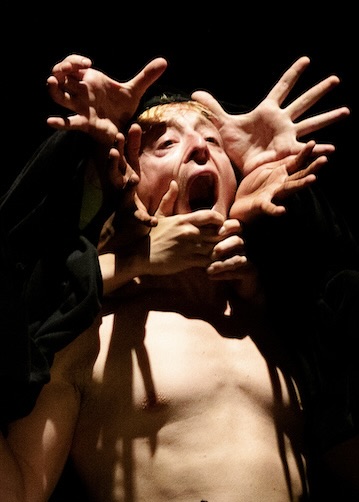 The audiences for this thing is real on Friday and Saturday night each saw a slightly different show in which six dancers, three musicians and a lighting designer improvised in the moment to create the work.
Structurally, this thing is real had zones rather than edges. As the audience entered the theater, Jimmy Joyner, clothed in a wear-it-how-you-will costume of tight black biker shorts and black toga-like wrap that he could style in various ways, was already in action, setting up and taking down and just generally fooling around with a 6-foot folding table and chair. He occasionally encroached upon the imaginary proscenium boundary separating the dance floor from the seats.
At one point, he twirled around and around while swinging the table, provoking more than a few people to wonder aloud what would happen if Joyner lost his grip and the thing came flying toward the risers. Several times, he manipulated his costume to humorous effect, tucking the drape into his shorts to create an outsized bulge at his crotch or tying the extra fabric to the table behind him and then asking a fabulously well-dressed patron to pull the fabric between his legs in order to drag the prop a few inches.
Like Joyner, the other dancers also manipulated the table and chair, along with the curtains, throughout. Their costumes were three parts quirky street wear and one part Cirque du Soleil, splashes of color and texture against the stark, black backdrop curtain. They added touches of character without restricting or obscuring movement.
By the time Joyner collapsed into the chair before the final section, he had evolved into a mischievous, playful, elusive personification of theater as a concept.
Walter Apps was the character who keeps busy in an attempt to avoid self-examination but eventually gets lost in the frightening depths of his soul. During a mesmerizing solo, he pulled aside the curtain hanging stage left to reveal the mirror where, like Narcissus, he was trapped by his own reflection.
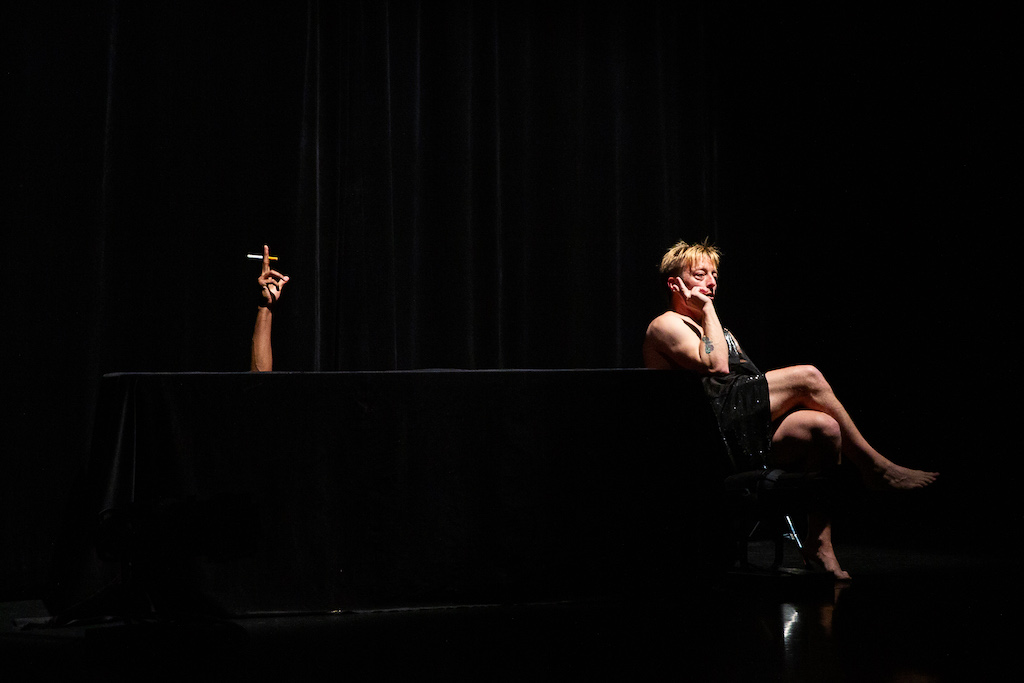
Henry Koskoff was a preening poseur who put on delightfully haughty airs and a posh British accent. Darvensky Louis was the man with all the masks, by turns drawn to and disgusted by everyone’s penchant for performance. Kendall Ramirez had an air of distraction and being slightly late to the party. Cailan Orn was an introverted extrovert who was alternately desperate to be seen or trying to hide herself and everyone else.
Traylor holds an MFA in choreography from California Institute of the Arts and prior to graduate school was already a successful freelance choreographer creating contemporary concert dance pieces for college, regional and second companies across the United States and abroad.
She told ArtsATL in an interview: “I think that my biggest takeaway from graduate school was Travis Preston, the dean of the theater school, telling us that as a director, your one job is to create and facilitate a space where the artists can be maximally creative.”
Traylor views “choreographer” and “director” as interchangeable roles in her current work within the kind of liminal spaces where concert dance, devised absurdist theater, puppetry, magic shows, circus performances and physical improv overlap and start to blur together.
For her, directing involves collapsing those genre distinctions and removing hierarchies and conventions that have historically partitioned the work of costume and stage design, dancing, acting, composing and playing music and even the physical labor of running a performance. It also requires ceding control to and trusting one’s collaborators, risking chaos to promote synergy.
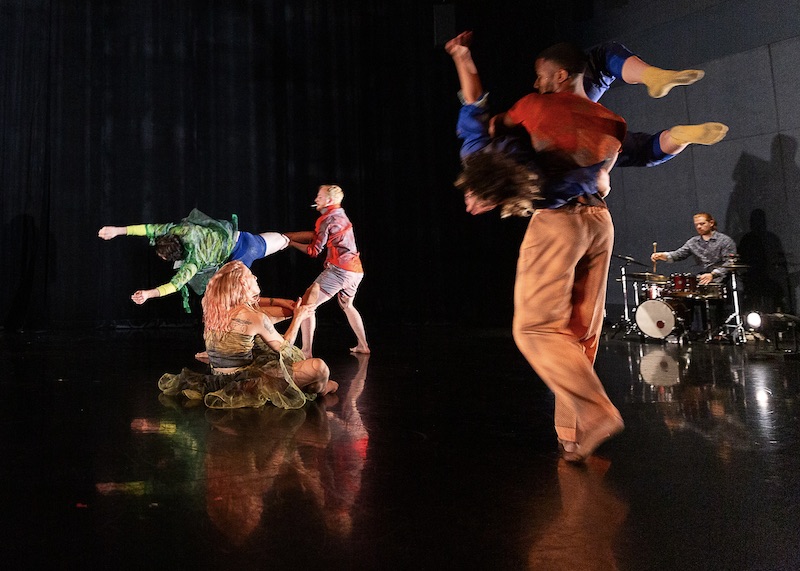
In the first big ensemble section for this thing is real, for example, the dancers transformed ordinary movements — bathing, hugging, making out, masturbating — into dance. The results were sometimes funny, sometimes gorgeous and sometimes totally absurd.
In one section, Koskoff lounged in a folding chair reciting snippets of poetry while Orn and Ramirez repeated and remixed a complicated bit of phrase work in response to his verbal prompts. As a kind of physical theater, the verbal call and dance response went on and on and started to seem too repetitive. But by making an adjustment as a viewer and watching it as pure dance without expecting humor or glimmers of meaning, the activity was revitalized as aesthetically interesting.
This thing is real largely represents a break from Traylor’s previous work. For her master’s thesis, she crafted a post-modern myth but found the linear narrative form stifling. Her more traditional choreographic projects before CalArts involved setting movement she first created for her own body on other dancers.
This thing is real was the culmination of her year as the inaugural Emory Arts Fellow in Dance, which has included creating work for the Emory Dance student performance, mentoring graduate students and teaching advanced modern technique and — with the Emory Arts Fellow in Music, Theodosia Roussos — a new co-designed dance and music lab.

“Entering this residency, I knew I wanted the piece to have an emotional trajectory and the audience to have a deep, visceral emotional experience,” she said. Along the way, she drew inspiration from the Talking Heads, both the band’s music and the documentary film, Stop Making Sense. The title, this thing is real, is a lyric from the David Byrne song “Slippery People.”
Although she listened to the Talking Heads constantly while creating this thing is real, Traylor deliberately avoided articulating overarching thematic or narrative concerns to guide her process. Further, throughout her work on the piece, Traylor said she had trouble seeing the emerging through lines because she was so deep in the weeds with the details.
Only as everything came together in tech and dress rehearsal and performance did she realize how preoccupations from her thesis — with the shadow self and illusion — had also shaped this thing is real. Those ideas were fully present in Saturday’s performance. Louis and Apps wrestled with inner demons. Orr wore her long, wavy hair like a disguise and Joyner, like a queer and mercurial master of ceremonies, directed and framed, revealed and concealed the other dancers.
Traylor already had a close working relationship developed over two previous collaborations with Los Angeles-based Drew Sensue-Weinstein, the sound designer. While she and the dancers rehearsed without music for the most part, he began his process watching rehearsal videos Traylor sent him. Collaborating remotely at first proved impossible.

“Drew told me the videos just weren’t working,” Traylor recalled. “He told me he couldn’t derive what we were putting down in the three-dimensional space through a screen. He needed the tangible energy of being with us in the studio.”
So Traylor brought Sensue-Weinstein to Atlanta in March for a week-long visit that was ultimately productive, though not necessarily in the way they had all anticipated. “It came and went like the snap of a finger. Honestly, I kind of wanted to go into a hole after that,” Traylor admitted. After “throwing things at the wall” and cutting a lot of material, Traylor and the dancers did, however, come away with about a quarter of what would eventually take shape as this thing is real.
Sensue-Weinstein, too, having been in the room where things were happening, was able to work later from video and cultivate a sound palette for the piece. “He came back the week before tech, and it was a little stressful,” Traylor said. “Even in tech [rehearsal], the sound design was still evolving, and it wasn’t until dress rehearsal that things really crystallized.” Drummer Chris Gravely and saxophonist Helene Kelman had only two rehearsals with everyone else before the technical run through.
 For dancers, hearing the music for the first time in a few rehearsals before opening night is unusual. Nonetheless, by the time the audience started to meander in for the first show, Traylor said dancers and musicians had a clear structure and relatively granular sense of the pacing for this thing is real, which then, like a good jazz performance, unfolded each night as a conversation among them.
During the show on Saturday, Sensue-Weinstein, who was on the sound board, Gravely and Kelman began on the floor with the dancers but then took their positions off to the side on stage right. The dancers responded to the sound, and the musicians responded to the dancers.
Traylor said their “mind meld” was especially sympathetic Friday evening. Even on Saturday, all the performers were so closely entrained with and so observant of each other that one might reasonably think the score was only meant to seem improvised but had been, in fact, very carefully arranged — or at least exhaustively rehearsed.
According to her own definition, Traylor’s direction in this thing is real was a resounding success. Each member of the ensemble — including Sensue-Weinstein and the musicians and technical director and lighting supervisor Gregory Catellier — glittered with virtuosity in the baroque setting Traylor created. For the audience, the event was an unforgettable, immersive trip into a vividly-realized surreality with a phenomenally talented group of artists.
::
Robin Wharton studied dance at the School of American Ballet and the Pacific Northwest Ballet School. As an undergraduate at Tulane University in New Orleans, she was a member of the Newcomb Dance Company. In addition to a bachelor of arts in English from Tulane, Robin holds a law degree and a Ph.D. in English, both from the University of Georgia.
STAY UP TO DATE ON ALL THINGS ArtsATL
Subscribe to our free weekly e-newsletter.

PLEASE SUPPORT ARTSATL
Your Gift Sustains the Coverage You Count On!
Related Posts