Filmmaker Hal Jacobs has spent 30 years revealing stories with a camera
For documentary filmmaker Hal Jacobs, stories unfold in unexpected ways, much the way Atlanta’s story has. Here, he reflects on 30 years of finding narratives.
Hal Jacobs’ latest documentary, Saving the Chattahoochee, aired on Georgia Public Broadcasting in April. The 40-minute film showcases former Atlanta Mayor Shirley Franklin and activist Sally Bethea’s decades-long battle to protect the Chattahoochee River. As the founding director of Chattahoochee Riverkeeper, Bethea spent more than 20 years fighting for the river’s restoration, working closely with Mayor Franklin to invest in the city of Atlanta’s water and sewer system and to stop further pollution of its most important waterway.
Saving the Chattahoochee is Jacobs’ latest work in a storytelling career spanning more than three decades. After starting out as a freelance writer and educational video developer, Jacobs transitioned into documentary filmmaking full-time in 2014, producing projects for arts and environmental nonprofits while exploring various passion projects with his close friend, photographer Joe Boris; his musician, son Henry Jacobs; and his wife, Executive Producer Alicia Macbeth Jacobs.
Transitioning from news writing to filmmaking felt like a natural next step for Jacobs, whose work has always focused on the good, the bad and the ugly of Atlanta’s rich history. While writing for The Atlanta Journal-Constitution, his feature articles touched on some of the city’s most complex and controversial figures, including Uncle Remus author Joel Chandler Harris and infamous segregationist Gov. Lester Maddox. Jacobs describes his shift to documentaries as a liberating experience, allowing him more control over his subject matter and a larger palette of creative tools with which to work.
For Jacobs, anything goes in documentary production. He loves how readily filmmaking allows for pleasant surprises — the loose, improvisational moments that emerge when a subject speaks off the cuff or the camera reveals a story that words cannot. This sense of discovery is what drives him, and the field’s ever-evolving technology makes for a veritable playground of experimentation. Jacobs believes that, for a documentary, it’s best to just choose a topic and dive right in, letting the meaning reveal itself organically throughout production. He’s not striving for “Ken Burns polish” or festival prestige, as he puts it — all that matters is finding insightful narratives that will stand the test of time.
Unique to Jacobs’ filmography is a focus on Southern stories. Born and raised in Jacksonville, Florida, he moved to Decatur in 1983 and credits the creative, open-minded community there as a major inspiration for his work. He gravitates toward themes of social justice and activism, always hoping to remind audiences that change is possible, even in their own backyards.
“Everyone I’ve profiled has spent decades of their lives involved in some passion that enriches the arts or environment or social justice,” Jacobs says. “We need to honor and rally around that kind of commitment. I don’t think you have to drive far around here to find stories worth telling.”
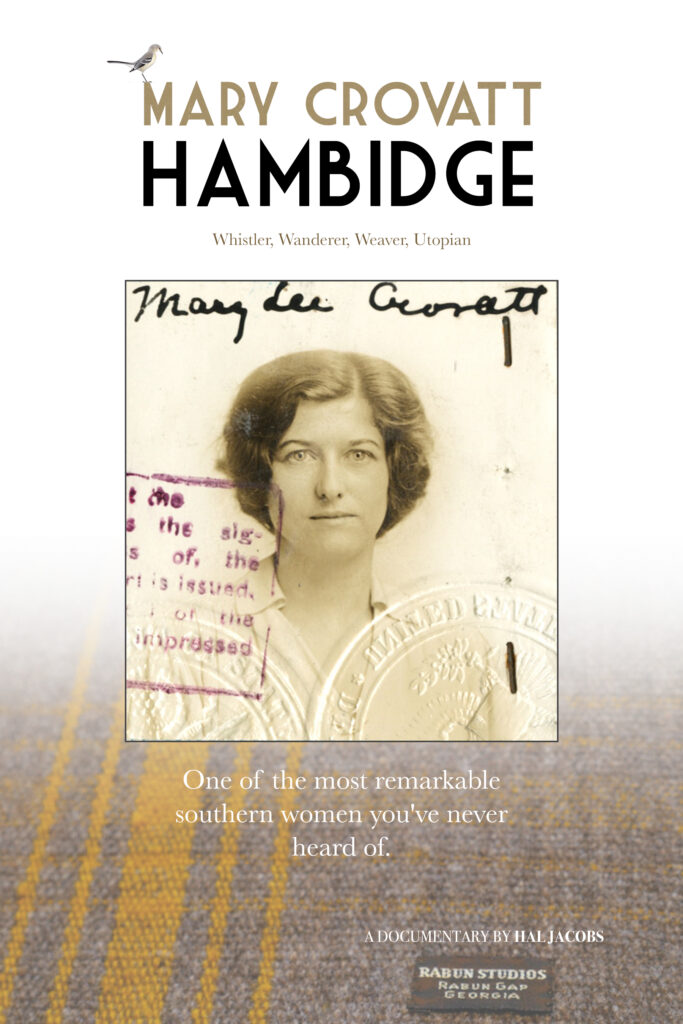
His first feature, Mary Crovatt Hambidge, focused on Hambidge’s fascinating career as a spinner and weaver, including her decades of artistic community-building in the Blue Ridge Mountains. The filmmaker stumbled across Hambidge while doing pro bono editing work for The Hambidge Center, a North Georgia artists’ retreat she founded in 1934. From there, Jacobs’ interest in her story deepened, along with his respect for her character. “She was a woman endlessly fascinated by life, especially its natural beauty,” he says. “She sought to live her life in balance with nature, as well as encourage other artists to do so.”

Most of Jacobs’ documentaries have covered places and people that, like Hambidge, he simply stumbled across. He describes finding new subject matter as “walking around in the yard and pulling weeds,” digging into stories that he’s already familiar with but still has questions about. “It’s one person that reveals a larger story that I think is interesting,” he says. “Finding that right character and then seeing the conflict involved in their life, usually from society or societal values.”
Jacobs is the first to admit that he doesn’t have a business model. He funds all of his documentaries with savings and public donations, and, at the end of the day, he’s never made these movies to make money. So far, he has used promotional emails to friends, family and local organizations to spread the word about his projects. Over the years, more and more people have chipped in donations, and Jacobs notes that his Decatur neighbors, in particular, are deeply appreciative of the time and work he puts into each and every film.
“[My work] moves fast. It’s smart. Sometimes it can even get a little funny,” he says.
He’s found appreciative audiences in diverse venues across the South, but there’s nothing quite like showing his films in and around Atlanta. “We get to show a different side of Atlanta when we tell these stories,” he says. “That’s the fun part.”
::
STAY UP TO DATE ON ALL THINGS ArtsATL
Subscribe to our free weekly e-newsletter.

PLEASE SUPPORT ARTSATL
Your Gift Sustains the Coverage You Count On!
Related Posts