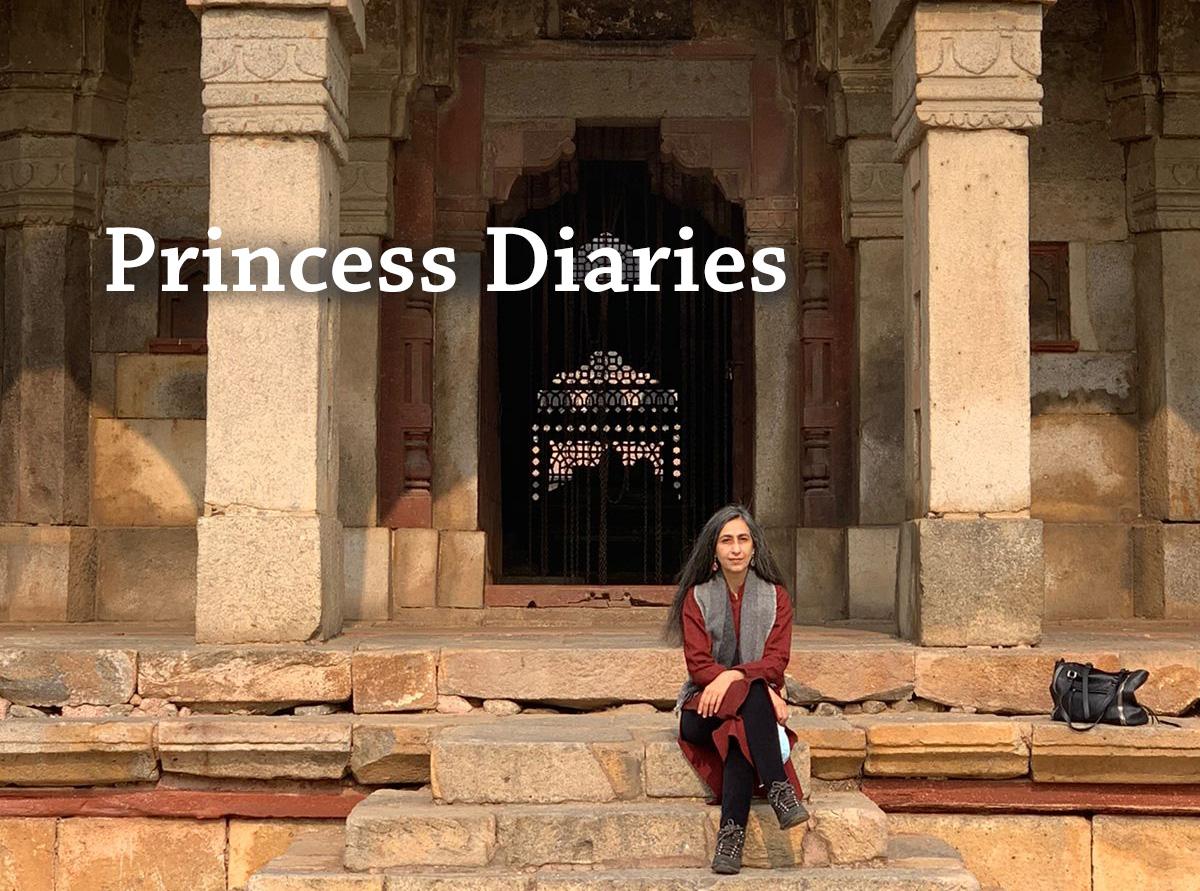
Ruby Lal Pulls a South Asian Writer from Obscurity
Ruby Lal’s ‘Vagabond Princess’ recovers one woman’s vast 16th-century scholarship. Why has it been ignored for so long?
::
In the summer of 1997, professor and historian Ruby Lal sat tucked inside the British Library, turning the delicate pages of a book written by 16th-century princess Gulbadan Begum, the first and only female historian of what Lal calls the “magnificent Mughals of India.”
Gulbadan, whose name translates to “Rosebody,” was a writer, poet, respected matriarch and learned adventurer who survived scandal and shipwreck, leading 11 women on an extraordinary six-year holy pilgrimage across dangerous seas into Arabia.
The daughter of Babur, founder of the Mughal Empire of South Asia, Gulbadan’s genre-bending book — part stream-of-consciousness memoir, part cultural and political history — detailed the daily lives and trials not only of princes and politicians but also of transgressive women, eunuchs, wet nurses, guards, courtesans and children.
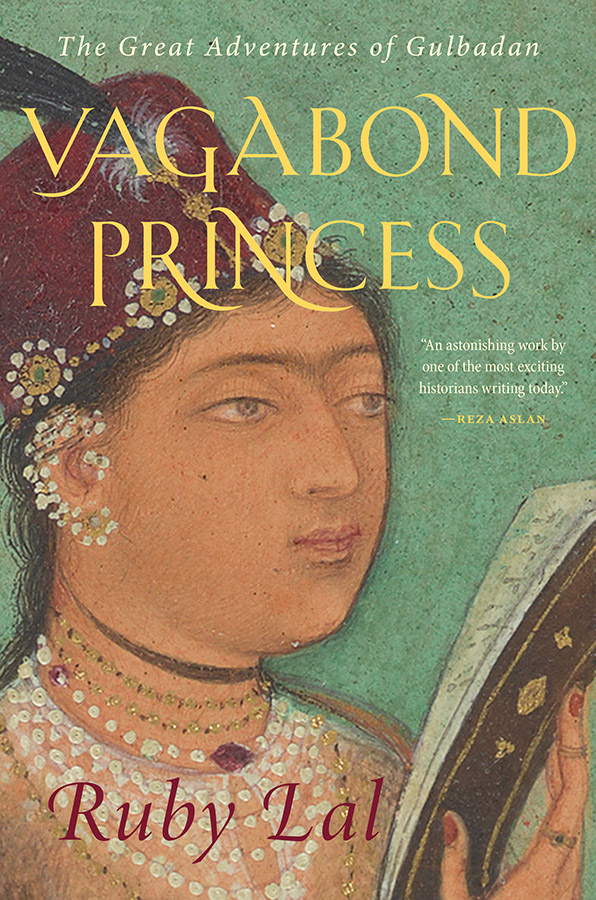
It was a “masterpiece that came out of an insightful witnessing of hard politics and much more,” writes Lal in Vagabond Princess (Yale University Press, 2024), her recently released biography of Gulbadan, a “lively prose work that shines with unrivaled granular details of Mughal wandering life.”
Despite most historians’ attempts to marginalize her story, Gulbadan’s book speaks to us now through Lal’s own rigorous scholarship. In writing Vagabond Princess, based on the manuscript that she first encountered that day in the library, Lal returns Gulbadan’s story to the center of Mughal history, where it belongs.
Lal writes of Gulbadan, “Experience was her book. Crossing the Khyber Pass in a caravan at the age of 6, being a young woman in exodus to Kabul and her time as a sagacious woman lodged in the harem: all informed her writing…She commenced writing from embodied memory and from events as she experienced and thought of them.”
Lal is an Emory University professor of Middle Eastern and South Asian Studies and author of the books Domesticity and Power in the Early Mughal World; Coming of Age in Nineteenth-Century India: The Girl-Child and the Art of Playfulness; and Empress: The Astonishing Reign of Nur Jahan.
She recently spoke with ArtsATL about writing Vagabond Princess and what it means to be a feminist historian.
::
ArtsATL: Tell me about your first encounter with Princess Gulbadan. What did it feel like for you discovering her memoir?
Ruby Lal: I’d seen her book in translation by Annette Beveridge, but the detail, the stream-of-consciousness style of narration…there was something quite physically moving about [seeing the original memoir]. On that August afternoon in 1997, when I held [the memoir] in my hands, it felt like a sacred moment — turning every page that was so fragile, reading slowly the Persian sentences from right to left, soaking in the atmosphere.
What I loved [about it], which male historians had criticized, was that this was a “soft society of women,” as it was called. But I found the details of movement, the sense of caravans being on the road, the tented societies, spending time in gardens, the picnics, losing a little niece in battle, the tough negotiations women were having with men — I found these details very succulent.
With the tactility of the text, I was very transported. It felt like a sacred moment, like a connection.
ArtsATL: One of the big ideas you were contending with in your research at this time was that there was no real feminist history of the Mughal Empire. Can you speak more about what you mean when you say feminist history?
Lal: It was in my first book, Domesticity and Power in the Early Mughal World, in which I first brought [Gulbadan’s] memoir center stage, brought scholarly attention to it as a text source.
There were two aspects, at that time, that I was dealing with. One was that there was no feminist history — by which I mean, there was nothing on the feminine experience.
When we think of the great Mughals of India, we immediately think Taj Mahal. But the Taj Mahal wasn’t there at that time. So who were these people? How did the dynasty come into being? And in terms of the feminine experience, how were women participants in the making of the politics and the empire? There was no sense of that, and that’s really what my book did.
But it’s not just that I found a woman’s source [Gulbadan’s memoir], and I thought, “Oh, this is brilliant.” Of course, it was an extraordinary source. But it was also about the politics of asking questions. It was about working with the politics of a rather male field in which, for no good reason, sources had been marginalized or erased out of our consciousness.
Gulbadan was the only woman historian of the Mughal empire. She was invited at the invitation of her nephew, Akbar the Great, to write this extraordinary book. It’s unique not only for the dynasty but for her era actually, because royal women [at that time] mostly wrote poetry.
What does it take for a man, or male scholars, to discard a source like that? As I write in Vagabond Princess, this is about male disbelief around feminine experiences and around women-oriented sources.
All of this constitutes a feminist practice, or, for me, a feminist form of writing history.
ArtsATL: How does Gulbadan come to be author of what we know as the only surviving female-authored historical memoir from the Mughal Empire?
Lal: Gulbadan was the daughter of the first Mughal king, Babur. She was half-sister to Humayun, and aunt to Akbar the Great.
The first thing to remember about this dynasty is that it was an itinerant, moving dynasty. And this was not unusual. We are talking early modern times, before the nation states have formed these stringent borders. Dynasties moved here and there. And that’s how states were formed in those days.
Gulbadan is born in Kabul in 1523, and, after her father’s initial conquests, she is the first girl to travel in the caravan that he invites to come to India as part of resettlement of his territory. She only has about five years with her father, and then he dies, and the empire goes to her brother, Humayun, whom she was very close to.
Her nephew, Akbar the Great, is called “the Great” because he’s the first emperor who establishes the empire in the ways in which we understand it, as the settlement of cities, with bureaucratic, administrative, imperial structures — which actually the British inherit later on, and the rest of the Mughals follow.
Akbar the Great establishes the first walled, red sandstone harem, which was a gesture toward respectability for his women. The whole projection of himself was as this god-like emperor, so his women had to be goddess-like, and the way to do that was to make them inaccessible and invite them to live behind the walls.
Gulbadan, along with other multigenerational women, go for the first time to live behind these walls, and it is from there that she leads her pilgrimage.
When she returns, Akbar’s empire is in a very strong position, and this is the time he wants to commission the first imperial history of the empire.
He invites various members, older generations, older imperial servants, officers to contribute their memories of their forefathers. And there was only one woman he invites amongst them, because of her standing, and that is Gulbadan — who is experienced, learned, highly thought of. She is a formidable matriarch, along with his mother, and that is the background into which she comes to write.
ArtsATL: What would Gulbadan have been reading as she was growing up? What role would story have played in her life and in her culture?

Lal: Story is seminal in this culture.
Gulbadan was also a poet, though there are only two lines of her poetry that have survived. And in her own library, she had her father’s memoir, which she greatly admired. Her father was a poet, a wanderer, a king, a terrific hero. And his memoirs included gorgeous meditations on everything that he sees, from tribes, to people, to animals, to birds, to women, the ongoings with his men, his own travels.
So she definitely read those. But none of them served as a literary model for her writing, which differed dramatically from most chronicles of her time. Her writing has no didactic charge. It falls out of this pragmatic/guidance/rule/moral exemplification. Her experience and knowledge germinated from the people around her, her movement, the gardens, tents, pavilions, ships, rivers, oceans, mosques, mansions, the red sandstone harem, women in history — all of this.
ArtsATL: I love that she mostly would have been reading these male-centered, male-authored, more didactic works, but she didn’t attempt to write toward that style. She was so sure of her own voice as a witness and as a writer. She didn’t feel the need to shape what she was writing to fit into conventions of the time.
Speaking more about the book, while Vagabond Princess does center Gulbadan’s life and her writing, it also really positions her within this larger constellation of other women. You write about women and their domestic experiences as central to the politics of the empire. It’s a story of mothers, and daughters, and aunts, and sisters and wives as co-creators of empire.
Lal: This is an early modern society, in which the dailyness of the activities are very intertwined with the politics of the time. Women are traveling in these tents. And the motherhood notion is not the bourgeois notion of “your child, my child, our child together” but really a child that’ll potentially carry forward the name of the dynasty — this gives power to the woman, especially if it happens to be a boy.
And I think each of these actions — the birthing of children, the advice the councilors give — this is a very powerful domain at this time, the domestic. And men — emperors, princes — they really turn to the women a lot of the time. The politics, the war, the decisions, these are all made in deep consultation with the women of the dynasty.
ArtsATL: As a feminist historian, what do you think we lose as students of history, as citizens of the world, when these stories, these women, women like Gulbadan, are excluded from scholarship and from our understanding of culture?
Lal: I think it’s linked with this knee-jerk reaction that we all have, which is that as we go forward in time, we are making progress. An extension of that is the idea that things in the past were really barbaric. They were very patriarchal systems, these courtly societies. But the extraordinary thing is the immense creativity and power, even the freedom, that women had [at the time].
I think we’d all do well to remember, to learn about these experiences. And I think that is why I’ve turned to writing for a wider audience, to share these incredible stories.
::
Beth Ward is an Atlanta-based writer and editor. Her work has appeared in numerous publications, including The Rumpus, Hyperallergic, Atlas Obscura, BUST magazine, The Bitter Southerner, Atlanta magazine and Burnaway. Learn more about her work at www.bethwardwriting.com.
STAY UP TO DATE ON ALL THINGS ArtsATL
Subscribe to our free weekly e-newsletter.

PLEASE SUPPORT ARTSATL
Your Gift Sustains the Coverage You Count On!
Related Posts