Review: ASO’s restraint pays off in Beethoven’s transitional symphonies
The composer’s Fourth and Seventh hint at the epic nature of the legendary works that followed.
::
The Atlanta Symphony Orchestra’s Beethoven Project continued unabated Thursday, March 6, with symphonies Four and Seven. Thus far, it’s been a generally successful foray into the nine symphonies that tower over the art form like the pillars of a majestic pantheon. With the Fourth and Seventh, the ASO tackles two works that see the composer in transitional states toward the Fifth and Ninth, his most legendary works.
The evening commenced with the Fourth Symphony. Beethoven was given to writing mellower symphonies in between his more epic creations, and the Fourth falls in between the politically charged Third (“Eroica”) and monumental Fifth. As such, the Fourth is, for the most part, a more sedate affair that occasionally hints at the thundering grandiosity imminent in the Fifth (for which Beethoven had already begun early drafts at the time of the Fourth’s writing.)
That sedate tone markedly contrasted the tumultuous state of Beethoven’s personal life. Tensions with his brother and the increasing severity of his hearing loss led the composer to move to Upper Silesia (located in parts of what are now modern-day Poland and the Czech Republic). The R&R proved short-lived when word of his arrival reached Count Franz von Oppersdorff, who commissioned No. 4 for his private orchestra.
More on ArtsATL: ASO’s intoxicating take on Beethoven’s Sixth and Eighth Symphonies
In recent times, I’ve chided the ASO for opening its concerts with softer fare that serves to blunt the effect of more passionate pieces later in the night, but, as with the March 1 Beethoven Project performance, that restraint paid off. The Fourth’s opening adagio returned the ASO to that same meditative, fluidly interwoven state that had been so satisfying in its approach to the Sixth and Eighth.
Earlier, the composer had been fully invested in gentle vibes, but the Fourth sees Beethoven wrestling with the darker concepts he would fully bring to the fore in No. 5. As such, the opening adagio is overtly relaxed, with a sense of controlled tension stirring in the background. The ASO strings know how to interact with one another in a way that accentuates this kind of subtle inner turmoil, and once again it played to great effect.
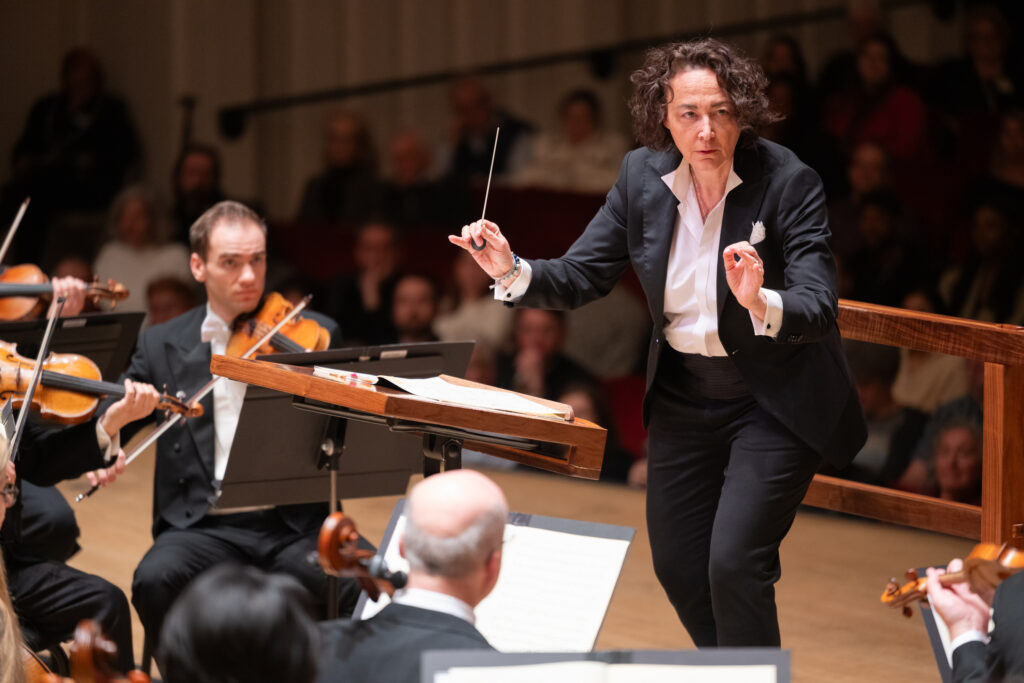
The Fourth ramps up in its later movements, almost as if Beethoven was so consumed with thoughts of the Fifth that he had to let a touch of its militaristic majesty burst forth in its predecessor. To that end, credit specifically goes to timpanist Michael Stubbart, who accentuated the orchestra’s louder stabs with consistently arresting hits. Beethoven was given to leaning hard on the percussion when composing at the top of his lungs, and Stubbart, along with his colleagues Joseph Petrasek and Michael Jarrett, kept the drama high.
The Seventh Symphony opens brightly and hits hard, but all in service of a more euphoric, uplifting tone. The composer was suffering multiple health issues at the time of the writing and feeling the massive inflation brought on by the Napoleonic Wars. Nevertheless, Beethoven maintained remarkably high spirits and an outgoing, sociable nature that defied his curmudgeonly reputation. That dichotomy between outer joy and inner turmoil defines the Seventh Symphony, with its moments of manic euphoria.
The ASO handled No. 7 well enough, but there was a noticeable waning of energy midway through the piece. In some of these instances, it can be difficult to tell if that’s a faltering in the actual playing or a deliberate choice by the conductor or composer, but, whatever the case, it felt as though some of the Seventh’s characteristic punch wasn’t quite there.
The fire and fury returned for the final allegro, and conductor Nathalie Stutzmann seemed to be having a blast all the while. She’s seemed a touch mechanical in some of her recent performances, and the resurgent enthusiasm she showed on the podium was clear evidence that the stated goal of the Beethoven Project — invigorating the ASO by delving into one of classical music’s most defining composers — is paying off.
Project Beethoven will continue throughout the spring with two additional pieces: the Triple Concerto April 3 and April 4 and the ambitious choral work Missa Solemnis. Beethoven’s magnum opus, Symphony No. 9, will happen in the fall. Hopefully, the ASO remains duly invigorated until then.
::
Where & When
Atlanta Symphony Orchestra’s Beethoven Project: Symphonies 4 + 7 at Atlanta Symphony Hall. Two more performances at 8 p.m. March 8 and 3 p.m. March 9. Free pre-concert talk at 6:30 p.m. March 8.
STAY UP TO DATE ON ALL THINGS ArtsATL
Subscribe to our free weekly e-newsletter.

PLEASE SUPPORT ARTSATL
Your Gift Sustains the Coverage You Count On!
Related Posts