
Muelas’ multifaceted musical mayhem takes flight, building community along the way
Discover how mariachi, opera and a German commune helped shape the band’s hardcore aesthetic.
::
A few hours before Muelas were supposed to leave for Europe, guitarist Kaemon Maggard woke up to a phone call.
“Hello? Hellooooo. Kaemon?”
He had thought it was his alarm. It was his bandmate, vocalist and violinist Susy Reyes.
“All of our flights just got canceled.”
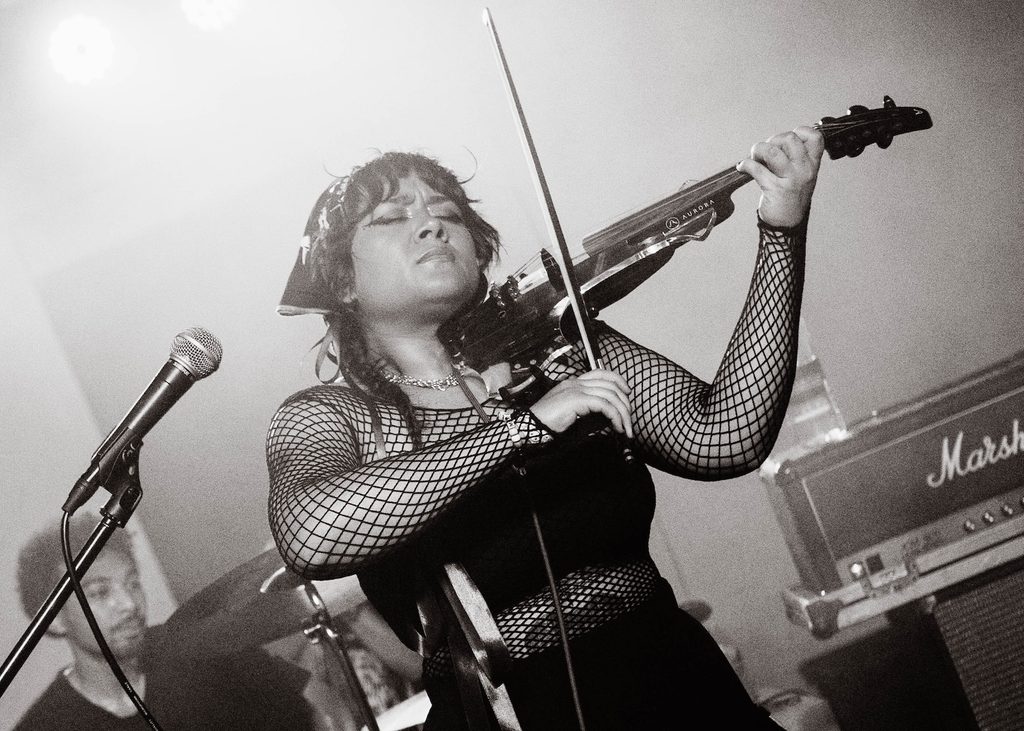
Maggard was still in his boxers. Within minutes, his computer screen was filled with browser tabs, one hand on the phone with airline support, the other clicking away in a desperate attempt to get five musicians from Atlanta to Denmark for what was, technically, their first tour as a band. Eventually, three of them — Maggard, James Cramer and Chris King — were booked onto Air France. Reyes and Musashi were put on Lufthansa.
All appeared resolved. Maggard, Cramer and King were sitting comfortably, cozied under blankets in upgraded seats, enjoying salmon in the sky as their plane coasted toward the Atlantic. A message from Reyes appeared on Cramer’s phone. Reyes’ and Musashi’s flights were canceled again. They had to go home.
At that same moment, Cramer recalls a flight attendant leaning over their row, and in his poshest voice, quotes, “Would you like some champagne?”
The band doubles over in laughter, the fit furthered by Reyes wryly observing, “I just find it very rude that the only two people of color in this band got left behind.”

Such badinage flows easily from Muelas, a project formed out of years of scene friendship and musical overlap. Maggard and Cramer met around a Wrecking Ball show (the now-defunct punk-rock music festival organized by locally enduring venue The Masquerade) and quickly began Nowhere Safe, accompanied by King on the bass. Reyes had arrived in their orbit as a music photographer, eventually shooting the album art for their 2024 record, all I remember, all I have lost. As Nowhere Safe began to wind down, the group’s innumerable quips about wanting to start something heavier together became more lucid; one jam session at Reyes’ and a bit of badgering from Maggard, and Muelas was born. Reyes’ longtime friend Musashi, who also plays in the band Big Yellow, came aboard as drummer.
Though they only played their first show a little over a year ago (on Father’s Day of 2025, to be exact) the band quickly gained traction both locally and abroad (in addition to a nod from Hayley Williams) with the release of their anti-ICE anthem “Melt.” The lead single of their recently released EP, Bellows, “Melt” is a pummeling, mosh-rousing maelstrom of post-hardcore rage, inspired by Reyes’ own experiences as a queer, first-generation Mexican American.
‘‘Muelas,” from the Spanish word for “molars,” is an apt name for a band whose sound packs as much bite as the values they stand upon. Opening track “F.Y.J.J.” features dueling vocals from both Reyes and Cramer, hurtled forward with chugging bass and distorted, gum-erupting violin. Its lyrics draw from Reyes’ months-long grassroots battle against developers in her Marietta neighborhood.
Though the fight against gentrification (and the recent adjacency in Marietta and beyond — data centers) remains an ongoing fight, the connection it gave Reyes’ to their community has been invaluable.
“The fact that I walk out my door and I know all my neighbors; we say hi to each other; we take care of each other. It gets me emotional. It’s very beautiful.”
Check out Aja Arnold’s story on Muelas on the ATL Arts Collective podcast from August 19
That sense of communal connection is at its most visceral on “Amor Moribundo.”
Structured around riffs from Cramer and Maggard, “Amor Moribundo” explores a particularly difficult period in Reyes’ life regarding feelings of grief and depression that felt, at the time, insurmountable. Performed live, it seems to stir as much catharsis within the band as it does in the audience.
“Looking out over a very big group of people, some that I knew and some that I did not know, and seeing people crying, moshing, smiling. It may be the first time I’ve started openly crying onstage,” recalls Cramer on the band’s EP release show. “It very much felt like what community could be in music.”
A string-backed, bolero-inspired interlude cuts through the breathless swells of doom, offering a chance for a particularly impressive display of operatic vocal control from Reyes, as well as a cohesive glimpse into the musical background that shaped her.
Reyes’ grandfather opened Los Reyes, one of Cobb County’s first Mexican restaurants, in the 1970s. Known for its live music and vibrant parties, Reyes grew up especially immersed in the sounds of mariachi, cumbia, norteño, duranguense, huapango and other forms of traditional Latin folk. Though J-rock and MySpace bands comprised much of what funneled through Reyes’ earbuds at the time, after work, they would sit and watch the mariacheros — transfixed.
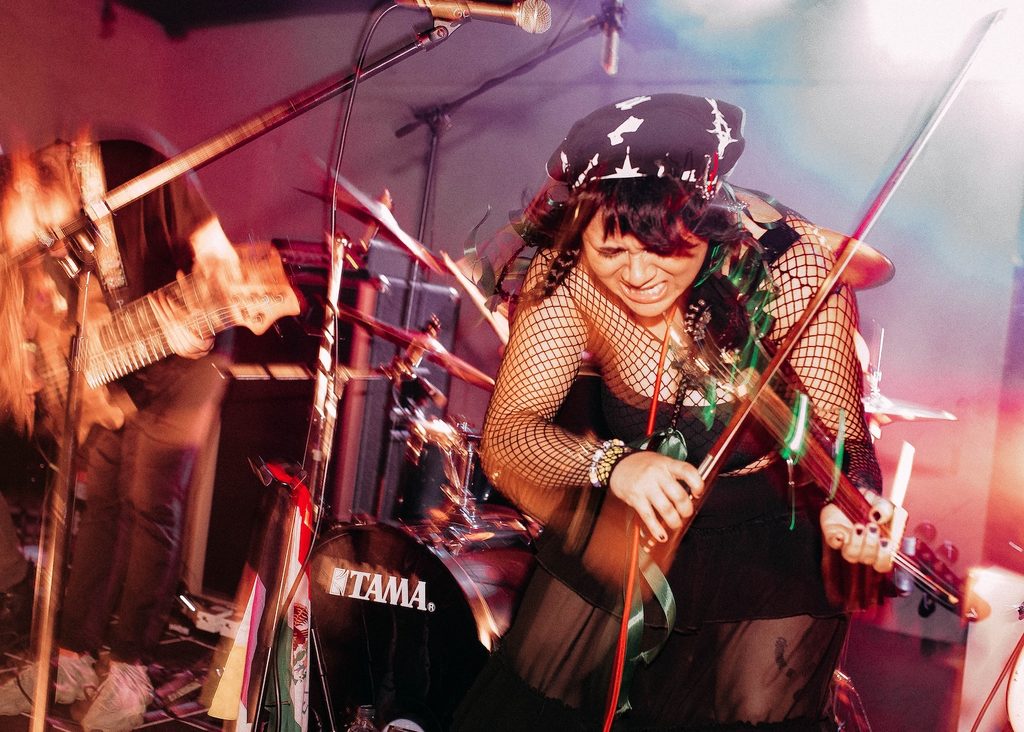
One such mariachero, nicknamed “Big Booty Judy” (“Those mariachi suits are tight!” she jokes), knew that Reyes played violin and liked to sing and would regularly encourage her to join them. Reyes describes her stage fright at the time as “horrific” but credits Big Booty Judy with pushing her out of her shell. Another push came when a high school choir director encouraged the already dedicated choir-and-orchestra student to audition for the Atlanta Opera’s High School Opera Institute. She got in, beginning the classical vocal training that would carry into college, where she would eventually meet the musicians who would become Mariachi Búhos de Oro. More than a decade later, they’re still playing together, at least between violin gigs with Rick Ross and the Renaissance Orchestra and an increasingly demanding schedule for Muelas.
Offstage, keeping Muelas afloat requires the decidedly unpunk, and more frequently unseen, labor of show-offer spreadsheets, press kits and bank accounts. To the band’s chagrin, it also includes monitoring social media metrics, though a comment on their “Melt” music video is what ultimately got them to Europe. Well, that and “the power of debt,” Maggard shrugs.
Despite Reyes and Musashi’s twice-canceled flights, the band ultimately made it to Europe, albeit one show down from the four they had booked on account of two of the members still being on a separate continent. The band’s Hamburg stop brought them to Gaußplatz, one of the city’s most enduring punk communes, which looks, as Cramer describes, like “if Fallout had gone in a much more peaceful direction.”
Born from the ethos of Germany’s squatting movements, Gaußplatz is an alternative housing community and subcultural hub located in an increasingly gentrified part of Hamburg. Here, graffiti and gardens cloak converted trailer caravans and open-air shows alike. Just before Muelas settled in for the night in one of the commune’s converted train cars, a new friend from Glower, a Hamburg-based band they had met while performing in Odense, tried to explain, through a bit of a language barrier, just how deeply rooted in community the place truly was.
“Yeah, uh, people die here,” he told Cramer, attempting to convey the depth of the residents’ connection to Gaußplatz. His partner quickly clarified after seeing Cramer’s expression.
Here, a puppeteer also gifted Reyes a tiny prop violin, which they now keep in their bedroom. But beyond spray-painted trailers and tiny violins, the experience of the commune offered Cramer a “life-changing” glimpse into a kind of infrastructure that becomes increasingly difficult to imagine with the rising cost of living in the United States.
“It’s not that we don’t have it here,” he says. “But it’s so much harder for people to prioritize [community] when everyone is struggling to just survive. When all you can do is look after yourself, it’s really hard to extend all these things for others, let alone to strangers. It was a stark reminder of how things could be equal parts discouraging but also encouraging in that it’s very achievable. To see it and experience it firsthand was such a privilege.”
Maggard echoes these sentiments, citing the financial challenges of being in a band or sustaining an independent venue in the United States. “At the same time,” he says, “it makes it so beautiful that we have all of these thriving music scenes across the country that really exist in spite of all of the odds.”
In the specific case of Atlanta, Muelas especially appreciates the wide net of genres that can be found populating the local music scene on almost any given night. It’s a tight-knit, multifaceted village upheld by reciprocity and one that will show up for you even if your very first show is on Father’s Day.
“I hope that people come to the shows and feel the raw anger and sadness and love that really exude from the body when we’re in a space together,” says Reyes. “You’re surrounded by a lot of people who have way more similar struggles than you think. If it wasn’t for my village, I wouldn’t have gotten to see all this cool shit!” They pause. “And then be left behind in the U.S. while the three white men board the plane to Europe!”
The band doubles over again, followed by a woeful Maggard: “You would have liked the salmon.”
Where and when
Muelas performs at 6:30 p.m. October 1 at Hell at The Masquerade, 75 Martin Luther King Jr. Drive SW.
::

Lindsay Thomaston is a photographer and culture writer with a background in media and politics. Her work has appeared in Paste Magazine, Rolling Stone, i-D, Dazed, Fashionista and Immersive Atlanta, among others.
STAY UP TO DATE ON ALL THINGS ArtsATL
Subscribe to our free weekly e-newsletter.

PLEASE SUPPORT ARTSATL
Your Gift Sustains the Coverage You Count On!
Related Posts