

When beauty melts: Niki Zarrabi’s ambitious evolution at Luca Fine Art
Atlanta artist Niki Zarrabi has cultivated a formidable reputation for her signature melting flowers. In her celebrated Femme Pétale series, lush, hyperrealistic bouquets cascade down the canvas in viscous drips, suggestive of exquisite collapse. Her new exhibition, To Have & To Haunt, presented at the recently opened Luca Fine Art in West Midtown, finds Zarrabi at a pivotal and ambitious moment. The show places her signature florals in direct conversation with a newer body of work that introduces narrative, symbolism and more of the artist herself within the frame. The result is a technically sound and often lovely exhibition that poses a central, challenging question: In an artist’s evolution toward a more personal and explicit voice, what is gained and what, if anything, is lost? Does the expansion of a visual language inevitably strengthen the art, or can it risk shattering the very mystery that made it so compelling in the first place?
Zarrabi’s work has always been rooted in the grand tradition of memento mori — the artistic reminder of mortality. When asked, she explained that Femme Pétale “was originally created as a meditation on reincarnation,” using flowers as a metaphor for our own cycles of blooming and fading. This conceptual foundation is strong, but the series’ power has always resided in its potent ambiguity. The melting felt elemental — a mysterious force of nature acting upon the petals. It was a surrender to an unseen entropy, and, in that mystery, the work found its elegance. The newer work in To Have & To Haunt seeks to evolve this conversation by personalizing it.
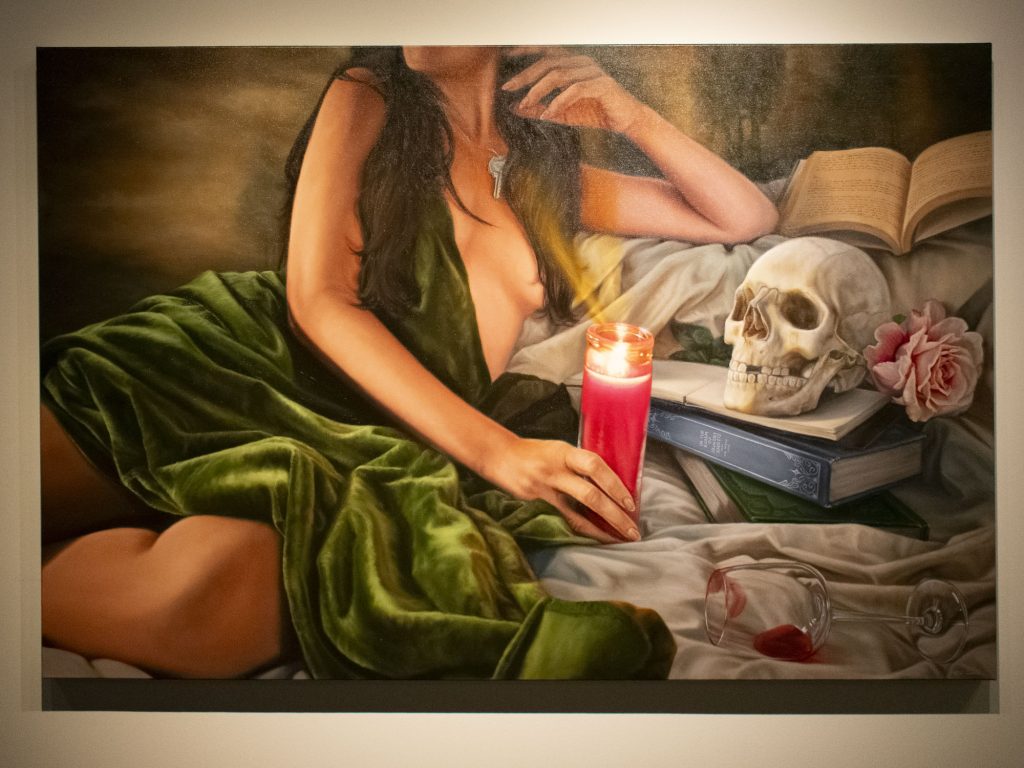
Zarrabi shifts from the universal condition of mortality to the specific death of “identity, of illusion and of love.” Drawing heavily on the symbolism of Dutch Renaissance and vanitas painting, she populates her still lifes with objects meant to evoke modern addiction, grief and obsession, creating what she calls “visual heirlooms of obsession and self-destruction disguised as beauty.” It is an ambitious and intellectually rigorous goal, aiming to connect our contemporary compulsions to the timeless vices of the Dutch greats.
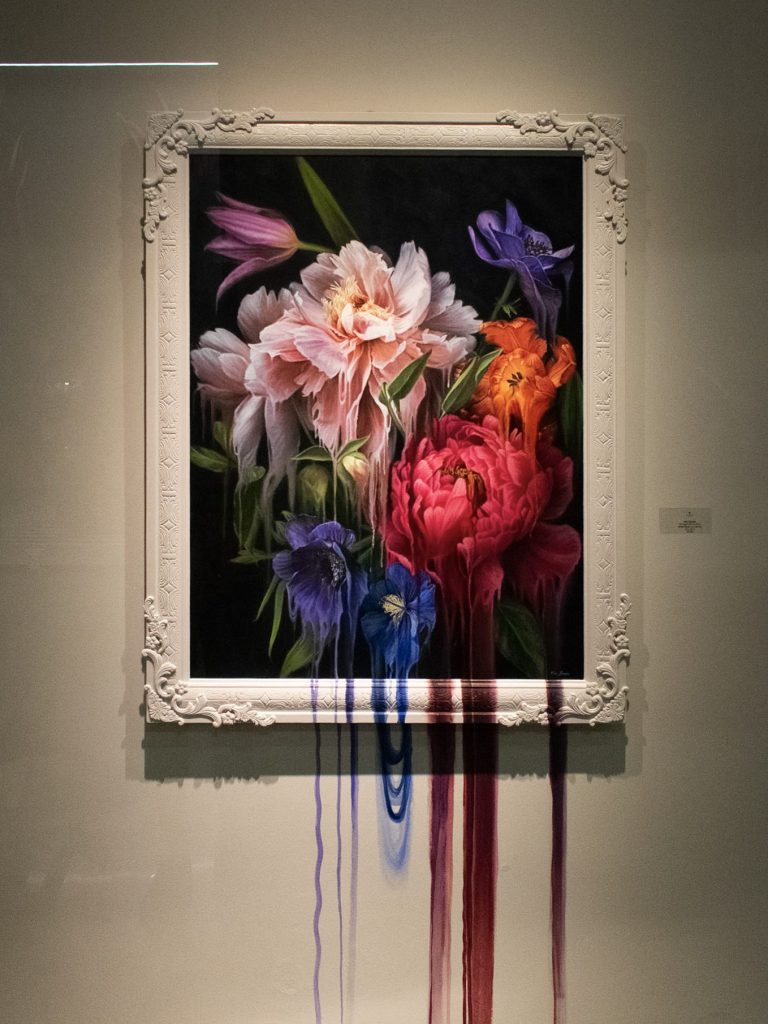

The exhibition’s strongest moments are found in pieces like Till Death Did Us Part I and II, where the pure, uninterrupted decay of the Femme Pétale series remains the focus. In these works, a lush bouquet emerges from a deep, velvety black background, as the flowers themselves seem to liquify. A large, pale pink peony at the center appears to sag under its own weight, its lower petals dissolving into streaks of color. Vibrant blue and deep crimson pigments bleed downward in streams, staining the flowers below before spilling off the canvas onto the ornate white frame and down the wall itself, all the way to the floor. Zarrabi’s signature gesture — breaking the fourth wall of the canvas — gives the work a sense of confident defiance, a hint that the artist is thinking beyond the boundaries of traditional painting. The technical execution is flawless; Zarrabi’s top-notch brushwork renders the texture of the petals and the glossy quality of their dissolution with breathtaking precision. The paintings are objects of undeniable beauty, and their emotional weight comes from what is left unsaid. It is a quiet, dignified meditation on transience.

By contrast, the newer works sometimes feel disjointed and compositionally confined. In Love You to Death, a skull sits behind a stack of books and an open box of chocolates into which lipstick-stained cigarettes have been seemingly snuffed out. Beside this scene rests a phone, its screen illuminated with the unmistakable logo of ChatGPT. While including digital technology in a conversation about modern addiction is a valid idea, the execution here is problematic. Conceptually, the topic of artificial intelligence is vast and nuanced, yet here it is reduced to a topical logo. The work imports all the cultural baggage of ChatGPT without engaging with any of its intellectual particulars. This potential conceptual flatness is compounded by a visual dissonance: the projected light from the phone’s screen clashes with the soft, reflected light that defines the rest of the candle-lit scene, creating a spatial disconnect. Including references to digital technology risks sacrificing the piece’s moody, timeless atmosphere for a punchline that feels overly simplified.
More crucially, the new works demystify the old ones. By introducing lit candles, Zarrabi reveals a potential metaphor for the melting flowers that were once so enigmatic. The elemental force is revealed to be simple physics, and with it the illusion is shattered. Dripping, once a symbol of inevitable decay, now just resembles melting wax. The flowers, by association, are no longer surrendering to an unseen entropy. They are simply melting like candles.
I found the experience of walking through To Have & To Haunt to be one of discovery and curiosity, followed by a slight sense of disappointment. The excitement of seeing the artist push beyond the familiar was tempered by the realization that the new territory is potentially less compelling than the old. The superhuman perfection of the florals sets an impossibly high bar, and while the new works are technically unimpeachable, they do not quite achieve the same transcendent glow. The beauty of the Femme Pétale paintings lies in their restraint; they are emotionally resonant because they trust the viewer to bring their own meaning to the elegant decay. The newer works, with their explicit symbols, feel prescriptive by comparison. They tell the viewer precisely what to think about grief, addiction and modernity, rather than creating a space for contemplation.
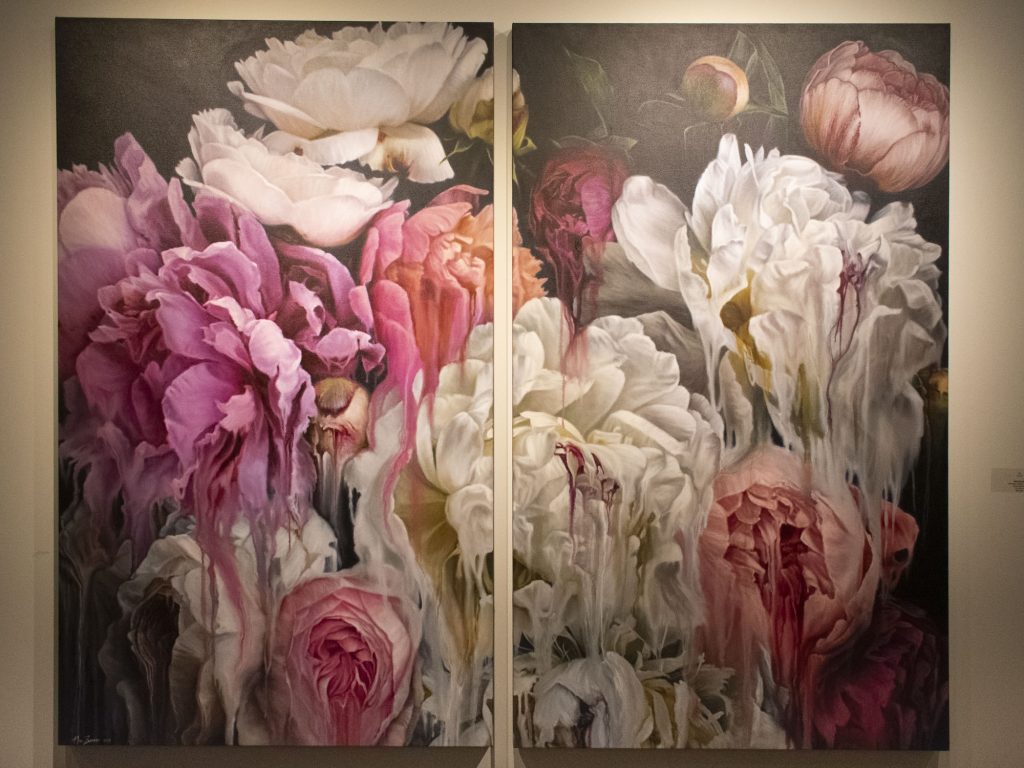
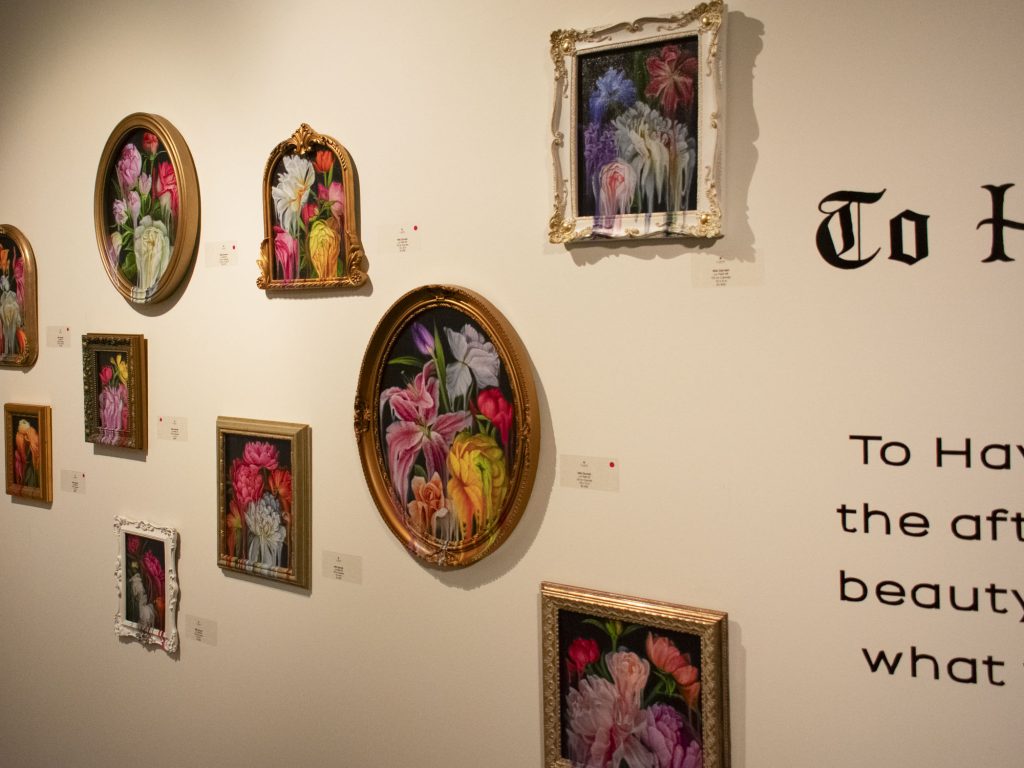
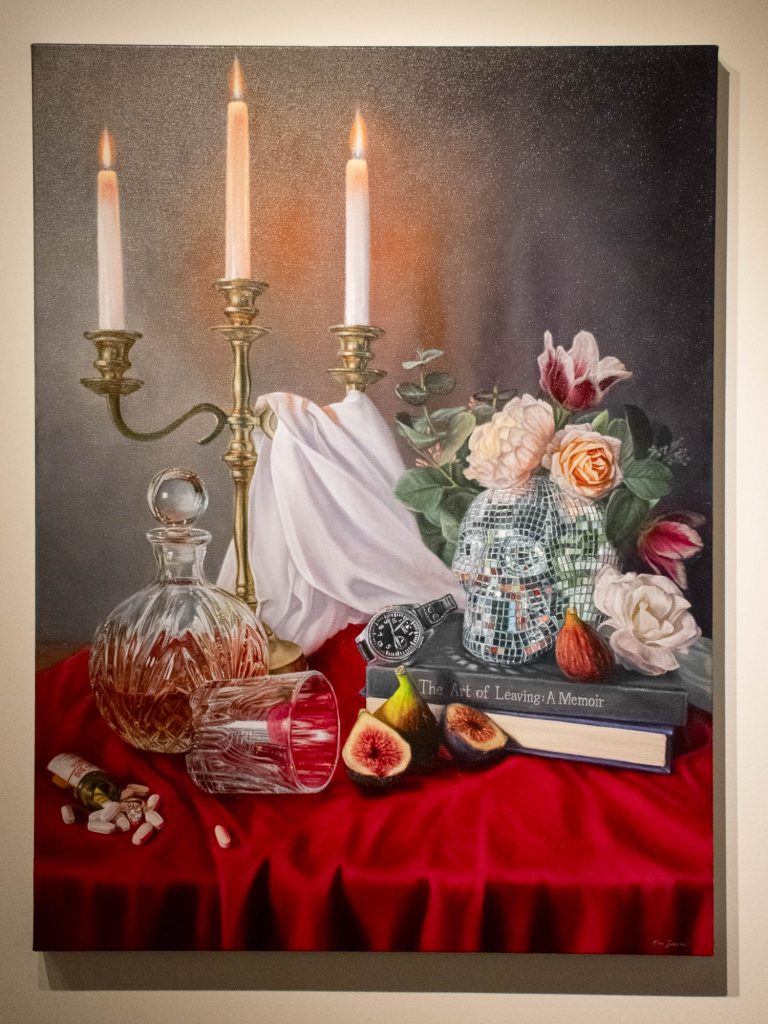

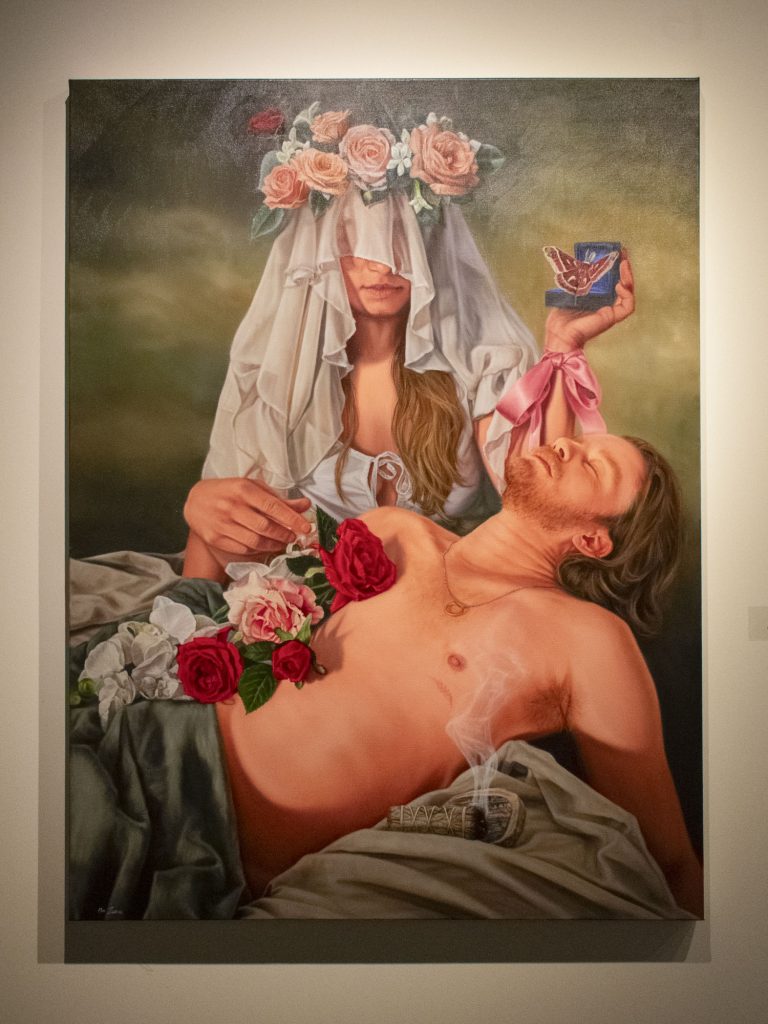
Ultimately, To Have & To Haunt is a fascinating document of an artist in transition and, by all accounts, an immensely successful exhibition. Zarrabi possesses a technical prowess that is beyond question, and her ability to render light, texture and emotion is a rare gift. Luca Fine Art, with its pristine white walls and professional presentation, provides a much-needed elevated platform for commercial artists in Atlanta, making her work feel more valuable and important than ever. That any critique can be made of the new direction is, in itself, a testament to the formidable power of the original Femme Pétale series. It is exciting to see an artist of Zarrabi’s caliber push the boundaries of her craft, and it will be just as exciting to see how she carries this evolution forward.
Niki Zarrabi’s To Have & To Haunt is on view at Luca Fine Art through December 6.
::

Dr. Kevin M. Storer is a multidisciplinary computing researcher living, working and collecting art in Atlanta. His approach to art criticism and collecting prioritizes the discursive power of artistic practice over purely aesthetic qualities. This perspective is informed by his internationally-awarded scholarship on the complex relationships between people and the objects we create — especially as they shape our identities and social realities. Kevin earned his Ph.D. in informatics from the University of California, Irvine.
STAY UP TO DATE ON ALL THINGS ArtsATL
Subscribe to our free weekly e-newsletter.

