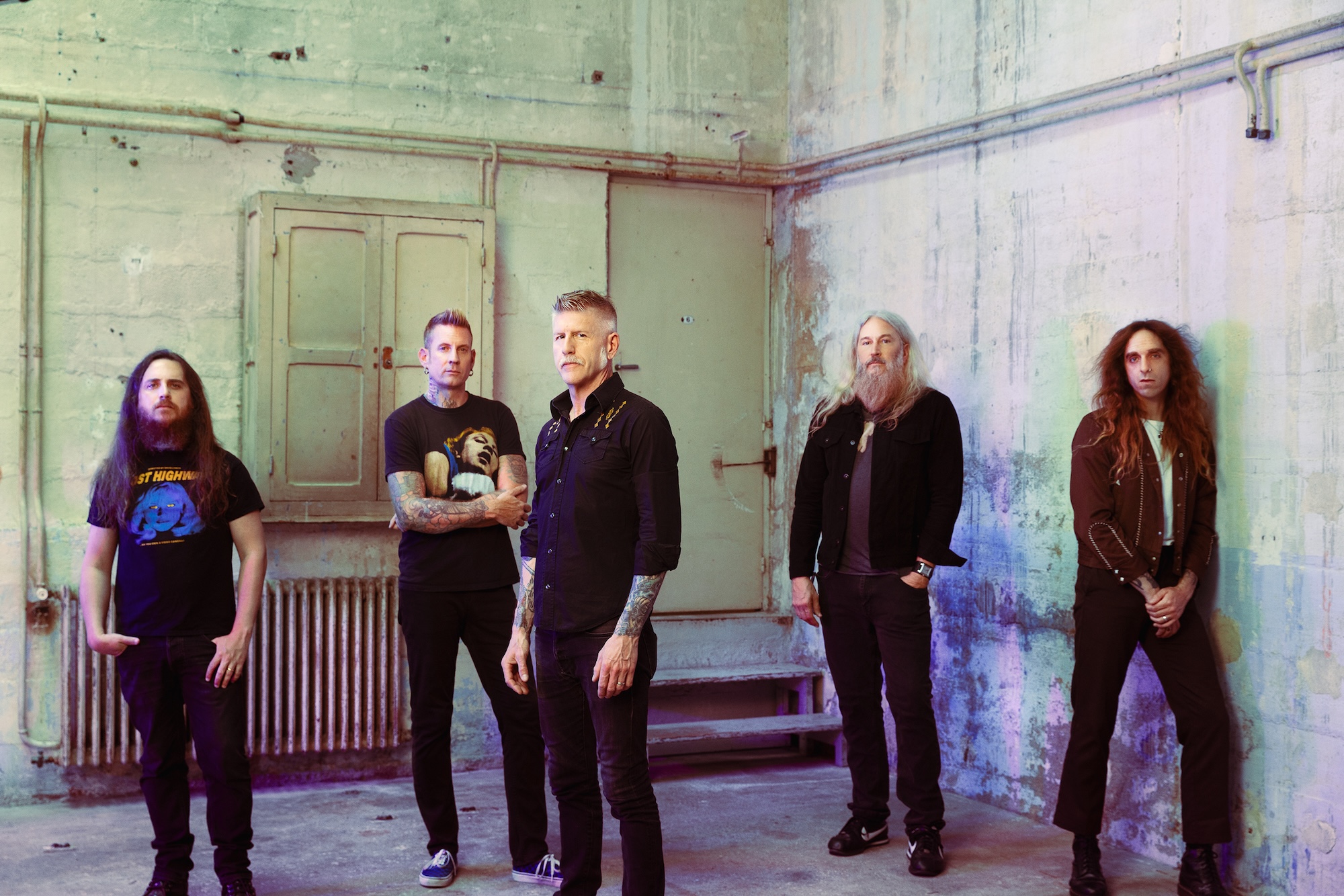
The heaviness of healing: Mastodon moves forward with ‘Marrow Deep’
Atlanta’s masters of metal will play the Eastern on October 22.
::
Atlanta’s own Mastodon, who bring their tour in support of this year’s Marrow Deep LP to The Eastern on October 22, have spent the better part of their quarter-century of operation not only as a band but as a brotherhood. Sadly, that bond — one of modern metal’s most enduring edifices of human connection — was shaken with the departure of guitarist and founding member Brent Hinds in March of 2025. That alone sent ripples through the metal world, but it was nothing to compare with the shockwaves that would follow less than a year later when Hinds was killed in a motorcycle accident.
Though the aura of Hinds’ passing invariably looms large over any discussion of the band’s forward motion, I steered my talk with bassist Troy Sanders toward the current state of the band and their integration of new guitarist Nick Johnston. Given the interwoven nature of the band in question, it seems like an insurmountable task — the heavy metal equivalent of replacing one of the Beatles.
Fortunately for Mastodon, Johnston’s reserved nature played to their advantage. Despite having written dozens of potential parts for the new album, he was reluctant to overstep his bounds.
“He was very cautious not to overstep,” affirmed Sanders. “He’s Canadian. He’s about as polite as they ever come.” Nevertheless, Mastodon is a team effort, and the band welcomed Johnston’s prolific songwriting into the process.

“He would send an idea to us on a daily basis,” continued Sanders. “He was just itchin’ and rarin’ to go.” That process was facilitated by band guitarist Bill Kelliher bringing a mobile studio rig on tour. Ideas flowed freely and were tested in the band’s natural habitat. “He would break that out every day and start working on ideas with Nick, working on ideas with our drummer Brann Dailor and really starting to dig in with all the ideas we’d collected over the previous year-and-a-half or so.”
Johnston was enthusiastic and emboldened by the band’s approval, but the prospect of carrying on in the shadow of Hinds’ monolithic absence still proved daunting. For Saunders, Johnston’s affable nature made it a smooth and optimistic process. “His humbleness just furthered the idea that we have more contributors, more collaborating, all without any ego whatsoever. The energy and the vibe was just very grounded and very exciting.”
The end result, according to Sanders, was the most important album of the band’s career, though he acknowledges that they always see their current newest album in that light. “We’ve always said that. Each and every record, we always want to further ourselves, push ourselves and challenge ourselves on our own instruments as players — also as a better bandmate — and also with the riffs, the songs, the vocal patterns and the lyrical subject matter. Everything that goes into a song and into an album, we always want to better ourselves. It’s a challenge that we all are passionate about. None of us are complacent and want to write the same record twice.”
Johnston’s work on Marrow Deep goes a long way to fill those shoes accurately. He captures Hinds’ signature style — those wailing blues leads intercut with modal exoticisms — but remains his own man. That musical selfhood is most apparent on his solo on “The Three Fates,” which echoes the intricate prog rock of Robert Fripp.
“He was just so amped up to get in there and make himself happy and everyone else proud,” beamed Sanders. “He said, ‘I’m not here to fill Brent’s shoes, because those shoes can’t be filled.’”
To that end, Sanders and company were careful to approach Johnston first on a human level and as a musical collaborator only later. “When Nick came into the fold, I was unaware of his history as a solo artist,” Sanders explained. “I wanted to get to know the man first. We hung out for two days before we even played music.”
The end result of that newly reoriented creative process was Marrow Deep, an album that, I noted to Sanders, seems to follow a larger conceptual continuity within Mastodon releases. The band appears to have a pattern of releasing straightforward metal albums (such as the compact and easily digested Leviathan) and then expanding out into intricate, experimental prog rock territory (albums like Crack the Skye) before returning to the straight-ahead rockers.
Marrow Deep, which follows the more epic and complex Hushed and Grim, maintains that trend by returning to a very bare-bones (pun intended) Mastodon that almost narrows accessibility to the point of calling up comparisons to AC/DC and Creedence Clearwater Revival (albeit still heavy as all hell). Sanders is quick to concur, saying that the pattern is real and intentional.
“You’re spot on. For example, when we were writing Crack the Skye, it was close to nine months. Very deep, very complex. That was our classic prog rock album that we’d always dreamt about creating. And then we went out and toured that thing around the world for a few years, and most of the shows we were playing that record in its entirety.” After multiple years touring in support of such a record, he explains, the band always feels ready to follow it with a stripped-down, back-to-basics rock album from a band that needs to have fun again.
A similar dilemma presented itself after the recent Hushed and Grim, a double album imbued with heavy themes revolving around the Covid-19 pandemic. “We love that record,” says Sanders. “But it’s a very heavy, deep, expansive listen. After touring that for a few years, we were very eager to reel it in. Let’s bust out some meat and potatoes and have some immediacy. Let’s come out swinging — get in, get out.”
That immediacy has made for an enthusiastic, career-retrospective tour. “We’re playing a good chunk of the new record. But we’re also playing a good chunk off of the new record. But we are also playing one or more songs off every other record we’ve done. There’s no songs we’re tired of playing.”
His energy is infectious, even when shadows pass over his face as he mentions his late bandmate. Troy Sanders and his new musical brother Nick Johnston — along with keyboardist João Nogueira — seem poised to prove that even the most broken bones can heal.
::

Jordan Owen began writing about music professionally at the age of 16 in Oxford, Mississippi. A 2006 graduate of the Berklee College of Music, he is a professional guitarist, bandleader and composer. He is currently the lead guitarist for the jazz group Other Strangers, the power metal band Axis of Empires and the melodic death/thrash metal band Century Spawn.
STAY UP TO DATE ON ALL THINGS ArtsATL
Subscribe to our free weekly e-newsletter.

PLEASE SUPPORT ARTSATL
Your Gift Sustains the Coverage You Count On!
Related Posts