Chamber Cartel returns to the stars with a percussive 20th century tour-de-force
The Atlanta ensemble presented the Southeastern premiere of Pléïades by Greek composer Iannis Xenakis in 2015.
::
One of the best-known celestial objects visible in the night sky is an open star cluster called the Pleiades. Also known as the Seven Sisters, so named for the seven brightest stars in the cluster, the Pleiades contains more than a thousand stars, many of which are brighter than the Sun.
Over millennia, the Pleiades have spawned multiple myths and legends. In Polynesian and Māori mythology, the great god Tāne, tired of hearing an exceptionally large and bright star endlessly brag about its brilliance, grabbed the star Aldebaran and hurled it at the arrogantly vain star, smashing it into the magnificent arrangement we recognize today as the Pleiades.
The modern-day celebration of Halloween originates from an old Druid rite, which holds that the veil dividing the living from the dead is at its thinnest, allowing for all sorts of spells and shenanigans, when the Pleiades reaches its highest point in the sky — known as a culmination — at midnight.
With these thoughts in mind, we look forward to Chamber Cartel’s performance of Pléïades by Greek composer Iannis Xenakis at the Goat Farm Arts Center on Saturday, October 24. Pléïades is a unique tour-de-force, making any performance a rare, not to be missed, opportunity.
Composed under commission from the city of Strasbourg, France, Pléïades premiered in May 1979 when Xenakis was 56 years old. A challenging work by any measure, Pléïades is a percussion sextet for six handmade, 19-note, wood-and-metal keyboard instruments called sixxen, along with a battery of conventional percussion instruments including timpanis, tom-toms, congas, xylophones and marimbas.
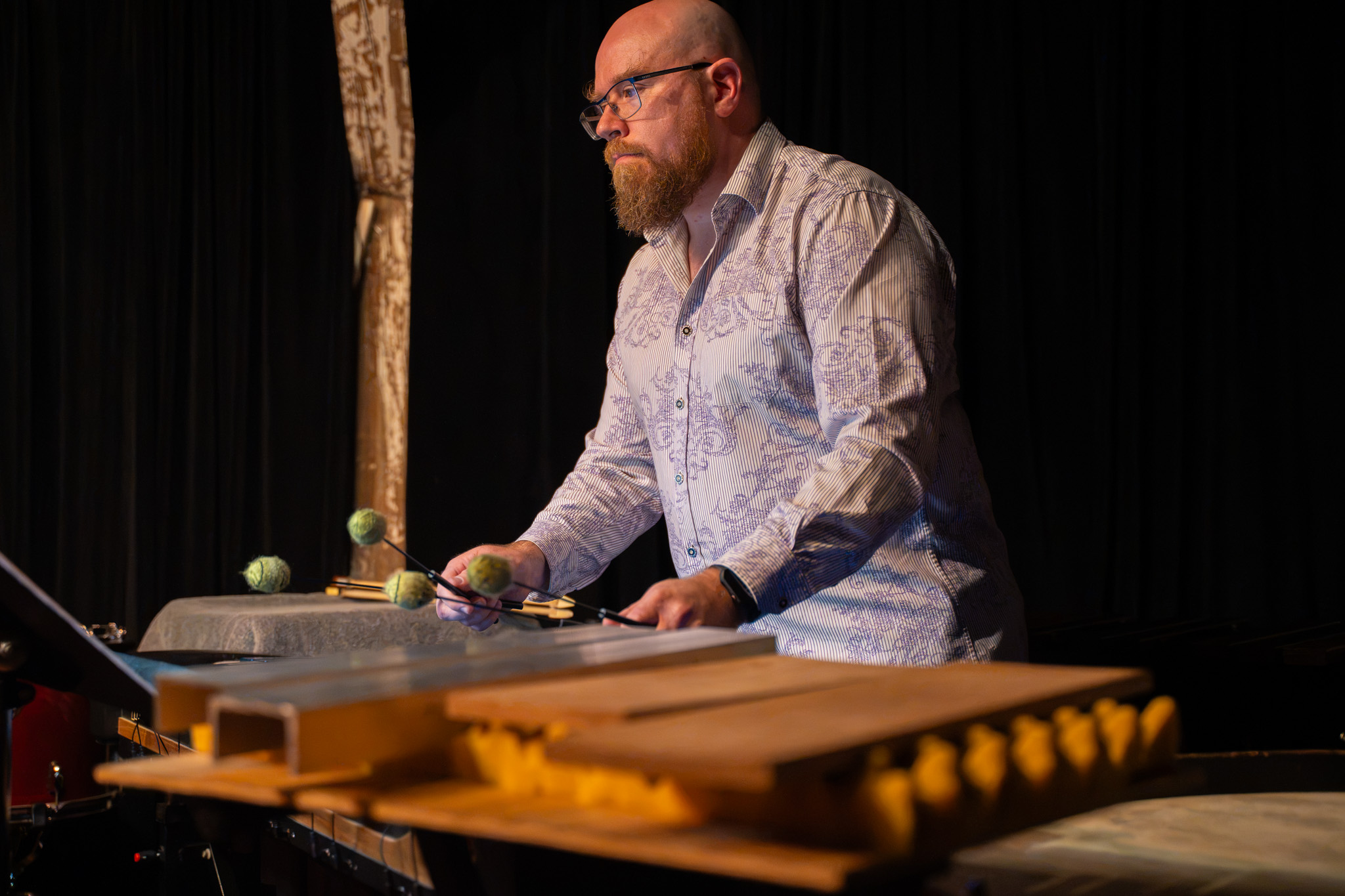
A decade ago, in October 2015, Chamber Cartel presented the Southeastern premiere of Pleiades at the Goat Farm’s Goodson Yard, a huge, 10,000-square-foot warehouse space with brick walls, concrete floors and large multipane windows.
Before a standing-room-only crowd of around 200, the ensemble delivered a thrilling, hall-shaking performance rivaling any amped up 21st century cinema experience. Two years later, Chamber Cartel staged a second Pleiades concert in the resonant, cavernous confines of the now sadly defunct Orpheus Brewing and Taproom adjacent to Piedmont Park.
This time around, Chamber Cartel Founder and Artistic Director Caleb Herron is excited about returning to Goodson Yard and thankful that he doesn’t have to construct another set of sixxen, of which only about 50 exist. The old models sound just fine.
“You can’t just go out and buy a sixxen, right? It’s a sort of special sound,” said Herron. “Also, we have a great percussion community in Atlanta. It takes skilled people to pull this off. I’m very fortunate to have studied under Stuart Gerber at Georgia State, who is playing with us.”
In addition to Herron and Gerber, professor of percussion at Georgia State University, the Pléïades ensemble includes Kellen King, co-director of the Georgia State University percussion ensemble; Jeremy Muller, lecturer at Georgia Institute of Technology; Khesner Oliveira, a GSU graduate and regular participant in new music projects; and Paul Stevens, also familiar to Atlanta new music audiences for performances with Chamber Cartel, Bent Frequency and Moloq.
Over the last couple of decades, a richly talented community of musicians and composers eager to take classical and chamber music in new technical and conceptual directions has developed in Atlanta. Just as significant is the embrace of this music by a sizable audience.
During any given year, enthusiasts can enjoy multiple, multiday, edgy music festivals, such as SoundNOW and No Words. Experimental music from around the world can be experienced live on a weekly basis at offbeat venues like eyedrum and Railroad Earth. New chamber and orchestral works are presented at recitals on campuses at GSU, Tech, Emory and Spelman. An important impetus for this development can be traced back to programs and professors at the city’s major universities.
“We’re not a tiny city by any stretch, but, on the other hand, we’re not New York, LA or Chicago either,” said Nickitas Demos, professor of composition at GSU. “For a city our size, to have so many performing artists that are interested in contemporary music along with an audience that appreciates this music, is really kind of remarkable.”
As a young man in the 1970s, Demos recalled learning about Bill Hill, bass trombonist with the Atlanta Symphony Orchestra at the time, a public school teacher and associate professor at GSU for 23 years. Hill founded the Annual Symposium of Contemporary Music for Brass, an internationally renowned congregational event, which presented some 400 new brass works during its run.
“In my composition seminar class at Georgia State, I’m doing a whole 30,000-foot view of the history of contemporary music in Atlanta going all the way back to Alfredo Barili in the 19th century,” Demos said. “Through Hugh Hodgson and Charles Knox and people like that, going all the way to the present day. We want our students and young composers to understand that this music didn’t come out of nowhere.”
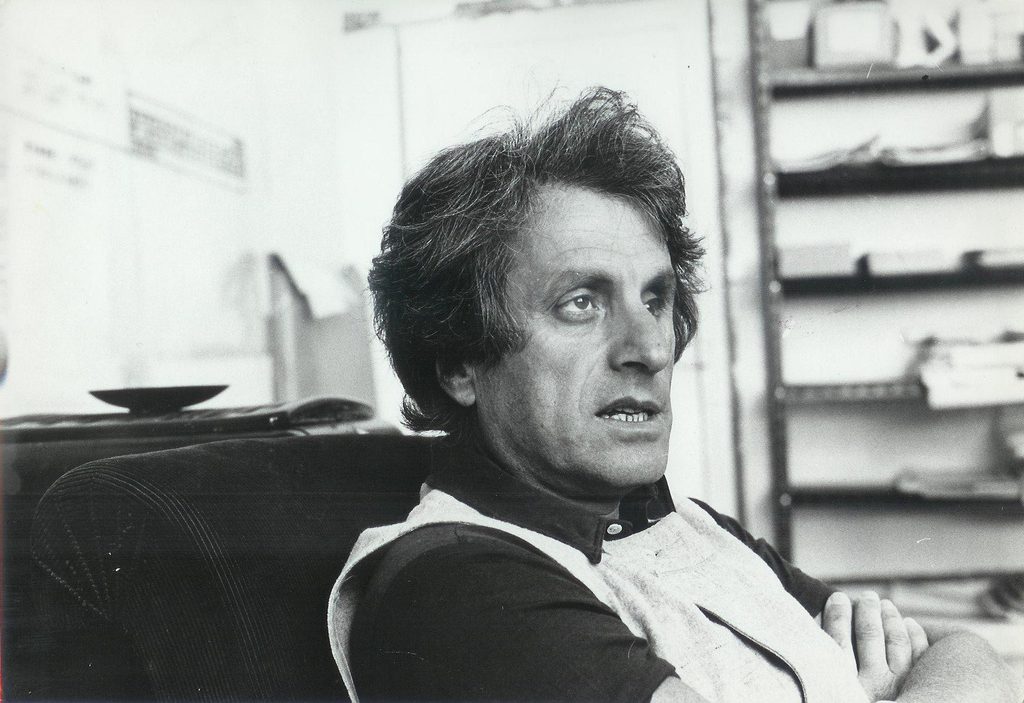
Xenakis was born in 1922 into a Greek family living in Romania. Following the German invasion in 1941, Xenakis fought in the Resistance, was wounded and lost sight in one eye. After the war, he wound up in Paris, where he mentored under legendary architect Le Corbusier and studied composition with Olivier Messiaen.
The effect of World War II on Xenakis and his peers, such as Karlheinz Stockhausen, Luciano Berio and Elliott Carter, was profound. Their experiences prompted a rebellion against the status quo, which led to the development of fresh conceptual ideas and new techniques that reshaped many of the fundamental principles of the art.
In his book, Formalized Music, Xenakis wrote: “… the collision of hail or rain with hard surfaces or the song of cicadas in a summer field. These sonic events are made out of thousands of isolated sounds; this multitude of sounds, seen as totality, is a new sonic event.” In composing, Xenakis employed mathematical constructs including set theory, stochastic models, statistical mechanics and game theory.
Demos comes from a Greek background. Although he admires Xenakis as a great post-war Greek artist, the two composers ply their craft in entirely different ways.
“I don’t write anything like he does, but it’s just such an interesting approach, especially something like Pléïades, where he’s using stochastic procedures. One of his big things is to kind of free himself from serialism. He thought that stochastic writing and using natural sounds was the way to go, but it demanded a lot of computational skills. Of course, he comes from this architectural background, so it’s very interesting writing to me. I’m very interested in soundscapes and things like that.”
Pléïades is typically staged with the musicians situated in a circle facing each other and the audience spread out around the outside of the circle. The array of instruments is impressive — a sculptural or architectural monument all its own. When the wildly percussive music commences, the effect is something that requires personal experience to truly appreciate
“It is an epic piece,” Herron said. “It’s 45 minutes long. When you’re in it, actually performing it with your colleagues, is an amazing feeling. You have to be concentrating a lot. The parts are individually difficult, and then, putting it all together is also difficult — to live in that sound; all these drums. To live in the sound of those sixxen, to have it envelop you …,” he said, his voice trailing off.
Sounds a little scary, doesn’t it?
Just in time for Halloween, Chamber Cartel presents Iannis Xenakis’ Pléïades at the Goat Farm Arts Center on Saturday, October 24.
::

An Atlanta native, Doug DeLoach has been covering music, performing and static arts in his hometown and beyond for five decades. Doug is a regular contributor to Songlines, a world music magazine based in London, and his ruminations on arts and culture have appeared in publications such as Creative Loafing, Georgia Music, ArtsGeorgia, The Atlanta-Journal Constitution, High Performance and Art Papers.
STAY UP TO DATE ON ALL THINGS ArtsATL
Subscribe to our free weekly e-newsletter.

PLEASE SUPPORT ARTSATL
Your Gift Sustains the Coverage You Count On!
Related Posts