The ghosts of segregation haunt Flux Projects’ “Ghost Pools” installation
To experience the whole story behind her East Point installation, Ghost Pools, the artist and writer Hannah S. Palmer says the viewer needs to experience both the site and history of the segregated community swimming pools that were built in 1953 and closed in 1982.
Ghost Pools is a summer-long public art project that makes visible these now filled-in pools and the erased history of segregation that Palmer unearthed for Flux Projects. She collaborated with Ann Hill Bond, who leads the oral history component, and Santiago Páramo who handled the sound production. The outdoor exhibit is on view through Labor Day across two sites.
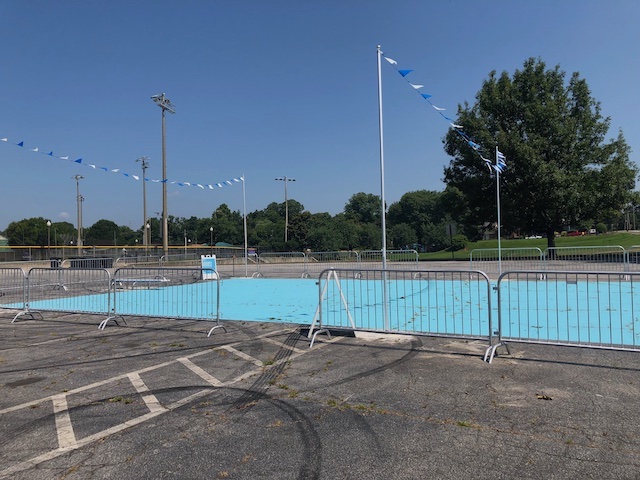
At the East Point Historical Society, Palmer stands adjacent to the grassy field of one of the two sites of Ghost Pools. “The difference in the location, the difference in the size of each pool — they are both thoroughly erased so you have to use your imagination to even picture what the pools were like,” Palmer says as she looks toward the field where the pools’ pennant flags glimmer as they move in the wind.
The project’s Spring Avenue site is difficult to locate, even via GPS, but Palmer leverages the theme of hiddenness to allude to what is underground. At the Randall Street site, it would be easy to overlook the painted concrete except for barriers and Flux signage.
Part of this obfuscation is intentional, causing viewers to pause and consider what parts of our community history are concealed. This theme is addressed in further detail through a historical timeline marker that extends across both locations. Palmer’s research into public pools alongside archival imagery reveal communities’ affection for pools and how the state and local residents and officials resisted desegregating these spaces in the 1960s.
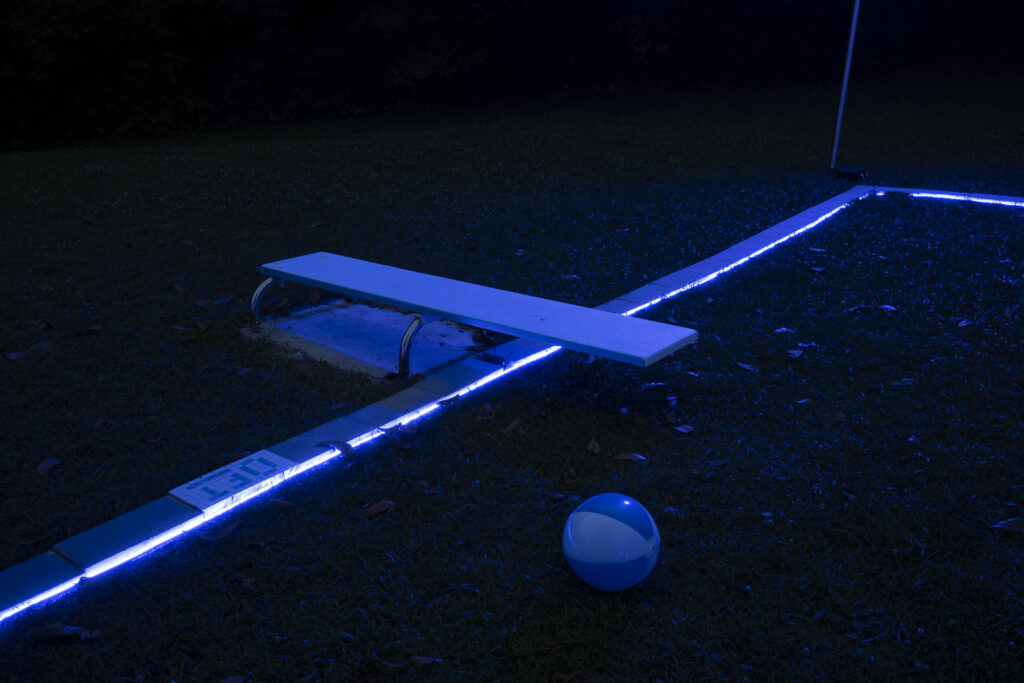
Walking toward the site through long grass, the intense summer sun already blazing, Palmer points out a row of pavers. They are the edge of the now filled-in pool. “No trace of a pool existed at either site,” she says. “I used aerial photos to get dimensions, and I laid out a footprint of each pool.” She walks along the paver edge and steps into the slender shade of a magnolia tree, which would be half submerged in water should the pool emerge from underground. At night, the Spring Avenue pool site glows blue with subterranean lighting. The artist installed a blue LED rope light along the pavers to allow visitors to see the pool around the clock.
The concept of Ghost Pools was inspired by Palmer’s interest in the creation of pools across America in the 1930s with Works Progress Administration funds, followed by the closure of pools in the 1970s and ’80s when cities took on ownership of pools and grappled with desegregation. In the case of the two East Point pools, there was a vote to pass a referendum bond to finance the pools. It failed, and the sites were bulldozed.
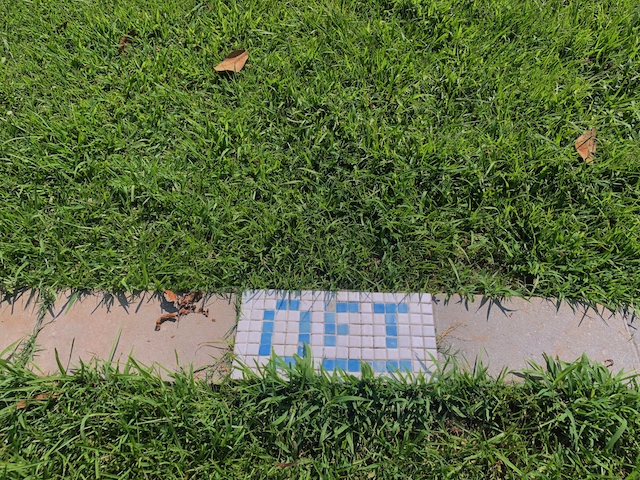
With her roots as a memoirist, Palmer is interested in how the stories we tell ourselves influence what we believe is historical fact and create opportunity for interpretation. In the Ghost Pools installation, there is a poetry of space and memory in the cheeky details, like the “0ft” sign tiled onto the edge of the pool or the diving board embedded in concrete.
Bond heads the oral history project for Ghost Pools and holds weekly recording sessions at the East Point Historical Society. Current and past residents share their stories of the Spring Avenue and Randall Street pools. Palmer suggests there will be a podcast released by Flux Projects about the recording and a printed record for the archive.
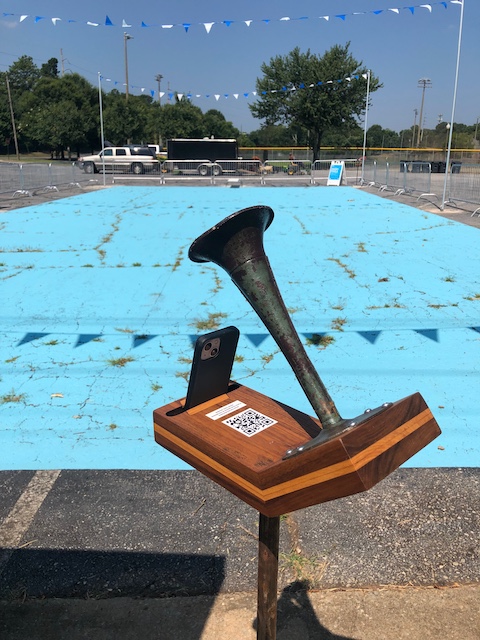
Immersed in the heat and standing on the pool-blue rectangle painted on the paved parking lot of the Randall Street pool site, Palmer slips her iPhone into a wooden and metal sculpture at the edge of the pool. She plays an audio component on the “iPhoneagraph,” as she calls it, a sculpture created by Páramo.
The sound of summer slips through the stifling air, as if the pool is just over there, when, in fact, it’s buried under dirt and concrete. It’s easy to imagine a pool here, and, more interestingly, it’s important to imagine a pool here. Palmer’s work provides the blueprint, an evocation of a hidden history and the magical components to elicit the fun and freedom possible in a public pool.
Part imagination, part play, part history lesson, Ghost Pools asks us to dream of the future while unearthing the past. The installation is on view 24 hours a day until Labor Day, when the artist will present a closing event.
::
Stephanie Dowda DeMer (she/her) is a lens-based artist and writer based in Atlanta.
STAY UP TO DATE ON ALL THINGS ArtsATL
Subscribe to our free weekly e-newsletter.

PLEASE SUPPORT ARTSATL
Your Gift Sustains the Coverage You Count On!
Related Posts