“Master Narrative” at Spelman reimagines creation story through Yorùbá gods
Harmonia Rosales has always admired Renaissance art — the realism, the linear perspective, the depth of human anatomy. And the storytelling.
Now, seven years’ worth of artworks by the Chicago-raised, Los Angeles-based artist who taught herself the techniques of Renaissance painting have come together to tell one of the world’s most intriguing creation stories.
Harmonia Rosales: Master Narrative will open at the Spelman College Museum of Fine Art on August 18 and will be on view through December 2. It’s the second stop on the collection’s national tour.
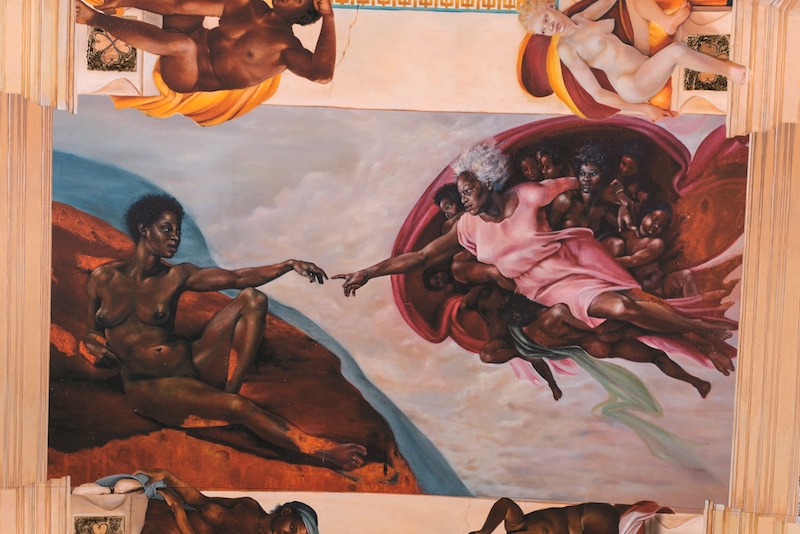
The exhibit is an exploration of the lives of West African-derived Yorùbá deities, or orishas, spiritual forces who like Catholic saints mediate between humankind and the divine. Many individual works are displayed at eye level. But the exhibit culminates in Rosales’ re-imagining of perhaps the most revered site of Renaissance art — the Sistine Chapel. Following the same architecture of Michelangelo’s fresco and others, Rosales’ work stretches across a replica of the overturned hull of a slave ship that is suspended from the ceiling.
Instead of European figures, though, Master Narrative retells creation stories through Rosales’ eyes as an Afro-Cuban woman whose roots also reach Jamaica.
The inspiration began when she thought of bedtime stories for her children and wanted them to know about deities who reflect them. It’s also inspired by struggles with her own identity that she experienced when she was young.
By challenging the dominant narratives, Rosales says, this exhibit preserves the memory of her ancestral lineage, honors the resilience of the Black diaspora and questions Eurocentric notions of beauty.
ArtsATL: You’ve defined your art as Black women’s empowerment through a diasporic lens. How does your identity within that lens guide your work?
Harmonia Rosales: Growing up, I never felt I was enough of anything. I wasn’t Black enough. Definitely wasn’t white. Didn’t feel Latina because I didn’t speak Spanish. I was a sponge for how society said we should look. My grandmother used to say “pelo bueno” — good hair. She would give me little gifts like a box of relaxer. It wasn’t until I had my daughter that I cut my hair off and cut the relaxer out because I wanted her to love her natural hair. I was finding myself by teaching her. She’s 13 now, and my son is 11. She doesn’t like her hair straightened at all. She likes it out, she likes it big and I love that.
I paint the features I used to dislike about myself, like dark elbows, my hair, my nose. I wanted the gods to look like where they came from in their purest form. I wanted to make them this really beautiful blue-black, like my great-great-grandmother, who was among the last enslaved.

ArtsATL: Do you practice the Yorùbá religion?
Rosales: Yes and no. I’m not one thing, which is why I can appreciate every religion. My Yorùbá influence mostly came from my grandmother and my dad. You learn from a priest or priestess until you go through the stages to become one. When you absorb the stories and learn to follow your intuition, you can retell them in a way that you understand. This is one reason Yorùbá hasn’t been written linearly in one book. One story could have 10 versions. To some, {the deity} Oshun could be beautiful and delicate; to some, she could be a warrior.
ArtsATL: How does that faith background translate to Master Narrative?
Rosales: I think a lot about Eve, but not as the woman in the Bible. She is our ancestors; she is what they went through to get us here. It’s about how she’s changed. The masterpiece, the boat, shows the creation of Earth by Yorùbá gods. Then, the gods creating Eve — us. Then Eve’s journey through the Transatlantic Slave Trade and losing those orishas, forgetting them in a sense. In the end, it shows heaven, but we remember the hell we lived through on Earth. Then it goes on to illustrate how we learn of our stories and take them back, reclaiming our identity.
ArtsATL: That’s a heavy concept. How is that symbolized?
Rosales: I use the fig tree a lot. A strangler fig. It’s a vine that grows from the top down and wraps around the host tree. Once its roots get into the soil, taking nutrients, the tree dies. It’s a symbol of manipulation and control. Society saying you’re not cute if you’re dark or because of your hair is all manipulation and control. It can take root in your Garden of Eden, which is your mind, but we can change that.

The children at the end {of the work} represent future generations. They’re sitting next to a strangler fig that has completely depleted the land. But none of them have bitten it. None of them have been manipulated by it. They’re looking to you, the viewer. They remind us that there’s always hope.
ArtsATL: How do you think people will receive this collection?
Rosales: There’s a lot of Christian art and Greek mythology art, but in order for us — people from the African diaspora — to be part of the conversation in the scope of religion, we have to have depictions of ourselves.
Some say their religion came first, others say theirs came first. I’m not saying anything except let’s study this, too. And for people who don’t know anything about it but know about the others, maybe they’ll make the connections and think, “Oh, Mary is Yemaya. Or Poseidon is Olókun. They’re kinda similar.”
ArtsATL: Master Narrative interweaves aspects of many religions seamlessly. What does that say to you about religion?
Rosales: The gods in the Yorùbá religion, and pretty much all of paganism, are basically nature and human emotions. They’re all part of one God — of whatever happened that created Earth and everything on it. We just give them names, flesh and bone. But if we give these gods life, then the major god is really us. We create our own heaven or hell on earth. We choose our own destiny. We have the ultimate control. That’s what I want to put out there.
::
Angela Oliver is a proud native of old Atlanta who grew up in the West End. A WKU journalism and Black studies grad, daily news survivor and member of Delta Sigma Theta, she works in the grass-roots nonprofit world while daydreaming about seeing her scripts come alive on the big screen.
STAY UP TO DATE ON ALL THINGS ArtsATL
Subscribe to our free weekly e-newsletter.

PLEASE SUPPORT ARTSATL
Your Gift Sustains the Coverage You Count On!
Related Posts