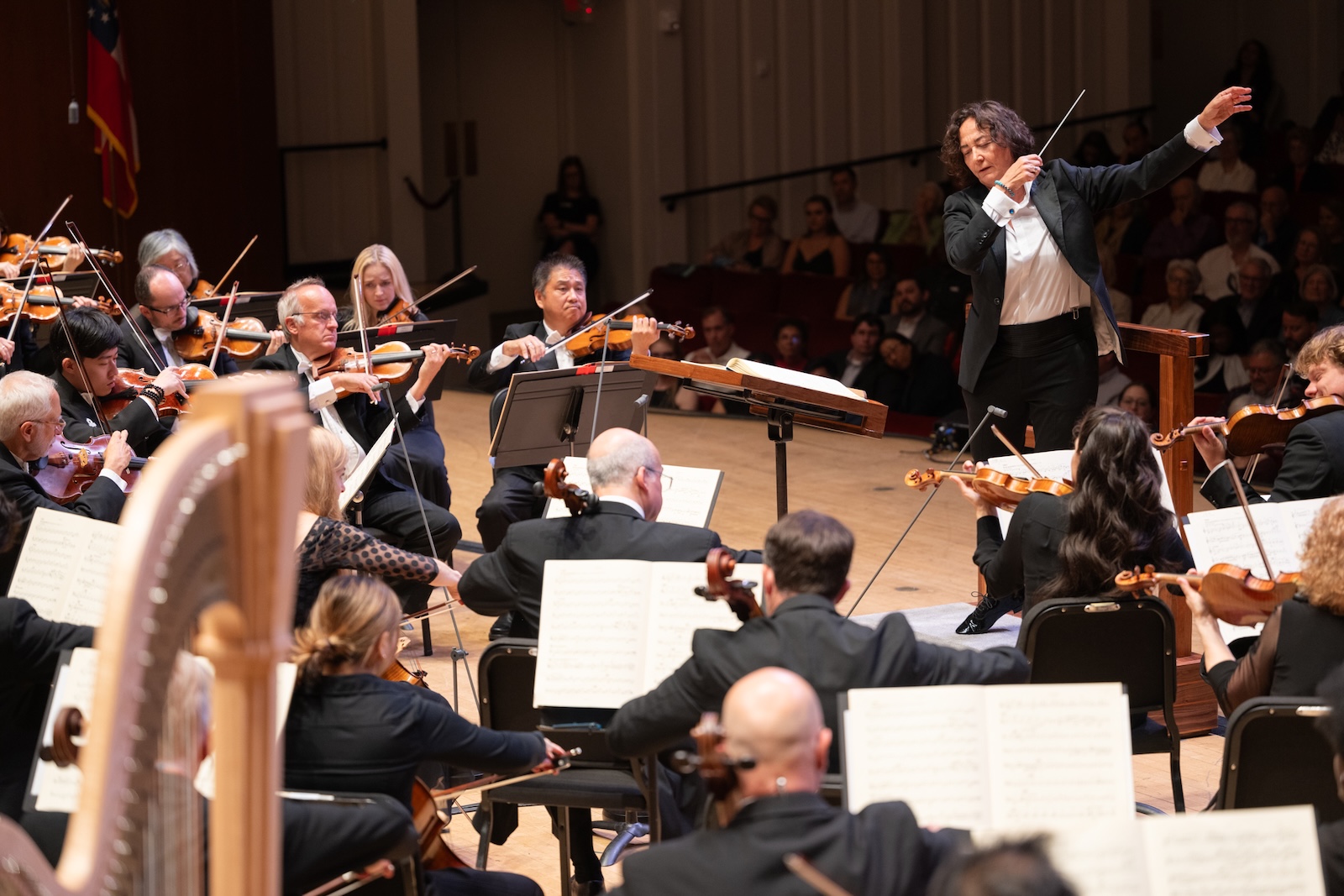
The Atlanta Symphony closes its season with a majestic Mahler
When the Atlanta Symphony Orchestra and Chorus assembled on Thursday, June 4, it did so for a season finale that carried with it all the gravitas of those words when applied to a prestige television drama. Throughout the preceding months, I’d watched the ASO open strong with Copland, Elgar and Strauss and complete its ambitious performance cycle of all nine Beethoven symphonies.
From there, things had taken a dramatic turn: A lackluster performance of Bach’s Mass in B minor had shaken my faith in the orchestra so profoundly that I wondered if they’d truly lost their spark. The course of the ship seemed to be righted, first at the hands of guest conductor Jerry Hou and then with a visit from former ASO conductor Robert Spano.
But could that mighty ship stay the course with Nathalie Stutzmann back at the helm? Such was the nature of my thoughts as the ASO launched into Gustav Mahler’s Symphony No. 2 in C minor. It is a work inspired by the death of the composer’s friend and mentor, Hans von Bülow. As such, it dramatizes the grieving process in all the denial, anger, bargaining, depression and acceptance it entails. This would have to be a work of devastating fury if it were to succeed at all.
As his own program notes indicated, the opening allegro maestoso dramatizes Mahler staring down at the grave of his deceased friend, and the instant onset of strings that stir almost violently and with barely restrained tension inform us that this is a man at war in his mind with the very nature of mortality. Mahler further wrote: “What is life and what is death? Will we live on eternally? Is it all an empty dream, or do our life and death have meaning?”
Thus, Mahler presents as a man asking “why” of the universe in the most menacing and agony-stricken way possible. That aura permeated the ASO in those opening moments that quickly built up to a thunderous cacophony — but one that never felt overblown or distorted, only arresting.
I seldom have ringing in my ears at even the loudest of classical concerts (decades of playing in metal bands will do that), yet here I found myself in need of recovery. The explosive precision of the orchestra was so majestically disorienting that I found myself shaken out of my analytical role and simply taken on the journey. If there is one thing I have learned as a music journalist, it is that things are going well when I forget that I’m at the concert in my professional capacity and am simply lost in the experience.
So it went — Mahler’s opus was made to thrash about with all the bipolar histrionics its composer intended. Militaristic fanfare gave way to wistful strings evoking images of warm, bittersweet memories, only to have the crushing agony of loss burst once more into the foreground.
To my supreme pleasure, the orchestra was joined by mezzo-soprano Rihab Chaieb, whom I had previously praised for her portrayal of Cherubino in the Atlanta Opera’s presentation of Mozart’s The Marriage of Figaro. At the time, I had been impressed with her acting chops as much as her voice. As such, I was curious to see her present entirely in concert diva mode without the added weight of playing one of opera’s most beloved comic relief sex pests.
Chaieb’s voice emerged into the delirious aftermath of that symphonic cacophony like a single white dove on the horizon of a landscape irradiated by nuclear war. Her solo was short but stirring, and her later duet with soprano Talise Trevigne only heightened the haunted aura.
That aura was further reinforced by the ASO Chorus, which, in stark contrast to the volatile display from the instrumentalists, sang with a soft, delicate, almost ghostly reverence. The contrast suggested the re-emergence of hope in the face of funerary darkness, just as the composer intended.
And that resurgence of hope put the worries that had plagued me since the night of the Bach mass to rest once and for all. It was still there — that dynamic range that can only be born out of an ensemble that is fully committed to the piece at hand. I still maintain that Stutzmann has had the ASO leaning too heavily on the classics for too long now. She needs to adopt Spano’s enthusiasm for discovering fresh blood. But for now, kudos on the return to form.
In the depths of mortal despair, the ASO was, once more, alive.
Where & when
Two performances remain of the ASO’s season finale, at 8 p.m. on June 6 and 3 p.m. on June 7.
::

Jordan Owen began writing about music professionally at the age of 16 in Oxford, Mississippi. A 2006 graduate of the Berklee College of Music, he is a professional guitarist, bandleader and composer. He is currently the lead guitarist for the jazz group Other Strangers, the power metal band Axis of Empires and the melodic death/thrash metal band Century Spawn.
STAY UP TO DATE ON ALL THINGS ArtsATL
Subscribe to our free weekly e-newsletter.

PLEASE SUPPORT ARTSATL
Your Gift Sustains the Coverage You Count On!
Related Posts