
An ambitious push for human rights: ‘This Is Now’ at the Goat Farm
This Is Now, a group exhibition currently on view at the Goat Farm, features more than 30 artists and ambitiously brings together dozens of activist movements to speak on acts of communal resistance. Featuring an array of artistic practices and works from emerging and established artists, the exhibition offers a unique blend of activism and art with some pieces attributed to entire organizations — while others list no name to honor and reflect a larger community.
The exhibition is intense, forcing audiences to consider hard truths and frightening realities. At the core of the collection is a sense of solidarity and resilience. This is truly an exhibition centered around representation and self-determination as artists strive for basic human rights during a time when so many have cruelly been denied their humanity and our environment faces ceaseless pollution.
At the entrance of the spacious venue, a map of Atlanta created by Mapping Atlanta, Atlanta Community Press Collective and Mary Stewart Walker plots 1,878 red and yellow circles, each representing a surveillance camera. Mapping out my home, my commute and locales I frequent, I reckoned with my own surveillance and the fact that those circles constitute only 4.2% of the total number of cameras that Atlanta is officially the most surveilled city in the United States. Adjacent to the map is a quilted trans pride flag created by Emiko Kuhs and emblazoned with the words “Come & Take It” framing a silhouette of an assault rifle. It is this juxtaposition of works that set the tone for a confronting and expressive exhibition that employs facts, statistics, personal identifiers as proclamations of resistance.
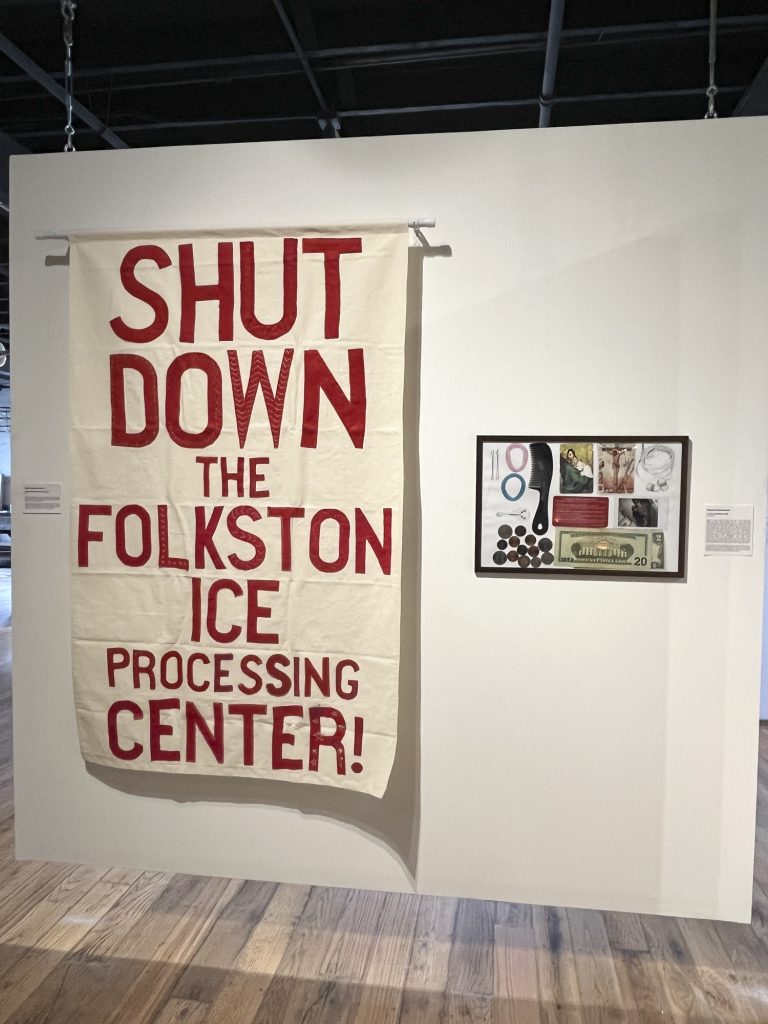
Elsewhere in the gallery, protest banners by Yehimi Cambrón Álvarez read, “Shut Down Stewart Detention Center!” and “Shut Down the Folkston ICE Processing Center.” On opening night, a third banner was in progress, and visitors were invited to stitch together in a circle. Some of the participants were already adept at the craft, and others were learning to sew for the first time. This simple yet profound act allowed the work to act as more than a purely aesthetic experience, instead offering an uncompromising message through education and active, visible community building.
Across the array of artists and movements, quilted and fiber-based mediums offer a through line despite varying approaches to the material. A Palestinian cross-stitch, tatreez, for example, differs from the contemporary quilted portraiture in Kimani Johnson’s Will Quilt for Sex (2026), which exudes queer and Black joy.
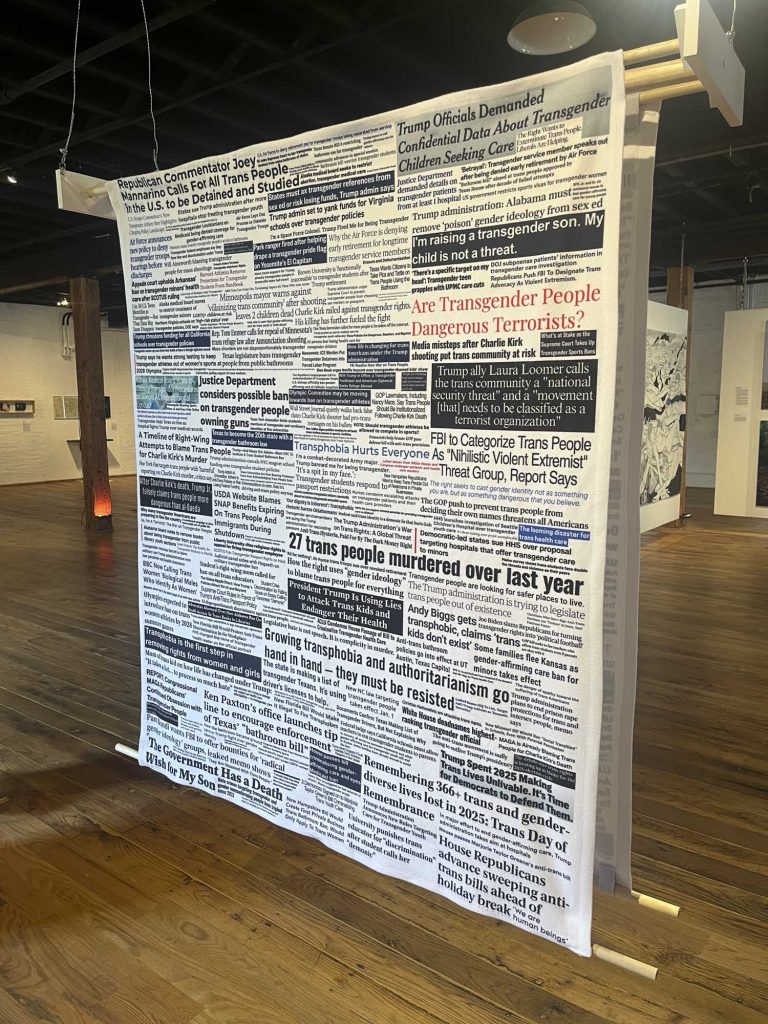
While some pieces express pride and joy in artists’ identities, others critique a broken system. Elijah Schmidt’s Uncomfortable (2025-2026) confronts state-sanctioned transphobic hate speech through an overwhelming collage of news headlines. Headings such as “Are transgender people dangerous terrorists?” and “House Republicans advance sweeping anti-trans bills ahead of holiday break” are pulled from various sources, a slew of mix-matched fonts and sizes that reflect the reality of casual violence against trans people. On top of an already perturbing text, the artist includes an audio piece, Topic of Debate: My Right to Exist (2025-2026) that similarly compiles sound bites from news channels, politicians and religious zealots preaching transphobic and violent ideologies. The compilation pulls no punches and is appropriately harrowing in its presentation.
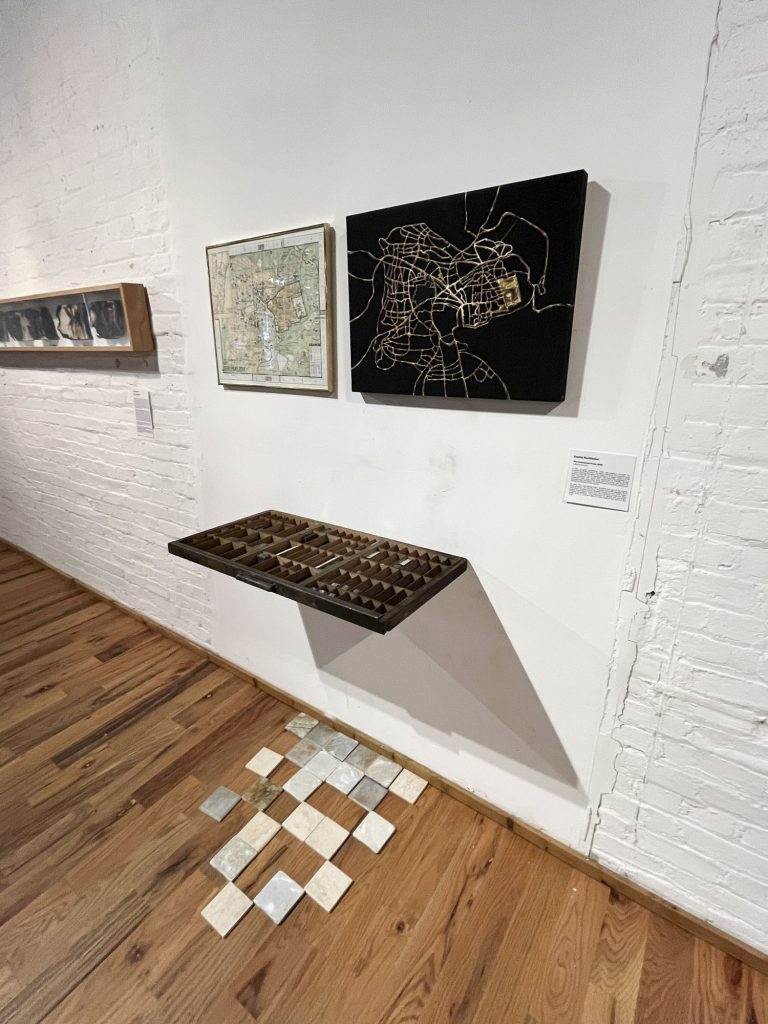
Nearby, works by Sophia MacMaster reference the artist’s lineage to The Commercial Press, a historical Palestinian printing press, with a map of Jerusalem originally published in 1952 hanging next to MacMaster’s painting, an abstracted response to the map. The exhibition offers poignant instances where the artwork gives way to a greater context of history and politics. Here, the work’s mere existence speaks volumes.
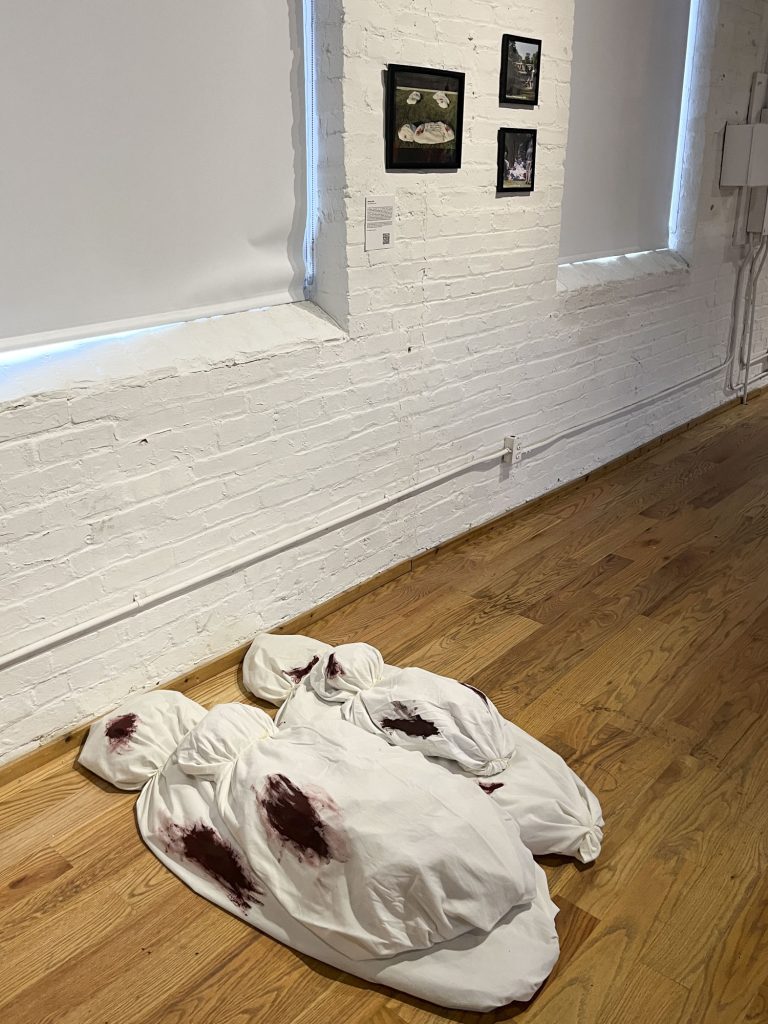
Without an artist to credit, Shrouds is composed of two bundled white sheets, wrapped and bound to resemble a body with blots of dark red to signify blood. Originally used in protests against the Palestinian genocide, it is displayed next to photos of the 2024 protests at the Emory University campus. In this instance, the shrouds have been re-contextualized as sculpture, and yet the accompanying images prevent the work from interpretation as solely an art object.
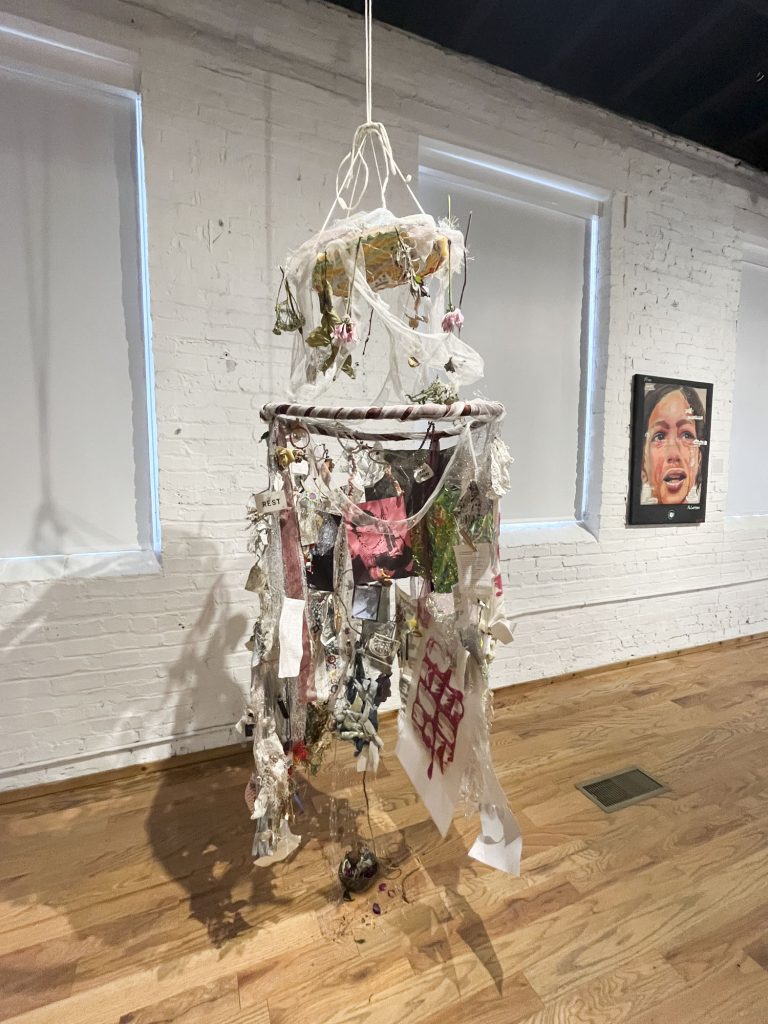
In another example of a work without a credited author, We Keep Us Safe acts as a communal altar. This work is entrancing, hovering and life-sized, a terraced hoop embedded with dried flowers, prints on fabric, as well as various print ephemera. One element is a memorial for slain activist Tortuguita, who was shot and killed by Georgia State Patrol in 2023 while peacefully protesting the construction of Cop City. Once more, as striking as the artwork is aesthetically, its lack of crediting gives way to greater meaning in its significance to the community and memory of fallen activists.
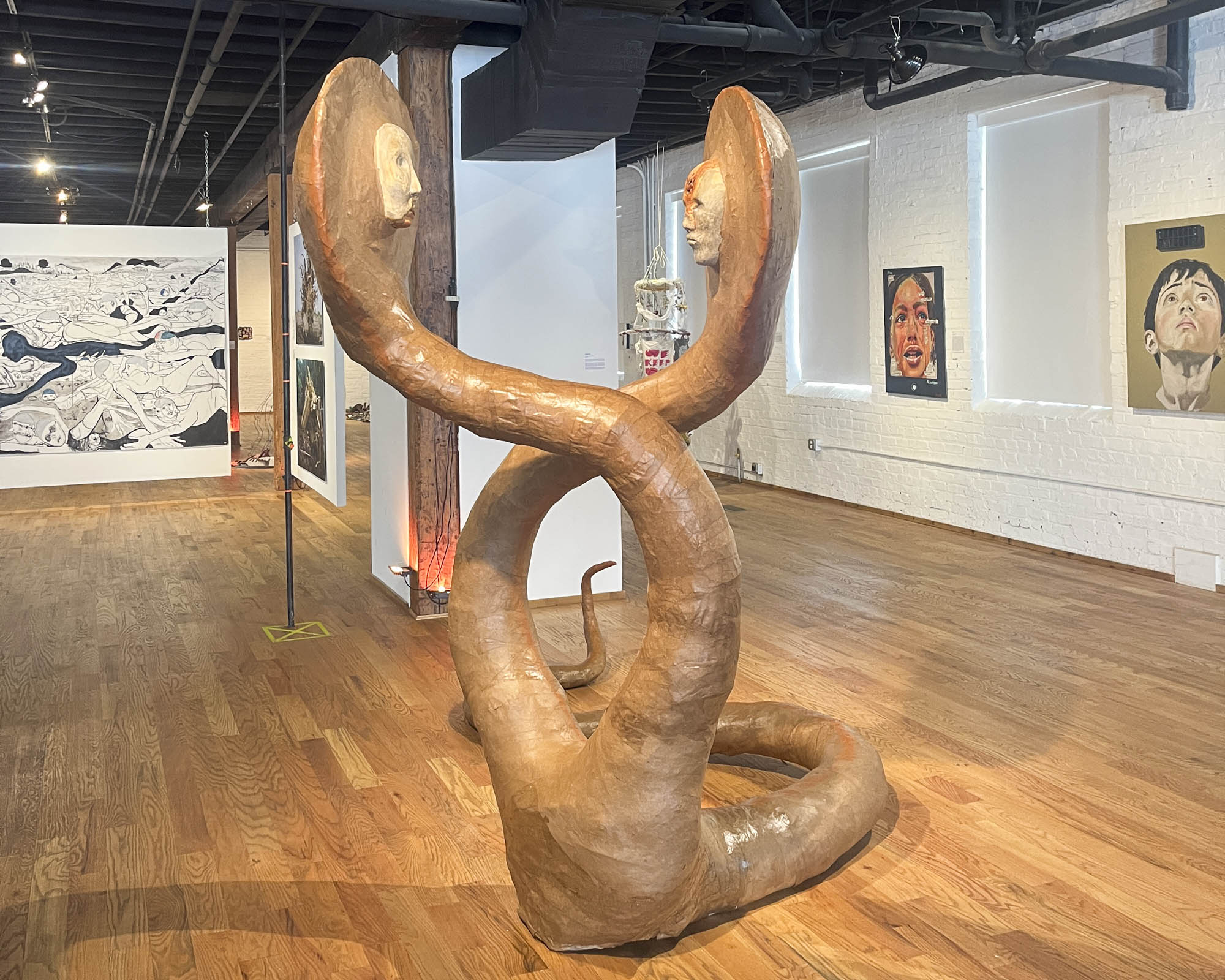
Despite the show’s overall success, not every moment sticks the landing. Works such as Muted Cries (2025) by Clem and Brill Adium’s why does this even exist? (2025) hanging next to each other come across as heavy-handed, with both depicting the commonly used imagery of distraught children to embody injustice. That said, it is compelling to view them with Gabi Madrid’s Two-Faced Serpent, whose epic and larger-than-life serpent reflects yet another pair of faces.
Madrid’s fantastical sculpture is not the only noteworthy sculpture that evokes a surreal and monstrous quality. Fatemeh Deiri’s steel and wax sculpture untitled (2025) is unsettling, with six lifelike wax-cast hands adjoined to a steel frame of tentacular appendages similar to those of an octopus.
The curation here is well-considered and effective at drawing parallels across movements that reinforce a universal fight for freedom and human rights. The politics of water, its precarity and the push for conservancy are paired with plights against deforestation. Works that express trans liberation reside alongside those that call for an end to ICE detention centers. While the movements may differ, the commonality among them is a valiant fight for basic human rights. At a time when the Trump administration perpetuates a white-hetero patriarchal world, these artworks encourage the dismantlement of oppressive systems. It beautifully orchestrates a collective voice that reaffirms support and solidarity across an array of related but disparate causes.
This Is Now is undoubtedly an ambitious exhibition packed with 33 artists that unites dozens of movements. Additionally, resources are available throughout its run for visitors to learn about various campaigns and take action, such as letter-writing initiatives to incarcerated individuals and supporting access to the Refaat Mobile Library. The organizers and curators — Amy Landesberg, Layla Ali Amar and Sophia MacMaster — were successful at coordinating a great many artists and organizations to deliver a poignant and powerful exhibition.
Don’t miss your chance to witness this powerful exhibition before it closes on June 13.
::
Noah Reyes is an artist taking steps in many different directions, resulting in a continuous dance between curating, writing and artmaking.
STAY UP TO DATE ON ALL THINGS ArtsATL
Subscribe to our free weekly e-newsletter.

PLEASE SUPPORT ARTSATL
Your Gift Sustains the Coverage You Count On!
Related Posts

