Shepard Fairey’s first solo exhibition in Atlanta pairs politically-charged imagery with message of hope
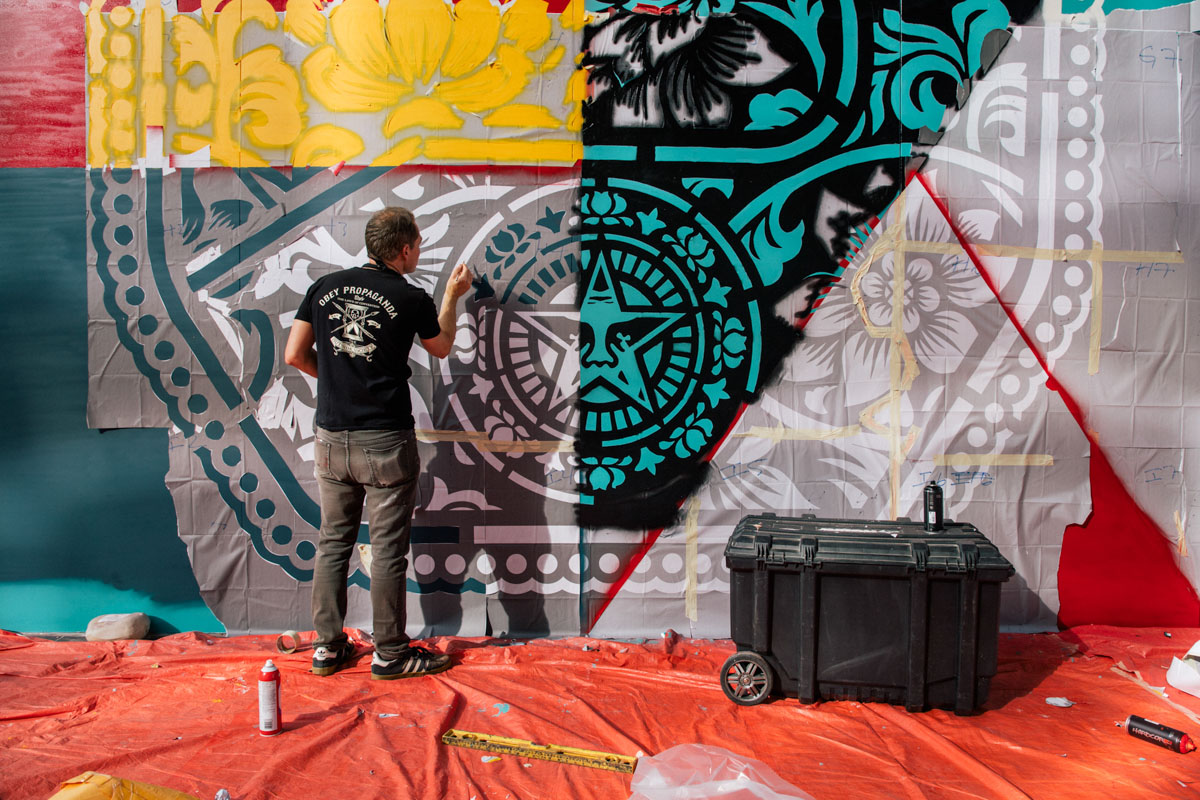
Fairey will also paint a new mural in Atlanta’s Sweet Auburn neighborhood to expand his reach to an area rich with activist history.
Shepard Fairey has spent much of his career making images that are difficult to ignore. His instantly recognizable graphic style, built on stark contrasts, bold colors and commanding portraits, has become a fixture of contemporary visual culture. But beneath the visual punch of his work is a persistent question: What can an image make people see, and what might it inspire them to do?
That question runs through New Day Rising, Fairey’s first solo exhibition in Atlanta, opening October 24 at ABV Gallery.
Featuring 180 works, the exhibition brings together paintings, prints, mixed-media pieces and other explorations of Fairey’s distinctive visual language. The show remains on view through January 3, 2027.
The exhibition shares its name with Hüsker Dü’s landmark 1985 album, although Fairey’s connection to the phrase extends beyond its musical origins. For him, the title suggests a way of moving through difficult times without surrendering to them.
“Hüsker Dü was one of my favorite hardcore/post-hardcore bands of the ’80s because they dramatically expanded that musical palette, bridging into bands like the Pixies and Nirvana,” Fairey says. “I’m a big fan of the New Day Rising album, but that album doesn’t specifically inspire the work in the show. The phrase ‘new day rising’ is very evocative and aligns with one of my philosophies: We can never give up, because every day offers opportunities for rebirth, renewal and progress.”
That philosophy gives the exhibition its center of gravity. Fairey’s work has long occupied the intersection of art, politics, commerce and public life, drawing on the visual shorthand of advertising and propaganda to challenge the systems that shape how people see the world. Behind it all, music has always remained a driving force.
“Music culture, to be blunt, is just generally cooler than visual art culture,” Fairey says. “This is largely true because it’s democratic and it makes us feel. We’re guided largely by emotions, and our brains follow; music does that beautifully, and I try to emulate that with my visual art. Whenever I can harness music’s power by working on music projects, I’m excited, both because it gives me joy and because it’s impactful.”
Since launching his “Andre the Giant Has a Posse” sticker campaign in 1989 while studying at the Rhode Island School of Design, Fairey has developed that impulse into OBEY GIANT, an expansive artistic practice that examines the influence of images on culture and political consciousness.
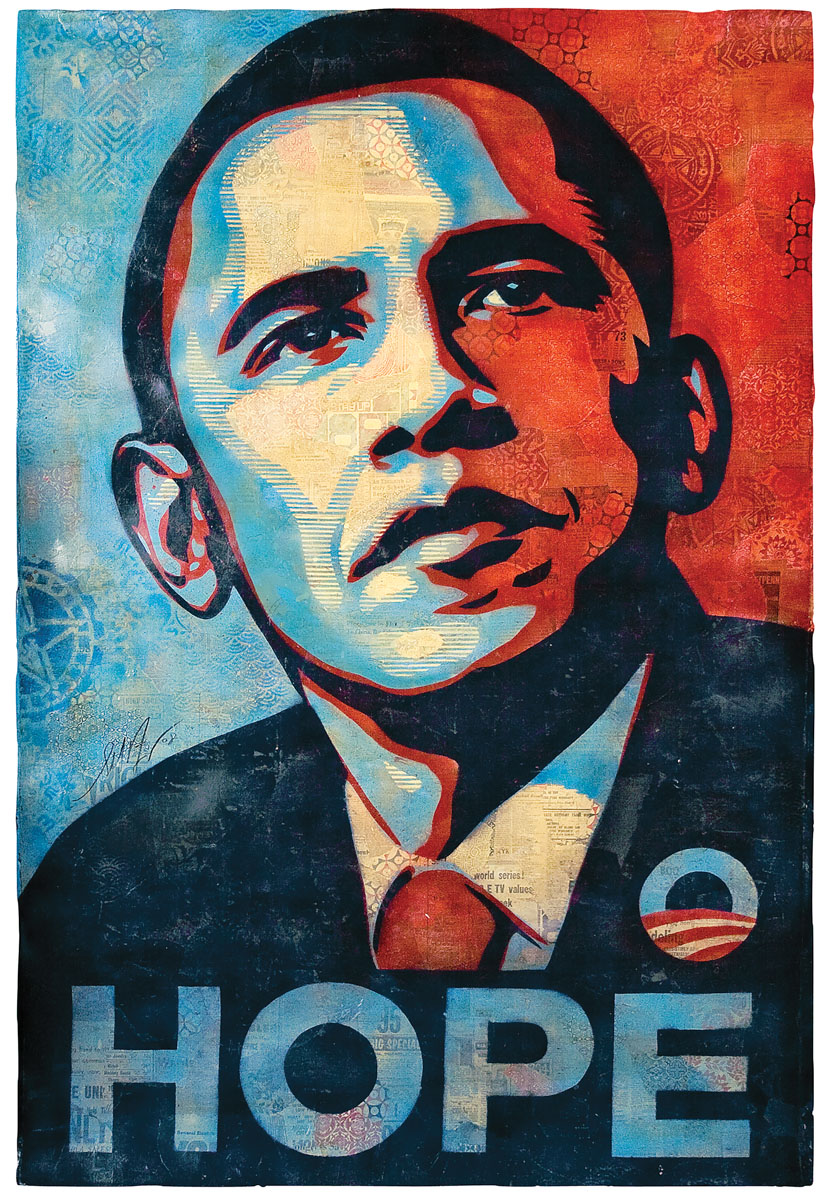
His work is familiar to many through its most recognizable pieces, including the portrait of Barack Obama he created for the 2008 presidential campaign. Yet Fairey’s broader practice has never been limited to a single image or political moment. His art repeatedly returns to questions of power, inequality, peace, environmental responsibility and the possibility of collective action.
New Day Rising brings those concerns into focus through portraits of figures who have challenged established power or helped reshape public consciousness. Among them are Civil Rights leaders John Lewis and Malcolm X, activist Angela Davis, musician and activist Chuck D of Public Enemy, artist Ai Weiwei, Nobel Peace Prize laureate Malala Yousafzai and cultural figures including Bob Marley, Muhammad Ali and Joe Strummer. Their presence establishes a lineage of people who have used their work, voices or public standing to push against the prevailing order.
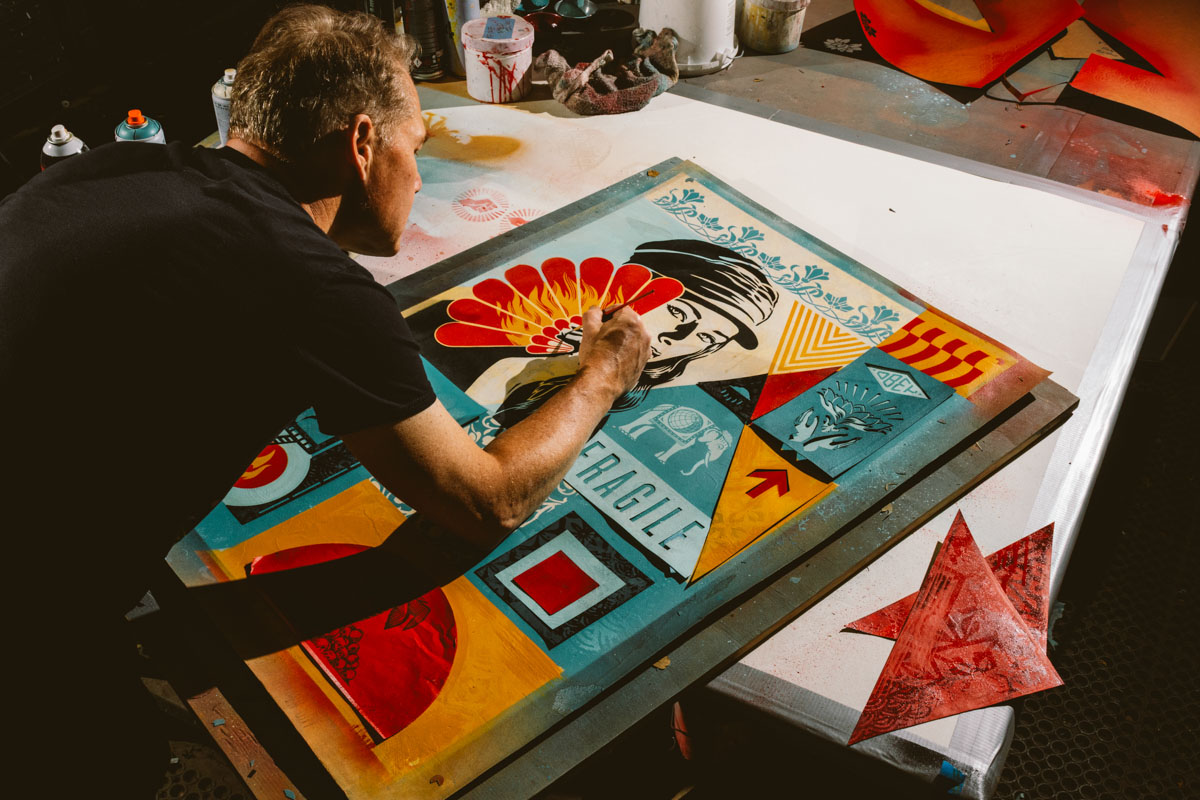
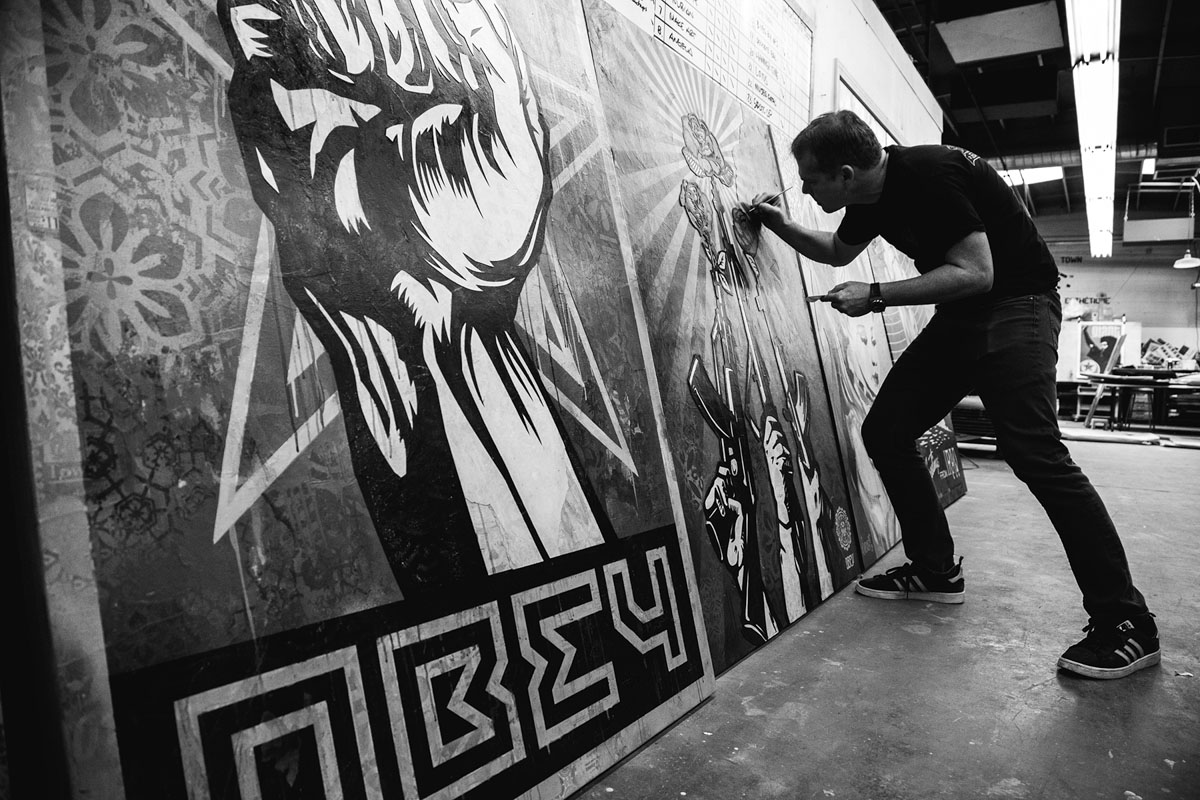
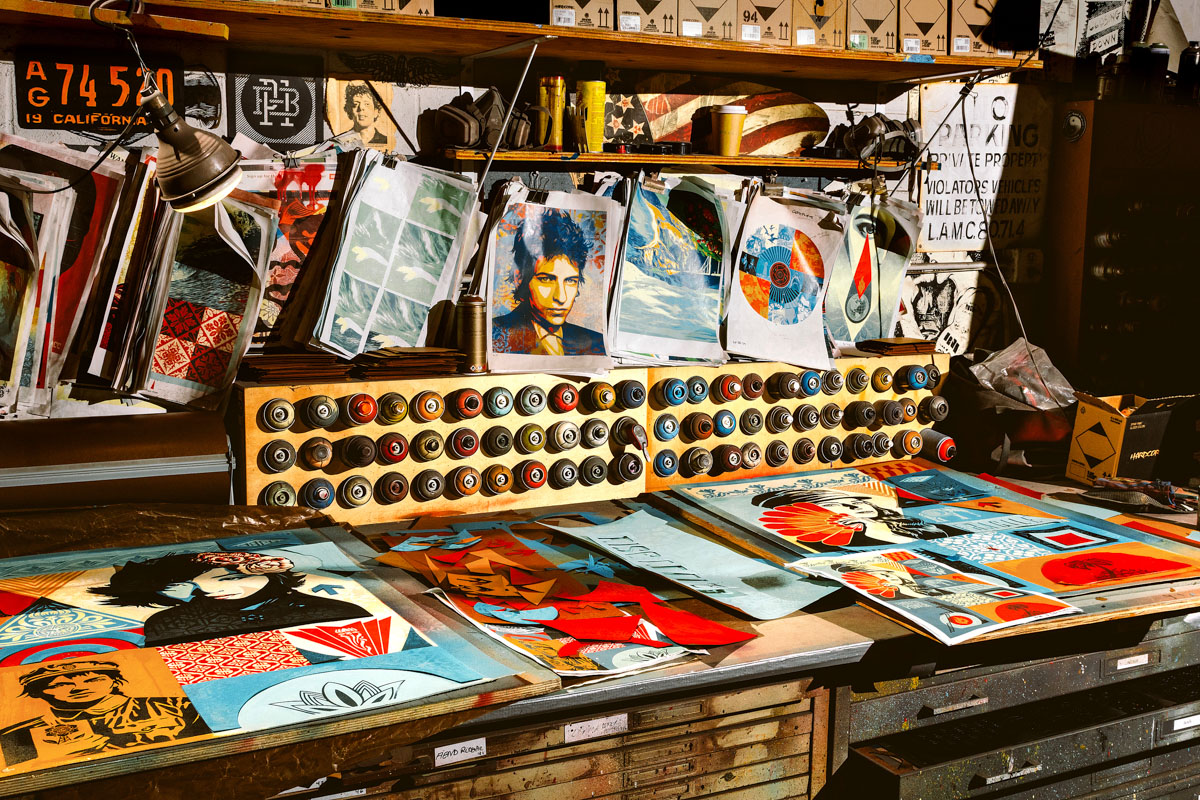
Visually, the New Day Rising exhibition builds on Fairey’s signature combination of graphic immediacy and layered composition. Bold, screen-printed forms emerge from painterly and collaged backgrounds, allowing the images to shift between the precision of graphic design and the texture of handmade work. The show encompasses mixed-media pieces on canvas and paper, monoprints, hand-painted multiples, silk screens on wood and metal, original hand-cut Rubylith illustrations and works combining stencils and spray paint with screen printing.
The result is a body of work that uses beauty and provocation in tandem. Fairey’s imagery draws the eye before asking viewers to consider what lies beneath the surface: the people represented, the causes they embody and the responsibilities that arise from confronting injustice.
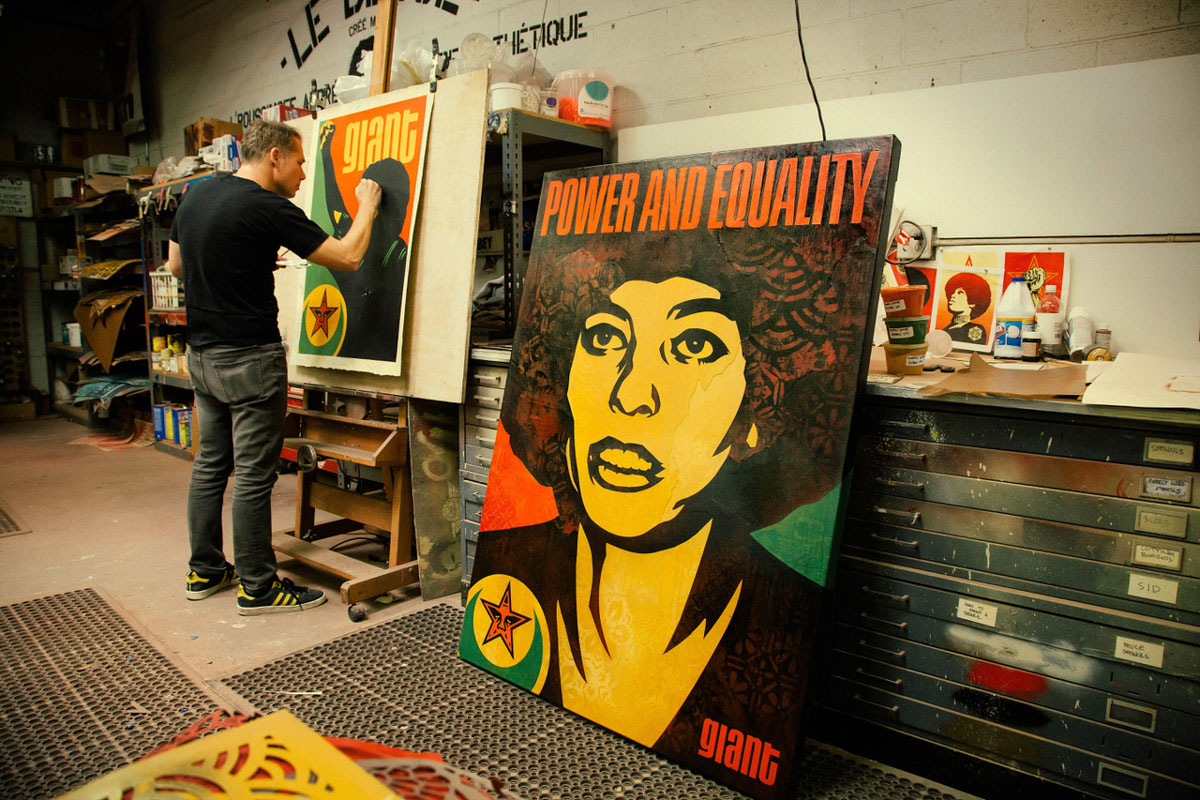
The exhibition’s namesake artwork, New Day Rising, features a woman gazing upward. Her expression suggests aspiration and the possibility of something better on the horizon. Against the backdrop of political division, growing economic instability and threats to individual freedoms, Fairey sees hope not as an escape from reality but as a necessary condition for changing it.
“I see my work as more about cumulative impact, but I do think that at this time, with fascism, increasing wealth inequality and many other challenges to people’s quality of life, it is important to remain hopeful because hope is a fuel for action and action is our way out of this,” Fairey says. “The woman in the piece, gazing upward with hope and aspiration, is symbolically important to the entire show.”
Other recent works take a more confrontational approach. Flames of Discontent considers how frustration with injustice can be channeled into action, while Environmental Activist Chaos turns its attention toward environmental advocacy. For Fairey, the act of making eye contact with a portrait subject can itself carry a kind of moral weight.
“I think that when the viewer has to look at the subject of the portrait in the eyes, there is at the very least a subconscious understanding of being accountable to your conscience,” he says.
Atlanta provides a particularly resonant setting for those ideas. The city’s history of Civil Rights organizing and grassroots activism has shaped its identity in ways that extend well beyond the South. From the work of Martin Luther King Jr. and Coretta Scott King, to generations of organizers, artists and community leaders, Atlanta has long served as a place where cultural expression and political action intersect.
Fairey has personal connections to the city, too. His parents attended college in Atlanta, his sister once lived here and professional skateboarder Andy Howell, who helped give Fairey his start in the skateboarding industry, spent years in the city. Those connections have kept Atlanta on his radar, but its history of activism is what most deeply informs his visit.
“I’m deeply moved by Atlanta’s history of activism, especially Martin Luther King Jr. and Coretta Scott King, which is why I’m painting a mural of Coretta Scott King while I’m there,” he says. “I’m also a big fan of Killer Mike for his music and his activism.”
The planned Coretta Scott King mural — which will go up at Sweet Auburn Grande at 229 Auburn Ave. NE in the historic Sweet Auburn district — extends the exhibition’s themes beyond the gallery walls, placing Fairey’s imagery in the public realm where his work has often found its most immediate audience. It also connects his interest in influential cultural figures to a city whose history continues to shape conversations about equality, representation and political change.
“Atlanta has helped shape how the world thinks about Civil Rights, equality and the power of people to create change,” says artist and ABV Gallery owner Greg Mike. “Those are ideas Shepard consistently addresses in his work, so there’s a meaningful connection between what he stands for and this city … His work asks people to pay attention, question what they see and recognize that their voices matter. Bringing it here creates an opportunity to reflect on Atlanta’s history while thinking about how we carry that legacy forward. The Coretta Scott King mural makes that connection especially powerful.”
Mike founded ABV Gallery in 2009 and has built its program around contemporary art, public projects and cultural events, bringing artists from Atlanta and elsewhere into a space that encourages exchanges between visual art and the broader creative community. Housed in a renovated former church in the East Atlanta Village, the gallery offers a fitting backdrop for an exhibition that considers how art can function as both an object of contemplation and a catalyst for action.
Fairey and Mike have been friends for years: Mike has shown work at Fairey’s Subliminal Projects gallery in Los Angeles, and the two have connected at various mural festivals and during the annual Art Basel Miami. Over the years, they’ve often talked about bringing Fairey to Atlanta for a project such as this. Once ABV’s new, larger space opened, the time was right to turn those conversations into a reality.
“When Shepard and I first discussed the show, he made it clear that painting a public mural was just as important to him as exhibiting the work in the gallery,” Mike says. “Nate Frost, our gallery director, and I connected with potential donors, property owners and foundations to explore the possibilities. Through those conversations, and working with Shepard’s team, Gorman & Company and Butler Street Community Development Corporation, Sweet Auburn emerged as the right fit.”
Mike goes on to say that the neighborhood’s connection to the King family and its significance in Atlanta’s Black Civil Rights history gives this portrait of Coretta Scott King a deeper meaning.
“It’s an opportunity to honor her own extraordinary legacy as an activist and leader while creating something people can experience every day,” he says.

For Fairey, the promise of a new day is not a guarantee that circumstances will improve on their own. It is an invitation to keep working toward that possibility. The portraits, symbols and layered compositions in New Day Rising reflect a belief that images can do more than document the present: They can help people imagine what comes next.
In a moment when the future can feel increasingly difficult to picture, Fairey’s work insists that hope is not passive. It is something to be practiced, defended and put to use.
“It’s all important, which is why I do all of it,” Fairey says. “It takes more time and energy, but I think that reaching people in every space possible is essential. In an age when so many people live through screens, I’m even more dedicated to public art, because I think things in physical spaces, at a transformative scale, remind us that we are sensory beings and need to relate to each other beyond the safety of screens.”
::
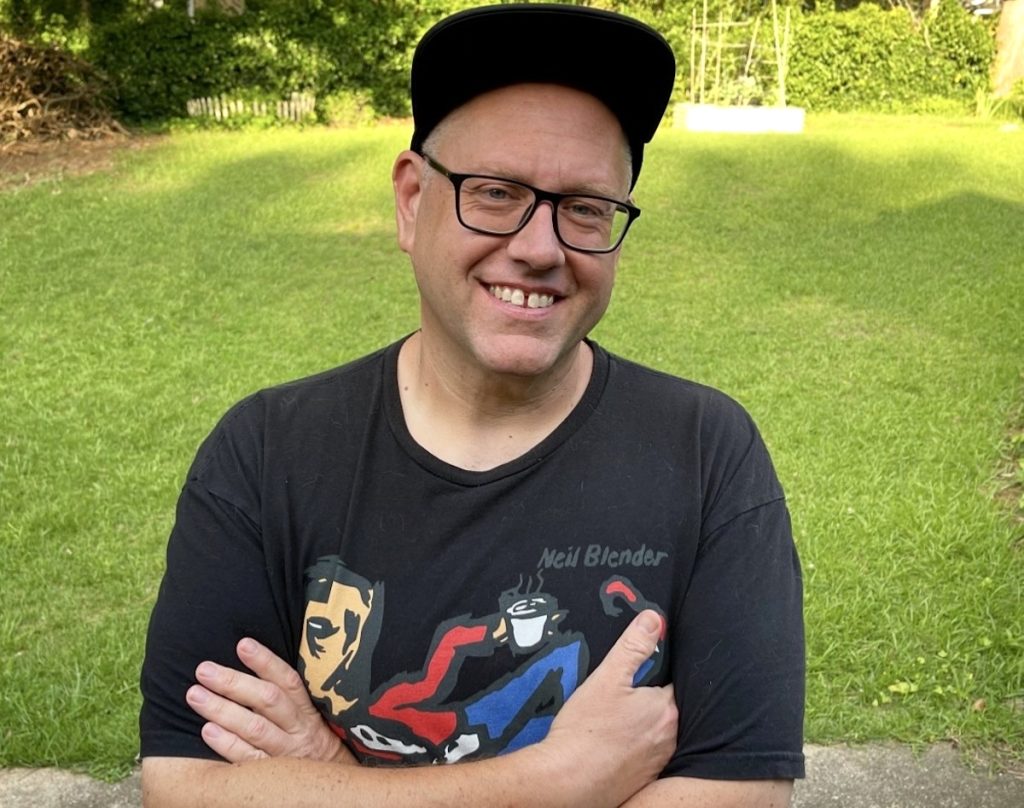
Chad Radford is an Atlanta-based music writer, editor and moderator whose work has chronicled the city’s music and cultural landscape for more than two decades. He is the author of Atlanta Record Stores: An Oral History, editor of the Smithsonian Anthology of Hip-Hop and Rap and former music editor for Creative Loafing. His writing has appeared in Atlanta Magazine, Flagpole, Record Plug and others. A longtime advocate for independent music and local culture, Radford is also the founder and editor of RadATL, where he continues to document Atlanta’s musicians, venues, record stores and creative communities.
STAY UP TO DATE ON ALL THINGS ArtsATL
Subscribe to our free weekly e-newsletter.

PLEASE SUPPORT ARTSATL
Your Gift Sustains the Coverage You Count On!
Related Posts