

Russell Malone, a great musician — an even better man (1963-2024)
Russell Malone’s guitar styling helped jazz greats sound great; his humanity touched many more
Russell Malone, the Georgia-born jazz guitarist whose lengthy credits include Diana Krall and Harry Connick Jr., passed away August 23 in Tokyo, Japan. He was on tour with pianist Donald Vega and bassist Ron Carter.
The news came so suddenly that even Malone’s manager, Jason Franklin, found out second hand. “A venue owner called and said ‘did Russell die?’” Franklin recalls. “I said ‘well, he didn’t tell me about it.’”
According to Franklin, that sort of exchange was right in line with Malone’s sense of humor. It’s a sentiment shared by those who knew and played with him.
“He was a funny cat — always kept you in stitches,” says Philip Harper, trumpeter for the Harper Brothers and a longtime professional acquaintance of Malone. “It was always a pleasure to see him when we’d end up on a bill together.”
Though Malone’s death was unexpected, health issues had plagued him in the latter years of his life. Even in those moments, his warm heart and good character shined through. Shortly before the Covid pandemic, a miscommunication resulted in Malone failing to pay Franklin his manager’s cut for a concert. They lost contact for an extended period of time due to the lockdown and other logistical issues, and Franklin left the matter unaddressed.
“One morning I got a Zelle for $600,” explains Franklin. “I called him, said ‘did you mean to send me $600?’ and he didn’t answer.” A few weeks later Franklin heard from Malone, who explained that he had been scheduled to go in for a surgery he might not survive and that he wanted to make sure the debt was paid. “That said a lot about him,” says Franklin.
For Franklin it was a gesture that summed up the essence of Russell Malone: that his ability to support and connect with his fellow musicians on stage was an outgrowth of the sincere, warm and fundamentally decent person he was in real life.
Malone was born in Albany, Georgia, in 1963 and found an early affinity for church music. He took up the guitar at age 5 and cited blues legend B.B. King as an influence. Later, he embraced the jazz stylings of George Benson and Wes Montgomery, displaying a mastery of their techniques even in his early 20s. In light of his extraordinary ability, it might be surprising to learn that Malone was largely self-taught.
“Back in our time, schools didn’t really have jazz programs,” explains Harper. “There were a few schools — Eastman, Berklee, maybe a couple of others.”
That lack of widespread education left aspiring jazz musicians of Malone and Harper’s era to become autodidacts, but Harper is quick to point out that in the pre-internet age, one’s commitment to learning jazz was evidenced by the time spent finding and listening to recordings. “There was no internet, no ‘push of a button,’” he adds. “You had to seek this music out.” The way a budding jazz musician would find a particular song or track that influenced him was a story unto itself. And it mattered.
Malone’s professional career began in earnest at age 25 when he joined the band of organist Jimmy Smith. Then, in 1990, he landed an ongoing gig with Harry Connick Jr. that saw him playing on multiplatinum recordings including We Are in Love and Blue Light, Red Light. His resume in the following decades reads like a who’s who of modern jazz legends, among them David Sanborn, David Benoit and Roy Hargrove.
Nevertheless, his most prodigious accomplishments came in his collaboration with jazz piano/vocalist Diana Krall, with whom he recorded seven studio albums beginning with All for You: a Dedication to the Nat King Cole Trio in 1996 and culminating in 2020’s This Dream of You.
Harper and Franklin both point to Malone’s work with Krall as a prime example of his unique ability to mesh with a band while still bringing his own signature flavor to the table. In Krall’s case, he provided an important counterbalance to the singer’s often delicate, pristine, sonic persona.
“When you come from a certain place, you bring a certain sound,” says Franklin. “Russell brought that down-home, Black, Georgia, church, soul feeling.”
“Diana Krall is cool,” says Harper. “But she needed Russell to give it some bottom — the roots of this music. He had enough dirt for the band. It can’t be too clean. Otherwise you’ve got classical people trying to play jazz.”
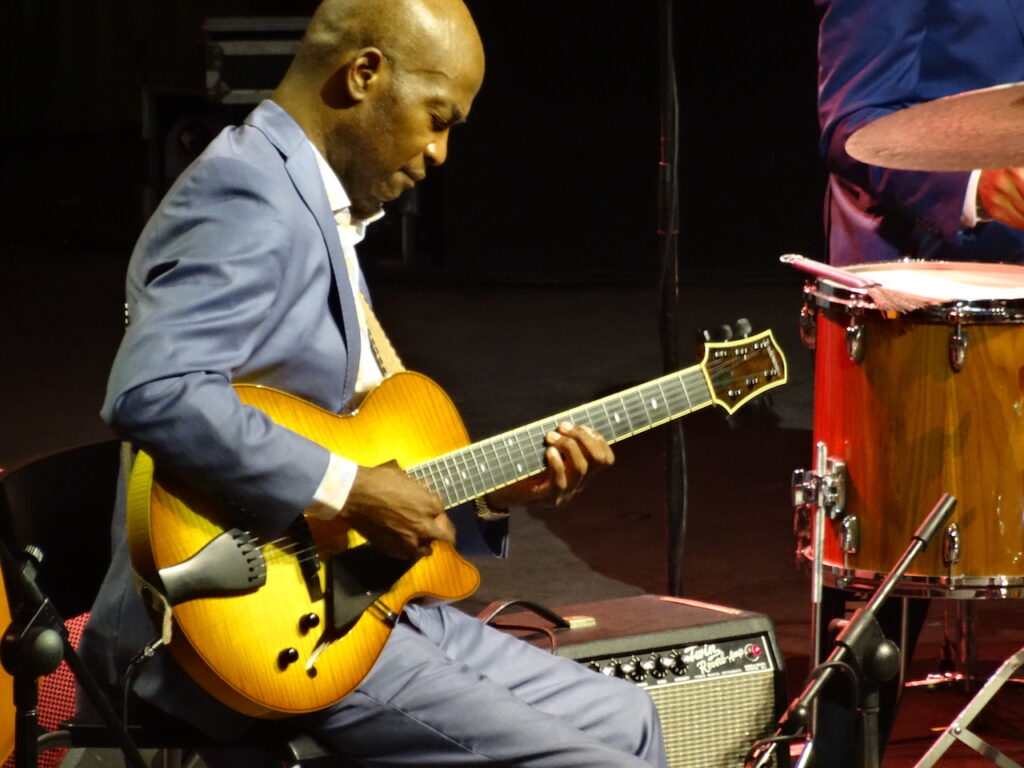
That harder edge is readily apparent in his performances with Krall, but Harper and Malone are quick to observe that while Malone’s playing gave her music a wider sonic palette, it never did so at the cost of the overall sound.
“He didn’t overpower what he played,” says Franklin. “He could have easily taken over, but he knew just what to play. That was his thing. Russell knew what to play to compliment you.”
“He was a groover,” says Harper, echoing the sentiment. “If you had him behind you, you were in a good place.”
That was true, but not just in music, Franklin adds. “On so many levels, Russell gave a damn. The man gave a damn about you, and the musician gave a damn about you.”
Malone passed along those values to others as well. He told a 2018 master class at Albany State University: “Being a good musician is great, but being a good human being is even better.”
::

Jordan Owen began writing about music professionally at the age of 16 in Oxford, Mississippi. A 2006 graduate of the Berklee College of Music, he is a professional guitarist, bandleader and composer. He is currently the lead guitarist for the jazz group Other Strangers, the power metal band Axis of Empires and the melodic death/thrash metal band Century Spawn.
STAY UP TO DATE ON ALL THINGS ArtsATL
Subscribe to our free weekly e-newsletter.

