Review: The pain of loss colored Terminus Ballet’s season opener
“A dancer dies twice,” is Martha Graham’s famous assessment of a dancer’s life. They die at the end of their days just like the rest of us, but the other death she speaks of — and judged the more painful — is when a dancer stops dancing.
The notion seemed to hover somewhere in the periphery on opening night of Out of the Box: Series II, a presentation of new works by Atlanta-based dance company Terminus Modern Ballet Theatre at Tula Arts Center through September 22. Graham’s words were the first I read when I opened the program: In his notes, choreographer Shane Taylor Urton cites the quote as among the inspirations for the first piece: Devotion.
No one’s dying and no one’s stopping dancing, but the show nonetheless marks a significant point of finality, the last company performances of founding member Rachel Van Buskirk. After a distinguished career with Atlanta Ballet and then Terminus, Van Buskirk is moving to Houston, where her husband is starting a tenure-track job at the University of Houston. I hesitate to compare a move to Houston to death, but the performance proved what a difficult, permanent and monumental artistic loss this will be for the company and for Atlanta dance audiences in general.
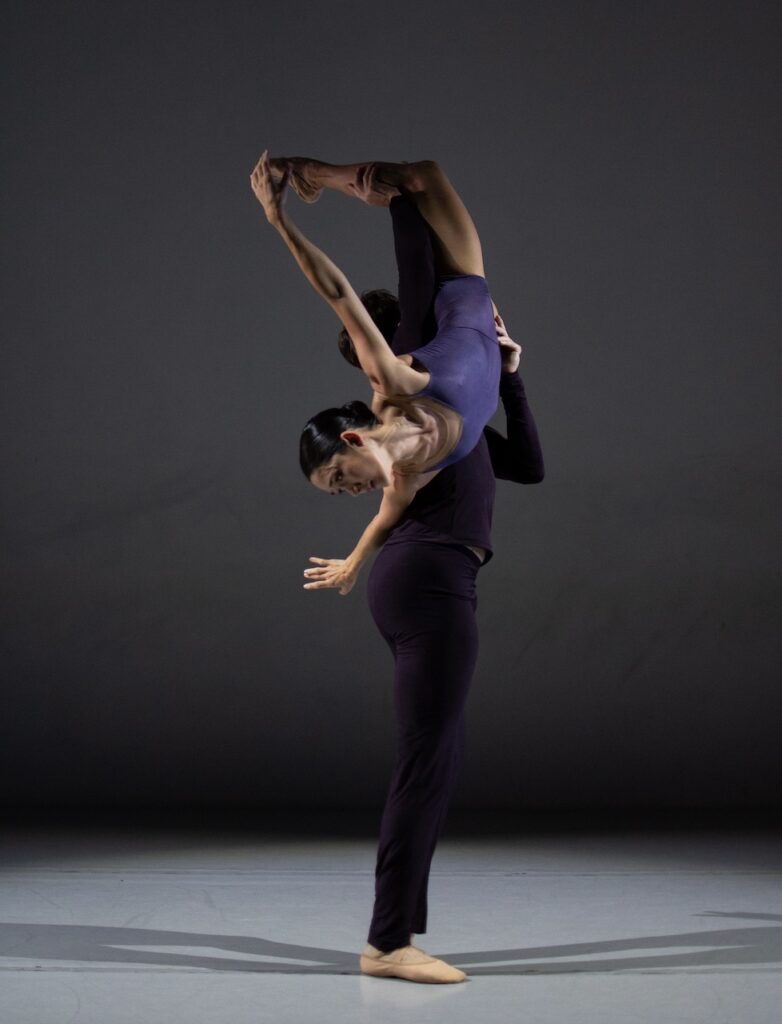
Without a doubt, the evening’s most striking moments belonged to Van Buskirk and fellow founding company member Christian Clark, whenever they paired. The two performed beautifully together in the final duet, company member Tara Lee’s meditative and quietly moving tribute to Van Buskirk titled Ad Terram. But their performances together in the first two ensemble pieces were truly extraordinary as well. As ArtsATL writer Robin Wharton accurately put it in her recent profile of Van Buskirk, “The two have developed an almost intuitive sense for moving together in complex neoclassical and contemporary pas de deux.”
In fact, almost any movement the two make together is interesting to watch. Especially thrilling were the lifts. The romanticism, weightlessness and eroticism that often characterize a typical ballet lift were all but absent here. Instead, the lifts had an almost existential quality, an unsettled sense of spiritual entanglement.
The first, in Urton’s opening piece, took my breath away, but the entire evening was a study in the number of inventive ways to lift and be lifted. Here, “being lifted” was far from passive: Van Buskirk twisted and spiraled as she passed through the air, both dependent on her partner’s support and intriguingly liberated in her navigation of space. Van Buskirk is always fascinating to watch, and the viewer’s eye stays busy noticing lovely details: the beautiful, precise change from slowness to speed in the sweep of a leg or the remarkable awareness in her face during moments of stillness.
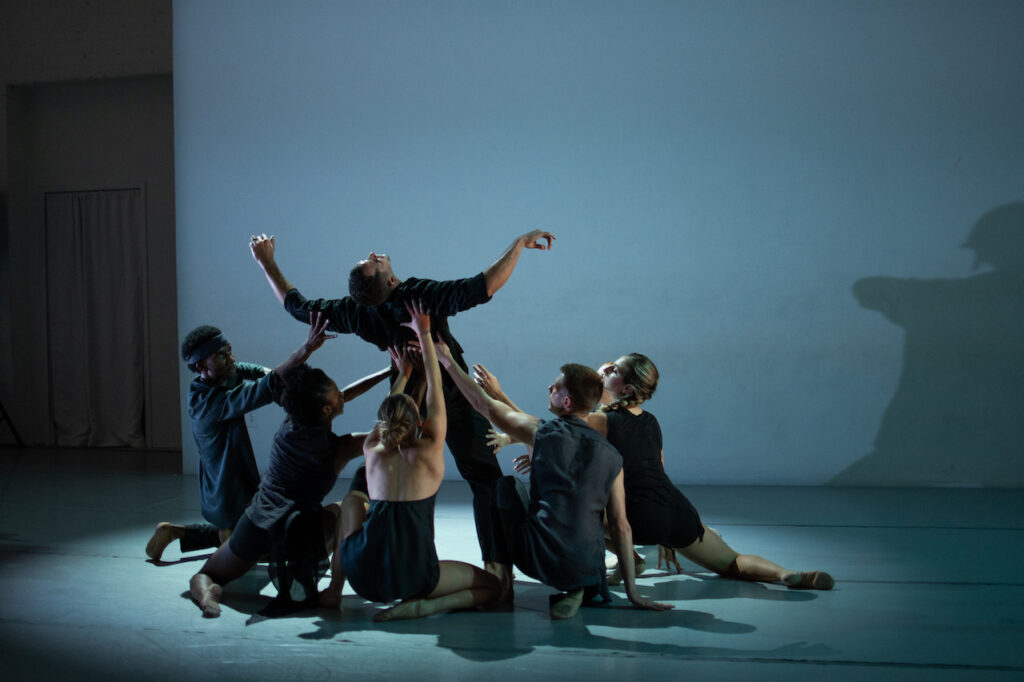
It was difficult for anything else to compete. Overall, the works seemed merely pleasant, enjoyable and presentational: We moved from arrangement to arrangement, but things lacked drama and force. There were some standout moments. I was fond of Urton’s opening piece when all the dancers, male and female, danced en pointe, creating a fluttering, lightly percussive accompaniment to violinist Adelaide Federici’s abstract exploration of the harmonics and resonance of her instrument. Tellingly, the dancers removed their ballet slippers and dropped them to the floor before leaving the stage, and Federici laid down her violin amidst the empty shoes, a fittingly bittersweet, silent and meditative ending.
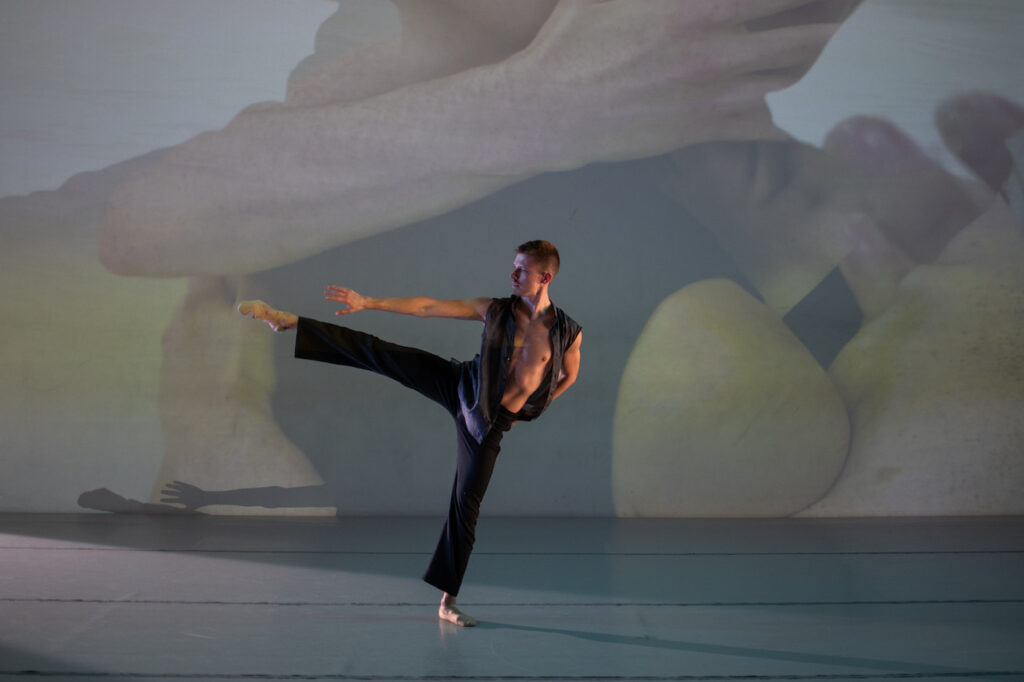
Choreographer Jennifer Archibald’s piece Take Only Memories, Leave Only Footprints was dominated by filmmaker Felipe Barral’s film projected on the walls, often covering the space from floor to ceiling. I’m not usually a fan of projection mixed with live dance: In a contest between dance and a giant screen for my attention, the screen often wins out. But Barral’s beautiful images of the dancers layered with images of the sea succeeded in coexisting with the live performers, an accomplishment for both Archibald and Barral as collaborators. Best of all was a moment when the dancers’ bodies made full contact with the screen, twisting and intertwining through the projection in procession, like figures on a Greek vase.
The final work, which will be performed only one more time during the run on September 22, narrowed the focus onto Van Buskirk and Clark alone. Some might argue that Lee’s choice of Moonlight Sonata was too lugubrious and dirgelike, even for a valedictory dance, but the old warhorse’s meditative, troubled and haunting qualities were brought to vivid life, almost a resurrection, by the dancers’ intensity. It was here that some of the program’s most extraordinary lifts occurred.
Fortunately, no one had to die (in either sense) at the end of the night, but it was nonetheless a bittersweet occasion. I don’t know Van Buskirk personally, but it was an evening that had me reflecting about some of the painful goodbyes and departures I’ve known in my life, the good fortune I’ve had to be touched by people I love and admire. Maybe it’s more accurate to say that we all die many times during our lives.
The evening also suggested some of the challenges ahead for the company. In 2017, the founding members broke from the Atlanta Ballet, bringing a massive wealth of talent, knowledge and experience with them: many years with a professional ballet company, many lead performances, work under the open-minded and considerate influence of then Artistic Director John McFall, dancing with some of the world’s leading choreographers, often creating world premier works.
As close friends and longtime colleagues, they were united by a singularly daring drive to bond together and create a company. As veteran members depart for other projects and places, even a worldwide search might not result in exactly the right alchemical mix.
It was heartening to see outstanding performances from the remaining ensemble members. Alex Gonzaga and Lenai Wilkerson, in her Terminus debut, made a powerful pairing throughout the evening, and Wilkerson likewise stood out for her focused interiority in Archibald’s work. But it was less heartening overall because the works lacked heft and focus, and the evening, though undeniably enjoyable, accomplished and meaningful, had a jumbled quality, with extraordinary moments popping to life against a merely pleasant background.
In the end, Graham’s point was not just about pain and death but about the joy, meaning, comfort and vitality that artistic creation brings to a life. A great dancer transforms movement from something that’s nice to look at into art, into a new kind of language. You know it when you see it, and this show was definitely a place in which to see it.
::

Andrew Alexander is an Atlanta-based writer.
STAY UP TO DATE ON ALL THINGS ArtsATL
Subscribe to our free weekly e-newsletter.

PLEASE SUPPORT ARTSATL
Your Gift Sustains the Coverage You Count On!
Related Posts