Review: Stutzmann, ASO and Chorus at their best with Brahms choral music
Johannes Brahms’ four symphonies, broad-shouldered and public-pleasing, can feel ubiquitous in the concert hall. Yet the composer’s deepest thoughts and most tender emotions lay in his writing for voice, his settings of poetry to music. And it’s where the composer devoted much of his energy: When you line up his complete scores on a shelf, you see that more than half of his lifetime’s output was music for singers in a variety of configurations.
Nathalie Stutzmann, the Atlanta Symphony Orchestra’s music director and an esteemed contralto before turning full-time to conducting, made one of the great recordings of Brahms’ Alto Rhapsody. Her connection with this composer’s vocal settings, a certain cradling affection, is enriching and three-dimensional.
Saturday in Symphony Hall, Stutzmann led the ASO and Chorus in three of Brahms’ gently existential works for chorus and orchestra, exploring lamentation, destiny and fate — and seeking comfort despite life’s obstacles. The three German Romantic poems contrast the unending serenity enjoyed by the ancient Greek gods with the misery that is the lot of humanity, what one commentator called “divine indifference to the human condition.” As always with Brahms on tragic subjects, his appeal is that the living should go on living; a glimpse of daylight will return if you wait for it.
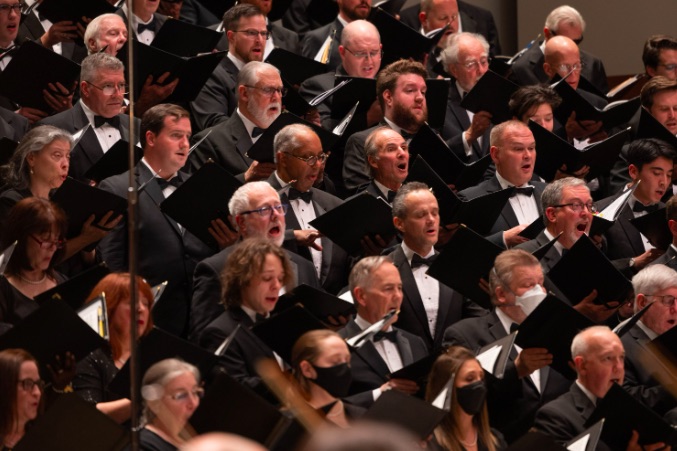
Throughout, Stutzmann’s warmth and lyricism were apparent in every phrase, and the orchestra and especially the mighty chorus were in splendid form.
They opened with “Nänie,” an elegy and meditation on mortality from a poem by Schiller, its opening so lovely and lightly expressed. The first lines — “the beautiful, too, must die” — came on a pillow of air. In her past performances with the chorus, Stutzmann seemed to push the singers outside their zone of comfort and stability, with unexpectedly fast tempos, clipped phrasing and a general disconnect from the orchestra. Too often, what might have been an exciting artistic challenge ended up problematic or merely messy. Not here; not in this repertoire.
The best of these choral works, in spirit and delivery, was “Gesang der Parzen” (Song of the Fates), from a bleak tale by Goethe inspired by Euripides and the unfolding disaster that was the Trojan War. The agitated opening, the timpani strokes of fate, the ominous beating heart, the burnished string ensemble, the men and then women chanting of mankind fearing the gods — this was the orchestra and chorus approaching its radiant, magnificent peak. It’s a beautifully balanced sound I haven’t heard since perhaps before the disruptions caused by the pandemic. That Stutzmann can, in fact, draw this level of artistic achievement from her band is promising news indeed.
And she’s still tinkering with Symphony Hall’s sound. Stutzmann re-seated the string sections so the cellos were nearer the center of the stage with the violas at the front, directly opposite the first violins. This offered some badly needed bass in the overall blend and, most welcoming, allowed us to hear prominent viola parts.
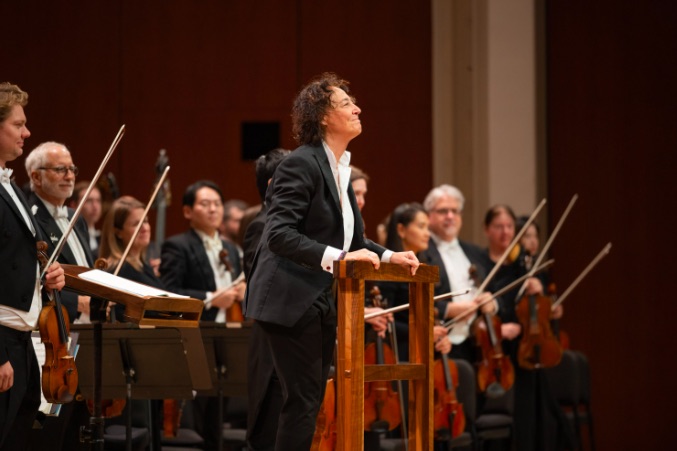
For the chorus, the ASO’s ever-brilliant chorusmaster, Norman Mackenzie, told me Saturday that the latest orchestral “shell” — floor-to-ceiling panels that surround the back and sides of the stage — allows sound to better project into the auditorium, and thus the chorus can make do with fewer singers. Saturday there were just 155 in the chorus, down from almost 200 in past years. A concert hall is said to be the instrument of the orchestra; as always, acoustics are worth upgrading in our problematic hall.
After intermission, the ASO took a programming detour. Rachmaninoff’s gloomy Isle of the Dead has a connection to “Nänie,” at least on paper: Brahms was friends with painter Arnold Böcklin, whose art inspired Rachmaninoff’s tone poem of the same name. But in the listener’s heart and ear, it felt like an abrupt, somewhat jarring, emotional shift. Stutzmann’s reading of Rachmaninoff was almost impressionistic, emphasizing the wavy and the watery. Nothing much happens across its 18 minutes, yet she controlled the tension masterfully, tightening and releasing, drawing us in.
With a handful of Dvorak’s Slavonic Dances to end the show — whoa, didn’t see that coming! — we were for some reason off to another planet. Fun and rollicking, blazing and loud, the five popular pieces were an orchestral lollipop coda to an otherwise emotionally ponderous evening.
::
Pierre Ruhe was the founding executive director and editor of ArtsATL. He’s been a critic and cultural reporter for the Washington Post, London’s Financial Times and The Atlanta Journal-Constitution and was director of artistic planning for the Alabama Symphony Orchestra. He is publications director of Early Music America.
STAY UP TO DATE ON ALL THINGS ArtsATL
Subscribe to our free weekly e-newsletter.

PLEASE SUPPORT ARTSATL
Your Gift Sustains the Coverage You Count On!
Related Posts