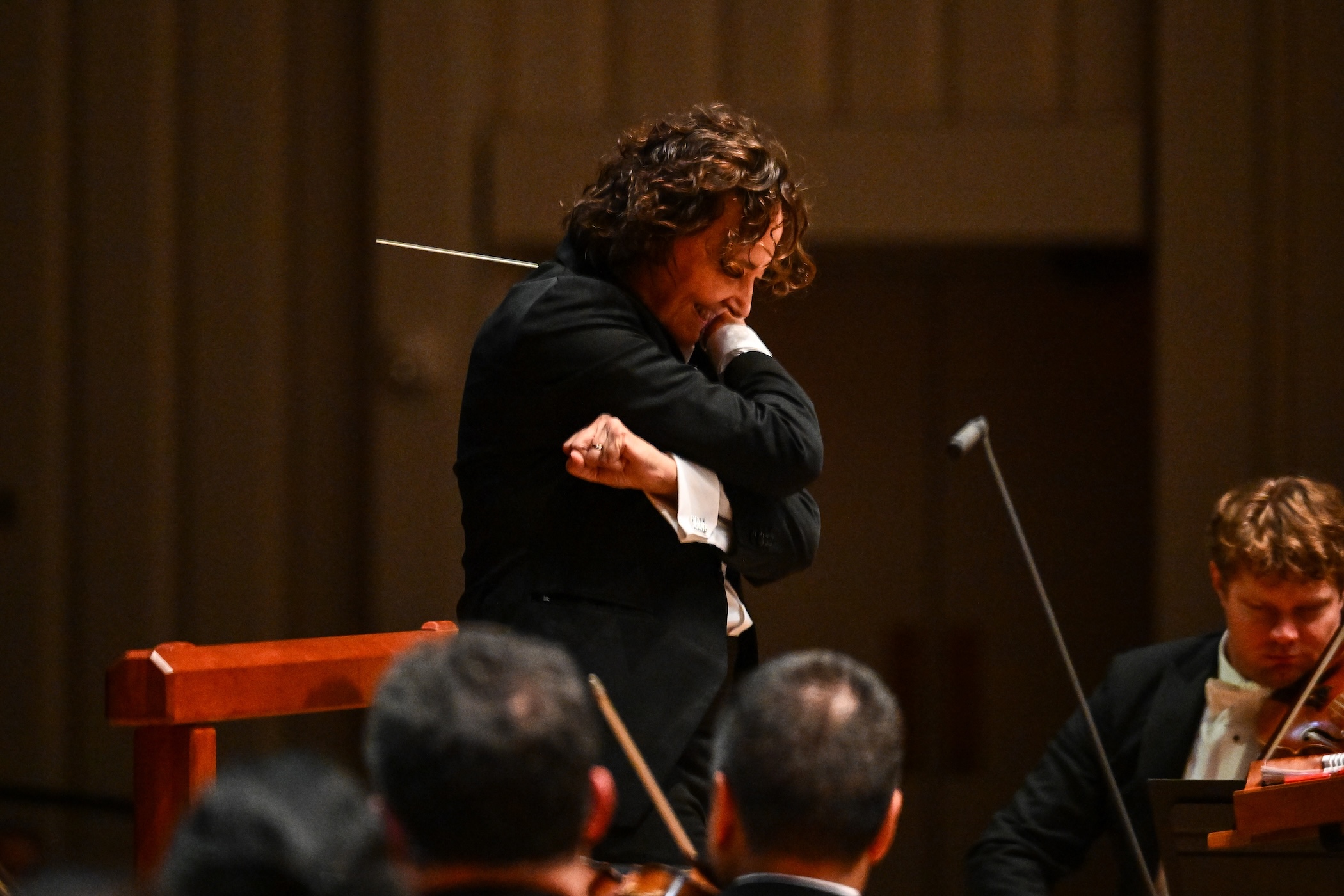
The ASO’s Nathalie Stutzmann talks opera, why Atlanta is her ‘main sport’ and the repertoire that’s in her blood
Nathalie Stutzmann, music director of the Atlanta Symphony Orchestra, was chosen to conduct Richard Wagner’s early opera, Rienzi, in July and August at Germany’s fabled Bayreuth Festival. Rienzi, which had never been performed in the historic Festspielhaus, was programmed as the centerpiece of the Festival’s 150th anniversary. In an interview with James L. Paulk, Stutzmann discussed her vision for the ASO and her flourishing international career.
ARTSATL: Let’s talk about the Atlanta Symphony Orchestra, where you’ve been music director for four years, and you recently renewed your contract for another three years. You’ve had time to build a relationship with the musicians, and you’ve recruited 21 musicians. You’ve just had a really successful season. What do you see as the biggest challenges going forward?
STUTZMANN: I think it’s a permanent challenge — you should never think you arrived somewhere. I think musicians are artisanal people. Every morning we have to try to do better. We have to start again — to practice. Why do we practice every day? Why do we question every day a score? Why do we reread a score that we have known for 40 years? We have to play it with a fresh vision, again and again. You can’t be happy about yourself. One night you had a fantastic concert. Great! But the next morning you have to stay humble and not sit on this, not say ‘OK, I know how to play; I know how to conduct.’ That is not at all my way. My way is to every day restart, searching: What can we do better today? When we play four times the same symphony, I try every time to offer something new, something fresh. Luckily, we are sentient humans and not robots. Every day we wake up, we are different and the music has to be alive. So for the next years, I just want to go on with this work.
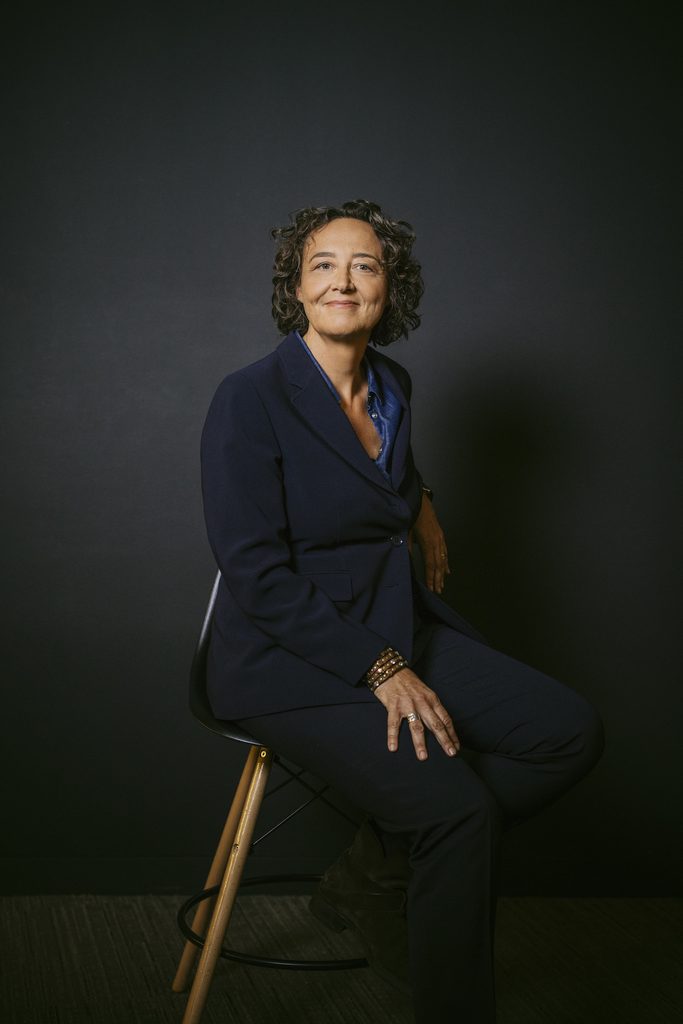
ARTSATL: You talked about creating an ‘Austro-Germanic sound’ with the ASO. Could you talk about what this means?
STUTZMANN: I am very sound-oriented. I think the quality of the sound should be the working base for any symphony orchestra. If you look at the list of the repertoire, the Austro-Germanic repertoire is clearly the most important — so much of the repertoire comes from those composers, from Beethoven to Strauss. That is the base, and then of course you have to go in every direction. But what creates an identity in the sound is the work in this repertoire, because it has an exigence of sound quality. There is some repertoire that you can play with a nice sound, a beautiful ‘international sound,’ let’s say. And it works. But when you touch Mahler 2, like we did, or Strauss or Bruckner, you need to create a special identity. Otherwise, it doesn’t go … it doesn’t give emotion … it doesn’t serve the music. My origins — I’m half German, half French — all this repertoire is in my blood.
ARTSATL: Along this line, you’ve said you want the ASO to be ‘America’s most expressive orchestra.’
STUTZMANN: Yes, I grew up with all those recordings, including major American orchestras, and, at that time, they each had a very specific sound. You could hear a CD and say: This is the Boston Symphony. I remember the sound of the Boston Symphony with Ozawa. I remember the sound of the Philadelphia or Cleveland. Nowadays it’s very different. The general level of orchestras is getting better and better. Most orchestras have great players. I mean, technically, the quality of the musicians is getting higher everywhere. But I feel there is a danger in the uniformity of the sound — internationalization of the sound. They definitely sound more similar. I want us to be unique. I’m never talking about being the best. ‘Big 5’ and ‘Big 10’ — what does that mean? It has to be unique, like this place here [Bayreuth]. The entire world comes here because it’s unique. And I want people to go to Atlanta because it’s unique. To have a sound that people can recognize is very rare in our days. My dream with Atlanta is to find this identity together. I think it’s something which also interests very much our musicians.
ARTSATL: Your recording of the Bruckner 4th Symphony was recently released on Warner Classics. And this season, you’ll be doing quite a bit of Wagner at the ASO. Do you see similarities between Bruckner and Wagner?
STUTZMANN: As you know, Bruckner’s biggest love was Wagner. He was in adoration of Wagner’s music; it was his favorite music ever. What is very similar is the dimension of things — the proportions. For both composers, one of the talents you need as a conductor is how to know where is the climax, because the way they build the climax can be so long, like 50 or 70 bars, or the last coda of Bruckner [from his 4th symphony], which is about six minutes. So usually people who are Wagner lovers are Bruckner lovers — and also conductors. It’s a very special skill that’s required, to build up those climaxes. It’s so generous, so large … the phrasing, the shape. You have some melodies, some themes, which could last for 20 bars, which is unique. So you need to have a special sense of architecture.
ARTSATL: Are you interested in doing concert versions of opera in Atlanta? As you know, the ASO was scheduled to perform a concert version of Tristan und Isolde a week after the pandemic shut things down. It’s an opera that has never been performed in Atlanta, not even when the Metropolitan Opera used to come here.
STUTZMANN: Yes. The Tristan project is on my wish list. You know that this year we do the first act of Die Walküre, which is already wonderful. But I really hope we can get this Tristan done.
ARTSATL: One thing you’ve not been doing very much is conducting contemporary works. Is that something you’d like to explore more?
STUTZMANN: Well, I just think people like Robert Spano are fantastic in this repertoire. We all must be able to do everything. And I love to sometimes touch on contemporary music, of course.
ARTSATL: We’re here at the Bayreuth Festival, where you had great success conducting Tannhäuser in 2023 and 2024. And now you’re having what seems to be an even greater success conducting Rienzi for the first time ever in the Festspielhaus, as part of the celebration of the Festival’s 150th anniversary. Did you know the opera before being invited to conduct it?
STUTZMANN: Like everyone, I knew the overture; I knew the prayer of the tenor, but I had no idea. I thought: ‘It’s not really played; it must be …’ I was wary that it might be a little green like Die Feen [Wagner’s first opera]. So when I was asked by Katharina [Katharina Wagner, great-granddaughter of the composer, is director of the Festival], I said: ‘I need to look at the score first.’ So I was looking at the score and listening to a recording, and I thought: ‘Why is it not played?’ There is so much of Wagner, and the material is so beautiful. So I decided to say yes because I was enthusiastic about this piece. I’m really happy that we played it in the end.
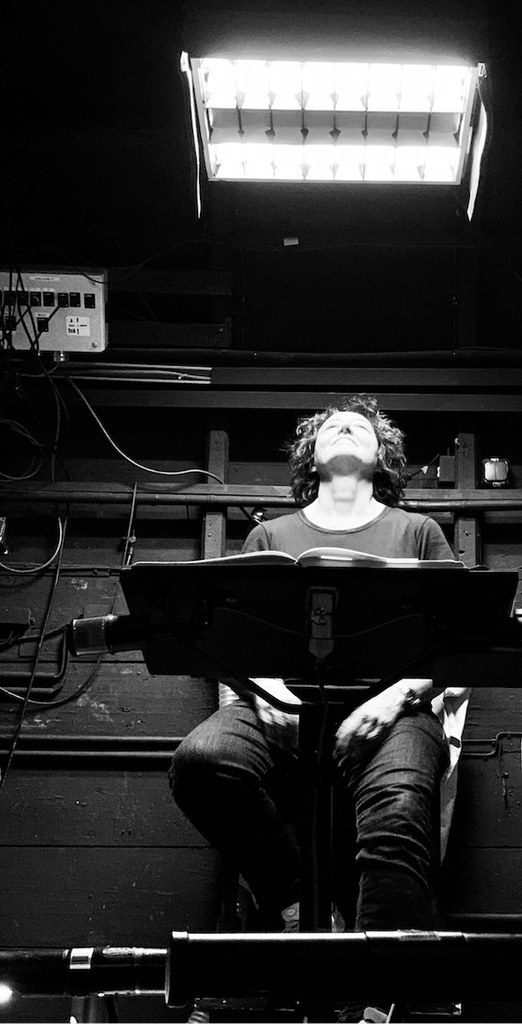
ARTSATL: Could you talk about how you handle the unique challenges of the Festspielhaus pit?
Yes, it’s a legendary place, and the pit is a legendary peril for the conductor. It is different from anything else in the world, and, when I talked about it with Christian Thielemann, we both agreed: ‘You have to take your two ears and put them on the table, and use another two ears.’ The skills one has learned on the podium fall short there. So either you figure out instinctively how it works, or you die [laughter]. It even scared off some illustrious colleagues [laughter]. You work with assistants. They become your ears in the hall. So you are on this old telephone: ‘Can you hear the violas here?’ ‘No.’ ‘OK, so we need to play more.’ ‘Are we late?’ ‘No. You are not late.’ ‘Is it long enough?’ ‘Is it articulated enough?’ This is the process.
ARTSATL: I know you’ll be conducting Tannhäuser in Munich in May. Are there any other Wagner operas you’ll be doing?
STUTZMANN: I have projects for 2029, but I can’t talk about that yet.
ARTSATL: What Wagner operas would you most like to conduct?
To be honest, Rienzi is probably one of the most difficult operas to conduct — it has all the difficulties of a late Wagner and all the difficulties of the early Wagner. It’s what I needed to be sure that I’m ready for Tristan and for the Ring. I want to conduct all the Wagner operas; it’s very simple — it’s my dream. I hope I will do Lohengrin. I did already Der fliegende Holländer two years ago, so I’m ready, and I will do it.
ARTSATL: You’ve had great success with opera. Would you consider an opera post somewhere?
STUTZMANN: Honestly, I don’t know. For now, I am mainly a symphony orchestra conductor. I want to focus on that. I still have so much repertoire I want to approach with them. I adore opera, and I’m lucky enough that I get to work with great opera houses across the globe. I’m in Bayreuth; I’ll be at the Paris Opera this winter — and Bayerische Staatsoper. So if one of those wonderful houses one day offers me a music directorship, I would consider it, of course. But for now, it’s not an immediate plan.
ARTSATL: It was recently announced that you’ll become music director of the Monte-Carlo Philharmonic Orchestra. Will that permit you to cut back on guest conducting?
STUTZMANN: You know, I am very lucky at this stage of my artistic life: I have the chance to conduct some of the best orchestras in the world. I have built up wonderful relationships, like for example the London Symphony, which invites me every year; the Concertgebouw; the Munich Philharmonic. I want to keep those relationships strong. But the fact that I have now also a family in Europe doesn’t mean my heart is not in Atlanta [laughs}. Atlanta is my main sport; it will stay my main sport. Monte-Carlo is a more compact schedule and a wonderful place. It’s a marvelous moment for me. I thought I had to go everywhere, and now I can choose. I love to be music director because I think the more you know the people, how to get the best of them, the better the relationship grows. And I saw that with Atlanta. It’s like building a family: Sometimes you have easy moments; sometimes hard moments. You have to take strong decisions as music director, which are not always popular. But you have to take them for the best general interest. But when I see how our relationship has grown — and this year was so beautiful! Humanly, we are better together; we understand each other better. And the more we build up on that, the better the music is. I think it’s very obvious in our concerts: The joy of playing, the way the orchestra gives me so much energy and that goes to the audience — that touches our people.
Where and when
The ASO’s 2026-27 season officially opens with Stutzmann conducting the Atlanta Symphony Orchestra during opening weekend, October 1 through October 4. For a full schedule and tickets, go to the ASO’s website.
::
James L. Paulk is a longtime classical music writer for publications including ArtsATL, The Atlanta Journal-Constitution and Musical America. He is also a former state senator.
STAY UP TO DATE ON ALL THINGS ArtsATL
Subscribe to our free weekly e-newsletter.

PLEASE SUPPORT ARTSATL
Your Gift Sustains the Coverage You Count On!
Related Posts