Review: Atlanta Opera’s ‘Silent Night’ is a dramatically moving meditation on war
The Atlanta Opera’s season-opening production of Silent Night at the Cobb Energy Performing Arts Centre was a marvelously sung, smartly staged, expertly conducted, dramatically moving artistic success. It also touched on the double-edged sword that cuts through most attempts to depict the kinder, gentler, nobly romantic side of war.
Running through November 15, Silent Night is Atlanta Opera General and Artistic Director Tomer Zvulun’s take on Kevin Puts’ Pulitzer-winning 2011 opera with a libretto by Mark Campbell. Campbell’s libretto, primarily sung in English, French and German, is based on the screenplay by Christian Carion for the Oscar-nominated 2005 French film Joyeux Nöel. In 2014, Zvulun directed the European premiere of Silent Night in Ireland and brought the same production to Atlanta, New York and other U.S. cities in 2016.
Silent Night tells the mostly true story of the 1914 Christmas truce, when enemy soldiers in World War I, entrenched along a 400-mile-long line running through France and Belgium, declared an impromptu ceasefire. The temporary cessation of hostilities led to a battlefield congregation between blood enemies featuring chocolates, sausages, adult beverages, dancing, soccer and sharing photos of loved ones.
In the encore program notes, Zvulun wrote: “Bringing [Silent Night] back to Atlanta feels especially meaningful in a world still marked by conflict. Its message of friendship, compassion and shared humanity is one we need now more than ever.” It’s worth noting that Zvulun, born in Ashkelon, Israel, in 1976, served a three-year stint as a medic in the Israeli Defense Forces.
Silent Night begins with three vignettes that serve as a prologue. In a Berlin opera house in 1914, international opera stars Anna Sørensen and Nikolaus Sprink (sung, respectively, by soprano Susanne Burgess and lyric tenor Kameron Lopreore) are performing. With the aid of the Cobb Energy Centre’s brightest audience-facing house lights (fair warning), the couple’s performance is starkly interrupted by the announcement that war has been declared.
The news reaches a small church in Scotland, where William Dale (baritone Joseph Lattanzi) fantasizes about military glory while browbeating his reluctant brother Jonathan (tenor Christian Sanders) into enlisting with him, as the parish priest, Father Palmer (lyric baritone Mark Diamond), looks on with dismay. The action shifts to the Parisian apartment of the Audeberts, where Madeleine (soprano Page Michels) upbraids her husband, identified in the libretto only as Lt. Audebert (baritone Luke Sutliff), for running off to war when she is pregnant with their first child.
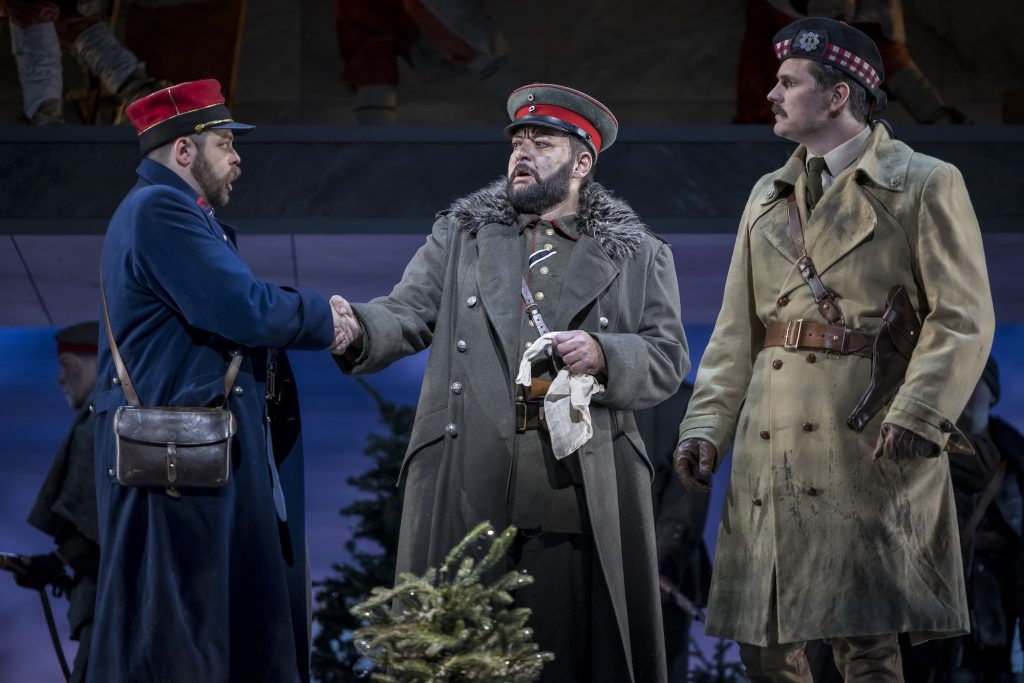
The main action transpires on a gray, rectangular structure with three levels taking up the entire stage, each one representing the encampments of the Scottish, French and German armies. The soldiers — members of the Atlanta Opera Chorus under the direction of Daniel Chervinsky — are decked out in realistically weathered military garb expertly crafted by the crack AO costuming squad. (Note: There are spoilers ahead for those who’d like to go into the show without all of the plot details.)
On the afternoon of December 23, a fearsome battle breaks out, pitting German troops against the French and Scottish allies. The chaotic clash and resulting mass carnage are staged with brutal realism by the AO production and art direction team. When William is mortally wounded, Jonathan is forced to abandon his brother on the battlefield.
In the French bunker, the French General (bass-baritone Wayne Tiggs) berates Lt. Audebert for his troops’ poor performance. Audebert complains to his adjutant Ponchel (baritone Edward Nelson) that he lost his wallet during the conflagration. The surviving soldiers slowly fall asleep, murmuring lullabies in a heartbreaking scene by the AO choristers.
The next day, Sprink is ordered to sing at a nearby chalet where the German Kronprinz (tenor Wayd Odle) resides; the engagement also features opera sensation Anna Sørensen. As much as he wants to see his beloved partner, Sprink’s war experience has left him deeply conflicted about participating in such an indulgent, extravagant event. With misgivings, he obeys the Kronprinz’s order.
During the soirée, Sørensen reveals that she has arranged for the couple to spend the night together. Sprink declines, telling her that he feels obligated to return to his comrades. Eventually (and representing a historically inauthentic plot device), Sørensen convinces him to take her with him.

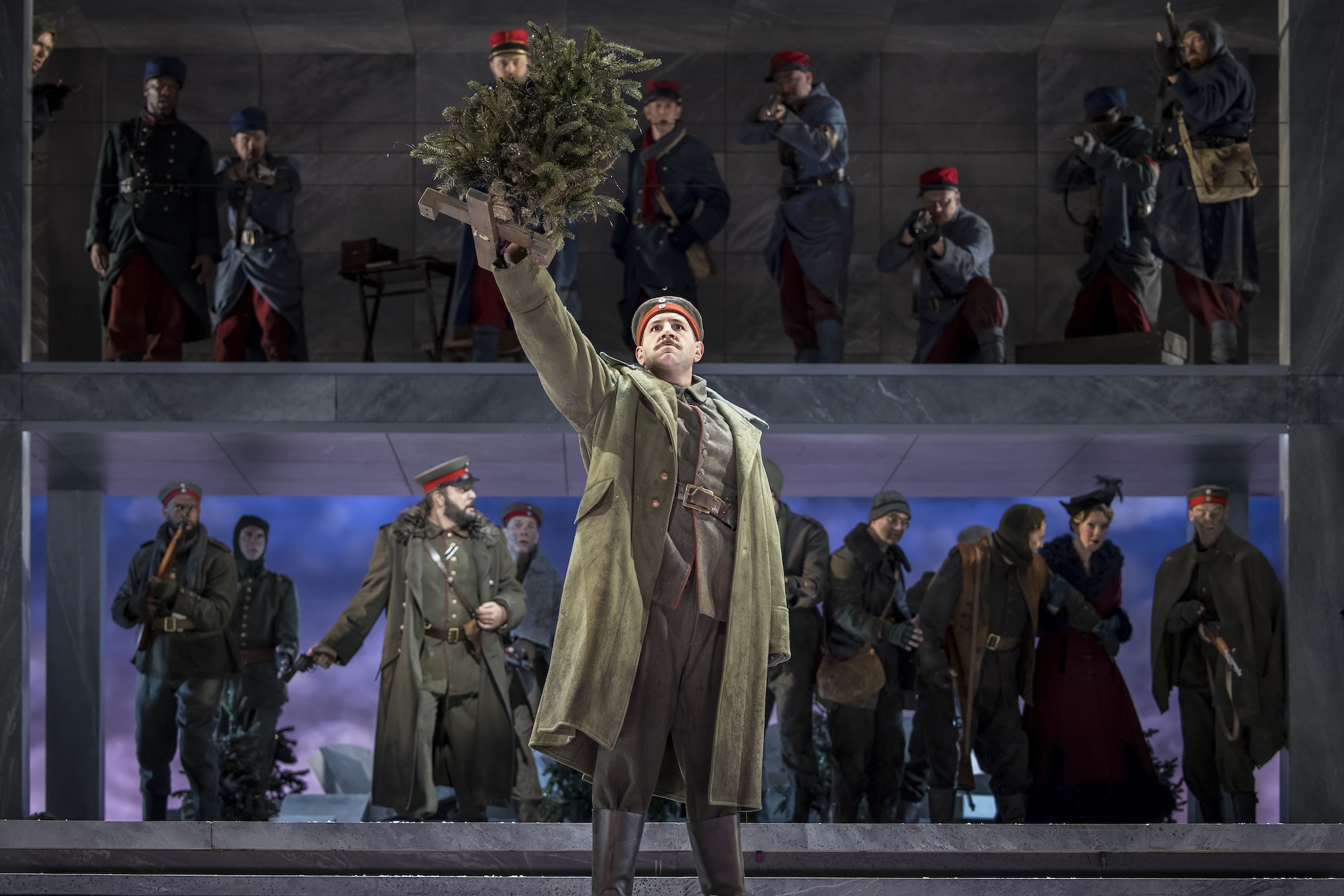
Back in the trenches, the Scottish soldiers are drinking whiskey and singing, accompanied by a bagpipe. When the men in the other bunkers hear the music, they initially react with bemusement and irritation (because of the bagpipes). When the Scottish music subsides, newly returned Sprink is inspired to sing “Stille Nacht” (“Silent Night”) and “Adeste Fideles,” in the middle of which the bagpiper chimes in. Emboldened by the response, Sprink stands on top of the bunker and raises a Christmas tree in a gesture of friendship. Ignoring the protestations of their superiors, the soldiers exit their bunkers and begin mingling. War-weary themselves, the three lieutenants agree to a ceasefire — but only on Christmas Eve.
When Sørensen appears, the soldiers are understandably dumbstruck. During a hastily arranged midnight mass, the diva passionately sings “Dona nobis pacem” (which Burgess absolutely slayed). As the mass concludes, bombs explode nearby.
On Christmas evening, Sprink mocks Lt. Horstmayer (Ukrainian-born American baritone Aleksey Bogdanov) for his blind allegiance to the Fatherland, resulting in an order for Sprink’s arrest for insubordination. When Sørensen and Sprink flee across no-man’s-land, Horstmayer orders his men to shoot, but they refuse.
The morning after Christmas, the British major orders the Scottish soldiers to the frontlines for participating in the Christmas truce. When a German soldier is spotted heading toward the French entrenchment, the major orders him killed. No one complies until the still-disconsolate Jonathan dispassionately shoots the man, only to learn that the victim is Ponchel, disguised in a German coat, sneaking back after an unauthorized visit with his mother.
The French general informs Lt. Audebert that his unit has been disbanded and that the lieutenant will be transferred to Verdun. Audebert informs the French general — who, it is revealed, is his father — that he has an infant son named Henri. The Kronprinz sends the German soldiers who participated in the Christmas truce off to the Eastern front. As the soldiers trundle away in a boxcar, they softly hum the Scottish ballad they heard on the night of the Christmas truce.
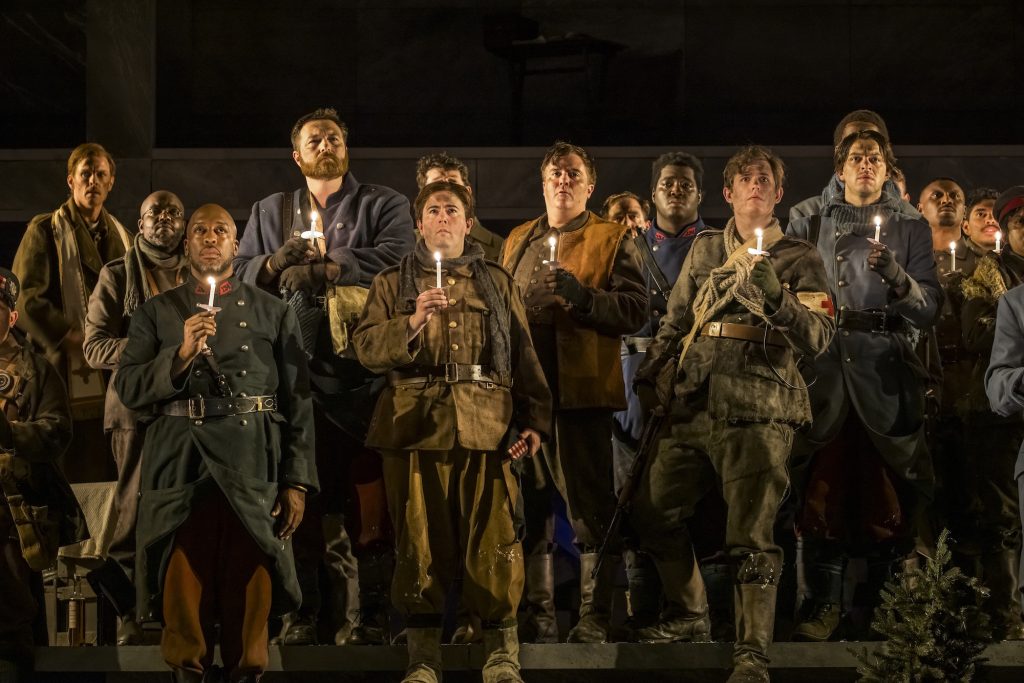
Puts’ score and Campbell’s libretto are unapologetically crafted to appeal to audiences raised on cinema soundtracks and theatrical realism. The Silent Night cast took full advantage of this built-in, crowd-pleasing quality.
Geneva, Switzerland-born Burgess, a frequent Atlanta Opera performer and former Glynn Studio Artist, amply demonstrated the extraordinary power and grace that has made her a Metropolitan Opera favorite. Lopreore’s Sprink expressed the mixed-up emotional state of a man caught between love, duty and death with authentic psychological depth and personal charm. The numerous baritone-heavy performers rounding out the production imbued even the most sentimental and predictable aspects of the wartime scenario with respectful gravity and verve.
Special kudos to Principal Conductor Iván López Reynoso for his deft handling of the Atlanta Opera Orchestra. Wrangling Puts’ multifaceted score, which moves between lyrical revelry, post-modern dissonance, cinematic tropes, nationalistic anthems, traditional folk songs and spiritual hymns, is no mean feat.
The double-edged sword mentioned above arises from the seemingly contradictory impulses that feed art and war. No sane person likes war, but plenty of sane people praise certain depictions of war for their insightful storytelling, sublime representation and awe-inspiring quality — for their ability to conjure an experience similar to witnessing a massive tornado, landslide or flood.
The Atlanta Opera’s production of Silent Night gives audiences many reasons to consider the topic from an aesthetically compelling, credibly humanitarian perspective. Consider it highly recommended.
Where and when
Three performances of Silent Night remain: 7:30 p.m. November 10 and November 13 and 3 p.m. November 15 at the Cobb Energy Performing Arts Centre.
::

An Atlanta native, Doug DeLoach has been covering music, performing and static arts in his hometown and beyond for five decades. Doug is a regular contributor to Songlines, a world music magazine based in London, and his ruminations on arts and culture have appeared in publications such as Creative Loafing, Georgia Music, ArtsGeorgia, The Atlanta-Journal Constitution, High Performance and Art Papers.
STAY UP TO DATE ON ALL THINGS ArtsATL
Subscribe to our free weekly e-newsletter.

PLEASE SUPPORT ARTSATL
Your Gift Sustains the Coverage You Count On!
Related Posts