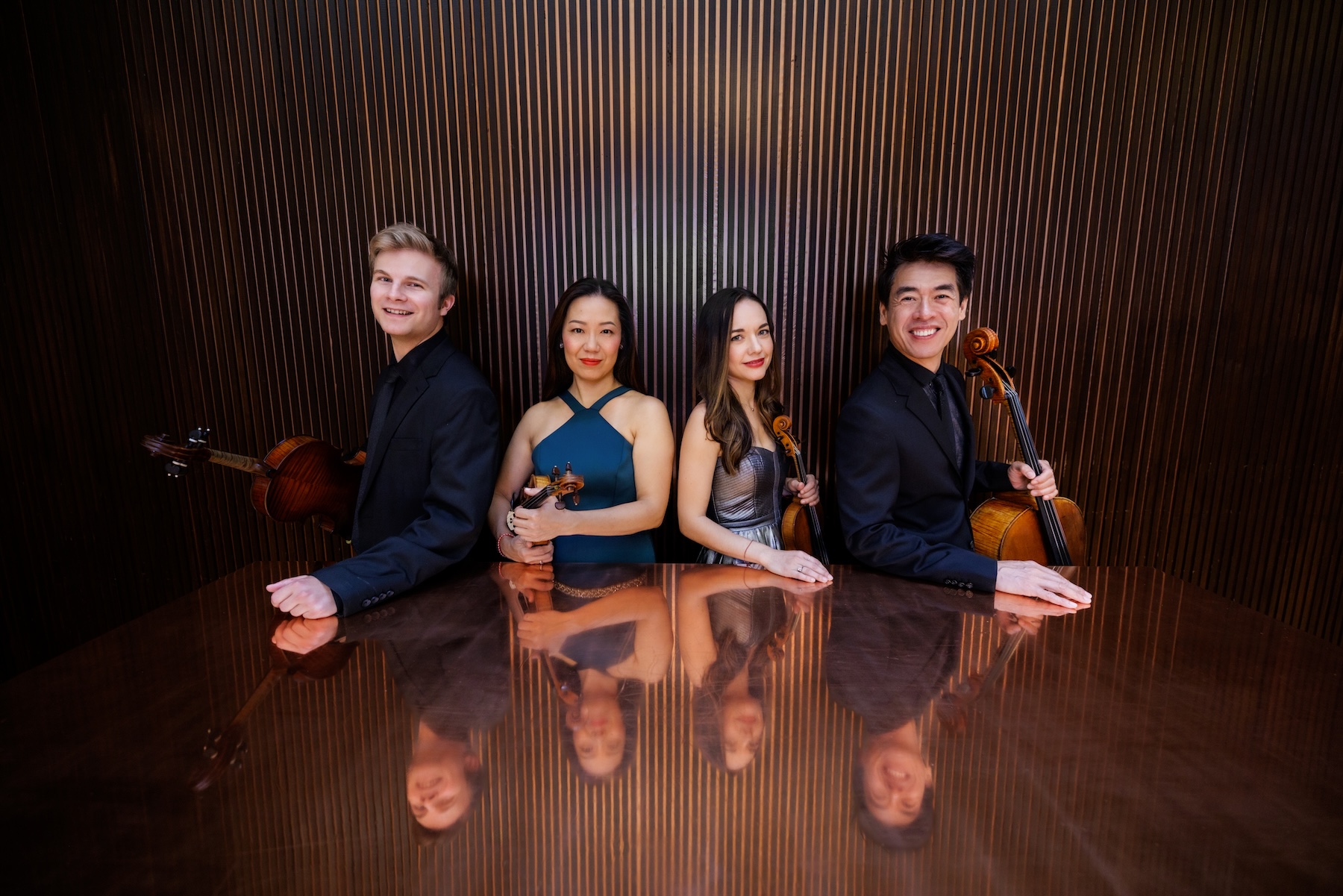
The Vega Quartet’s season debut offers something old and a refreshingly new commission
The Vega Quartet takes the stage at Emory University’s Cannon Chapel on Saturday, October 3, for The Old & the New, a part of the Waits Chamber Music concert series. In keeping with the theme, the afternoon will feature works by Brahms and Mozart alongside the world premiere of Thought in Scales, Op.123, by Tristan Schulze.
Commissioning Schulze, a cellist and composer based in Vienna, came at the behest of Emory Chamber Music Society of Atlanta Founder and Artistic Director William Ransom, who discovered the composer’s work and was soon fascinated.

“We’ve always commissioned pieces from composers,” he explains. “Every organization does that in different ways — some have a competition, some just take submissions. We’ve always done it by finding composers that we really like and asking them to write a piece.”
Many of those commissions, Ransom points out, are pieces for the Vega Quartet, given their residency at Emory. The result has been a plethora of new chamber works, the recent premiere of Joel Thompson’s long-delayed new piece outstanding among them. For Ransom, the discovery of Schulze was a natural part of that continuum.
“I’m always keeping my ears open for composers that I don’t know. I heard this fascinating concerto for cello and brass quintet — which sounds impossible — by Tristan Schulze.” Instantly enamored with the unorthodox piece, Ransom quickly contacted Schulze about a commission. The composer was quick to accept.
Ransom wanted to give Schulze as much creative breathing room as possible. “I left it wide open to him, as I usually do,” he continues.
To that end, Schulze’s own program notes on the piece reflect a densely orchestrated but culturally diverse conceptual vision. This stems from the composer’s own fascination with the parallels between Indian ragas and ancient Greek harmonic modalities. That, coupled with an interest in indigenous Native American music born out of travels near the Hudson River, became the basis for a piece that is fiendishly intricate in its meter and its melodic structure.
For Vega Quartet violist Joseph Skerik, Schulze’s work feels refreshingly contemporary. “A lot of the music he writes seems to be almost rock-influenced,” he enthuses. “You have someone that has a classical background that’s fusing different elements together.” Skerik’s keen appreciation for the piece stems from that multilayered complexity. “It’s kind of a virtuosic piece for the ensemble and individually. I think it’s going to be a lot of fun to put together — kind of something different than what we’ve premiered in the past, I would say.”
For Skerik, that different approach played into how the ensemble prepared. “It’s a very rhythmically driven piece. When there is a rhythmic ostinato, usually doubled and very prominent, that usually helps us understand what the composer is going for and puts us in line, in a way.” That, combined with the piece’s lack of a lengthy performance history, makes for a more fluid and intuitive learning process than an established piece hampered by tradition.

Ransom elaborates on the piece’s modernist leanings. “It’s not what we would think of as ‘contemporary music,’” adds Ransom, giving his own perspective on Schulze’s avant-garde stylings. “It’s very much in the tradition of the canon but also in the modern language. In general, that’s what I like in new music. People are even using new words for music that’s not based around traditional harmony or melody. More about sound coming together in different, interesting ways.”
Schulze’s piece serves as a prelude to a flurry of upcoming activity for the Vega Quartet. 2027 will see the ensemble tackling all 16 of Beethoven’s string quartets across six concerts to commemorate the 200th anniversary of his death. It’s a bold, ambitious effort that echoes the Atlanta Symphony Orchestra’s recent performance of all nine of the composer’s symphonies.
“That’s kind of a Mount Everest thing for any string quartet,” observes Ransom. “It’ll be the third time they’ve done the whole cycle, but they change members every now and then, so that changes the group as well.”
The sheer musical fascination that both Ransom and Skerik express for Thoughts in Scales is readily apparent. It promises to be another bold step forward for Emory’s already widely accomplished ensemble-in-residence.
Where and when
In addition to the premiere of Schulze’s Though in Scales, The Old & the New will include Mozart’s Sonata in C Major, K. 521 for Piano 4 Hands iand Brahms’ Piano Quartet in C Minor. The Vega Quartet will be joined by pianist Rachelle McCabe. The performance is at 8 p.m. October 3 in Emory University’s Cannon Chapel.
::

Jordan Owen began writing about music professionally at the age of 16 in Oxford, Mississippi. A 2006 graduate of the Berklee College of Music, he is a professional guitarist, bandleader and composer. He is currently the lead guitarist for the jazz group Other Strangers, the power metal band Axis of Empires and the melodic death/thrash metal band Century Spawn.
STAY UP TO DATE ON ALL THINGS ArtsATL
Subscribe to our free weekly e-newsletter.

PLEASE SUPPORT ARTSATL
Your Gift Sustains the Coverage You Count On!
Related Posts