Review: Ryoji Ikeda’s ‘data-verse’ at the High lacks something at its core
Early in 2024, new media artist and musician Ryoji Ikeda opened a solo exhibition in Tartu, Estonia, one of three cities designated by the EU that year as a European Capital of Culture. The show included the critical paths (2024), an installation using the DNA information of 100,000 Estonians presented in a data river that ran on LED screens along the ceiling of a narrow, mirrored corridor more than 80 feet long. It also included vox aeterna (2024), a nine-channel audio work consisting of vocal sounds from the Estonian Philharmonic Chamber Choir.
This kind of tight coupling in which raw data is transformed into something both meaningful and surprising is, however, largely missing from the centerpiece of Ryoji Ikeda: data-verse, on view at The High Museum of Art through August 10.
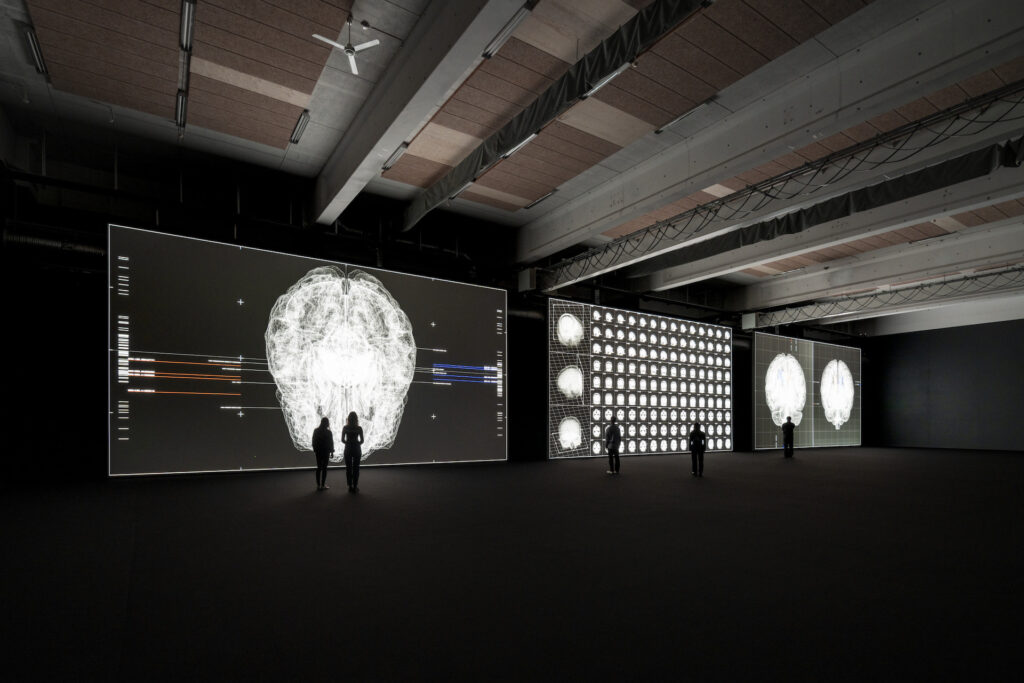
Instead, data-verse 1/2/3 (2019-2020) — the show’s massive signature installation work — relies on visual fireworks and vague pronouncements about “the universe” to deliver a show designed to dazzle but whose significance doesn’t bear up under the weight of all its noise and flashing lights.
A Japanese-born multimedia artist who now lives and works in Paris, Ikeda was a pioneer of glitch in the 1990s. Glitch is a musical genre that makes use of the sounds produced by computer malfunctions, crashes, software bugs and other data distortions. Ikeda has gone on to produce works of visual art globally for three decades, similarly exploring light, data and other forms of information manipulation, many on a monumental scale.
Data-verse 1/2/3 consists of three multistory screens installed in the High’s largest exhibition space — the second level of the Wieland Pavilion — in total darkness. Projected onto these screens are synchronized representations of data and imagery from a variety of sources, such as NASA and The Human Genome Project. Some 45 scientific disciplines are represented here in data collected over the course of 20 years.
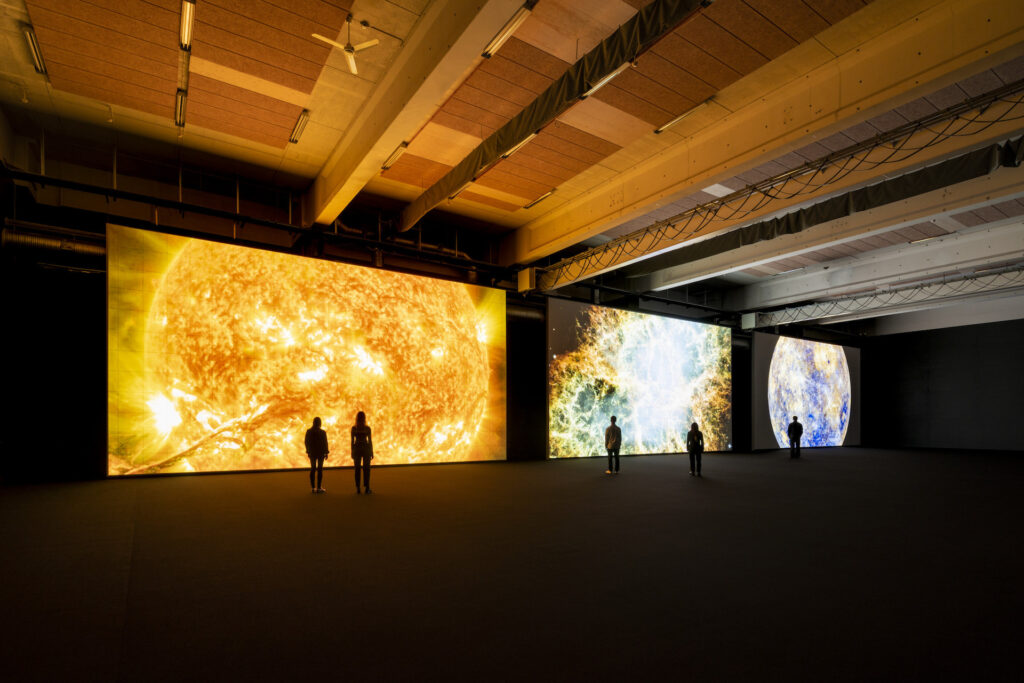
In a precise 11-minute and 40-second loop of increasing frenetic speed, we are treated to images of proton collision experiments, DNA sequences, computer circuitry, digital renderings of human organs, progressive brain scans, security camera footage, weather maps, global flight patterns and images of supernovas, among other things. That is, the images span a scale from the subatomic to the universal.
Rendered using software written by the artist, the images flicker about in the sort of dazzling but incomprehensible way we’ve become accustomed to on TV shows like the CSI franchise, complete with the rotating schematics, flashing pointers and sonar blips that inform the viewer They’re doing science!
Data-verse 1/2/3 works in precisely this sort of Hollywood-tinged way: data used as a prop to make you think of science without actually producing any new way of seeing the world. Rather, you are meant to be simply overwhelmed here. (The number of times the word “overwhelming” is used in the written materials for the exhibition is a concerning sign.) And the main feature of overwhelm is that it makes you stop asking questions as the world whizzes by too fast to interrogate it.
The idea that, in the 21st century, big data occupies a nearly dictatorial position over our lives deserves not just to be illustrated but to be rethought in a way that isn’t happening in data-verse 1/2/3.
Fans of Ikeda will recognize the accompanying soundtrack’s sonic vocabulary of ultrahigh frequencies and minimalist fuzz, clicks and cracks from albums like 2005’s dataplex or 2013’s supercodex. And the soundscape — Ikeda’s true strength as an artist — left to its own devices would have carved out a new terrain of aural experience. But when slavishly wedded to the visual ticks and flicks of the on-screen imagery, the sound comes across less as a soundscape and more as mere sound effects.
Other works in the show are far more successful and are in themselves worth a trip to the museum. At the entrance, a pair of monumental works immediately introduces Ikeda’s twin obsessions with light and sound. Point of no return (2018) is a monolith of pulsating light surrounding a central, circular void of perfect blackness, a black hole from which nothing — not even light and certainly not your perceptions — will escape.
Mass (2023) is a floor-sized projection of flickering light with single or double black holes that expand out from the center to fill the entire space. In mass, Ikeda overwhelms to a very different and useful effect, as the senses of sight and hearing feel stretched and near exhaustion.
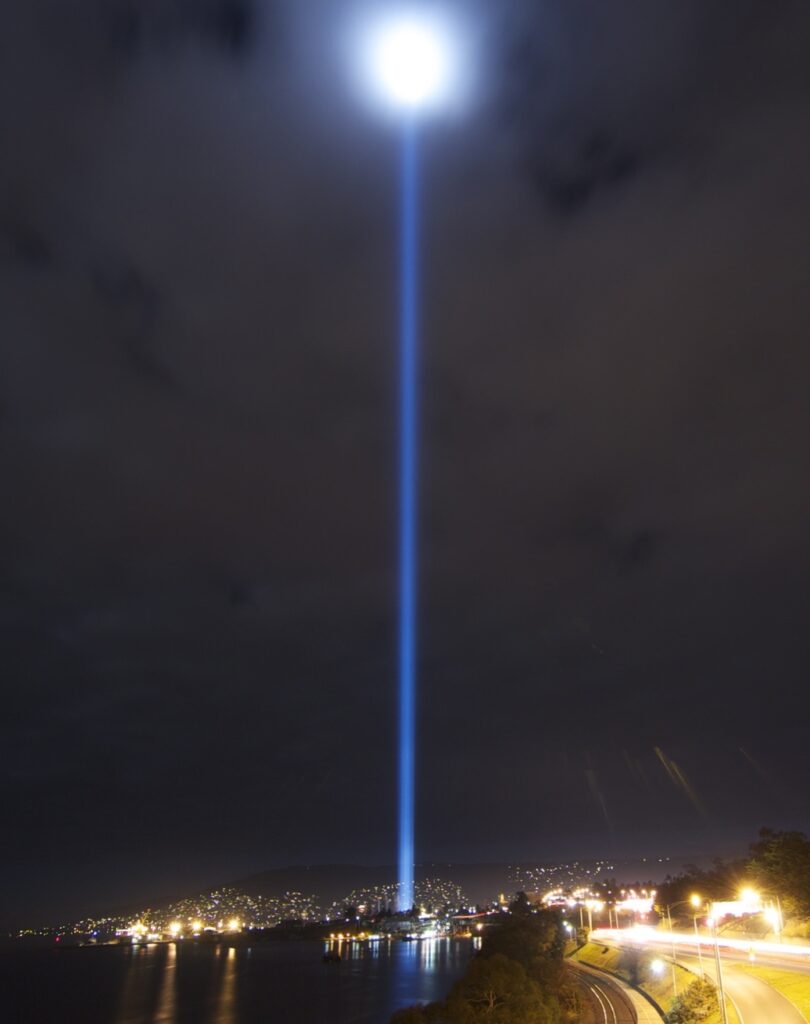
At the end of the next hallway stands the sublime line (2008). A simple, vertical breach in the darkness creates a tight beam of pure light that hints at something vast and spiritual beyond itself. Ikeda has a long history of using piercing rays of light seen most dramatically in his spectra series, in which he uses various kinds of industrial lamps to beam light into the night sky in evocative locations around the world.
Closing the exhibition on the back end is a series of two-dimensional works. Displayed without labels or wall text, they invite viewing as a unified work, meditating on data and its transformations. Barcode-style graphics, framed punch cards, 16-millimeter film and other objects create an open space for contemplating data, how it moves and how we know what we think we know.
Ikeda considers his works to be abstract art. He has stated that he approaches all of it as composition, “whether it’s arranging sounds in music, organizing pixels in visual works or transforming data into abstract forms.” This conceit rings true for the sculptural works at the start of the show and the two-dimensional works at the end.
However, at the heart of the show lies real data with concrete relationships to the world. Staying on the surface of this data and using it mostly as dazzling graphics comes well short of this artist’s ability to say something new and surprising about the information around us.
::

Cinqué Hicks is an editor-at-large at ArtsATL. A Warhol grant-winning art critic and writer, he has written for Public Art Review, Art in America, Artforum.com, Artvoices and other national and international publications. He has served as senior contributing editor of the International Review of African American Art and as interim editor-in-chief of Art Papers. He was the founding creative director of Atlanta Art Now and producer of its landmark volume, Noplaceness: Art in a Post-Urban Landscape.
STAY UP TO DATE ON ALL THINGS ArtsATL
Subscribe to our free weekly e-newsletter.

PLEASE SUPPORT ARTSATL
Your Gift Sustains the Coverage You Count On!
Related Posts