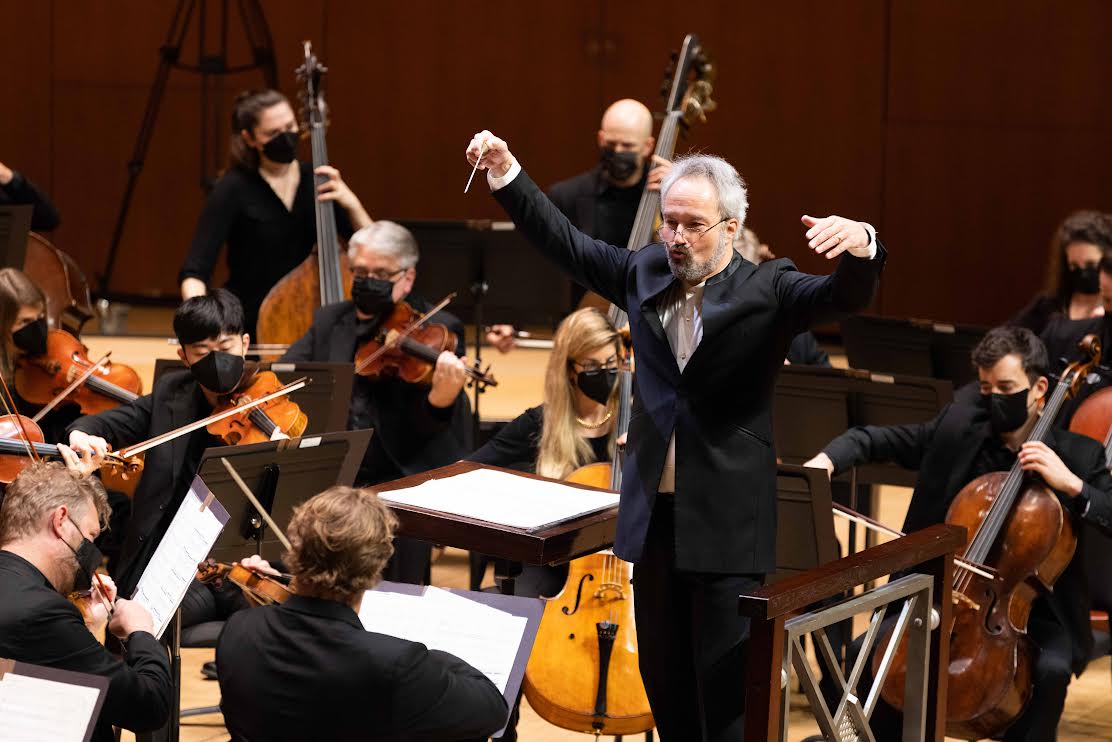
Review: Guest conductor Carlos Kalmar brings pizzazz to Symphony Hall
Anyone curious about what a conductor does on the podium could find answers by comparing the last two Atlanta Symphony Orchestra programs. Conducting, we learn, is as much about persuasive musicality as group psychology. It’s also about negotiating an interpretation with a stage full of skilled musicians who, oftentimes, know the music better than the person waving the stick.
Last weekend’s ASO concert was led by a late substitute, the current music director of the Oregon Symphony, a relative unknown who led popular hits that somehow didn’t flatter himself or the ASO.
This week, on the podium Thursday as scheduled, is the former chief from Oregon, Carlos Kalmar. Born in Uruguay to Austrian parents, Kalmar has been a regular ASO guest and was perhaps once in the running to be Atlanta’s next music director — till Nathalie Stutzmann swooped in and claimed the prize. She starts officially this fall. In the meantime, we get concerts from ambitious maestros whose visits are no longer an audition, but just a chance to put on a satisfying concert.

They opened with music from 2016 by Jessie Montgomery (born in 1981), one of the fastest rising composers on the scene. Her Records from a Vanishing City was inspired by memories of her family’s vibrant (but rapidly gentrifying) Lower East Side neighborhood in Manhattan, and by an LP collection she inherited from an artistic, eclectic family friend. Among the great jazz and folk tunes from around the globe, one record took on a special meaning: a lullaby and rhythmic chant from Angola, sung as a call-and-response by a women’s chorus.
Montgomery’s Records opens with dream-sequence gurgles from the woodwinds, like when the screen gets all wavy in a TV show, telling you we’re traveling back in time. Soon the full weight of the orchestra imposes itself, but only in flickers. Affectionate little solos for oboe, then clarinet, then bassoon and muted trumpet all feel like depictions of characters from her childhood, maybe quirky neighbors and beloved family. The energy builds and recedes as shards of memory. It feels so personal. The final section is something like a passacaglia, a lament for her LP-collecting friend. There’s a gentle rocking back and forth in the orchestra, like a lullaby, and four individual violins sing out and harmonize together. It’s an incredibly tender moment of love and family put into music. Kalmar and the ASO played it as a small masterpiece. Jessie Montgomery is unstoppable.
Kalmar’s tightly integrated program orbited around dance. Like the Strauss family and the waltz, Argentine composer Astor Piazzolla took what had been a popular dance, the tango, and elevated it to high art of the concert hall. The solo part in Piazzolla’s 1979 Concerto for Bandoneon, subtitled “Aconcagua,” was played here by classical accordion virtuoso Ksenija Sidorova, a Latvian star of the instrument. (Both the bandoneon and accordion are squeezeboxes. The latter has buttons under the left hand to play chords, and a keyboard under the right for melody. It’s a streamlined cousin of the former, which has hundreds of buttons on both sides, no keyboard, and plays a kaleidoscope of note combinations depending if you pull or squeeze.)
The concerto starts at full throttle, seductive and energized, and in an instant you’re on a sweaty dance floor in Argentina, or a New York tango club. If you’re thinking of a sentimental, slightly louche accordion at a 1940s Paris café, think again. Piazzolla makes the (amplified) soloist a full partner, or rival, to the orchestra, no different than a heavyweight piano concerto, and his tangos are modernist, often angular and harmonically complex. Musically charismatic, Sidorova is at once exuberant and melancholy, and she plays her accordion like a weapon, sexy and dangerous.

In Schubert’s “Unfinished” Symphony, after intermission, Kalmar pushed the boundaries. He made the quiet, songful parts especially gentle and loving. The forceful declarations were all the more impactful, sometimes in anguish, elsewhere a little menacing. The orchestral musicians seemed to hang on the tip of his baton — evidence of a maestro in full control, or perhaps an orchestra willing to cede a little authority to their guest.
Still, like most ASO guest conductors, he started the Schubert too loud, so the floor was too high. To the audience, it narrows the ASO’s dynamic range from mezzo-forte to fortissimo. Is it difficult for the orchestra to play quietly because of the stage acoustics? Because of that super-loud ventilation system in the auditorium? (And has the A/C always been so loud and distracting?)
With Piazzolla on the bill, it was a neat programming trick to close with “Music of the Spheres,” a grand waltz by Josef Strauss, the lesser brother from the famous waltz family. Kalmar pushed and pulled and stretched the music, and it’s so elastic and elegant it would snap right back into place. It was a fun and slightly intoxicating way to round off the evening.
About an hour before the main event, 11 ASO musicians played a short chamber music concert with a refreshing DIY aesthetic. English horn player Emily Brebach, who didn’t perform, served as emcee. Music we rarely hear, by Samuel Coleridge-Taylor and Zoltán Kodály, was on the bill. So too was early Romantic composer Friedrich Hermann, his Capriccio for Three Violins, Op. 2. The trio of young ASO violinists — Sissi Yuqing Zhang, Rachel Ostler and Dae Hee Ahn — had all recently studied together at music school and were evidently friends. They’ve performed this short work before. It crackled and popped with life.
The program, without the chamber concert, will be repeated Saturday evening.
::
Pierre Ruhe was the founding executive director and editor of ArtsATL. He’s been a critic and cultural reporter for the Washington Post, London’s Financial Times and the Atlanta Journal-Constitution, and was director of artistic planning for the Alabama Symphony Orchestra. He is publications director of Early Music America.
STAY UP TO DATE ON ALL THINGS ArtsATL
Subscribe to our free weekly e-newsletter.

PLEASE SUPPORT ARTSATL
Your Gift Sustains the Coverage You Count On!
Related Posts